2027 Social Work Requests for Proposals: How Agencies Compare Service Requirements
Audited and Verified:
Our Editorial and Data Verification Process
Research.com uses government datasets, official education statistics and primary institutional information to support its career and degree guides. Our review process checks factual accuracy, occupational definitions, source dates and the requirements associated with the credentials discussed.
How This Article Was Fact-Checked
Our editorial team verifies salary estimates, employment projections, education requirements and program information against original data providers and official organizations. Salary figures are checked against the relevant occupational definitions and reporting periods. Information about licensure, accreditation and required in-person training is reviewed separately.
Fact-checked and verified on:

Co-Founder and Chief Data Scientist
A social work request for proposals can look affordable until its staffing, coverage, and reporting requirements are read together. For public agencies, nonprofits, and providers, a sound comparison means more than checking which bidder offers the lowest price. It means determining whether each proposal can deliver the specified services safely, legally, and consistently.
This guide explains how to compare RFP requirements, test provider capacity, and identify the terms that can change a bid or award decision.
Key Things You Should Know
- Compare the full service model - not just the named service - including eligible clients, locations, hours, referral rules, staffing, and reporting.
- Separate minimum qualifications from scored preferences: a required license or coverage area can disqualify a proposal even if its price is attractive.
- Test whether proposed staff hours, caseloads, payment terms, and outcome measures fit together; an inexpensive bid may be infeasible if the contract funds less capacity than it requires.
What is a social work request for proposals, and who issues one?
A social work request for proposals (RFP) is a solicitation asking organizations to explain how they would provide defined social services, at what cost, and with what qualifications and safeguards. A government department might seek family-support services; a health system might seek care coordination; or a nonprofit might seek a partner for housing outreach. An RFP describes the proposed contract, not an offer of employment or a grant award.
Identify the issuer and funding source before comparing opportunities. Public procurements may impose formal submission, competition, records, and contract rules; a private nonprofit may use a less formal process. Either can pass through requirements from a government funder. The solicitation, its attachments, and any issued addenda - not a summary on a job board - control what a bidder must submit.
Universities also work with agencies to arrange student placements, although a field agreement is not automatically an RFP or a paid service contract. Prospective students making social work program comparisons for future students can ask how a program establishes placement partnerships; that is a different question from whether a provider qualifies for a service contract.
How do agencies compare service requirements in social work RFPs?
Agencies first separate nonnegotiable requirements from preferences that can be scored. A provider unable to serve a required county or supply a required licensed clinician may be ineligible, regardless of its strengths elsewhere. Among eligible proposals, the agency can then compare how convincingly each bidder will deliver the same scope.
The comparison below shows why two bids described as "case management" may not offer equivalent service. Each dimension changes the resources needed or the client experience.
| Requirement dimension | What may differ between solicitations or bids | Why the difference matters |
| Service volume | People enrolled, active cases, completed visits, or hours of service | These are different units and cannot be priced as though interchangeable. |
| Access | Referral acceptance, response times, language access, and after-hours coverage | A weekday-only model may not satisfy a continuous-coverage requirement. |
| Service intensity | Brief navigation versus recurring assessment and follow-up | Similar enrollment totals can demand very different staffing. |
| Accountability | Required records, quality reviews, and client outcomes | Data collection and follow-up consume staff time beyond direct contact. |
For a defensible comparison, create a requirement-by-requirement record showing where each bidder addresses the solicitation, whether the response supplies evidence, and which assumptions remain unresolved. Use the published scoring method rather than inventing weights after bids arrive. Workforce preparation can inform a staffing review - accredited BSW coursework and placement comparisons illustrate what students may study - but a degree program description does not establish that a proposed worker meets this contract's duties or qualifications.
What education and licensing requirements appear in social work RFPs?
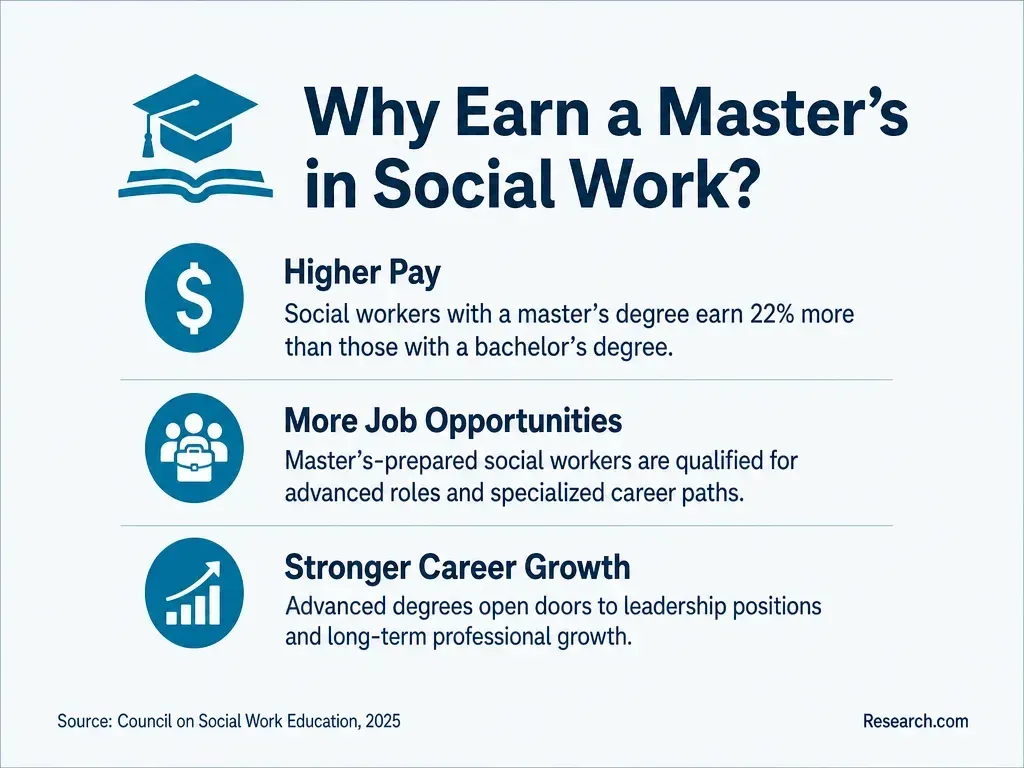
Qualifications should follow the actual work. Outreach, benefits navigation, and some case-management positions may accept a BSW, a human services degree, or specified experience. Clinical assessment or psychotherapy may require an MSW, an applicable state license, and, for independently performed work, the appropriate clinical authority. School-based work can involve separate education-agency qualifications. The contract may also specify training, background screening, language skills, or experience with a particular population.
Read each requirement at the level it applies: the organization, program director, supervisor, individual worker, or subcontractor. A firm's licensed director does not automatically authorize unlicensed staff to perform restricted services. Likewise, graduation from an MSW program, passing an examination, and holding an active license are separate milestones. For remote or cross-border services, verify authority in the jurisdiction where services are delivered or the client is located, as applicable.
When an RFP mentions online-trained staff or multi-state coverage, online social work master's programs and state board requirements provide useful educational context. The current licensing board and solicitation remain the authorities for a particular worker and contract.
An RFP may prescribe full-time-equivalent positions, minimum on-site hours, staff-to-client ratios, supervisor credentials, vacancy coverage, and limits on subcontracting. Other solicitations specify service outputs and leave staffing design to bidders. In either case, compare available service capacity, not just the number of positions on an organization chart. Leave, training, travel, documentation, supervision, and meetings reduce time available for client contact.
A simple capacity check exposes incompatible promises. If one full-time worker has 26 hours a week available for client work after other duties, and a completed contact including its documentation takes 1.5 hours, the planning capacity is about 17 contacts a week - not 40. This is an illustrative calculation, not a universal caseload standard. Contacts also differ from active cases: clients needing frequent follow-up consume more capacity than those receiving brief navigation.
Review who supervises whom, how often supervision occurs, and who takes responsibility when a worker leaves. Contract oversight, BSW/MSW field instruction, and board-approved post-degree clinical supervision are different functions. Providers planning a clinical workforce should separately check questions about qualifying clinical social work experience; an RFP's use of the word "supervision" does not establish that employment hours qualify toward licensure.
Compare the total cost of delivering the required scope with the contract's allowable payments. Staff wages and benefits are only the starting point. Supervision, recruitment, travel, interpretation, secure records systems, insurance, training, quality review, and administrative reporting can be substantial. Check whether the budget is a fixed ceiling, a reimbursement rate, payment per completed service, or another arrangement - and which costs are allowable.
Payment timing can be as important as the headline award. Reimbursement after documented expenses requires cash to cover payroll first; payment tied to completed contacts can expose a provider to referral fluctuations outside its control. Read the rules for start-up costs, unfilled positions, annual rate changes, invoice rejection, record retention, and contract renewal. Compare reporting frequency and required data fields with the staff time and systems included in the proposal.
A provider offering tuition assistance as a retention strategy may explore comparing lower-cost MSW pathways, but should budget any assistance it actually promises. Neither a worker's educational aid nor a hoped-for grant should be treated as available contract revenue without confirmation.
What roles, salaries, and career opportunities involve social work procurement and service delivery?
On the buying side, program officers, contract managers, analysts, and public administrators define scopes, review proposals, monitor performance, and manage funding requirements. On the delivery side, social workers, case managers, clinical supervisors, program directors, and evaluation staff turn the awarded scope into services. Qualifications vary: a procurement analyst may need contracting and budget expertise without a social work license, while a clinician must meet the applicable practice requirements.
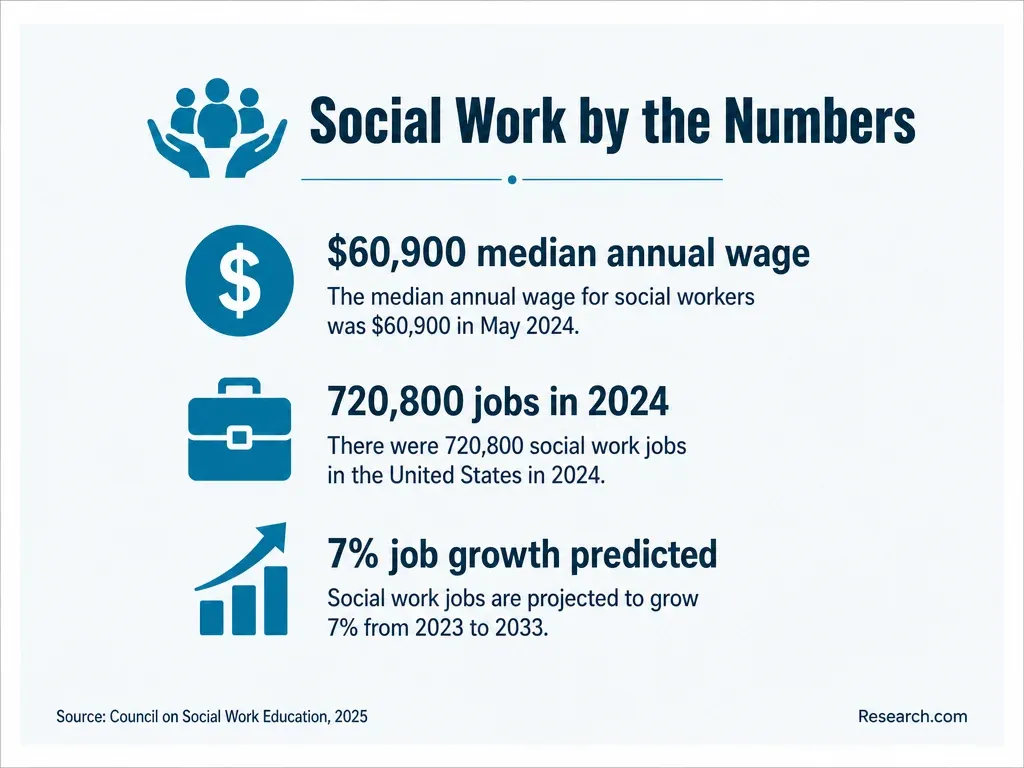
For salary context, the U.S. Bureau of Labor Statistics reports a May 2025 median annual wage of $61,780 for social workers overall and projects 6% employment growth from 2025 to 2035. Its reported medians are $59,550 for child, family, and school social workers; $67,880 for healthcare social workers; and $60,280 for mental health and substance abuse social workers. These occupational figures do not describe procurement analysts' pay, guarantee an MSW graduate's salary, or replace a local agency's pay scale. Social work master's pay and geographic differences offer additional context for comparing locations.
For a career move, start with the work you want to perform. Direct service calls for population knowledge, documentation, boundaries, and appropriate supervision; contract management adds procurement rules, budget analysis, and performance monitoring. Ask employers which credential is required for the specific position and whether experience managing services can substitute for another degree.
Other Things You Should Know About Social Work
Usually, yes, through the solicitation's designated question process and deadline. Rely on the agency's official written response or addendum, not an informal conversation that other bidders cannot see.
Often, if the RFP permits partners or subcontractors. Check which organization must sign the contract, meet minimum qualifications, carry insurance, and remain accountable for the team's work.
An incumbent may know the service environment, but it must still meet the published requirements. Agencies should evaluate bids using the stated criteria and applicable procurement rules, not assume prior contract ownership determines the award.
Check whether the procurement allows a debrief or records request, and note any deadlines. Use the available feedback to distinguish a compliance failure from weaknesses in price, evidence, or service design before bidding again.
- 15.305 Proposal evaluation. | Acquisition. GOV https://www.acquisition.gov/far/15.305
- Data and Information Systems: Issues for Performance... - NCBI https://www.ncbi.nlm.nih.gov/books/NBK231008/
- General Schedule Qualification Policies | U.S. Office of Personnel Management https://www.opm.gov/policy-data-oversight/classification-qualifications/general-schedule-qualification-policies/
- RFP #255 | ca.gov https://www.contracosta.ca.gov/DocumentCenter/View/92326/RFP-255-FGCWN-Service-Providers_published
- Request for Proposal (RFP) Evaluator's Guide | nd.gov https://www.omb.nd.gov/request-proposal-rfp-evaluators-guide
- Data Collection Methods and Logic Models | Bureau of Justice Assistance https://bja.ojp.gov/funding/performance-measures/data-collection-methods-and-logic-models
- Medicare Telemedicine Health Care Provider Fact Sheet | cms.gov https://www.cms.gov/newsroom/fact-sheets/medicare-telemedicine-health-care-provider-fact-sheet
- BPPM Competitive Proposal Evaluation Process | FTA https://www.transit.dot.gov/funding/procurement/bppm-competitive-proposal-evaluation-process
- 2 CFR Part 200 -- Uniform Administrative Requirements, Cost Principles, and Audit Requirements for Federal Awards https://www.ecfr.gov/current/title-2/subtitle-A/chapter-II/part-200
- Informed Consent FAQs | hhs.gov https://www.hhs.gov/ohrp/regulations-and-policy/guidance/faq/informed-consent/index.html