2027 Social Work Community Partnerships: Memoranda of Understanding and Role Clarity
Audited and Verified:
Our Editorial and Data Verification Process
Research.com uses government datasets, official education statistics and primary institutional information to support its career and degree guides. Our review process checks factual accuracy, occupational definitions, source dates and the requirements associated with the credentials discussed.
How This Article Was Fact-Checked
Our editorial team verifies salary estimates, employment projections, education requirements and program information against original data providers and official organizations. Salary figures are checked against the relevant occupational definitions and reporting periods. Information about licensure, accreditation and required in-person training is reviewed separately.
Fact-checked and verified on:

Co-Founder and Chief Data Scientist
A community partnership can give social work students meaningful field learning - or leave them unsure who supervises their work, protects client information, and responds when a placement goes wrong. A memorandum of understanding (MOU) helps a school and agency set those expectations before students begin.
For field coordinators, agency staff, and BSW or MSW students, this guide explains what an effective agreement covers, where its limits lie, and how to assess a partnership before relying on it for education or career plans.
Key Things You Should Know
- An MOU should identify the school's, agency's, and student's responsibilities; the individual learning agreement should then specify the student's tasks, supervision, and competency goals.
- An MOU alone does not authorize access to client records, guarantee a placement, or turn curricular field hours into post-degree clinical supervision.
- Before accepting a placement, verify who approves the site, provides field instruction, handles safety concerns, and decides whether completed work counts toward the degree.
What is an MOU in a social work community partnership?
A memorandum of understanding records how two or more organizations intend to work together. In social work field education, the parties are commonly a university and a community agency, such as a school district, hospital, housing nonprofit, or public benefits office.
The document can establish placement capacity, points of contact, supervision expectations, and procedures for resolving problems.
An MOU is the organizational framework, not the student's complete placement plan. A separate affiliation agreement may govern legal or insurance terms, while a student learning agreement identifies specific activities and competencies.
Agencies partnering on outreach or program evaluation may need a different MOU from those hosting direct-service interns. For readers deciding which education route fits their goals, a social work degree pathway overview provides context; the partnership itself must still fit the actual program and student role.
What should a social work partnership MOU include?
The most useful MOU answers operational questions before a student encounters them in practice. The parties can use the following items as a drafting or review checklist, adapting them to the setting and any separate legal agreement.
- Purpose and scope: The populations, services, sites, placement types, and activities covered, and activities explicitly excluded.
- People and authority: Designated school and agency contacts, eligibility and onboarding decisions, field instructor qualifications, and who may approve a change in duties.
- Learning conditions: Expected schedule and location, supervision arrangements, access to appropriate learning tasks, evaluation dates, and accessibility accommodations.
- Risk and privacy: Orientation, record access, consent processes, incident reporting, safety escalation, insurance responsibilities, and applicable agency policies.
- Lifecycle: Effective dates, review and amendment procedures, placement interruption or termination, and responsibilities for students already assigned when the agreement ends.
Keep organization-wide terms in the MOU and individual goals in each learning agreement. This matters particularly when a student enters a different sequence: advanced standing eligibility and traditional MSW options involve different program-approved learning plans, so partners should not assume every MSW student has identical preparation or placement requirements.
How do MOUs clarify roles among schools, agencies, and students?
Role clarity requires more than naming a supervisor. The agreement should say who can assign work, who evaluates learning, and who acts if service needs conflict with the student's educational objectives. This division is a useful starting point; the school's field policies and signed documents control the actual arrangement.
The comparison below shows where responsibilities usually sit and which boundary prevents a common misunderstanding:
| Participant | Typical responsibility | Boundary to clarify |
| Social work program and faculty liaison | Approve the site and learning plan, monitor competencies, and determine academic credit. | Agency staffing needs do not replace the program's field requirements. |
| Agency and field instructor | Provide orientation, suitable tasks, supervision, feedback, and a route for safety concerns. | A task supervisor may coordinate daily work without serving as the approved field instructor. |
| Student | Follow approved duties, document learning, seek supervision, and report concerns promptly. | Student status does not confer independent clinical authority or unrestricted records access. |
For a doctoral project or agency evaluation, distinguish a research mentor from someone authorized to approve field learning or client services. Even when a student is exploring affordable online DSW education, project access and agency approvals require their own clearly assigned decision-makers.
The agreement should allocate responsibility for training and decisions, not promise that an MOU itself makes a disclosure lawful. Specify who grants record access, what systems students may use, how access ends, and whether client information may appear in coursework, supervision, recordings, or evaluation.
Use the minimum information permitted by applicable law and policy; removing a name alone may not make a case unidentifiable.
Clients should know the student's role and applicable choices about participation under agency and legal requirements. The agency should explain how students obtain supervision, report an incident, and respond when a client needs a qualified professional rather than an intern.
Address secure communication, remote work, mandated-reporting escalation, and situations in which the student or client feels unsafe. State law, setting-specific privacy rules, professional ethics, and agency policy may impose different duties; the authorized organization must verify them.
Admission screening and permission to work with clients are separate decisions. For example, guidance on MSW applications when academic referees are unavailable does not change an agency's requirements for screening, orientation, consent, or supervised access.
What careers and salaries are associated with social work community partnerships?
Community partnerships expose students to work in schools, hospitals, behavioral health, housing, child welfare, and nonprofits. Depending on the role, graduates may coordinate services, connect clients with resources, organize outreach, or evaluate programs.
A placement can build relevant experience and contacts, but it is not a job offer; some positions require an MSW, a state license, school-specific qualifications, or additional supervision.
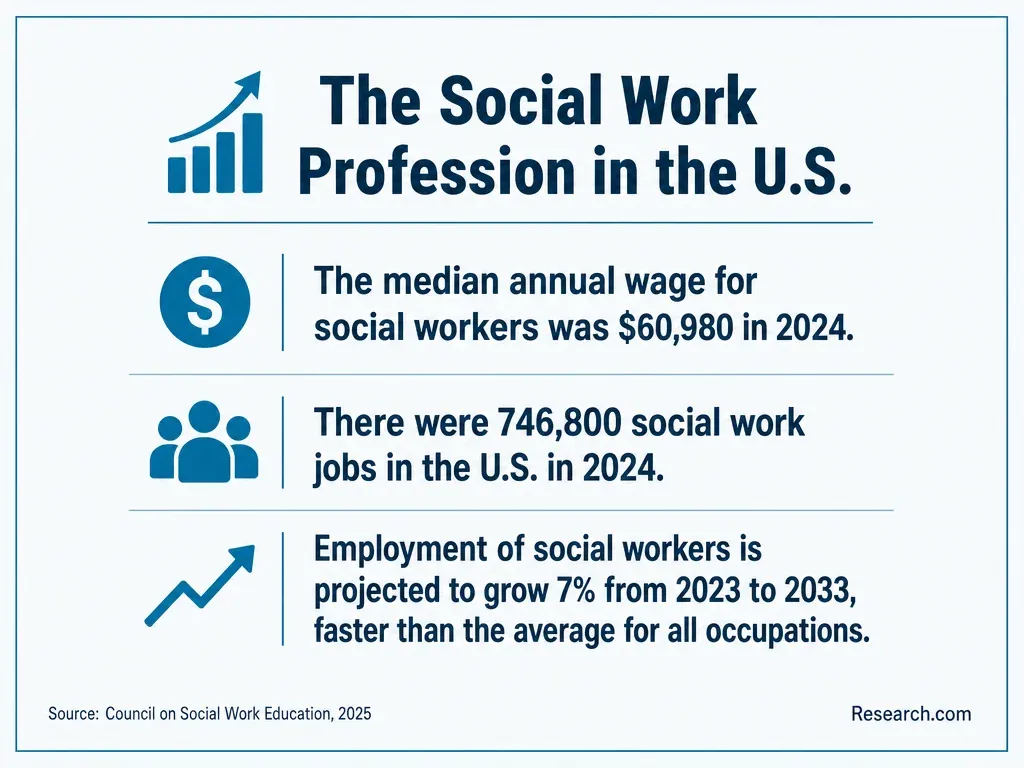
The U.S. Bureau of Labor Statistics figures below describe broad occupations, not salaries earned because someone completed a partnership-based placement. The categories can help compare settings, while actual pay depends on location, employer, duties, and qualifications:
| BLS occupation | Median annual pay, May 2025 | Projected employment growth, 2025-2035 |
| Child, family, and school social workers | $59,550 | 4% |
| Healthcare social workers | $67,880 | 8% |
| Mental health and substance abuse social workers | $60,280 | 10% |
Use a placement to test workplace fit as well as career interest: observe supervision quality, caseload expectations, documentation time, safety practices, and referral capacity.
For a location-specific pay comparison, consider comparing state salary figures for social work roles, while keeping the occupational category and local job requirements in view.
If your target is community outreach or program coordination rather than a regulated social work role, relevant experience or targeted training may be more direct than another degree.
Other Things You Should Know About Social Work
Yes. Ask the field office which agreement governs your placement and whether it can share the document or its student-relevant terms. Some contractual provisions may not be distributed, but you should be able to obtain the policies and contacts needed to participate safely.
Pause the disputed task when safe to do so and contact the field instructor and faculty liaison. They can determine whether the work fits the approved learning plan and whether duties or the placement need to change.
Potentially. The school must approve the site and confirm that it can provide suitable learning, supervision, safety procedures, and evaluation. Organizational size alone does not establish suitability.
The school's field office and the agency's authorized contact should review whether the change affects approved activities, supervision, safety, or the agreement's scope. They can decide whether an amendment or new approval is needed before students work under the changed arrangement.
- Summary of the HIPAA Security Rule | hhs.gov https://www.hhs.gov/hipaa/for-professionals/security/laws-regulations/index.html
- A Guide to Memorandum of Understanding Negotiation and Development | ASPE https://aspe.hhs.gov/reports/guide-memorandum-understanding-negotiation-development-0
- CDC Program Evaluation Framework, 2024 | MMWR https://www.cdc.gov/mmwr/volumes/73/rr/rr7306a1.htm
- Memorandum of Understanding (MOU) | texas.gov https://www.dfps.texas.gov/Doing_Business/Contract_Handbook/Chapter_3/3-08-mou.asp
- Partnership Agreement Resources - Office of the Provost https://provost.duke.edu/faculty-resources/memorandum-understanding-mou/
- Memorandums of Understanding (MOUs) | gatech.edu https://generalcounsel.gatech.edu/legal-affairs/memorandums-understanding-mous
- Social Workers' Ethical Responsibilities to Clients https://www.socialworkers.org/About/Ethics/Code-of-Ethics/Code-of-Ethics-English/Social-Workers-Ethical-Responsibilities-to-Clients
- Drafting a Memorandum of Understanding | nonprofitrisk.org https://nonprofitrisk.org/resources/drafting-a-memorandum-of-understanding/