2027 Social Work Case Allocation: Fairness, Competence, and Workload Considerations
Audited and Verified:
Our Editorial and Data Verification Process
Research.com uses government datasets, official education statistics and primary institutional information to support its career and degree guides. Our review process checks factual accuracy, occupational definitions, source dates and the requirements associated with the credentials discussed.
How This Article Was Fact-Checked
Our editorial team verifies salary estimates, employment projections, education requirements and program information against original data providers and official organizations. Salary figures are checked against the relevant occupational definitions and reporting periods. Information about licensure, accreditation and required in-person training is reviewed separately.
Fact-checked and verified on:

Co-Founder and Chief Data Scientist
Assigning every social worker the same number of cases can look fair while leaving one person with far more urgent, complex, or time-consuming work. For supervisors, field instructors, students, and early-career practitioners, allocation affects service continuity, staff development, and the ability to respond safely.
This guide explains how to weigh client needs against worker competence and available capacity, document assignment decisions, and raise concerns when workloads exceed what a team can reasonably manage.
Key Things You Should Know
- Fair allocation balances client urgency, case complexity, worker competence, continuity, and available time - not case counts alone.
- A weighted caseload should include direct contact, documentation, travel, coordination, supervision, and predictable crisis work; there is no universal safe case limit across settings.
- When capacity is insufficient, supervisors should reassess risk, redistribute or defer work where appropriate, and document unmet staffing needs rather than treating an even split as a solution.
What is case allocation in social work?
Case allocation is the process of deciding which practitioner or team will take responsibility for an incoming or existing client, family, or service episode. It includes more than assigning a name in a record: the decision should establish who will make contact, coordinate services, document work, consult a supervisor, and cover the case during an absence.
Allocation differs from triage, which determines how urgently a need must be addressed. A high-priority referral may require immediate attention without becoming one worker's long-term case. Duties also vary across child welfare, hospitals, housing programs, and behavioral health services. Readers comparing those settings can use this guide to comparing jobs that use a social work master's degree as a starting point, then check actual job descriptions.
How can social work cases be assigned fairly?
Fairness means using consistent, explainable criteria - not giving everyone the same number of files. Client needs come first, but assignments must also account for language access, existing relationships, staff capacity, and whether an agency can provide the supervision or specialist support a case requires.
A practical allocation review follows this sequence:
- Identify any immediate safety, statutory, or time-sensitive response requirements under the applicable agency policy and law.
- Match the case's needs and likely tasks to available workers' roles, demonstrated skills, language resources, and supervision.
- Compare each worker's weighted workload, including existing urgent cases, travel, documentation, and scheduled leave.
- Record the reason for the assignment, the first action and due date, and when the decision will be reviewed.
Check assignments across the team over time. Repeatedly giving complex cases to the most experienced worker may protect clients in the short term but create an unsustainable bottleneck. In a student placement, case assignment must also fit approved learning objectives and field-instruction capacity. When comparing placements, ask about exploring MSW programs with practicum assistance, including how the school and agency coordinate assignments and supervision.
How does social worker competence affect case assignments?
Competence is task- and setting-specific. A worker may be skilled at benefits navigation yet need consultation before handling a complex behavioral health referral. Supervisors should consider observed assessment and documentation skills, population-specific training, cultural and language responsiveness, familiarity with local services, and the worker's legal scope and agency authorization.
A developing practitioner can take on more demanding work when responsibilities are defined, supervision is accessible, and the agency has a plan for escalation. A student's coursework or completed field hours do not establish independent competence. Likewise, a clinical concentration is preparation, not permission to perform independently licensed services; those considering such roles should distinguish allocation readiness from MSW pathways for future clinical social workers.
Competence matching should not become a reason to isolate workers from learning opportunities. Pair appropriate cases with coaching and review, while reserving tasks outside a worker's scope for qualified staff.
Caseload size counts assigned cases; workload estimates the time and resources needed to serve them. Neither a single case count nor a simple "high/medium/low" label captures every agency's work. A useful measure combines expected service tasks with actual time spent and is reviewed when client circumstances change.
The comparison below shows why two workers with the same case count may have different capacity. These are measurement categories, not universal scoring rules.
| Measure | What it captures | What it can miss |
| Open case count | Number of assigned cases | Differences in urgency and required contact |
| Complexity rating | Factors such as multiple service needs, coordination demands, and instability | Travel, documentation, and sudden changes |
| Estimated task time | Contact, preparation, records, meetings, referrals, and travel | Unpredictable crises and delays outside the worker's control |
| Available work time | Hours remaining after leave, training, supervision, and other duties | Whether coverage and specialist support are actually available |
Agencies can test a weighting system against time records, overdue tasks, and staff and client feedback, then revise it. Avoid using a numerical score as a substitute for judgment: one new urgent referral can change the day's priorities. Students considering short-format MSW program comparisons should apply the same distinction to their schedules - fewer months of study do not necessarily mean a lighter weekly field or coursework load.
The NASW Code of Ethics provides relevant professional guidance on competence, client commitment, confidentiality, supervision, and responsible administration. It does not supply a universal numerical caseload limit or replace law, licensing rules, contracts, or agency procedures. An ethical allocation makes it possible to provide services within role and competence, respects client preferences where feasible, and avoids leaving foreseeable needs unattended without a response plan.
Allocation discussions should disclose only the client information needed to make and carry out the decision. Supervisors should also examine whether language barriers, disability access needs, geography, or assumptions about a population are unfairly affecting who receives service or which worker is assigned. Reporting duties and record-access rules must be checked against the applicable jurisdiction and setting.
Clinical-license supervision records serve a different purpose from daily caseload decisions or student field evaluations. Workers tracking that separate requirement can consult a social work supervised hour documentation guide, while confirming what their own licensing board accepts.
When a worker reports an unmanageable caseload, a supervisor should review specific tasks and deadlines, not simply compare file counts. The review should identify urgent client needs, work that can be reassigned or jointly handled, available coverage, and any service that the team cannot currently provide within required timeframes.
A useful escalation process is concrete and documented:
- Ask the worker to identify affected cases, pending actions, time demands, and any immediate concerns through approved channels.
- Review priorities and competence or scope requirements with the worker; arrange consultation or qualified coverage where needed.
- Redistribute work, adjust intake or schedules when authorized, and communicate service changes appropriately.
- Record remaining capacity gaps and bring staffing or policy decisions to agency leadership; set a date to reassess.
Training alone cannot fix a shortage of available hours. Leaders choosing whom to recruit or develop should start with the tasks the agency needs covered, then use a social work degree pathway overview to distinguish educational routes - not as a substitute for checking an applicant's skills, license where required, and capacity for supervision.
What are the career outlook and salaries for social work case managers?
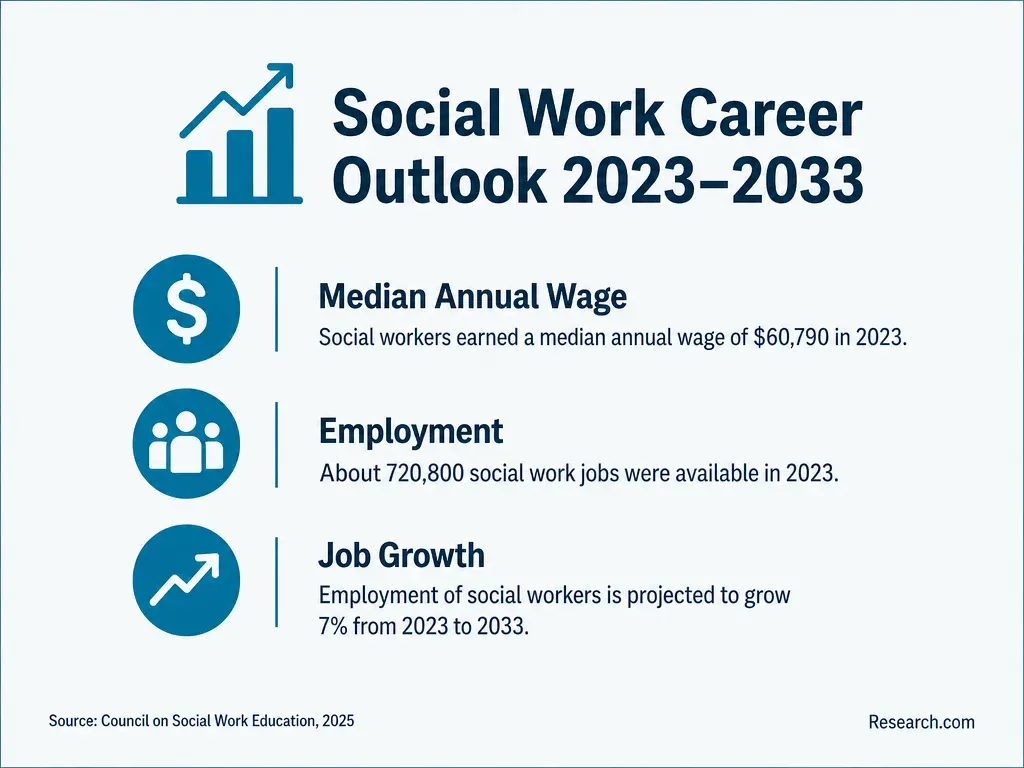
There is no single federal wage category for every job titled "social work case manager." The U.S. Bureau of Labor Statistics (BLS) groups social workers by occupational specialty, so the best comparison depends on the actual duties and setting. Its May 2025 medians and 2025-2035 projections provide context, not an offer or an MSW graduate salary.
These BLS categories illustrate how setting changes the comparison:
| Social work occupation | May 2025 median annual pay | Projected employment growth, 2025-2035 |
| Child, family, and school social workers | $59,550 | 4% |
| Healthcare social workers | $67,880 | 8% |
| Mental health and substance abuse social workers | $60,280 | 10% |
A housing or benefits case-management job might fall outside these categories. Compare the employer's salary range, required credentials, supervision, caseload expectations, travel, and advancement opportunities rather than relying on an occupation-wide median.
If an MSW is optional, weigh its full cost and field-related reduction in paid work against the positions it would actually make accessible. Online MSW tuition and fee considerations are one part of that calculation, not evidence of a guaranteed return.
Other Things You Should Know About Social Work
Continuity can help, but agencies may need to reassign a case. A planned handoff should clarify outstanding tasks, the new contact, and what information can be shared under applicable privacy rules.
Clients can raise concerns and ask about reassignment. Whether a change is possible depends on agency capacity, service rules, and the circumstances; the request should receive a respectful review.
Worker input can reveal relevant skills, conflicts, or capacity limits. The agency should still use a consistent assignment process and have a supervisor accountable for the decision.
Review it at a regular interval set by the agency and sooner when a case becomes urgent, a worker's availability changes, or deadlines and service needs begin to exceed capacity.
- Worker Rights and Protections | Occupational Safety and Health Administration http://www.osha.gov/workers
- Influence of Burnout on Patient Safety: Systematic Review and Meta-Analysis - PMC https://pmc.ncbi.nlm.nih.gov/articles/PMC6780563/
- Understanding caseload and workload approaches | education.gov.uk https://support-for-social-workers.education.gov.uk/employer-standards/standard-3/caseload-and-workload
- Mental health at work | who.int https://www.who.int/news-room/fact-sheets/detail/mental-health-at-work
- Caseload and Workload Management | akleg.gov https://www.akleg.gov/basis/get_documents.asp
- Dissecting racial bias in an algorithm used to manage the health of populations | Science https://www.science.org/doi/10.1126/science.aax2342
- Section 7. - Building Culturally Competent Organizations https://ctb.ku.edu/en/table-of-contents/culture/cultural-competence/culturally-competent-organizations/main
- Five Ways High Caseloads Hinder Social Work | Walden University https://www.waldenu.edu/online-masters-programs/master-of-social-work/resource/five-ways-high-caseloads-hinder-social-work
- Workload and Caseload Management | psu.edu https://militaryfamilies.psu.edu/resources/view/workload-and-caseload-management/
- NASW Standards for Social Work Case Management | socialworkers.org https://www.socialworkers.org/Practice/NASW-Practice-Standards-Guidelines/NASW-Standards-for-Social-Work-Case-Management