2027 Single-Case Designs in Social Work Research: Structured Evaluation in Practice Settings
Audited and Verified:
Our Editorial and Data Verification Process
Research.com uses government datasets, official education statistics and primary institutional information to support its career and degree guides. Our review process checks factual accuracy, occupational definitions, source dates and the requirements associated with the credentials discussed.
How This Article Was Fact-Checked
Our editorial team verifies salary estimates, employment projections, education requirements and program information against original data providers and official organizations. Salary figures are checked against the relevant occupational definitions and reporting periods. Information about licensure, accreditation and required in-person training is reviewed separately.
Fact-checked and verified on:

Co-Founder and Chief Data Scientist
Social workers often need to know whether a service is helping a particular client or setting, even when a large study is impractical. A single-case design turns repeated, routine observations into a structured evaluation - but only if the measures, timing, and ethical safeguards fit practice. This guide is for students, field learners, practitioners, and agency staff deciding how to evaluate an intervention. It explains which designs are feasible, what results can and cannot show, and when additional research training is worth pursuing.
Key Things You Should Know
- A single-case design measures an outcome repeatedly across baseline and intervention phases; one intake score and one follow-up score are not enough to assess a pattern of change.
- Choose a design that does not delay needed care: a multiple-baseline design can introduce an intervention at different times without withdrawing it.
- Interpret changes in level, trend, variability, and overlap alongside service records and client priorities; improvement alone does not prove the intervention caused it.
What is a single-case design in social work research?
A single-case design is a structured way to study change in one unit - such as a person, family, group, classroom, or agency team - through repeated measurement over time. The "case" is the unit being evaluated, not necessarily one individual. Researchers compare observations across defined phases, commonly a baseline phase labeled A and an intervention phase labeled B.
This differs from a case narrative, which describes events without a planned measurement schedule, and from a simple before-and-after comparison, which can miss an existing trend. It also differs from a large group study: repeated observations help assess change within a case but do not automatically establish that the same approach will work elsewhere.
For a learner exploring where this method fits in coursework, exploring academic pathways in online social work is a starting point; the deciding detail is whether a particular program teaches repeated-measures evaluation and permits an appropriately supervised project.
How do social workers use single-case designs to evaluate interventions?
Social workers use these designs to answer a narrow practice question: Did the outcome change after a defined service began, and is that change meaningful to the person or setting involved? A hypothetical housing-support project, for example, might track the number of completed housing-application steps each week before and after a new navigation process begins. The example describes a possible plan, not actual client data or a demonstrated result.
A workable evaluation starts with a service decision, not with a preferred graph. The practitioner identifies an outcome the client values, records how the existing service operates, sets a feasible observation schedule, and specifies when the new component begins. They also document concurrent changes - such as a benefits decision or a new referral - that could explain an apparent improvement.
In a field placement, the student needs agency permission, an approved learning task, and supervision before collecting or using service information. Comparing social work placement support policies can help prospective students ask who arranges sites and supervises evaluation activities; placement access is not permission to use confidential records for research.
What are the main types of single-case designs?
The choice depends chiefly on whether the intervention can ethically be delayed, withdrawn, or introduced in stages. The comparison below summarizes what each design can test; none overrides client needs or agency rules.
| Design | Phase pattern | Best fit and principal caution |
| AB | Baseline, then intervention | Practical for routine monitoring; a change after B begins provides limited evidence of causation. |
| Withdrawal or reversal | Often ABAB | Tests whether change tracks introduction and withdrawal; inappropriate when stopping help could cause harm or effects cannot readily reverse. |
| Multiple baseline | Intervention begins at different times across people, settings, or behaviors | Can strengthen a causal explanation without withdrawing care; requires comparable measurement and defensible timing. |
| Alternating treatments | Two or more approaches alternate on a planned schedule | Compares approaches when rapid switching is feasible; carryover effects can obscure differences. |
| Changing criterion | Successive, specified performance targets | Fits gradual skill-building; targets must be meaningful and changes must not be explained by unrelated events. |
An AB design may be sufficient for a service-improvement question even when it cannot support a strong causal claim. More elaborate designs demand additional observations, coordination, and analysis. Students comparing online MSW completion timeline comparisons should check whether a compressed field or capstone schedule leaves enough time for the design they propose.
Baseline is the repeated record of an outcome before the intervention changes. It helps show the starting level, direction, and natural variation. The intervention phase uses the same outcome definition and measurement schedule so that a shift is interpretable. Baseline must not become a reason to withhold urgent or established care; when delay is inappropriate, use an existing routine-data period if access is authorized, or choose another evaluation approach.
A useful measure is specific, feasible, and connected to a client-defined or service-defined goal. Depending on the setting, it could be a weekly count of attended appointments, a consistently administered self-report rating, or a documented task completed. Define precisely what counts, who records it, when it is recorded, and how missing entries are handled. Pairing a numerical measure with brief contextual notes can reveal why a count changed without treating those notes as proof of causation.
Measurement also has a cost: staff time, accessible tools, training, and secure storage. When comparing lower-cost online social work master's programs for evaluation training, ask whether students have access to methods instruction and approved data tools rather than assuming that lower tuition makes a field project inexpensive to complete.
Plot observations in time order and mark each phase change. Visual analysis examines level (typical magnitude), trend (direction), variability (fluctuation), immediacy (how soon change follows a phase transition), and overlap (how similar the phase values remain). Repeated demonstrations across phases or baselines make an intervention explanation more credible than one apparent shift. Summary statistics or specialized effect estimates can supplement a graph, but the choice of statistic and its assumptions should be stated.
Interpretation must account for maturation, seasonal patterns, changes in who records outcomes, missing observations, other services, and regression toward a usual level after an unusually difficult period. A rising score may also be a poor outcome if the measure does not reflect what matters to the client. Results for one case may guide that case's next service decision without representing an entire population.
Students who need stronger measurement or statistics preparation can compare course expectations before applying; comparing MSW GPA and prerequisite policies addresses entry rules, but admission standards alone do not establish the quality of a program's research-methods instruction.
Delivery format does not determine whether a social work degree qualifies someone to seek licensure. For a BSW or MSW, verify the specific program's CSWE accreditation status for the relevant cohort, institutional accreditation, state enrollment or placement authorization, and the licensing board's educational rules in the state where practice is intended. Graduation, license eligibility, and license issuance are separate decisions; an MSW alone does not authorize independent clinical practice.
Online study may reduce campus travel, but live classes, skills activities, and local field placements can still impose fixed schedules. Campus study may offer easier access to faculty and established local agency relationships, though support varies by program. In either format, ask who secures a placement, who qualifies as a field instructor, and how a proposed evaluation project is approved. Checking MSW program authorization and professional eligibility is a useful starting point; obtain confirmation from the program and the relevant state board for your circumstances.
What are the salaries and job outlook for these social work careers?
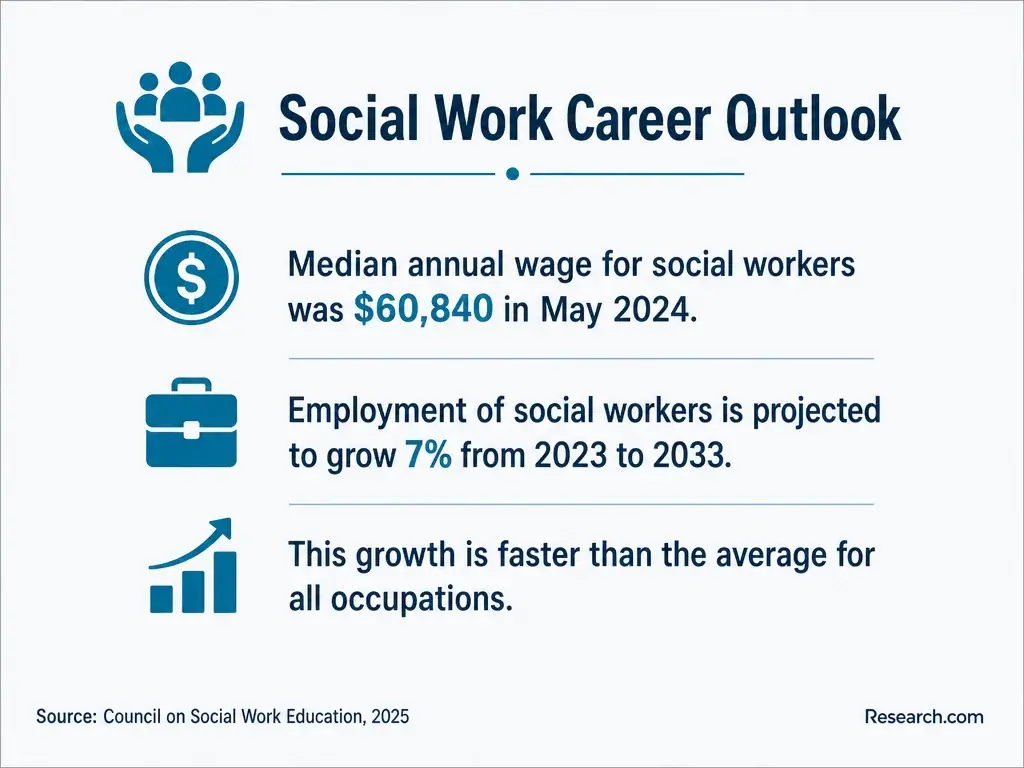
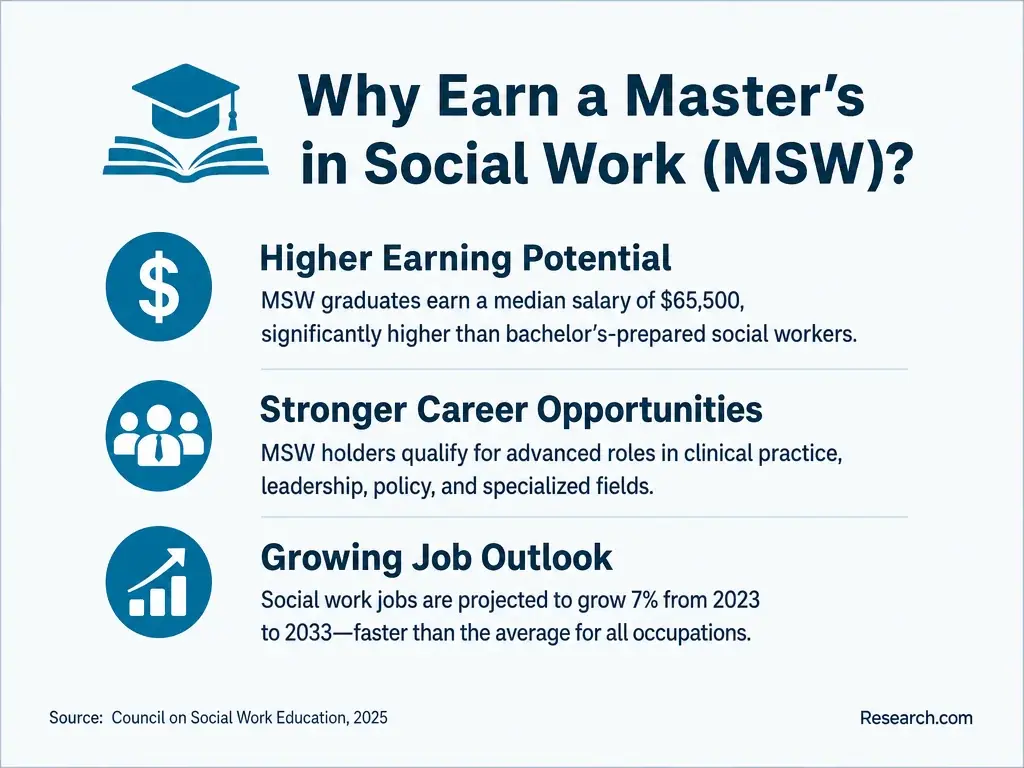
Single-case evaluation is a skill, not a separately tracked occupation with its own wage. The following U.S. Bureau of Labor Statistics social work categories provide career context using May 2025 median annual pay and projected employment change for 2025-2035.
| BLS occupation | Median annual pay, May 2025 | Projected employment change, 2025-2035 |
| Social workers, all specialties | $61,780 | +6% |
| Child, family, and school social workers | $59,550 | +4% |
| Healthcare social workers | $67,880 | +8% |
| Mental health and substance abuse social workers | $60,280 | +10% |
These are occupation-wide medians and projections, not expected pay or job growth for people who use single-case designs. An agency evaluator may also fall under a different occupation. Compare the duties, location, license requirements, and employer pay scale of actual openings; social work salary differences across states can add geographic context without replacing a local job search.
Other Things You Should Know About Social Work
Only if your school and agency permit it. Use an approved, de-identified description of your question, design, and learning; do not include client-level records or identifiable graphs without authorization.
Not necessarily. A secure, agency-approved spreadsheet may be enough to plot observations. Follow data-storage rules, and use more specialized tools only when the analysis requires them.
Choose an interval that matches how the outcome occurs and can be recorded consistently. If observations are too sparse to assess a pattern, state that limitation or use another evaluation method.
Yes. Collaboratively selecting outcomes can make the evaluation more relevant and accessible, provided the proposed measures respect privacy, are feasible to collect, and meet any applicable oversight requirements.
- WWC | Single-Case Design Technical Documentation https://ies.ed.gov/ncee/wwc/Document/229
- Single-Case Design, Analysis, and Quality Assessment... - PMC https://pmc.ncbi.nlm.nih.gov/articles/PMC5492992/
- Informed Consent - StatPearls - NCBI Bookshelf - NIH https://www.ncbi.nlm.nih.gov/books/NBK430827/
- Read the Belmont Report | hhs.gov https://www.hhs.gov/ohrp/regulations-and-policy/belmont-report/read-the-belmont-report/index.html
- Outcome Measure - an overview https://www.sciencedirect.com/topics/computer-science/outcome-measure
- Chapter 3., Section 9. Developing Baseline Measures | ku.edu https://ctb.ku.edu/en/table-of-contents/assessment/assessing-community-needs-and-resources/developing-baseline-measures/main
- Model for Improvement: Establishing Measures | Institute for Healthcare Improvement https://www.ihi.org/library/model-for-improvement/establishing-measures