2027 Schema Therapy in Social Work: Further Training for Clinical Social Workers
Audited and Verified:
Our Editorial and Data Verification Process
Research.com uses government datasets, official education statistics and primary institutional information to support its career and degree guides. Our review process checks factual accuracy, occupational definitions, source dates and the requirements associated with the credentials discussed.
How This Article Was Fact-Checked
Our editorial team verifies salary estimates, employment projections, education requirements and program information against original data providers and official organizations. Salary figures are checked against the relevant occupational definitions and reporting periods. Information about licensure, accreditation and required in-person training is reviewed separately.
Fact-checked and verified on:

Co-Founder and Chief Data Scientist
Schema therapy training can deepen a clinical social worker's work with persistent relationship patterns and complex emotional needs, but a course certificate is not the same as specialty certification - or permission to practice independently. For licensed clinicians and social workers approaching independent practice, the decision is whether further training fits their clients, supervision access, schedule, and budget.
This guide explains the training and certification routes, what to check before paying a provider, and when focused professional development makes more sense than another degree.
Key Things You Should Know
- Schema therapy is postgraduate clinical training, not a replacement for an MSW, state clinical license, or required post-degree supervision.
- International Society of Schema Therapy (ISST) certification involves more than attending classes: applicants must meet the applicable training, supervised-case, and competency-assessment standards.
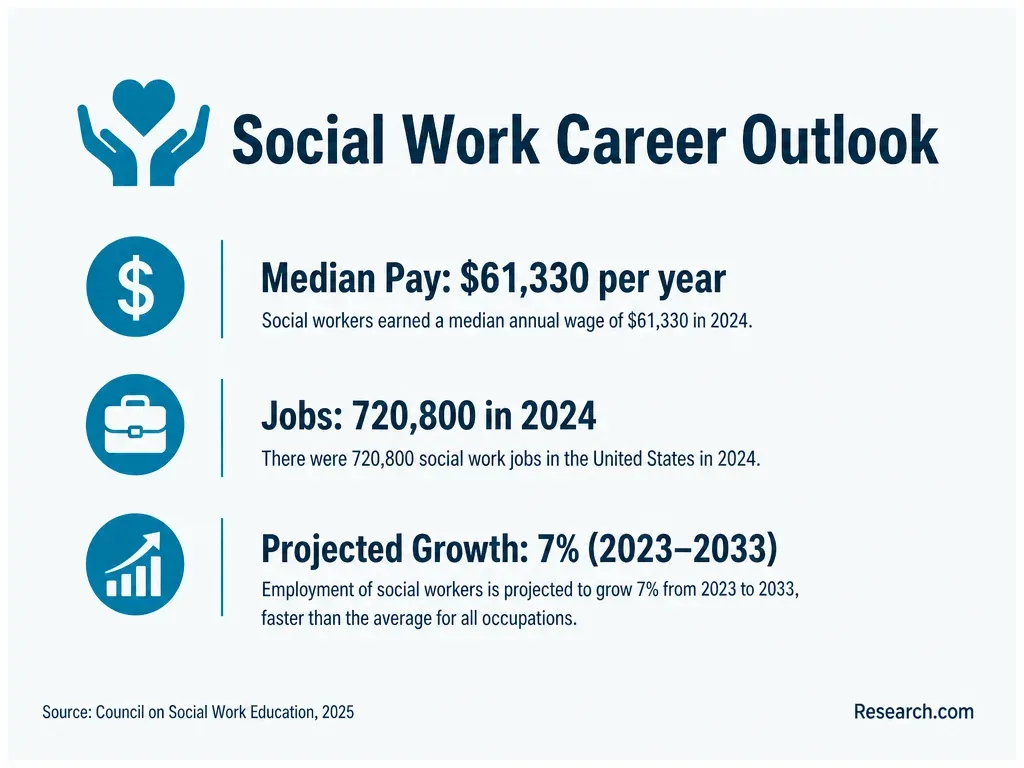
- The relevant U.S. Bureau of Labor Statistics category, mental health and substance abuse social workers, has a May 2025 median annual wage of $60,280 and projected employment growth of 10% from 2025 to 2035; neither figure measures a schema therapy pay premium.
What is schema therapy, and how do clinical social workers use it?
Schema therapy is an integrative psychotherapy approach associated with Jeffrey Young. It examines enduring patterns, called early maladaptive schemas, alongside coping responses and shifting emotional states, often called modes. Clinicians use cognitive, experiential, behavioral, and relationship-focused methods to help clients recognize and change those patterns.
For a clinical social worker, schema therapy adds a treatment framework to - not a replacement for - person-in-environment assessment. A clinician might consider how a client's learned expectations interact with present relationships, discrimination, housing instability, or other circumstances rather than attributing every difficulty to an internal pattern. The approach is often discussed in relation to longstanding or complex difficulties, but training in a model does not establish that it is suitable for every client or condition.
Schema therapy is most relevant to social workers providing psychotherapy within their authorized scope. Those exploring roles for master's-prepared social workers should distinguish psychotherapy positions from case management, advocacy, and other roles where this intensive clinical training may have less direct value.
What education and licensure do social workers need before pursuing schema therapy training?
Training providers may admit learners at different career stages, but providing psychotherapy depends on state law, license status, supervision arrangements, and workplace policy. In the United States, the usual clinical social work foundation is an MSW meeting the applicable state board's educational requirements, followed by any required post-degree supervised experience, examination, and clinical license. State license titles and permitted activities differ.
An MSW student or provisionally licensed social worker may be able to study schema therapy or use appropriate skills under qualified supervision. Neither MSW field education nor a specialty course substitutes for board-approved post-degree clinical supervision. A BSW alone does not confer independent psychotherapy authority. For readers who do not yet hold an MSW, traditional MSW routes for non-BSW graduates explain an entry path that is separate from advanced standing.
Before enrolling, confirm what your state board permits at your current license level, whether your supervisor can support work with the intended client population, and whether the training provider's own eligibility rules accept your qualification.
How do clinical social workers earn schema therapy certification?
The ISST offers a voluntary specialty-certification route; a course provider may also issue its own certificate of attendance. These are different documents. ISST certification does not issue a social work license or expand its legal scope, and requirements can differ by certification level and treatment modality.
The practical sequence is to identify the exact ISST pathway sought, confirm eligibility, complete qualifying instruction and skills practice, undertake the required supervised clinical work, and submit the specified case material and competency assessments. Confirm the current ISST standards and approved training arrangements before selecting a course: completion of an introductory workshop alone should not be advertised or understood as ISST certification.
If independent clinical licensure is still your immediate goal, prioritize that board-governed pathway. MSW licensure alignment before enrollment matters more than a prospective specialty credential when an educational decision remains unresolved.
Substantive training connects formulation to observable clinical skills. Coursework commonly addresses schemas, coping styles and modes; assessment and collaborative case formulation; the therapeutic relationship; and cognitive, experiential, and behavioral interventions. Role-play can help clinicians rehearse emotionally demanding techniques before considering their use in client care.
Supervised practice adds something a lecture cannot: feedback on actual clinical judgment, pacing, boundaries, formulation, and the clinician's response to challenging interactions. Ask how cases are selected, how recordings or other case material are assessed, and what happens if a trainee needs further development. Client consent, privacy rules, agency policy, and secure handling of recordings must govern any submitted material.
For clinicians still building foundational skills, the distinction between academic placement and later specialty supervision is important. Online BSW curriculum and field education options concern generalist preparation; BSW field hours do not replace supervised schema therapy cases or post-degree clinical-license hours.
Providers may deliver lectures, live skills exercises, and supervision online, in person, or through a hybrid format. The useful distinction is not simply "online versus campus": it is whether the format includes the interaction, observation, feedback, and clinical-case work required for the learner's goal. An asynchronous course may teach concepts without satisfying a certification pathway's live-practice or supervision standards.
Working clinicians should request the actual session calendar, time zone, attendance policy, practice-partner expectations, recording requirements, and supervision availability. In-person training can offer immediate role-play feedback but adds travel and time away from practice; online training reduces travel without necessarily offering flexible hours. This resembles the scheduling distinction in comparing self-paced and structured MSW coursework, although specialty-training rules must be checked separately.
There is no single duration or U.S. price for schema therapy training. An introductory course may fit into a short series of sessions, while certification also depends on access to suitable cases, qualified supervision, assessment, and the applicant's pace. A provider's advertised course length is therefore not a reliable certification-completion date.
Compare a full-pathway quote, not just workshop tuition: ask separately about instruction, supervision, competency review, required membership or application charges, travel, and time away from paid clinical work. Obtain the provider's current written fee schedule and ask what must be paid again if additional supervision or reassessment is needed. If you still need the qualifying degree, lower-tuition Master of Social Work pathways address a much larger, separate educational expense; an inexpensive specialty course cannot replace it.
Your state social work board sets clinical-license renewal and continuing-education rules, including any topic or provider restrictions. Requirements differ by jurisdiction and can change, so check the rules for your license and renewal period. Do not assume every schema therapy course earns board-accepted credit; request documentation of its CE approval before enrolling.
Check ISST's current terms separately for any obligations associated with your certification, membership, directory listing, or continued professional standing. A course that satisfies a state CE requirement does not automatically meet an ISST requirement, or vice versa. Keep certificates, dates, provider details, and supervision records in separate files so each authority receives the evidence it requests.
For clinicians reviewing a degree as well as ongoing CE, social work degree options and program formats address initial education. They should not be confused with the shorter professional development used to maintain an existing license.
What are the salary and job outlook for clinical social workers?
The closest broad Bureau of Labor Statistics comparison for many psychotherapy-oriented social work positions is mental health and substance abuse social workers. Its May 2025 median annual wage was $60,280, and BLS projects 10% employment growth from 2025 to 2035. This occupation includes workers with different duties, employers, experience levels, and credentials; it does not isolate schema therapists or establish a return on certification spending.
Evaluate a potential financial benefit against your actual job offers, employer reimbursement, supervision expenses, and time spent training. Geography and setting matter as well; a state-by-state MSW salary overview can provide broader context, but local postings and compensation policies are more useful for judging a specific opportunity.
Other Things You Should Know About Social Work
Do not assume it is universally required. Ask the specific training or certification pathway whether personal therapy or other self-practice is expected, recommended, or mandatory.
Removing names alone may not be enough. Follow the applicable consent, privacy, agency, and training-provider rules before recording or sharing any session.
Not necessarily. Review your policy terms and ask the insurer whether the intended work, setting, and supervision arrangement are covered.
Clients should receive an accurate explanation of the proposed treatment and the clinician's qualifications as part of informed consent. Never imply a certification has been earned when it has not.
- The social determinants of mental health and disorder - PMC https://pmc.ncbi.nlm.nih.gov/articles/PMC10786006/
- NYS Social Work: LCSW License Requirements | nysed.gov https://www.op.nysed.gov/professions/licensed-clinical-social-worker/license-requirements
- Refugee and migrant mental health | who.int https://www.who.int/news-room/fact-sheets/detail/refugee-and-migrant-mental-health
- Intervention Strategies for Schema Healing 3 (Chapter 8) | Cambridge Core https://www.cambridge.org/core/books/cambridge-guide-to-schema-therapy/intervention-strategies-for-schema-healing-3/5298674DA70B911D9F9D26726C9E4606
- Schema Therapy: What It Is, What It Treats & Techniques | Cleveland Clinic https://my.clevelandclinic.org/health/treatments/schema-therapy
- Training Curriculum Requirements | schematherapysociety.org https://schematherapysociety.org/Training-Curriculum-Requirements