2027 Participatory Evaluation in Social Work Research: Sharing Evaluation Decisions with Stakeholders
Audited and Verified:
Our Editorial and Data Verification Process
Research.com uses government datasets, official education statistics and primary institutional information to support its career and degree guides. Our review process checks factual accuracy, occupational definitions, source dates and the requirements associated with the credentials discussed.
How This Article Was Fact-Checked
Our editorial team verifies salary estimates, employment projections, education requirements and program information against original data providers and official organizations. Salary figures are checked against the relevant occupational definitions and reporting periods. Information about licensure, accreditation and required in-person training is reviewed separately.
Fact-checked and verified on:

Co-Founder and Chief Data Scientist
A social services agency can measure whether a program met its targets and still miss what participants consider meaningful change. Participatory evaluation addresses that gap by involving people affected by a program in decisions about what to study, how to interpret evidence, and what to do with the findings. For social work students, researchers, and agency staff, the challenge is sharing authority without compromising privacy, rigor, or client choice.
This guide explains how to structure those decisions, choose workable methods, and determine whether additional training or a degree would help.
Key Things You Should Know
- Participatory evaluation gives stakeholders defined influence over evaluation questions, measures, interpretation, and use of findings - not merely a chance to answer a survey.
- Agree on decision rights before collecting data; separate voluntary participation in evaluation from access to services, and obtain any required agency or research-ethics review.
- A social work degree can build research and practice skills, but many agency evaluation roles do not require clinical licensure or a new degree. Choose training according to the work and employer requirements.
What is participatory evaluation in social work research?
Participatory evaluation is an approach in which people who deliver, use, fund, or are affected by a social service help shape the evaluation, rather than serving only as sources of data. Depending on the project, stakeholders may include clients, family members, frontline staff, community organizations, agency leaders, and funders. Participation can range from advising on a survey to sharing decisions throughout the project; calling an evaluation participatory should mean more than seeking feedback after its design is fixed.
Consider a hypothetical housing-support program. An agency might count referrals and placements, while participants might also want to know whether housing feels safe, remains stable, and allows access to work or family. Those priorities can change the questions and measures without making administrative counts irrelevant. The evaluator's task is to make both sets of evidence useful and explain where they disagree.
Participatory evaluation is not automatically community-based participatory research, a randomized study, or a promise that every stakeholder controls every decision. An agency may retain legal responsibility for records and reporting, while a funder may require particular measures. The useful question is which decisions can genuinely be shared and whether stakeholders have the time, information, and support to exercise that influence. Learners considering formal methods training can use exploring academic pathways in online social work as a starting point, then inspect individual course and project requirements.
How do stakeholders share evaluation decisions in social work?
Start by distinguishing input from decision authority. An advisory group that can suggest questions but cannot revise them has a different role from a group that approves measures or helps decide what findings mean. Neither arrangement is inherently wrong, but describing the difference openly prevents a consultation exercise from being presented as shared control.
A practical decision agreement can be built in this sequence:
- Name the decisions: evaluation questions, indicators, recruitment, data collection, interpretation, reporting, and changes to the program.
- For each decision, specify who proposes, who decides, who must be consulted, and which legal, contractual, or safety limits cannot be delegated.
- Set accessible meeting arrangements, compensation or reimbursement where feasible, a way to register disagreement, and a date to revisit the agreement.
- Record how stakeholder input changed the design - or why a proposed change could not be adopted - and report back to those who contributed.
Power matters as much as the agreement. A current client may reasonably hesitate to criticize a service in front of their caseworker. Separate listening sessions, independent facilitators, anonymous channels, or former-service-user advisers may provide safer options. No participant should have to join an evaluation to receive services.
For a student project, confirm which decisions the agency can share before promising participants control over its data or operations. When comparing programs for this kind of learning, comparing MSW practicum placement assistance can help frame questions about access to suitable community partners and approved evaluation tasks.
What methods and ethical safeguards support participatory evaluation?
Choose methods that fit both the decision and participants' circumstances. Brief interviews or listening sessions can reveal how people experience a service; accessible surveys can show how widely a concern is reported; administrative records can document reach and follow-up. Using more than one source helps test whether an apparent improvement reflects participants' experiences, but it does not remove selection bias or prove that the program caused a change.
Invite stakeholders to review proposed wording and the interpretation of summarized findings, not identifiable records they are unauthorized to see. If only the most satisfied participants attend meetings, seek other safe ways to hear from people who left the program or could not access it. Document who was not represented so that a small advisory group is not mistaken for the whole community.
Before recruitment or data access, establish voluntary participation, meaningful consent, secure storage, minimum-necessary access, and rules for quotations and reporting small groups. Discuss compensation without creating pressure to participate. Check agency policy and applicable privacy and reporting law. Whether an activity is program evaluation, quality improvement, or research requiring institutional review is an oversight determination - not a label the evaluator can settle by preference. A university project may also require school review even when an agency approves it.
Build accessibility, translation, participant compensation, and secure data handling into the project budget. Doctoral learners should keep those project expenses distinct from their education costs when using social work doctoral tuition comparisons; affordable enrollment does not establish that a program will fund community participation.
For students seeking a BSW or MSW, verify the specific program's Council on Social Work Education (CSWE) accreditation status and the status applicable to their cohort. Institutional accreditation is a separate question. Accreditation matters to educational quality and can affect license eligibility, but the applicable state board - not the school or CSWE - decides whether an applicant meets a license category's requirements.
Participatory evaluation itself generally is not a separately licensed social work activity. A researcher or program evaluator should still check whether a job uses a protected social worker title or includes duties requiring a state license. Graduation, exam eligibility where an exam is required, license issuance, and independent clinical authority are distinct steps. Academic field education is not automatically post-degree clinical supervision.
Admissions flexibility does not answer these accreditation or licensure questions. When reviewing MSW programs with accessible admissions, confirm the exact track's status, field arrangements, and the rules of any state where you expect to practice before enrolling.
Look for courses in research design, qualitative interviewing, statistics, measurement, policy, and program evaluation, alongside practice instruction in engagement, power, and ethics. A strong learning sequence moves from drafting a feasible question to testing a measure, analyzing appropriately accessed data, discussing interpretations with stakeholders, and presenting limitations clearly.
Field education or a capstone can provide a supervised setting for that sequence if the school and agency approve the work. A manageable deliverable might be a stakeholder-informed evaluation plan or an analysis of de-identified, authorized program information - not a promise of access to client files or publishable results. The learning agreement should identify the student's tasks, supervision, permissions, and what can be shared outside the agency. Paid work or volunteering does not automatically count as field education.
Compressed study can leave less time to establish trust and obtain project approvals. Students considering accelerated MSW study planning should ask whether a participatory project can realistically fit the field and capstone calendar; a smaller, well-governed project may teach more than an ambitious unfinished one.
What are the salary and job outlook for social work evaluation careers?
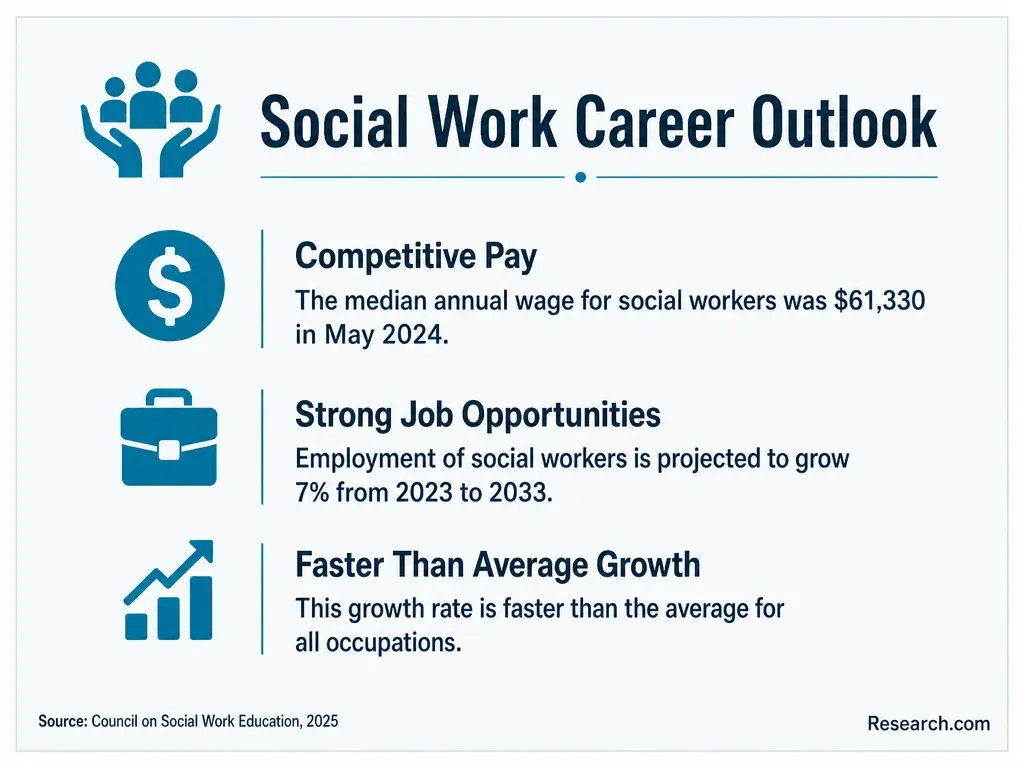
The U.S. Bureau of Labor Statistics does not publish a single wage or growth figure for "participatory social work evaluator." As context, its May 2025 median annual wage for social workers across specialties was $61,780, with employment projected to grow 6% from 2025 to 2035. Those figures describe a broad social worker occupation, not evaluator pay, an MSW graduate's expected salary, or demand for participatory methods specifically.
For a meaningful offer comparison, use the employer's job classification, location, responsibilities, and posted range. A research analyst or program manager may fall outside the BLS social worker category, while a licensed practice role may include evaluation among many duties. Social work earnings across different state markets can add geographic context, but it cannot replace the salary range for the actual position.
Other Things You Should Know About Social Work
Document the competing interpretations and the evidence behind each. Do not force consensus or erase a minority view; explain how the disagreement affects conclusions and next decisions.
When the project agreement allows it, share an accessible summary for factual correction and interpretation. Set a clear review period and explain who retains final reporting responsibility.
Budget for qualified language support, test translated materials for clarity, and offer participation formats people can use. Do not rely on a family member to interpret sensitive feedback by default.
Explain withdrawal options during consent, including any point after which already combined or de-identified information cannot feasibly be removed. Participation or withdrawal should not affect access to services.
- Stakeholders' engagement for improved health outcomes - PMC https://pmc.ncbi.nlm.nih.gov/articles/PMC11979262/
- Read the Belmont Report | hhs.gov https://www.hhs.gov/ohrp/regulations-and-policy/belmont-report/read-the-belmont-report/index.html
- Step 4 - Gather Credible Evidence | Program Evaluation https://www.cdc.gov/evaluation/php/evaluation-framework-action-guide/step-4-gather-credible-evidence.html
- Research Ethics - StatPearls - NCBI Bookshelf - NIH https://www.ncbi.nlm.nih.gov/books/NBK459281/
- Process evaluation | aifs.gov.au https://aifs.gov.au/resources/practice-guides/process-evaluation
- Understanding the 9 Core Competencies of Social Work | Tulane School of Social Work https://tssw.tulane.edu/news/understanding-9-core-competencies-social-work
- Collaborative, Participatory, and Empowerment Evaluation | sagepub.com https://journals.sagepub.com/doi/10.1177/1098214013509875
- Research Ethics and Informed Consent | Educational Research Basics by Del Siegle https://researchbasics.education.uconn.edu/ethics-and-informed-consent/
- Study participants and informed consent | apa.org https://www.apa.org/monitor/2015/09/ethics
- Section 6. Participatory Evaluation - Community Tool Box https://ctb.ku.edu/en/table-of-contents/evaluate/evaluation/participatory-evaluation/main