2027 Reentry Planning in Social Work: Connecting Justice, Housing, Employment, and Support
Audited and Verified:
Our Editorial and Data Verification Process
Research.com uses government datasets, official education statistics and primary institutional information to support its career and degree guides. Our review process checks factual accuracy, occupational definitions, source dates and the requirements associated with the credentials discussed.
How This Article Was Fact-Checked
Our editorial team verifies salary estimates, employment projections, education requirements and program information against original data providers and official organizations. Salary figures are checked against the relevant occupational definitions and reporting periods. Information about licensure, accreditation and required in-person training is reviewed separately.
Fact-checked and verified on:

Co-Founder and Chief Data Scientist
Leaving incarceration can mean trying to secure a place to sleep, income, identification, healthcare, and transportation at the same time. Reentry planning helps people navigate those connected needs before and after release.
This guide is for social work students, early-career practitioners, and human services professionals considering reentry work. It explains what effective coordination involves, where professional boundaries matter, and how to judge whether a BSW, MSW, license, or more targeted experience fits the role you want.
Key Things You Should Know
- Effective reentry planning starts before release when possible and turns referrals into confirmed next steps: an eligible housing option, a workable employment plan, and appointments the person can reach.
- A BSW can prepare graduates for generalist service coordination; an MSW may fit advanced or clinical roles. Neither degree alone authorizes independent clinical practice.
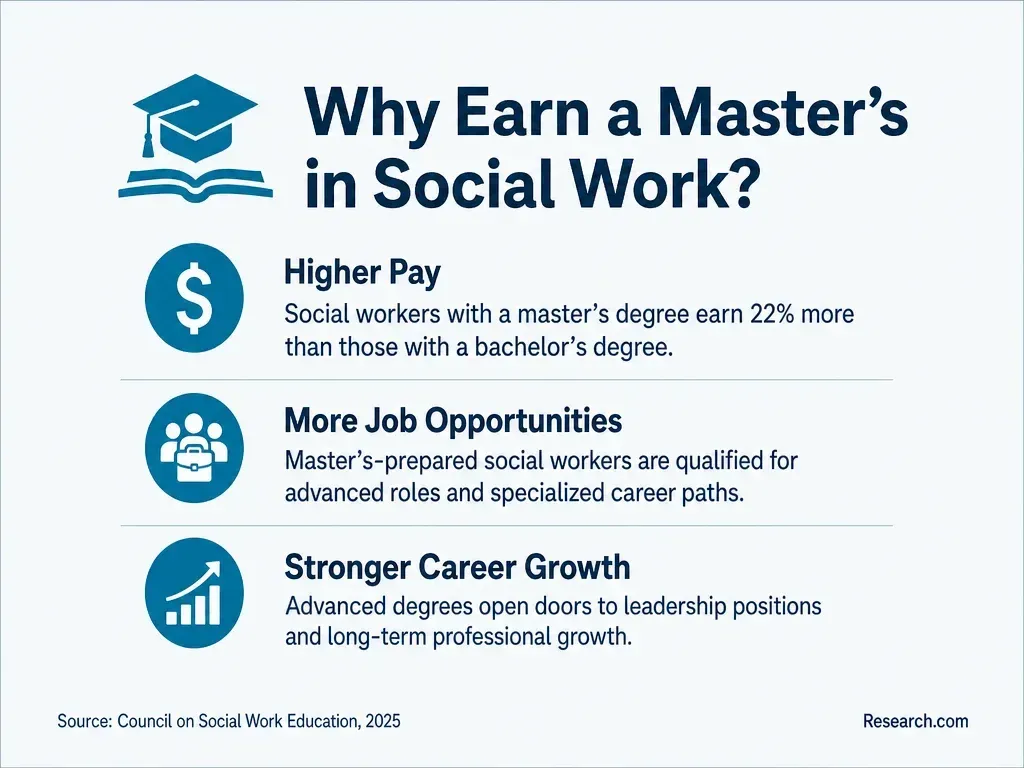
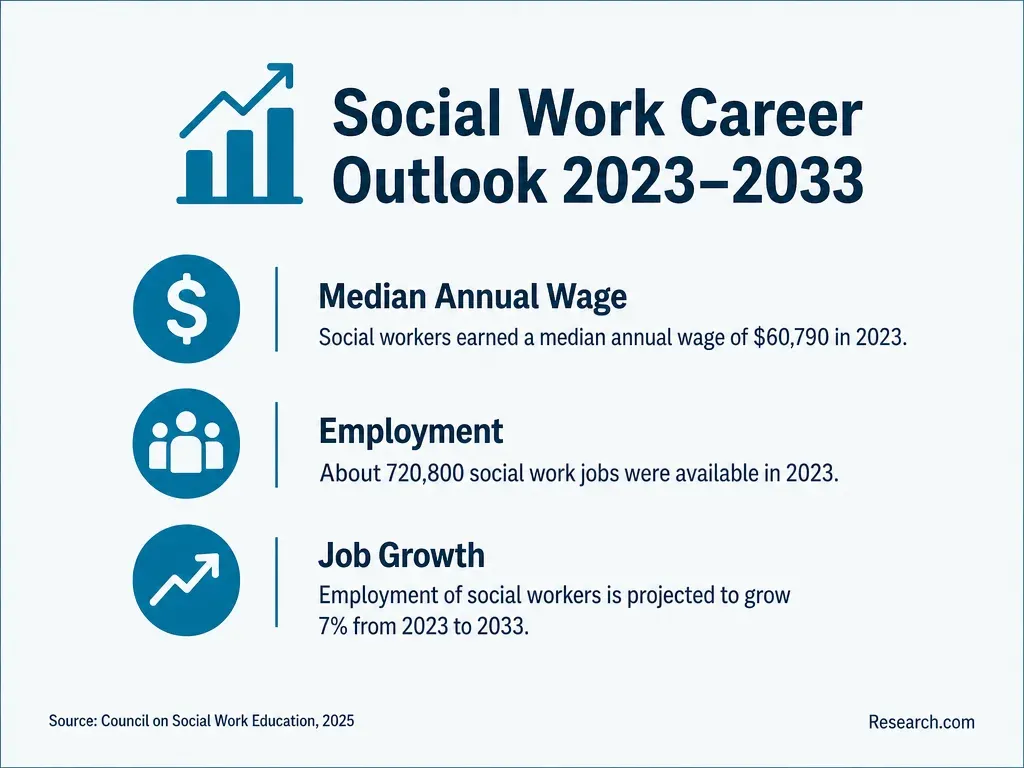
- The U.S. Bureau of Labor Statistics reports a May 2025 median annual wage of $61,780 for social workers overall and projects 6% employment growth from 2025 to 2035; neither figure predicts pay or openings in reentry specifically.
What is reentry planning in social work?
Reentry planning is collaborative preparation for life in the community after jail or prison. A social worker assesses immediate needs and longer-term goals, identifies barriers, coordinates services, and follows up as circumstances change. Planning may begin in custody, at release, or after a person has returned home. It can also serve people under probation or parole supervision.
The work is more than handing someone a referral list. A housing referral is useful only if the provider has space, accepts the applicant's circumstances, and can be reached. An employment appointment may depend on identification, transportation, clothing, and a phone. Social workers address these connections while respecting the person's priorities and choices. The breadth of MSW job families and professional development also matters here: reentry work can involve direct service, clinical care, community partnerships, or program management rather than one uniform job.
Social workers do not control release decisions, guarantee housing or employment, or provide legal representation merely by working in a justice setting. Their responsibilities depend on their role, employer, license, and applicable law.
How do social workers connect reentry clients with housing, employment, and support services?
A useful plan is organized around dependencies and deadlines, not just separate service categories. With the client, the worker identifies what must happen on release day, what can wait, and who is responsible for each contact. The following sequence is adaptable to agency policy and the person's circumstances:
- Confirm the starting point: Discuss the expected release location and date, identification, medication, benefits, income, transportation, supervision conditions, and the client's own goals. Verify information rather than assuming a release date or eligibility is final.
- Build a housing path: Check actual vacancies, admission criteria, accessibility, location restrictions, required documents, and a backup option. Distinguish an application or referral from an accepted placement.
- Connect income and employment: Identify document needs, benefits eligibility, workforce services, training, and employers' stated hiring requirements. Coordinate job-search timing with housing stability, health needs, and any supervision schedule.
- Arrange continuing support: Seek consent for appropriate referrals to healthcare, substance use treatment, peer support, family services, and legal aid. Confirm appointments, transportation, contact methods, and who will follow up after release.
For example, a worker may help confirm an intake appointment and bus route rather than record "referred to housing" as a completed outcome. If permission is needed to share information with a provider, obtain and document it under applicable law and agency policy; justice involvement does not make every client record freely shareable. Supervision conditions, confidentiality rules, and mandatory-reporting duties require jurisdiction-specific guidance.
Students considering this work should ask how a placement teaches coordination across real agencies, not simply whether its name includes "reentry." Questions about who arranges sites and supervises community-based work are central to MSW practicum site coordination questions.
What degree do you need to work in reentry social work?
The answer depends on the job's duties, not the population served. Some reentry navigation, peer support, outreach, and employment-services positions accept relevant experience or a human services credential. Jobs designated as social worker positions may require a BSW or MSW, while psychotherapy or independent clinical assessment can require an appropriate state clinical license. Read the posting's required qualifications and duties together.
The table compares common routes by the work they can prepare someone to seek. It does not replace an employer's requirements or a state licensing board's decision.
| Route | Potential fit in reentry | Important limit |
| Relevant experience or adjacent human services education | Outreach, navigation, peer support, or workforce services where the employer permits | Does not confer a protected social work title or clinical authority |
| BSW | Generalist assessment, case management, advocacy, and service coordination | Job and license eligibility vary by state and employer |
| Traditional or advanced-standing MSW | Advanced practice, supervision pathways, program leadership, or preparation for clinical licensure | Graduation is not an independent clinical license |
A traditional MSW can admit applicants whose bachelor's degree is in another discipline. Advanced standing is generally reserved for applicants with a qualifying social work bachelor's degree under the program's rules; justice-sector experience or a related bachelor's degree does not by itself qualify. If you already have a BSW, comparing advanced standing and standard MSW pathways can help you avoid repeating foundational study unnecessarily. A DSW or PhD is not normally needed for frontline reentry coordination; pursue doctoral study only if its leadership, practice-development, or research purpose fits your goal.
Reentry-related jobs appear in correctional agencies, community nonprofits, housing programs, behavioral health providers, public agencies, and workforce organizations. Titles are inconsistent: a "reentry specialist" may perform case management, while a "forensic social worker" position may have substantially different clinical or court-facing duties.
The table distinguishes roles by their primary work so you can evaluate postings rather than rely on titles. Qualifications remain employer- and state-specific.
| Role focus | Typical work | What to check in a posting |
| Reentry case manager or navigator | Release planning, referrals, follow-up, benefits and housing coordination | Degree requirements, caseload, community travel, and supervision |
| Housing or employment specialist | Provider relationships, applications, job readiness, and access barriers | Whether specialized housing or workforce experience matters more than an MSW |
| Behavioral health social worker | Assessment, treatment coordination, and possibly therapy | Required license, clinical scope, and qualified supervision |
| Program coordinator or manager | Partnerships, staff support, reporting, and service improvement | Management experience, funding responsibilities, and outcome measures |
For any role, ask about onboarding, safety procedures, documentation load, partner-agency access, and support after difficult cases. If the duties include therapy, examine clinical experience expectations across social work pathways rather than assuming a reentry placement or MSW alone establishes clinical eligibility.
How can you choose a reputable social work program for a reentry career?
Start with three target job postings and identify which require a BSW, an MSW, a license, or simply relevant service experience. That prevents paying for a credential your preferred role does not require. If a degree is warranted, compare schools using evidence tied to your intended work:
- Confirm the exact program's accreditation status, entry route, and eligibility in the state where you expect to study and practice.
- Ask the field office for examples of approved reentry-related learning settings, placement support, supervision arrangements, and travel or scheduling expectations.
- Compare total program costs and feasible work hours, not just advertised tuition; ask whether employer-supported or employment-based field learning is permitted and how it is approved.
- Request available completion and career-outcome information, including the cohort and what the measures do - and do not - show.
Use those answers to compare a degree with a more direct entry route. If your goal is housing navigation or workforce support and local employers accept your present qualifications, targeted training and supervised agency experience may be the better first step. If the roles you want require an MSW or a clinical license pathway, choose a program that supports those requirements rather than the cheapest advertised credit price alone. Comparing lower-cost MSW pathways is most useful after you have verified the program, placement, and licensing fit.
Other Things You Should Know About Social Work
No. Release and supervision decisions belong to the relevant authorities, and no service program can guarantee an individual outcome. Describe what a program offers without promising a legal result.
No. Eligibility, application timing, and processing vary by program and jurisdiction. A worker can help identify the responsible agency, required documents, and a plan for the period before a decision.
Often, if the person wants their involvement and information-sharing rules permit it. Discuss what support relatives can realistically provide and obtain any consent required before disclosing confidential information.
Recheck the essentials first: a safe destination, transportation, contact method, urgent care needs, and any supervision instructions. Then confirm which referrals remain usable and transfer coordination to providers in the new location where appropriate.
- Transitional Jobs Reentry Demonstration (TJRD) | acf.gov https://pathwaystowork.acf.gov/program-detail/461
- Arrest and Conviction Records: Resources for Job Seekers, Workers and Employers https://www.eeoc.gov/arrestandconviction
- Coordination to Reduce Barriers to Reentry | United States Department of Justice https://www.justice.gov/archives/opa/press-release/file/1497911/dl
- Reentry Research at NIJ: Providing Robust Evidence for High-Stakes Decision-Making https://nij.ojp.gov/topics/articles/reentry-research-nij-providing-robust-evidence-high-stakes-decision-making
- Chapter 3: Mental Health Treatment (Probation and Supervised Release Conditions) | United States Courts https://www.uscourts.gov/about-federal-courts/probation-and-pretrial-services/post-conviction-supervision/overview-probation-and-supervised-release-conditions/chapter-3-mental-health-treatment-probation-and-supervised-release
- ICJIA | An Overview of Evidence-Based Practices and Programs in Prison Reentry https://icjia.illinois.gov/researchhub/articles/an-overview-of-evidence-based-practices-and-programs-in-prison-reentry/
- Reentry Assistance - Franklin County, Ohio https://www.franklincountyohio.gov/Safety-Justice/Reentry-Assistance
- The Social Worker's Role in Reducing Recidivism | Virginia Commonwealth University https://onlinesocialwork.vcu.edu/blog/social-workers-role-in-reducing-recidivism/
- Barriers to Work: Improving Employment in Licensed Occupations for Individuals with Criminal Records | ncsl.org https://www.ncsl.org/labor-and-employment/barriers-to-work-improving-employment-in-licensed-occupations-for-individuals-with-criminal-records
- Beyond Recidivism: Redefining Measures to Understand Reentry Success | CSG Justice Center https://csgjusticecenter.org/publications/beyond-recidivism-redefining-reentry-data-health-housing-employment/