2027 Questions to Ask Before Accepting a Long-Term Care Social Worker Position
Audited and Verified:
Our Editorial and Data Verification Process
Research.com uses government datasets, official education statistics and primary institutional information to support its career and degree guides. Our review process checks factual accuracy, occupational definitions, source dates and the requirements associated with the credentials discussed.
How This Article Was Fact-Checked
Our editorial team verifies salary estimates, employment projections, education requirements and program information against original data providers and official organizations. Salary figures are checked against the relevant occupational definitions and reporting periods. Information about licensure, accreditation and required in-person training is reviewed separately.
Fact-checked and verified on:

Co-Founder and Chief Data Scientist
A long-term care social worker offer can look promising until the caseload, after-hours calls, or responsibility for difficult discharges becomes clear. For BSW and MSW graduates, career changers, and experienced social workers, the right decision depends on what this particular facility expects, and whether it provides the authority and support to do the work well.
These questions will help you test the job description against staffing, compensation, resident-rights practices, and your qualifications before you accept.
Key Things You Should Know
- Ask for the current census, social work staffing, open positions, and recurring documentation deadlines, not just a stated caseload.
- Compare the offer with relevant local jobs; the U.S. Bureau of Labor Statistics reports a May 2025 median annual wage of $67,880 for healthcare social workers, not a guaranteed nursing-home salary.
- Confirm the facility's credential rules, state requirements, supervision arrangements, and inspection record before treating the offer as a sound career move.
What does a long-term care social worker do at this facility?
"Long-term care" may mean a nursing home, skilled nursing facility, assisted living community, or another residential setting. Ask which residents you would serve and what a typical week involves.
Duties may include psychosocial assessments, care planning, family meetings, discharge coordination, benefits referrals, grief support, and responding to resident grievances. The balance changes substantially between short-stay rehabilitation and ongoing residential care.
Request the job description and ask who handles admissions, insurance issues, behavioral health referrals, and discharge appeals. Clarify whether you would provide counseling or primarily coordinate services; a job title alone does not establish clinical practice authority.
If you are moving into the role from another discipline, comparing social work graduate applicant requirements can inform a future education plan, but first establish whether this employer requires an MSW at all.
What caseload and documentation workload will I be expected to manage?
Ask for the average and peak resident census, the number of social workers covering it, and how many admissions and discharges occur each week. A manageable resident count can still conceal a heavy workload if short-stay turnover is high or one position is vacant. Ask whether you would cover more than one building and who takes over during leave.
Have the manager walk you through a normal week in the electronic record: assessments, care-plan meetings, required notices, referrals, and follow-up. Ask which deadlines are fixed, whether protected documentation time exists, and what work remains unfinished at the end of a typical shift. If you plan to study while employed, understanding online social work degree choices matters, but an online format will not make an unpredictable caseload easier to manage.
How do the salary and benefits compare with similar positions?
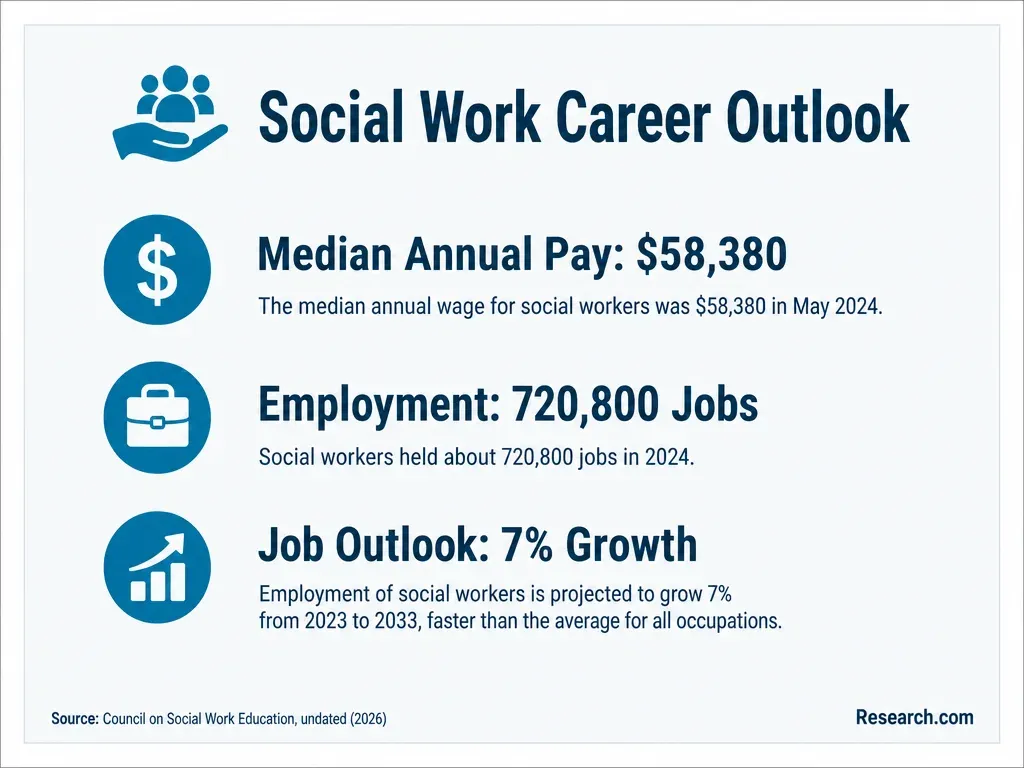
Compare the written offer with local nursing-facility, hospital, hospice, and other relevant social work postings that require similar credentials and hours. The BLS figures below provide national context, not a pay scale for this facility. A nursing-facility position may not align perfectly with either occupational category.
| U.S. occupation | May 2025 median annual wage | Projected employment growth, 2025-2035 |
| Healthcare social workers | $67,880 | 8% |
| Social workers, all specialties | $61,780 | 6% |
Ask about the pay range, overtime eligibility, paid time off, health insurance, retirement contributions, mileage, and any on-call compensation. Calculate what the offer means after commuting and benefit costs.
Do not accept low pay solely on the assumption that another degree will raise it later; if leadership education is a longer-term goal, assess online DSW study with cost in mind separately from the value of this offer.
Ask the employer to identify the qualifications required by state law, the facility's policies, and the specific job description. Federal nursing-home rules require a full-time qualified social worker in facilities with more than 120 beds and define a qualifying education-and-experience route that is not limited to social work degrees.
State rules and employer standards may be stricter. A role open to a human services graduate does not necessarily authorize that employee to use a protected professional title or perform licensed clinical work.
If the job requires a BSW, MSW, or license, confirm the exact credential and issuing state. CSWE programmatic accreditation can matter for licensing eligibility, but graduation is not license issuance, and an MSW alone does not confer independent clinical authority.
For a position tied to a particular state, use verifying social work degree recognition with a state board as a starting point, then obtain the board's current determination for your circumstances.
Ask for the scheduled hours and the hours the previous person actually worked. Find out who covers evening admissions, weekend discharges, family calls, emergencies, and holidays; how often you would be on call; and whether calls can be resolved remotely. Request the employer's overtime and on-call policies in writing, including how time is recorded and compensated.
A predictable schedule matters if you have caregiving responsibilities, another job, or plans for further study. Even MSW study formats with independent coursework can involve scheduled meetings and on-site field education. Evaluate the facility's actual schedule rather than assuming you can fit those commitments around the posted shift.

Ask how staff respond when a resident refuses a proposed plan, raises a grievance, reports mistreatment, or disagrees with family about discharge. Look for a process that takes residents' preferences and decision-making rights seriously, documents concerns, and provides a route to escalate them without retaliation. Ask how staff access an ombudsman, protect records, and receive guidance on applicable reporting duties.
Also clarify who may provide clinical assessments or treatment, particularly when behavioral health needs exceed the position's scope. Ethical judgment is essential in any role, but a guide to clinical MSW education options is not a substitute for the license, supervision, and workplace authorization a specific clinical duty may require. Treat evasive answers about grievances or resident choice as a reason to investigate further.
Request an onboarding plan covering the electronic record, resident-rights procedures, discharge processes, safety practices, and the facility's referral network. Ask when you will begin carrying a full caseload and who reviews your early documentation. Training should match the duties assigned, not end after a brief software orientation.
If you are pursuing clinical licensure, ask a separate set of questions: Is qualified supervision available under your state board's rules? Who pays for it, how often does it occur, and how are hours documented?
Employment and BSW or MSW field education do not automatically count toward post-degree clinical requirements. Review social work clinical experience counting and verification, then confirm the arrangement with the applicable board before relying on it.
For a Medicare- or Medicaid-certified nursing home, look up its CMS Care Compare profile and read the underlying inspection findings, not just the overall star rating. Check the dates, seriousness, and recurrence of deficiencies, along with staffing information and any reported enforcement actions.
Ask the hiring manager what changed after significant findings and whether those changes are visible in current staffing and procedures. Ratings are useful screening tools, not a complete picture of daily practice.
Assisted living oversight generally runs through state systems rather than the federal nursing-home rating system, so identify the facility's license type and consult the appropriate state regulator.
If you are considering the site for both employment and BSW field learning, inspect it as a prospective learning environment too; online BSW curriculum and field education options do not make an unsuitable or unapproved agency placement acceptable.
What opportunities are available for advancement and continuing education?
Ask what advancement has actually looked like for people in this position: senior social worker responsibilities, supervision, care-management leadership, or a move to another service line. Request specifics about continuing-education funding, paid training time, conference approval, and whether promotions require credentials the employer will help you obtain.
Choose development that fits your target role. An MSW may matter for positions requiring graduate social work preparation; focused training or broader facility experience may be more useful for another goal.
A qualifying BSW graduate considering an MSW can use planning the transition into an appropriate MSW track to explore options, while recognizing that advanced standing depends on the program's rules. Before accepting, weigh the full offer, duties, staffing, rights practices, pay, and growth, rather than treating a possible future promotion as compensation for a weak position now.
Other Things You Should Know About Social Work Programs
Yes. Ask for an approved visit or a conversation with a current social worker. The facility may restrict access to protect residents' privacy, but it should be able to explain the team's workflow.
If you can, ask about the work they personally observed and when they worked there. Use their account alongside current staffing information and inspection findings rather than treating one experience as conclusive.
Request a reasonable extension and identify the facts you need, such as the written schedule, pay terms, and reporting structure. An unwillingness to clarify material conditions is itself useful information.
Often, yes. You can ask about salary, paid training, a staged caseload, or a scheduled offer review. Get any agreed changes in writing before accepting.
- Alternative Work Schedules | U.S. Office of Personnel Management https://www.opm.gov/policy-data-oversight/pay-leave/reference-materials/handbooks/alternative-work-schedules/
- What the Discharge Planner Needs to Know in Order to Effect a Safe and Efficient Transition | ny.gov https://www.health.ny.gov/professionals/patients/discharge_planning/discharge_checklist.htm
- The Role of Continuing Professional Training or Development in Maintaining Current Employment: A Systematic Review https://pmc.ncbi.nlm.nih.gov/articles/PMC10647344/
- Discharge Planning and Transitions of Care | PSNet https://psnet.ahrq.gov/primer/discharge-planning-and-transitions-care
- The Supply and Demand of Professional Social Workers Providing Long-Term Care Services: Report to Congress | ASPE https://aspe.hhs.gov/reports/supply-demand-professional-social-workers-providing-long-term-care-services-report-congress-0
- Flexible Schedules | U.S. Department of Labor https://www.dol.gov/general/topic/workhours/flexibleschedules
- Professional Excellence Program: Stepping up Nurse Retention Through a System-Wide Clinical Ladder - ScienceDirect https://www.sciencedirect.com/science/article/pii/S1541461225001697
- Full article: Interprofessional supervision among allied health professionals: a systematic scoping review https://www.tandfonline.com/doi/full/10.1080/13561820.2024.2343837