2027 Questions to Ask Before Accepting a Developmental Disabilities Social Worker Position
Audited and Verified:
Our Editorial and Data Verification Process
Research.com uses government datasets, official education statistics and primary institutional information to support its career and degree guides. Our review process checks factual accuracy, occupational definitions, source dates and the requirements associated with the credentials discussed.
How This Article Was Fact-Checked
Our editorial team verifies salary estimates, employment projections, education requirements and program information against original data providers and official organizations. Salary figures are checked against the relevant occupational definitions and reporting periods. Information about licensure, accreditation and required in-person training is reviewed separately.
Fact-checked and verified on:

Co-Founder and Chief Data Scientist
A developmental disabilities social worker position can offer meaningful work, but the job title alone tells you little about the caseload, authority, travel, or support behind it. If you are a new graduate, an experienced social worker, or a human services professional considering a move into disability services, examine the offer as carefully as the mission. The questions below will help you identify the actual duties, confirm that you qualify, and decide whether the employer gives staff enough time and resources to serve people well.
Key Things You Should Know
- Confirm the role's actual duties and required credentials: service coordination, clinical treatment, and eligibility decisions can carry different qualifications and responsibilities.
- Ask for both the assigned caseload and the time available per person; a head count alone hides travel, documentation, crises, and vacancies.
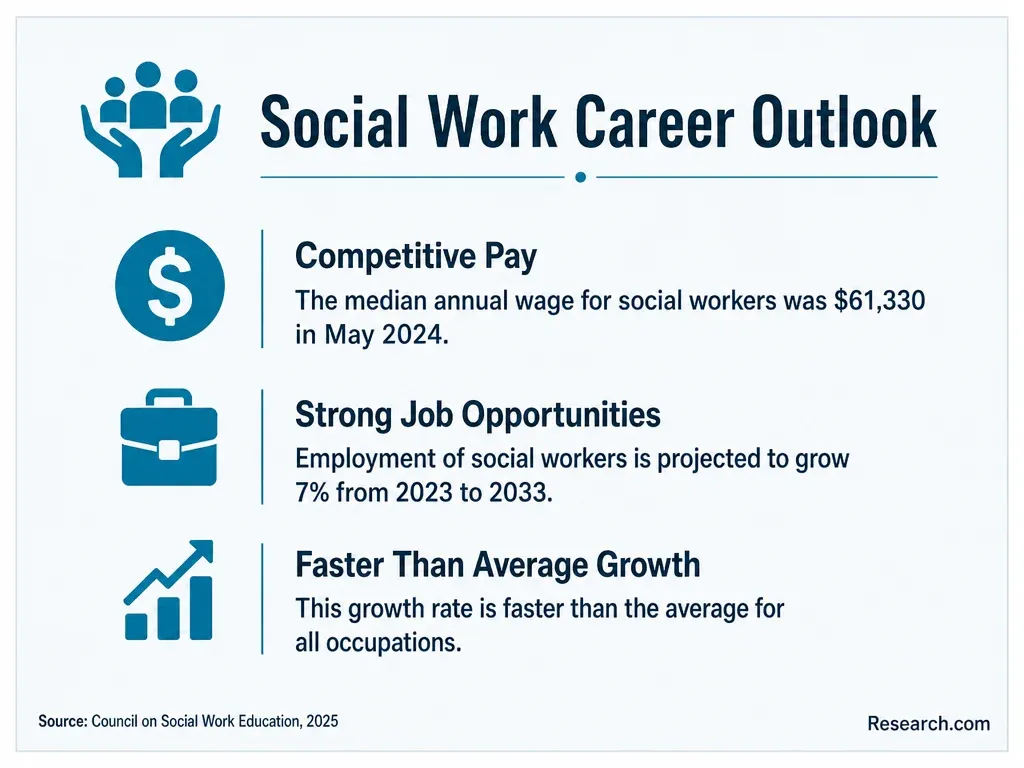
- Compare the offer with relevant labor-market data, not a promised "social worker" salary: the U.S. Bureau of Labor Statistics reports a May 2025 median of $61,780 for social workers across specialties.
What does a developmental disabilities social worker do?
The role supports people with intellectual or developmental disabilities and, often, their families across service systems. Depending on the employer, work may include person-centered planning, benefits and housing referrals, coordination with schools or healthcare teams, support during transitions, advocacy, and documentation. Some positions also involve clinical assessment or treatment; others are primarily case management and may be open to professionals without a social work degree.
Ask: "What will I do in a typical week, and which decisions can I make independently?" Request examples of the people served, the age groups, the service settings, and the proportion of time spent in direct contact versus records and authorization systems. Clarify who handles urgent concerns and who makes eligibility, treatment, or safeguarding decisions. An MSW concentration does not, by itself, authorize psychotherapy; if treatment is part of the job, compare its requirements with clinical practice preparation through an MSW and your state's licensing rules.
What salary and benefits should developmental disabilities social workers expect?
There is no single national wage category for this job title. Pay depends on whether the position is classified as social work, healthcare, behavioral health, or another human services occupation, as well as its location, employer, and credential requirements. The following Bureau of Labor Statistics figures provide context, not a salary quote for a disability-services opening.
| U.S. social work occupation | May 2025 median annual pay | Projected employment growth, 2025-2035 |
| Social workers, all specialties | $61,780 | 6% |
| Healthcare social workers | $67,880 | 8% |
| Mental health and substance abuse social workers | $60,280 | 10% |
Use the category that best matches the duties, then ask the employer for its pay range and classification. Compare the full offer: health coverage and employee premiums, retirement contributions, paid leave, mileage reimbursement, overtime eligibility, on-call pay, continuing education, and license or supervision expenses. For a public-sector job, ask about the pay grade and steps; for a nonprofit, ask how raises are funded. If the position requires further education, weigh its actual cost against the pay difference rather than assuming an MSW will produce a raise. A guide to affordable online MSW study can help frame that calculation, but the employer's requirements should come first.
What degrees and state licenses does the position require?
Ask the hiring manager to separate minimum hiring requirements, preferred qualifications, and duties reserved for licensed staff. A service-coordination position may accept a BSW, an MSW, or another relevant degree under its employer's rules. A position involving clinical diagnosis or psychotherapy may require an appropriate state license, supervision, and limits on practice. State license names and requirements differ; a degree or passed examination is not the same as an active license.
Request the written job classification and ask whether your current degree, license status, and experience qualify you for every assigned duty. If the employer promises that you can gain a license later, establish what you may do before it is issued and who will supervise you. For a degree decision, comparing graduate social work programs for licensure planning is a starting point; the applicable state board determines eligibility. A career changer should not enroll in another degree until the employer confirms it is required for the target role.
A caseload number is meaningful only alongside the work each case requires. Ask for the current average and expected maximum, how many people are newly assigned each month, and whether staff inherit overdue plans or vacant positions. Also ask how the employer adjusts assignments for complex needs, interpretation, extensive travel, and crisis follow-up.
Find out who completes benefits paperwork, schedules appointments, maintains records, and covers cases during leave. Ask to see the expected documentation deadlines and how productivity is measured. A manageable role should leave room for direct contact, consultation, and timely follow-through - not merely enough time to close records. If the answers suggest that coordination and leadership work are concentrated in different positions, a guide to professional pathways after an MSW can help you compare the roles before accepting a caseload that does not fit your goals.
Ask where visits occur - homes, schools, workplaces, healthcare facilities, or the office - and how often you will travel beyond the advertised service area. Confirm whether a personal vehicle is necessary, what mileage and parking are reimbursed, and whether travel and documentation time count within the workday. If evenings, weekends, or on-call shifts are required, obtain the rotation, response expectations, and compensation terms in writing.
These details matter especially if you are combining work with caregiving or study. Ask how much control staff have over appointments and what happens when a visit runs late. If you are considering an online social work master's program by duration, check its live classes and field-placement schedule against the actual job timetable; online coursework does not make field education or an on-call rotation flexible.
Ask who will supervise you, how frequently you will meet, and who is available for consultation between meetings. A strong orientation should cover the employer's service system, person-centered planning, accessible communication, documentation, confidentiality, and procedures for concerns about abuse or neglect. Ask whether training includes working with people who use augmentative communication, have co-occurring behavioral health needs, or rely on multiple agencies.
Clarify whether supervision is ordinary workplace support or is intended to meet a state board's requirements for post-degree clinical experience; do not assume it qualifies. Similarly, BSW or MSW field instruction is an educational arrangement approved by a school, not a substitute for employee onboarding. Advanced standing and traditional field education differences can help students distinguish their academic placement obligations from what a prospective employer promises on the job.
Ask how people participate in setting their own goals, choosing services, communicating preferences, and challenging decisions. Look for concrete practices: plain-language or alternative-format materials, qualified interpreters when needed, accessible meeting options, and time to communicate without rushing. Ask how staff work with families and legally authorized decision-makers while respecting the person's rights and preferences under applicable law.
A useful test is how the organization handles disagreement: Does it document the person's wishes and explain available choices, or default to what is easiest for the service system? Ask whether people with disabilities help evaluate services. If you are still selecting a BSW program, use undergraduate social work program quality comparisons to investigate field learning and accessible, person-centered practice - not just a program's delivery format.
What career advancement opportunities and job prospects exist in disability services?
Ask what staff in this position have actually moved into: senior service coordination, supervision, clinical roles, program management, quality improvement, or policy and advocacy work. Find out which moves require an MSW, a particular state license, management experience, or specialized training. Request examples of internal openings and the employer's support for developing those qualifications; a stated "growth opportunity" is less useful than a defined pathway.
The BLS projects growth across several social work occupations, but those broad projections do not predict vacancies at one disability-services agency or guarantee promotion. A professional moving from education, healthcare support, or human services may already have valuable coordination and communication skills. Compare those skills with the posting before pursuing a new credential. If an MSW is genuinely needed and your bachelor's degree is in another field, online MSW programs with broader entry criteria may help you explore traditional entry routes; admission standards, field requirements, and eventual licensing eligibility still require separate checks.
Other Things You Should Know About Social Work
Yes. Ask for a conversation with someone doing the same job. Questions about a typical week, turnover, and the usefulness of supervision can reveal gaps between the posting and daily practice.
Ask whether it is permanent or grant-funded, when its funding is reviewed, and what happened to comparable positions after prior funding changes. No employer can guarantee future funding, but it should be able to explain the position's status.
Ask about employer-provided devices, approved communication systems, reimbursement, and records-retention rules before using one. Follow agency policy and applicable privacy requirements rather than assuming a personal phone is acceptable.
Get the start date, pay, work location, credential requirements, and any background-screening or other contingencies in writing. Ask when the offer becomes final before giving notice at your current job.
- Fact Sheet #22: Hours Worked Under the Fair Labor Standards Act (FLSA) | U.S. Department of Labor https://www.dol.gov/agencies/whd/fact-sheets/22-flsa-hours-worked
- Care Coordination | Agency for Healthcare Research and Quality https://www.ahrq.gov/ncepcr/care/coordination.html
- Supported Decision Making in Serious Mental Illness - PMC - NIH https://pmc.ncbi.nlm.nih.gov/articles/PMC6093283/
- Travel time as hours of work | U.S. Department of Commerce https://www.commerce.gov/hr/practitioners/compensation-policies/premium-pay/travel-time-as-hours-of-work
- Home & Community-Based Services 1915(c) | medicaid.gov https://www.medicaid.gov/medicaid/home-community-based-services/home-community-based-services-authorities/home-community-based-services-1915c
- Child Abuse Identification & Reporting Guidelines | ca.gov https://www.cde.ca.gov/ls/ss/ap/childabusereportingguide.asp
- The Link Center | acl.gov http://acl.gov/programs/the-link-center
- Trauma-Informed Approaches and Programs | samhsa.gov https://www.samhsa.gov/mental-health/trauma-violence/trauma-informed-approaches-programs
- Mandatory Reporting Laws - StatPearls - NCBI Bookshelf - NIH https://www.ncbi.nlm.nih.gov/books/NBK560690/
- eCFR:: 42 CFR Part 441 Subpart G -- Home and Community-Based Services: Waiver Requirements https://www.ecfr.gov/current/title-42/chapter-IV/subchapter-C/part-441/subpart-G