2027 Problem-Solving Therapy in Social Work: Training and Practice Contexts
Audited and Verified:
Our Editorial and Data Verification Process
Research.com uses government datasets, official education statistics and primary institutional information to support its career and degree guides. Our review process checks factual accuracy, occupational definitions, source dates and the requirements associated with the credentials discussed.
How This Article Was Fact-Checked
Our editorial team verifies salary estimates, employment projections, education requirements and program information against original data providers and official organizations. Salary figures are checked against the relevant occupational definitions and reporting periods. Information about licensure, accreditation and required in-person training is reviewed separately.
Fact-checked and verified on:

Co-Founder and Chief Data Scientist
Problem-solving therapy can help clients turn an overwhelming concern into a manageable goal and a plan they can test. For social work students and early-career practitioners, the important distinction is between learning this method and being authorized to provide psychotherapy. This guide explains the intervention, where it fits, how to build competence through coursework and supervision, and what to check before paying for training or choosing a clinical MSW program.
Key Things You Should Know
- Problem-solving therapy is a structured, collaborative intervention; learning its steps does not by itself authorize psychotherapy.
- Choose training that includes observed skills practice and feedback, not just a completion certificate. Field education and post-degree clinical supervision serve different purposes.
- There is no single required national problem-solving therapy certification. Verify your state's scope-of-practice rules and any employer or payer requirements before enrolling.
What is problem-solving therapy in social work?
Problem-solving therapy, often abbreviated PST, is a structured intervention that helps a person identify a specific problem, generate possible responses, choose a feasible option, try it, and review the result. It also addresses the person's confidence and approach to problems. The social worker collaborates rather than prescribing a solution.
PST fits social work's person-in-environment perspective when practitioners examine constraints as well as individual choices. A client facing a housing problem, for example, may need help identifying a next step, but therapy cannot create an affordable apartment or replace benefits advocacy. Effective practice distinguishes problems the client can influence from barriers that call for referrals, coordination, or systemic action.
PST overlaps with cognitive-behavioral approaches but is a specific intervention, not a synonym for every form of CBT. It also differs from general case management: arranging a service can be part of a plan, while clinical PST includes a deliberate therapeutic process and review of how the client approaches problems.
A BSW can provide a foundation in collaborative generalist practice; readers considering that route can examine online undergraduate social work degree choices without assuming a BSW alone confers clinical authority.
What education and licensing are needed to practice problem-solving therapy?
The answer depends on what you will do, where you will do it, and your state's rules. A social services worker may use collaborative problem-solving within an authorized case-management role. Providing PST as psychotherapy, diagnosing a condition, or billing for clinical treatment may require an appropriate social work license, supervision, and employer or payer approval. A course certificate cannot expand a legal scope of practice.
For a clinical social work career, the usual educational starting point is a qualifying MSW with relevant clinical coursework and field learning. States determine license categories, examinations where required, supervised-experience rules, and when independent practice is permitted.
MSW graduation, license eligibility, license issuance, and independent clinical authority are separate milestones. Before selecting a program, use its published details for comparing graduate social work programs for licensure planning, then confirm eligibility with the board in the state where you intend to practice.
How can social workers train in problem-solving therapy and earn certification?
Training options include clinical coursework, agency instruction, continuing education, workshops, and supervised practice using a PST manual or protocol. Look beyond the label: useful training teaches assessment and treatment fit, demonstrates the intervention, lets learners rehearse it, and provides specific feedback on recorded role-plays or observed work where permitted.
There is no universal national PST certification required of social workers. A provider's "certificate" may document attendance, assessed competence, or continuing education; those are different claims. Before paying, ask who issues it, what performance is assessed, whether continuing education credit is accepted by your licensing board, and whether your employer recognizes it.
If you need an initial degree rather than a short course, exploring online social work qualifications is a separate decision from choosing PST training.
Protocols vary, but PST generally follows the sequence below. In clinical work, the practitioner adapts its pace to assessment findings, client preferences, accessibility needs, and supervision rather than treating the steps as a script.
- Establish fit and a working agreement: Clarify the client's priorities, role expectations, and whether another response is needed first.
- Define one manageable problem: Describe what is happening in specific terms without reducing a structural barrier to a personal failing.
- Set a realistic goal: Agree on an observable change the client considers worthwhile.
- Generate options: Brainstorm possibilities before judging them, including supports and referrals.
- Choose a plan: Weigh feasibility, risks, resources, and the client's preference; identify a small next step.
- Try the plan: Specify what will happen and when, with support appropriate to the practitioner's role.
- Review and adjust: Discuss what happened, what got in the way, and whether to revise the plan or redefine the problem.
A student might rehearse this sequence in a simulation, then receive field-instructor feedback before using it with clients. Academic field instruction is not automatically equivalent to the post-degree experience required for clinical licensure; comparing field education and post-degree experience requirements can help clarify that distinction.
Social workers may encounter PST in behavioral health, primary care, aging services, and other settings where a structured, goal-focused clinical intervention fits a client's needs and the worker's authorized role. It has been studied for concerns including depression, but evidence for a population or condition does not mean it is appropriate for every client. Language access, cognitive demands, trauma history, immediate safety needs, and the client's own priorities all affect fit.
Setting alone does not determine scope. A hospital social worker might provide authorized clinical treatment in one position and primarily coordinate discharge resources in another. Ask prospective employers who conducts clinical assessments, who provides therapy, what supervision is available, and how clients are referred when PST is not suitable.
If those duties are your goal, planning graduate study for clinical social work should include the placement opportunities and state licensing pathway, not just a program's concentration name.
There is no standard PST training length or price. A brief introductory course may teach the framework, while a program with practice, observation, and feedback takes a larger time commitment. Degree study and any state-required post-degree supervision are separate, substantially longer commitments. A short course can sharpen an existing practitioner's skills; it cannot substitute for an MSW or a required clinical license.
Compare options by total cost and usable learning: course fees, paid work time lost, travel, required live sessions, supervision access, and any continuing education benefit. If you need an MSW, include tuition, fees, placement-related expenses, and possible reductions in earnings during field education. Cost-focused online MSW program choices are a starting point, but a low advertised tuition figure is not the full cost of becoming practice-ready.
What are the salary and job outlook for social workers using problem-solving therapy?
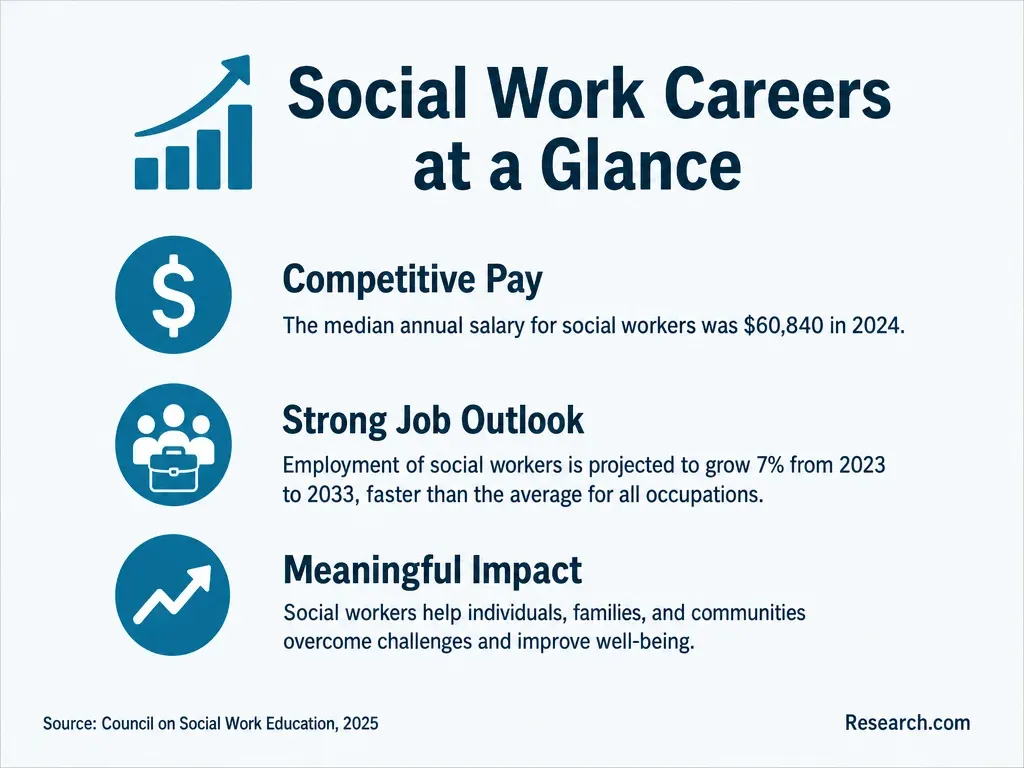
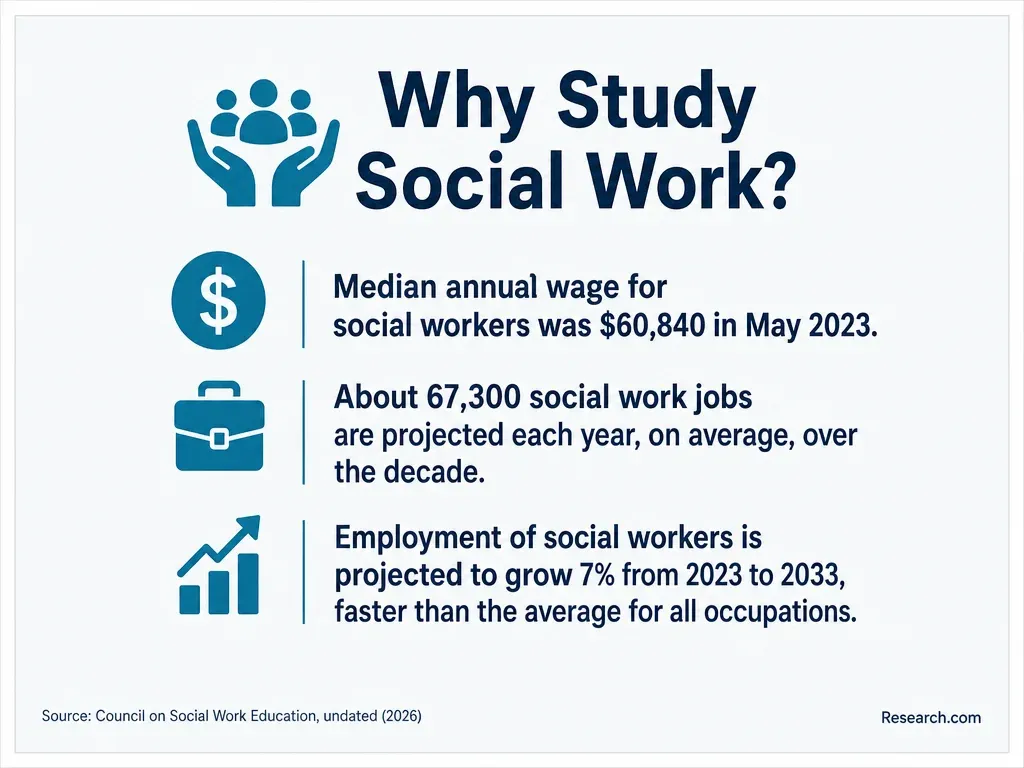
Employers do not generally report a separate wage for "PST social workers." The closest useful comparison depends on the actual job. The U.S. Bureau of Labor Statistics reports the following May 2025 median annual wages and projected employment changes for 2025-2035:
| Occupation | Median annual wage | Projected employment change |
| Mental health and substance abuse social workers | $60,280 | +10% |
| Healthcare social workers | $67,880 | +8% |
| Social workers, all specialties | $61,780 | +6% |
These are occupation-wide figures, not PST premiums or promised salaries for MSW graduates. A prospective role's license requirements, duties, employer, and location are more useful for estimating personal earnings. Use a guide to comparing social worker pay by location alongside actual local job postings before deciding whether additional degree study makes financial sense.
Other Things You Should Know About Social Work
Pause the planned exercise and follow your role, supervision arrangements, agency procedures, and applicable law. A problem-solving worksheet is not a substitute for an appropriate safety response.
No single format fits everyone. A practitioner may use a verbal plan, accessible reminder, or another agreed method, provided it supports the client's participation and the treatment approach.
Do not frame a structural barrier as a failure of motivation. Explore what support, advocacy, referral, or service coordination is available, while being honest about what an individual plan cannot change.
They can serve different purposes: motivational interviewing may help explore ambivalence, while PST structures the work of testing a chosen solution. Combine methods only within your competence, authorized role, and treatment plan.
- The Efficacy of Cognitive Behavioral Therapy - PMC - NIH https://pmc.ncbi.nlm.nih.gov/articles/PMC3584580/
- Evidence-Based Practices Resource Center | samhsa.gov https://www.samhsa.gov/libraries/evidence-based-practices-resource-center
- Problem-Solving Therapy (Chapter 5) - Psychotherapy in Later Life | Cambridge Core https://www.cambridge.org/core/books/psychotherapy-in-later-life/problemsolving-therapy/2FC2C0B4014A4012E1CBFFAFAE6E2C39
- Problem Solving Treatment (PST) Training - AIMS Center https://aims.uw.edu/interventions/problem-solving-treatment/
- Therapeutic work with clients living in poverty | sagepub.com https://journals.sagepub.com/doi/10.1177/00207640221139798
- Better relationships with patients lead to better outcomes | apa.org https://www.apa.org/monitor/2019/11/ce-corner-relationships
- 12.3 Ethical Issues in Multicultural Counseling | Guidelines for Online Teaching and Design https://open.lib.umn.edu/ethicalpractice/chapter/12-3-ethical-issues-in-multicultural-counseling/
- Understanding the 9 Core Competencies of Social Work | Tulane School of Social Work https://tssw.tulane.edu/news/understanding-9-core-competencies-social-work
- The Nine CSWE Social Work Competencies | texascollege.edu https://www.texascollege.edu/the-nine-cswe-social-work-competencies
- Problem-Solving Therapy: Definition, Techniques, and Efficacy | verywellmind.com https://www.verywellmind.com/an-overview-of-problem-solving-therapy-4767991