2027 Primary Care Social Worker: Responsibilities, Education, and Career Fit
Audited and Verified:
Our Editorial and Data Verification Process
Research.com uses government datasets, official education statistics and primary institutional information to support its career and degree guides. Our review process checks factual accuracy, occupational definitions, source dates and the requirements associated with the credentials discussed.
How This Article Was Fact-Checked
Our editorial team verifies salary estimates, employment projections, education requirements and program information against original data providers and official organizations. Salary figures are checked against the relevant occupational definitions and reporting periods. Information about licensure, accreditation and required in-person training is reviewed separately.
Fact-checked and verified on:

Co-Founder and Chief Data Scientist
Primary care clinics increasingly address needs that cannot be resolved in an exam room alone, from difficulty obtaining food or housing to behavioral health concerns. Social workers help patients and care teams navigate those needs, but the job can look different across clinics.
This guide is for prospective students, career changers, and early-career social workers deciding whether primary care is a good fit. It explains the work, the qualifications employers may seek, and the practical questions to ask before choosing a program or accepting a position.
Key Things You Should Know
- Primary care social workers assess social and behavioral needs, coordinate services, and follow up with patients; psychotherapy is part of some positions, not all of them.
- A BSW may qualify you for some care-coordination jobs, while clinical integrated-care positions commonly seek an MSW and an appropriate state license. Neither degree alone grants independent clinical authority.
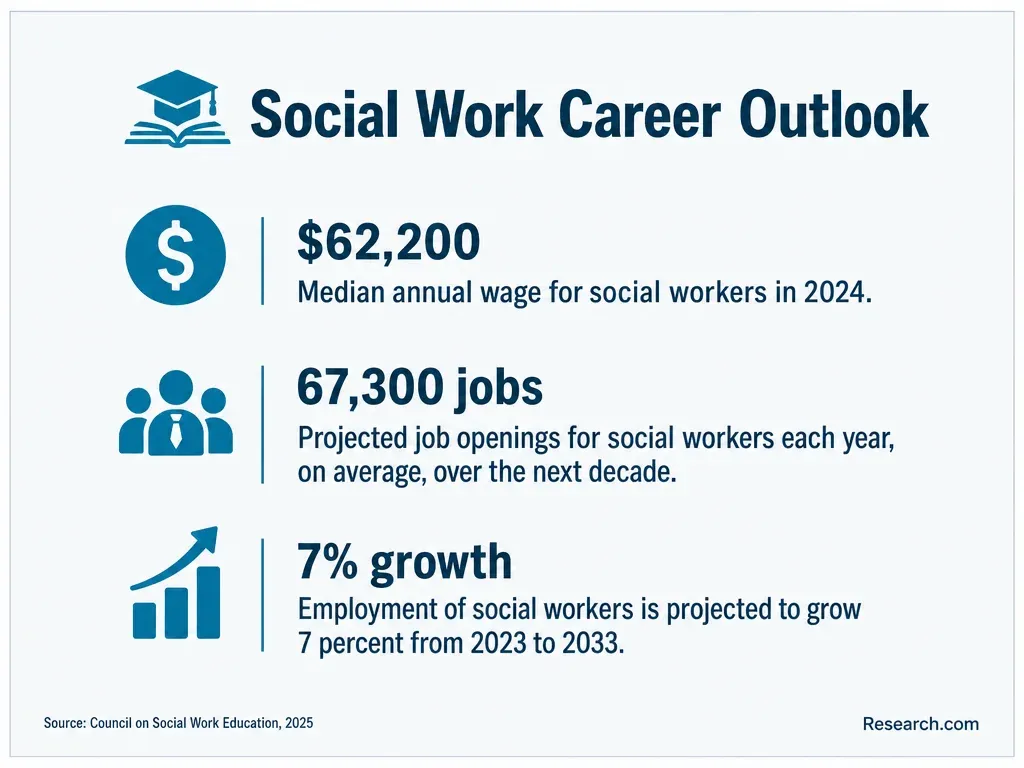
- The U.S. Bureau of Labor Statistics reports a May 2025 median wage of $67,880 for healthcare social workers and projects 8% employment growth from 2025 to 2035; neither figure is specific to primary care clinics.
What does a primary care social worker do?
A primary care social worker works alongside medical staff in settings such as family medicine practices and community health centers. The role addresses factors affecting a patient's ability to receive care and manage health, while keeping the patient's goals and choices central.
A typical day may involve assessing barriers to appointments or medication access, helping a patient navigate benefits and community services, coordinating with a behavioral health provider, documenting a care plan, and following up to see whether a referral was useful. Some positions also include brief behavioral health assessment or intervention. Others focus chiefly on resource navigation and care management. Clinic staffing, patient needs, funding, and the worker's license determine the boundaries.
Unlike a hospital discharge role, primary care often allows repeated contact over time. That continuity can make follow-up meaningful, but it can also expose gaps in local services that the social worker cannot fix alone. Readers comparing this position with other social work master's career options should look closely at how much of the advertised job is clinical care versus service coordination.
What degree do you need to become a primary care social worker?
The job description, not the job title alone, determines the educational requirement. Some clinics hire BSW graduates for generalist social work or care-coordination positions. An MSW is more commonly expected when the position includes advanced behavioral health practice or requires a clinical-license pathway. Some navigation jobs also accept human services or related degrees; they are not necessarily licensed social work positions.
The following comparison shows which route is worth considering for your target duties. It does not replace an employer's requirements or a state board's education rules.
| Route | Best match in primary care | Important limit |
| BSW | Generalist support, resource navigation, and some care-coordination roles | Does not substitute for an MSW where advanced clinical preparation is required |
| Traditional MSW | Advanced practice preparation for graduates whose bachelor's degree is not a qualifying BSW | Graduation does not itself authorize independent psychotherapy |
| Advanced-standing MSW | A shorter MSW route for applicants with a qualifying social work bachelor's degree who meet program rules | Relevant work or a different bachelor's major does not automatically confer eligibility |
| DSW or PhD | Possible later routes toward practice leadership or research | Neither is an entry requirement for primary care social work |
If your goal is direct clinic work, avoid paying for more education than the position requires. A doctorate is usually a separate career decision; affordable advanced social work degree options matter only if you later decide doctoral training serves a specific leadership or research goal.
What licenses or certifications do primary care social workers need?
Requirements vary by state and by duties. A clinic may require a state social work license for a position titled "social worker," a particular license level for clinical services, or no social work license for a separately titled resource-navigation position. A voluntary specialty certification is not a universal entry requirement.
For a clinical role, distinguish four steps: completing qualifying education, meeting any initial-license requirements, accumulating board-accepted post-degree supervised experience where required, and receiving the license that permits the intended scope of practice. MSW field education does not automatically count as post-degree clinical supervision. If you plan to pursue independent clinical practice, use a social work supervised hour documentation guide to frame questions for your state board and prospective supervisor before accepting a job.
Ask the employer which license must be active on your start date, which duties require it, and whether qualified supervision is available. Confirm permitted activities and application requirements with the licensing board in the state where you will practice.
Start by checking the Council on Social Work Education's current accreditation information for the specific BSW or MSW program and your anticipated enrollment period. Institutional accreditation and a school's general reputation do not establish that its social work program meets a particular state board's education requirement.
For a primary care goal, compare programs on healthcare-related coursework, partnerships with outpatient or community health agencies, access to qualified field instruction, and evidence that students can obtain suitable placements in their area. Ask the field office who identifies sites and what happens if a desired clinic cannot take a student. Review published field schedules as carefully as tuition: a convenient class timetable will not help if placements conflict with work or caregiving.
If you need undergraduate preparation, online bachelor of social work program options can provide a starting point for comparison, but verify each program's status, field arrangements, and eligibility in your state directly before applying.
BSW applicants generally need to meet university requirements and, where applicable, separate admission requirements for the social work major. MSW applicants typically submit academic records and application materials such as a statement and references, but prerequisites, grade standards, and experience expectations differ by program.
A non-BSW graduate can apply to traditional or foundation MSW routes if they meet the program's criteria. Advanced-standing admission is different: it generally depends on a qualifying social work bachelor's degree and additional program-specific rules. Experience in healthcare can strengthen an application without replacing that educational qualification.
If your academic record needs explanation, exploring less competitive MSW admission pathways may help you identify schools to investigate. Still verify the program's accreditation, admissions standards, field capacity, and outcomes rather than treating admission ease as the main measure of fit.
What skills and work environments make primary care social work a good fit?
This work suits people who can build trust quickly, listen without assuming every problem has an immediately available service, and coordinate across professional boundaries. Experience in case management, community outreach, healthcare administration, or behavioral health support may transfer well, but new social workers still need supervised practice in assessment, documentation, ethics, and clinic workflows.
Compare prospective workplaces on caseload, appointment length, access to interpreters, referral partnerships, supervision, safety procedures, and expectations for after-hours contact. Ask how the clinic distinguishes resource navigation from clinical treatment and how staff handle referrals when community services are full. Those answers tell you more about day-to-day fit than the job title does.
If you want to provide psychotherapy, check whether the position and your license pathway actually support that goal; clinical social work coursework and field training can prepare you, but do not replace required post-degree supervision. If you prefer sustained coordination and advocacy without conducting therapy, a nonclinical primary care position—or an adjacent care-navigation role—may be the more direct fit.
Other Things You Should Know About Social Work
No. Prescribing belongs to appropriately authorized medical professionals. A social worker may help a patient discuss medication concerns with the care team or address barriers to obtaining a prescription.
It depends on the service, payer, clinician's license, and clinic billing arrangements. Ask the employer which services are billable and who is authorized to provide and document them.
Follow the clinic's language-access procedures and use a qualified interpreter when required. Do not assume a family member or an untrained bilingual staff member is an appropriate substitute.
Do not assume so. Practice authorization can depend on where the patient is located, the service provided, and applicable state rules. Confirm requirements with the relevant boards and your employer before providing cross-state care.
- Health Outcomes and Costs of Social Work Services: A Systematic Review | nih.gov https://pmc.ncbi.nlm.nih.gov/articles/PMC5731071/
- Accountable Care and Accountable Care Organizations | cms.gov https://www.cms.gov/priorities-innovation-key-concepts-accountable-care-accountable-care-organizations
- Integrated people-centred care - GLOBAL https://www.who.int/health-topics/integrated-people-centered-care
- Six Domains of Healthcare Quality | Agency for Healthcare Research and Quality https://www.ahrq.gov/talkingquality/measures/six-domains.html
- How to Become a Social Worker: Education and Degrees | ASU Online https://asuonline.asu.edu/newsroom/online-learning-tips/how-to-become-social-worker/
- Medical Social Worker - Explore Healthcare Careers | Mayo Clinic College of Medicine and Science https://college.mayo.edu/academics/explore-health-care-careers/careers-a-z/medical-social-worker/
- Social Work Role | Center for Health Interprofessional Practice and Education https://healthipe.utexas.edu/social-work-role
- Behavioral Health Integration Fact Sheet | apa.org https://www.apa.org/health/behavioral-integration-fact-sheet
- NASW Standards for Social Work Practice in Health Care Settings | socialworkers.org https://www.socialworkers.org/Practice/NASW-Practice-Standards-Guidelines/NASW-Standards-for-Social-Work-Practice-in-Health-Care-Settings