2027 Post-MSW Clinical Supervision in Arizona: Supervisor Approval, Records, and Work Settings
Audited and Verified:
Our Editorial and Data Verification Process
Research.com uses government datasets, official education statistics and primary institutional information to support its career and degree guides. Our review process checks factual accuracy, occupational definitions, source dates and the requirements associated with the credentials discussed.
How This Article Was Fact-Checked
Our editorial team verifies salary estimates, employment projections, education requirements and program information against original data providers and official organizations. Salary figures are checked against the relevant occupational definitions and reporting periods. Information about licensure, accreditation and required in-person training is reviewed separately.
Fact-checked and verified on:

Co-Founder and Chief Data Scientist
An Arizona MSW graduate can work toward clinical licensure only if the experience, supervisor, and records meet state requirements - not simply because a job provides therapy experience. This guide is for new graduates and LMSWs choosing a position or arranging supervision.
It explains the hour thresholds, how to assess a supervisor and work setting, what to document, and how to prepare for the LCSW application. Use it to identify problems before months of work become difficult to verify.
Key Things You Should Know
- Arizona's LCSW pathway generally requires 3,200 hours of post-degree supervised clinical work over at least 24 months, including 1,600 hours of direct client contact and 100 hours of clinical supervision; verify the rules applicable to your application with the Arizona Board of Behavioral Health Examiners.
- At least 50 of the 100 clinical supervision hours must be individual supervision. A qualified supervisor and a clinical job title are not enough on their own: the work, supervision arrangement, and records must also qualify.
- Keep contemporaneous records of work, direct client contact, and supervision, and obtain each supervisor's required verification before changing jobs or losing contact with them.
What are Arizona's post-MSW clinical supervision requirements for LCSW licensure?
Arizona's supervised-experience pathway to Licensed Clinical Social Worker (LCSW) licensure generally calls for 3,200 hours of supervised clinical work completed over at least 24 months. Within that experience, candidates generally need 1,600 hours of direct client contact and 100 hours of clinical supervision, including at least 50 hours of individual supervision. These are separate measures: 3,200 hours of employment do not establish that 1,600 hours involved direct clinical contact.
Post-degree experience is different from MSW field education. An accelerated MSW, clinical concentration, or extensive graduate placement does not automatically reduce Arizona's post-MSW requirement. Likewise, finishing the hours does not itself issue an LCSW; the board must determine that the applicant meets its requirements. Arizona candidates comparing other jurisdictions should not import another state's definition of qualifying hours; comparing social work clinical experience expectations can provide context, but Arizona's board controls an Arizona application.
Who can supervise an LCSW candidate in Arizona, and how is eligibility verified?
A clinical supervisor must meet Arizona's applicable qualifications; being a manager, experienced clinician, or holder of an advanced degree is not sufficient by itself. Before beginning, confirm the person's license category, active status, disciplinary restrictions, and eligibility to supervise the clinical experience you intend to claim. Ask how the supervisor will review your actual clinical practice - not just sign an hours form at the end.
Use the Arizona Board of Behavioral Health Examiners' license lookup, current supervision rules, and application instructions to verify eligibility. Get the supervisor's full name and license number, clarify who will provide individual and any group supervision, and ask the board about an unusual license type or out-of-state supervisor before relying on the hours. An academic credential cannot replace a qualifying professional license: even a doctorate and its associated DSW tuition and fee considerations are separate from Arizona's supervisor-qualification decision.
How do Arizona LCSW candidates document and submit supervised hours?
Record experience as it happens, then use the board's current forms and instructions when applying. The purpose of a personal log is to make the supervisor's eventual verification accurate - not to substitute for a required board form. A practical record identifies each employer and supervisor, dates and hours worked, direct client-contact hours, supervision dates and duration, supervision format, and any interruptions or supervisor changes.
Set a regular reconciliation date with your supervisor. Compare your log with agency scheduling and supervision records, resolve discrepancies promptly, and retain copies of completed verification documents. If you leave a position, request the required supervisor verification while the supervisor can still review the records. Protect client confidentiality: an hours log should describe categories of work without names, identifying details, or copies of clinical notes.
Do not submit MSW placement records as though they were post-degree employment records. School-supported field placement assistance in online MSW education concerns curricular training; Arizona's board separately evaluates post-degree clinical experience.
The deciding factor is qualifying supervised clinical social work, not the employer's name or the employee's title. Behavioral health agencies, hospitals, community clinics, and other organizations may offer appropriate experience when the duties include clinical services and qualified supervision. Assessment, diagnosis and treatment-related work, psychotherapy, and other direct clinical services may be relevant within the candidate's authorized scope and agency policies.
Before accepting a role, compare its expected weekly duties with both the 3,200-hour total and the 1,600-hour direct-contact requirement. A job dominated by administration, benefits navigation, outreach, or general case management may provide valuable social work experience without generating enough qualifying clinical contact.
Ask how the agency schedules clients, protects supervision time, and documents clinical duties. For someone still choosing a role, exploring professional opportunities after MSW study can help distinguish clinical positions from other worthwhile MSW careers that do not serve the same licensing goal.
Confirm that your MSW satisfies Arizona's education rules, including the applicable social work program-accreditation requirements. Institutional accreditation alone does not answer whether a social work degree meets the board's criteria. The Arizona Board of Behavioral Health Examiners - not the university - determines licensure eligibility.
Arizona's Licensed Master Social Worker (LMSW) is the usual license candidates obtain before practicing toward the LCSW under supervision. Check when the board permits experience to begin counting, which license status must be maintained, and what activities the LMSW may perform under supervision.
Neither graduation nor an LMSW grants independent clinical authority. Earlier BSW accreditation and program selection can affect MSW entry routes, but a BSW or prior field hours do not replace the qualifying MSW and post-degree clinical experience required for this pathway.
An outside supervisor may be an option when an employer cannot provide qualified clinical supervision, but the arrangement must still satisfy Arizona's supervisor and experience rules. The supervisor needs a meaningful way to evaluate the candidate's clinical work. An employment supervisor and a clinical supervisor may therefore have different responsibilities, which should be clear to both people and the candidate.
Before paying for outside supervision, agree in writing on access to appropriately de-identified clinical material, consultation with the employer when needed, confidentiality, scheduling, documentation, and what happens if either relationship ends. Ask the board to clarify any arrangement whose eligibility is uncertain. Graduates comparing accelerated graduate social work programs should budget for this possibility after graduation: a shorter academic route does not guarantee an employer will supply post-MSW clinical supervision.
Arizona's requirement that at least 50 of the 100 clinical supervision hours be individual means group supervision cannot make up the entire requirement. Whether a particular online or telephone meeting counts depends on the board's current supervision rules, including any conditions concerning format, interaction, and documentation. Do not assume that an agency's remote-meeting policy establishes board acceptance.
Agree in advance on how each session will be classified and recorded, and confirm the current board rule before relying on a remote format for required hours. Also follow employer requirements for private discussion of client information and secure technology. The delivery format of an MSW is a separate question; social work degree formats and learning expectations do not determine whether Arizona accepts a post-degree supervision meeting.
There is no single statewide price for post-MSW supervision. Some employers provide it as part of a job; an outside supervisor may charge per individual or group session. The cost decision turns on the number of paid sessions needed, whether missed meetings are charged, travel or technology expenses, and whether the employer reimburses fees. Request the complete fee agreement before committing, especially if you expect to remain in supervised practice for at least 24 months.
When comparing offers, the lower salary is not necessarily the more expensive choice if one employer supplies reliable supervision and another does not. Conversely, free supervision has limited value if the role cannot provide qualifying clinical duties or consistent meetings. Keep educational spending separate from this calculation: online MSW programs organized by cost help compare degree expenses, not the price or eligibility of post-degree supervision.
Use the Arizona Board of Behavioral Health Examiners' current LCSW application and instructions to establish the required education, license history, supervised experience, and other eligibility information. Arrange for each supervisor to complete the required verification accurately. The board - not an employer or exam-preparation provider - decides whether the application meets Arizona's standards and when the candidate is authorized to take any required examination.
Arizona's LCSW pathway includes the applicable Association of Social Work Boards (ASWB) Clinical examination. Follow the board's current authorization and exam-registration sequence rather than booking on the assumption that logged hours alone establish eligibility. Passing an exam is a distinct step from board approval and license issuance; continue practicing within your existing license and supervision requirements until the LCSW is issued.
Application and examination fees belong in a full career-transition budget. That is true even for graduates exploring the career value of affordable MSW study: a low-cost degree does not remove post-degree licensing expenses.
What jobs, salaries, and career prospects are available to Arizona LCSWs?
An Arizona LCSW may pursue clinical roles in behavioral health, healthcare, community agencies, and other settings, subject to the position's duties, payer rules, and employer requirements. The license can support greater clinical autonomy than an LMSW, but it does not guarantee a particular job, reimbursement arrangement, or authority to practice in another state.
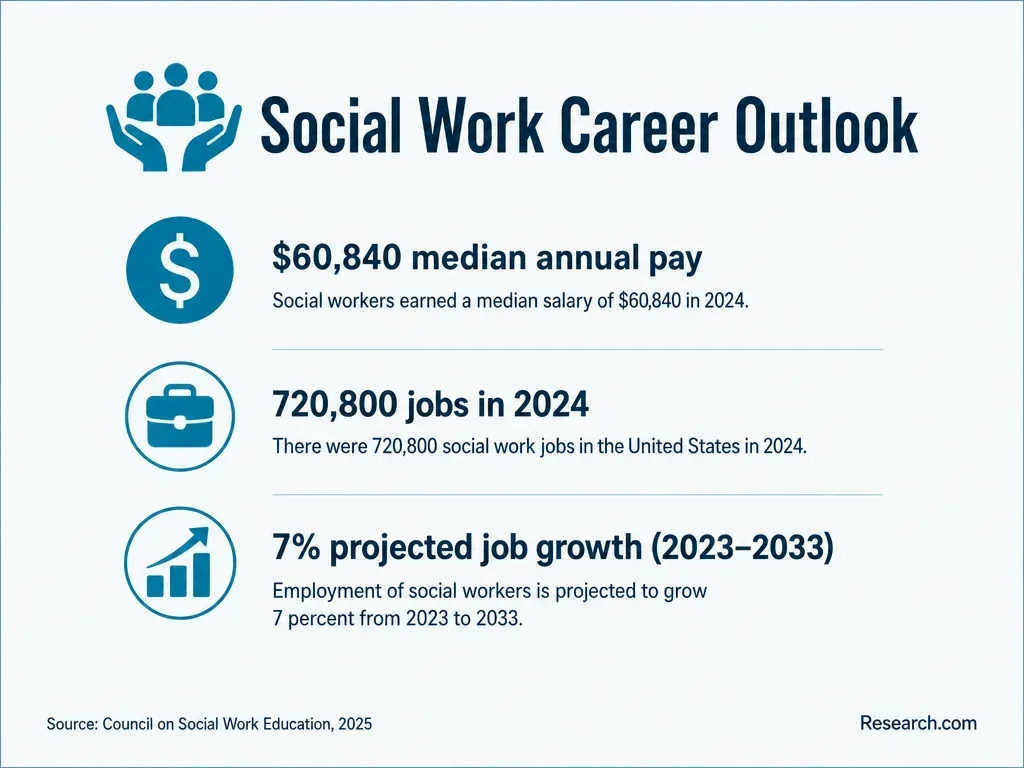
For national context, U.S. Bureau of Labor Statistics figures supplied for May 2025 put median annual pay at $60,280 for mental health and substance abuse social workers and $67,880 for healthcare social workers. Projected employment growth from 2025 to 2035 is 10% and 8%, respectively. These are occupation-wide U.S. measures - not Arizona LCSW salaries, starting offers, or guaranteed outcomes.
For a local job decision, compare actual Arizona postings by license requirement, caseload, supervision or consultation support, schedule, and compensation; planning an MSW career with regional salary context is a starting point, not a substitute for a written offer.
Other Things You Should Know About Social Work
No. The other state's licensing authority determines eligibility and practice privileges. Check its endorsement requirements before relocating or serving clients there remotely.
No. Use the license title you currently hold. An application, exam result, or completed experience does not confer the LCSW title before license issuance.
Not necessarily. Ask the employer and insurer how the arrangement is covered, including the outside supervisor's role, before clinical work begins.
Not solely for that purpose. The LCSW pathway turns on Arizona's qualifying social work education, licensing, examination, and supervised-experience requirements - not possession of a doctorate.
- View Document | azleg.gov https://www.azleg.gov/viewdocument/
- Registered Mental Health Counselor Intern | floridasmentalhealthprofessions.gov https://floridasmentalhealthprofessions.gov/registered-mental-health-counselor-intern/
- Information for Supervisors | az.gov https://bbhe.az.gov/clinical-supervision/information-supervisors
- NYS Social Work: Social Work Licensure & Practice FAQs | nysed.gov https://www.op.nysed.gov/professions/licensed-master-social-worker/faq-licensure-practice
- Rule 4757-17-01 | Counseling supervision. https://codes.ohio.gov/ohio-administrative-code/rule-4757-17-01
- Ariz. Admin. Code § R4-6-212.01 - Exemptions to the Clinical Supervision Requirements https://www.law.cornell.edu/regulations/arizona/Ariz-Admin-Code-SS-R4-6-212.01
- Arizona supervised hours for licensure - Miyndsett https://miyndsett.com/licensure/arizona/
- Arizona Social Work License: LBSW, LMSW & LCSW Requirements | Human Services Edu https://www.humanservicesedu.org/arizona-social-work-requirements/
- How to Serve as a Clinical Supervisor for LCSWs in Arizona | telementalhealthtraining.com https://www.telementalhealthtraining.com/supervision/how-to-become-an-approved-clinical-supervisor-for-lcsws-in-arizona
- How to Become a Social Worker in Arizona: License Guide (2026) | MSW Online https://mastersinsocialworkonline.org/licensure/arizona/