2027 Nonprofit vs Government Social Work Employment: Work Structures and Career Tradeoffs
Audited and Verified:
Our Editorial and Data Verification Process
Research.com uses government datasets, official education statistics and primary institutional information to support its career and degree guides. Our review process checks factual accuracy, occupational definitions, source dates and the requirements associated with the credentials discussed.
How This Article Was Fact-Checked
Our editorial team verifies salary estimates, employment projections, education requirements and program information against original data providers and official organizations. Salary figures are checked against the relevant occupational definitions and reporting periods. Information about licensure, accreditation and required in-person training is reviewed separately.
Fact-checked and verified on:

Co-Founder and Chief Data Scientist
A nonprofit and a government agency may serve the same families but offer very different jobs. For students, new graduates, and social services professionals weighing offers, the employer's funding, authority, staffing, and supervision can matter as much as the job title. This comparison explains where the work overlaps, where pay and daily conditions may diverge, and which questions reveal the better fit for your goals.
It also shows when a social work degree or license is essential - and when your existing qualifications may be enough.
Key Things You Should Know
- Government roles often operate within civil-service classifications and statutory procedures; nonprofits may have more program-design flexibility but must answer to grants, contracts, and donors. Neither structure guarantees a manageable caseload.
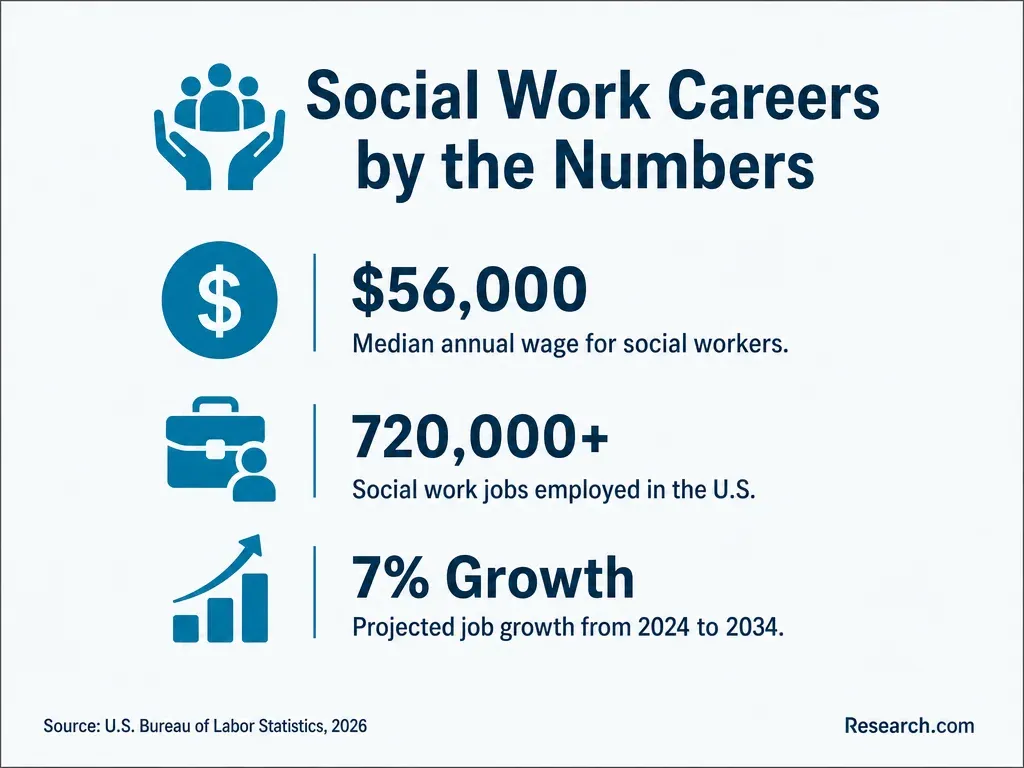
- The U.S. Bureau of Labor Statistics reports a $61,780 median annual wage for social workers across specialties in May 2025 and projects 6% employment growth from 2025 to 2035. Those figures do not establish what either sector will pay you.
- Compare written offers for salary, benefits, supervision, caseload, funding security, and required credentials. A BSW, MSW, or license is necessary for some positions but not every social-services job.
How do nonprofit and government social work jobs differ?
Government social work typically involves delivering or administering services under public law, budgets, and agency policy. Nonprofit social work takes place in independent organizations pursuing a service mission, often with a mix of public contracts, grants, donations, and earned revenue. The distinction describes the employer - not necessarily the client population or whether a position requires licensure.
The comparison below shows how organizational structure can shape the same kind of service role. Individual agencies may differ substantially.
| Work feature | Government employer | Nonprofit employer |
| Accountability | Statutes, public budgets, agency rules, and oversight | Board governance, mission, contracts, funder conditions, and applicable law |
| Hiring and pay | May use civil-service classifications, pay grades, and formal eligibility screens | May negotiate within a smaller budget or grant-funded position |
| Program changes | May require policy approval or procurement | May pilot changes faster, subject to funding and contracts |
| Service boundaries | May determine eligibility or carry out a statutory function | May provide outreach, advocacy, treatment, or contracted services without controlling public eligibility |
For example, a public child welfare worker may have duties tied to state authority, while a nonprofit family-support worker may focus on voluntary services and referrals. Read the actual posting rather than inferring authority from "social worker" in the title. For a broader view of MSW careers across different practice settings, compare duties before comparing employers.
How do social worker salaries and benefits compare across nonprofit and government employers?
Government positions may offer published pay steps, pensions, or collectively bargained benefits; nonprofits may offer different health plans, retirement contributions, or scheduling arrangements. None of these is universal. A nonprofit's higher starting salary can be worth less than a public offer with stronger insurance and paid leave - or more, depending on eligibility and vesting.
BLS reports the following May 2025 occupation-wide median annual wages. These are useful benchmarks for identifying the appropriate specialty, not nonprofit-versus-government pay rates or predictions for a new graduate.
| BLS social work occupation | Median annual wage |
| Child, family, and school social workers | $59,550 |
| Healthcare social workers | $67,880 |
| Mental health and substance abuse social workers | $60,280 |
Compare offers using annual base pay at the stated hours, likely overtime or on-call pay, insurance premiums and deductibles, retirement contributions and vesting, leave, commuting costs, and any license or continuing-education support.
Location also changes the comparison; social work salary differences across states provide context, but a local pay schedule and written offer are more decisive. Government and qualifying nonprofit employment can both potentially count toward Public Service Loan Forgiveness if the borrower, loans, and payments meet program rules; do not treat forgiveness as an automatic benefit.
How do caseloads, schedules, and autonomy differ between nonprofit and government social work jobs?
A public agency may have standardized assignment rules, mandated documentation, after-hours coverage, and limited discretion over eligibility decisions. A nonprofit may allow more room to tailor outreach or groups, yet require staff to meet contract targets or cover vacancies. Either workplace can involve crisis work, travel, safety risks, and secondary trauma.
Caseload numbers alone are a poor workload measure. Twenty complex investigations with court deadlines may demand more than a larger caseload of stable follow-up contacts. Ask how active cases are weighted, how quickly new staff reach a full caseload, who covers absences, which records must be completed after visits, and whether travel or on-call time is compensated. Request the actual schedule, including evenings and weekends, rather than relying on "flexible" in a posting.
If an employer advertises clinical supervision, ask who provides it, whether it occurs during paid time, and whether the arrangement meets your state board's rules. Employment, academic field education, and post-degree clinical supervision are different experiences; understanding which social work hours may count can prevent an expensive assumption.
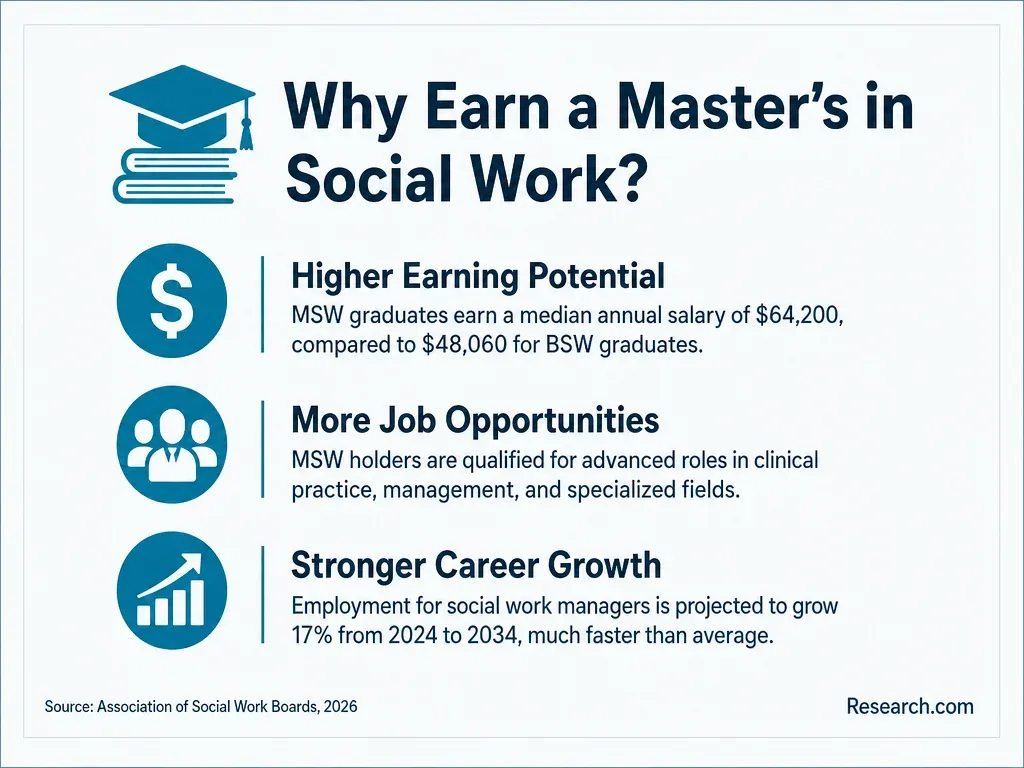
A BSW prepares graduates for generalist practice and can fit qualifying entry-level social work positions. An MSW provides advanced preparation and is commonly required for clinical social work roles, though independent clinical practice requires additional state-specific steps. Some case-management, outreach, eligibility, and program roles accept other degrees; the posting and applicable state law determine what qualifies.
Applicants with a bachelor's degree outside social work can consider a traditional or foundation MSW. Advanced-standing MSW tracks generally require a qualifying BSW and program-specific eligibility; related work or a psychology degree alone does not establish eligibility. A DSW or PhD is rarely a prerequisite for the sector choice itself. Seek one only when a defined leadership, teaching, or research goal warrants it.
If you are considering the BSW route, resolve social work bachelor's accreditation questions before enrolling. Programmatic accreditation, employer requirements, and the rules of the state where you intend to practice can each affect your options.
Government agencies may offer formal onboarding, classification ladders, and internal postings, but promotion can depend on vacancies, examinations, or budget approval.
Smaller nonprofits may give staff earlier responsibility for partnerships or program design, while offering fewer management layers. Larger nonprofits can have extensive specialist and leadership tracks. In either sector, a supervisor's availability and competence matter more to an early-career worker than a promised title several years away.
Ask who reviews case decisions, how often individual supervision occurs, what training is funded, and whether the agency has a documented path from your role to the next one. If you need post-degree clinical supervision, obtain the proposed supervisor's qualifications and the arrangement in writing for board review; a supportive manager is not necessarily a qualifying clinical supervisor.
Students can test an employer's learning culture during placement, but field instruction is not the same as future employment supervision. When comparing online MSW programs with field placement support, ask who secures sites, who qualifies as a field instructor, and how the school handles a placement that cannot provide the agreed learning opportunities.
How can students compare social work programs for accreditation, cost, length, and field placements?
Start with two or three actual job postings in the sector and location you want. Identify which requirements are mandatory, then compare only programs that can plausibly support those goals. A lower tuition price is less useful if placement scheduling forces a major reduction in paid work or the program does not meet a target board's educational rules.
Use the following checks to build a comparison you can confirm with each school and, where relevant, your state licensing board:
- Verify the institution's accreditation, the specific BSW or MSW program's CSWE accreditation status for your cohort, and any applicable state educational requirements.
- Confirm your entry route, required courses, expected length, full- or part-time sequence, and whether prior education actually qualifies you for advanced standing.
- Request total tuition and required fees, then add books, travel, placement-related expenses, and income you may forgo during field education.
- Ask who arranges placements, where they are available, which schedules agencies offer, and whether an employment-based placement requires separate approval.
- Compare career services and agency partnerships against your target public or nonprofit roles, without treating placement access as a job guarantee.
To narrow the cost comparison, online MSW programs organized by cost can be a starting point. Request a current, individualized cost and field plan before making an enrollment decision.
Other Things You Should Know About Social Work
Yes, if you meet the public position's education, experience, license, and hiring requirements. Translate your nonprofit work into specific evidence of service coordination, documentation, policy implementation, or partnership management rather than relying on a similar job title.
Often, within the worker's duties, applicable law, and agency policy. Advocacy for an individual's access to services differs from speaking publicly on behalf of an agency or using an official role for political activity; clarify those boundaries with the employer.
Membership generally depends on the association's eligibility rules, not the employer sector. Membership can provide resources and networking, but it does not grant a state license or expand professional scope.
Volunteering can help you learn about its mission, population, and working conditions if you can afford the time. Ask about training, boundaries, and confidentiality; volunteer experience does not automatically substitute for required education, licensed experience, or an approved field placement.
- Comparing the Compensation of Federal and Private-Sector Employees in 2022 | Congressional Budget Office https://www.cbo.gov/publication/60235
- Understanding the Career Path | U.S. Office of Personnel Management https://www.opm.gov/policy-data-oversight/career-paths-for-federal-program-and-project-management-guide/understanding-the-career-path/
- NASW Standards for Social Work Case Management | nycourts.gov https://www.nycourts.gov/reporter/webdocs/nasw_standards_socialwork_casemgt.htm
- The Difference Between Case Management vs. Social Work | Virginia Commonwealth University https://onlinesocialwork.vcu.edu/blog/case-management-vs-social-work/
- How to Become a Social Worker: Steps and Requirements | University of North Dakota https://und.edu/blog/how-to-become-a-social-worker.html
- Government Funding Cuts Put Nonprofits at Risk across the Nation | Urban Institute https://www.urban.org/urban-wire/government-funding-cuts-put-nonprofits-risk-across-nation
- Public, Nonprofit & Private Sector Guide | Human Services Edu https://www.humanservicesedu.org/hs-employment/
- Compensation for Nonprofit Employees | councilofnonprofits.org https://www.councilofnonprofits.org/running-nonprofit/employment-hr/compensation-nonprofit-employees
- Social Worker Salary Guide by State: LCSW and MSW Pay | Social Work License Map https://socialworklicensemap.com/social-work-careers/social-work-salary/
- Social Work Salaries | socialworkers.org https://www.socialworkers.org/careers/career-center/kickstart-your-job-hunt/social-work-salaries