2027 MSW Policy Courses for Future Clinicians: Connecting Systems and Client Services
Audited and Verified:
Our Editorial and Data Verification Process
Research.com uses government datasets, official education statistics and primary institutional information to support its career and degree guides. Our review process checks factual accuracy, occupational definitions, source dates and the requirements associated with the credentials discussed.
How This Article Was Fact-Checked
Our editorial team verifies salary estimates, employment projections, education requirements and program information against original data providers and official organizations. Salary figures are checked against the relevant occupational definitions and reporting periods. Information about licensure, accreditation and required in-person training is reviewed separately.
Fact-checked and verified on:

Co-Founder and Chief Data Scientist
A client may need effective therapy and still be unable to attend because of insurance rules, transportation gaps, or an agency waitlist. MSW policy courses help future clinicians understand, and respond appropriately to - the systems shaping those barriers.
This guide explains what the courses teach, how policy learning connects to fieldwork, and which program features matter if clinical practice is your goal. It also covers the admissions, cost, licensure, and career questions worth checking before you enroll.
Key Things You Should Know
- MSW policy courses connect individual needs with benefit rules, service funding, organizational procedures, and opportunities for ethical advocacy; they do not replace clinical skills training.
- Look for assignments that trace a policy from its written rule to its effect on service access, plus a supervised field placement where you can observe that connection.
- An MSW does not grant independent clinical authority. For context, the U.S. Bureau of Labor Statistics reports a $60,280 median annual wage for mental health and substance abuse social workers in May 2025, not a guaranteed salary for MSW graduates.
What are MSW policy courses, and why do future clinicians take them?
MSW policy courses examine how laws, public programs, funding decisions, and agency rules shape social services. Students may study how a policy is developed, who qualifies for a service, how it is implemented, and whether its effects match its stated aims. Course titles vary: social welfare policy, policy analysis, and policy practice can cover overlapping material.
For a future clinician, the purpose is not to turn every therapy session into policy advocacy. It is to recognize when a client's difficulty accessing care reflects a system constraint rather than an individual choice, and to respond within the clinician's role.
A policy course can strengthen referral planning, interdisciplinary communication, and the ability to identify a recurring service gap without making unsupported claims about its cause.
Students entering through a traditional MSW program may encounter policy alongside other foundation subjects. Advanced-standing students typically build on qualifying BSW preparation, though each program sets its sequence. If you are still choosing an undergraduate route, comparing accredited social work bachelor's degrees can help you examine the preparation on which an MSW may build.
How does social policy affect clinical practice and client services?
Policy affects what services an agency can offer, who can receive them, how care is documented, and what happens after a referral.
Clinicians need to distinguish a law or benefit rule from an insurer's terms, a funder's conditions, and their own agency's procedures; each has a different decision-maker and a different route for resolving a problem.
The examples below show why a clinically sound plan may also require policy literacy. They describe possible constraints, not determinations about any particular client's eligibility:
| Service issue | Policy or systems question | Clinical relevance |
| Interrupted appointments | Are coverage, authorization, scheduling, or transportation rules involved? | The clinician can explore feasible care options and coordinate an appropriate referral. |
| Unstable housing | What eligibility criteria and local service capacity govern assistance? | Assessment and goals can account for barriers that treatment alone cannot remove. |
| Discharge from care | Which agency procedures and community resources affect continuity? | The team can plan a realistic handoff rather than assume a referral guarantees access. |
A clinician should verify applicable rules with the appropriate agency or authority, protect client information, and avoid promising a benefit or placement.
An experienced social worker whose primary goal is to redesign services across organizations may eventually consider advanced leadership education; that is a different decision from choosing an MSW policy course, and DSW tuition and fee considerations matter only if that further degree serves a defined role.
What topics and skills do MSW policy courses cover?
Expect a mix of policy history, analysis, and practice, rather than a single national syllabus. A strong course teaches students to read a rule accurately, identify whose access it affects, weigh evidence about implementation, and communicate a feasible recommendation. Work may include policy briefs, testimony exercises, budget reviews, or analyses of agency procedures.
For clinical preparation, the most useful assignment follows a question all the way from policy text to client-service implications: What does the rule say? Who administers it? Where might implementation differ from intent? What evidence would support a proposed change? This sequence helps students separate an observation at one agency from a general claim about a program.
Course pacing matters when comparing accelerated graduate social work programs. A compressed schedule can leave less time to revise a policy analysis, consult stakeholders, and connect the assignment to field observations. Ask for sample syllabi and assignment timelines rather than assuming that the same course title means the same learning experience.
Field education lets students test classroom ideas against an agency's actual service pathways, under an approved learning agreement and field instruction.
A student might map a referral process, compare published eligibility criteria with the agency's intake procedure, or draft a de-identified summary of recurring access barriers for supervision. Such work should support, not displace, required client-service competencies.
Before starting a policy-related field task, use these checks to keep the project educational and appropriate to the placement:
- Agree with the field instructor and school on the learning objective, deliverable, and permitted sources of information.
- Confirm whether the agency allows review or use of records; use aggregated or de-identified information only as approved.
- Separate a documented pattern from a suspected cause, and bring proposed changes to supervision before sharing them externally.
MSW field education is part of the degree. It is not automatically the post-degree supervised experience a state may require for independent clinical licensure. Students planning that later step should separately review understanding which social work hours may count and confirm the rules with their licensing board.
Check three distinct matters: the institution's accreditation, the MSW program's Council on Social Work Education (CSWE) accreditation status for your intended cohort, and the education rules of the state where you expect to seek licensure.
CSWE accredits social work programs; a state board decides whether an applicant meets its licensing requirements. Neither a clinical concentration nor graduation itself issues a license.
Policy coursework is part of a broader educational decision. Ask whether the program offers the clinical courses and field opportunities relevant to your goals, then verify any state requirements concerning education, examinations, and post-degree supervision.
License categories, permitted activities, and supervisor rules differ by state. The school can explain its curriculum, but the board is the authority on eligibility and practice privileges.
For online study or an out-of-state school, checking MSW program authorization and professional eligibility is especially important. Confirm both that the school can enroll and place you where you live and that the degree meets the intended board's current educational criteria.
Policy reading, discussion, and writing can work in either format. The more consequential differences are often when students must attend live classes, how they practice skills, and how the school arranges and supports field placements. An online MSW does not eliminate in-person agency work or necessarily offer an asynchronous schedule.
This comparison highlights questions that affect the link between policy learning and clinical preparation; individual programs may differ from either description:
| Feature | Online program: verify | Campus program: verify |
| Policy discussion | Live-session times, group-work expectations, and feedback on written analysis | Class meeting times and opportunities for discussion with local practitioners |
| Clinical skills practice | Required live labs, residencies, or campus visits | On-campus labs and attendance requirements |
| Field education | Placement support, approved agency geography, and local field instruction | Agency partnerships, travel distance, and placement scheduling |
Compare actual calendars and field policies, not just delivery labels. A useful starting point for comparing program structures in social work education is whether you can complete both policy assignments and supervised clinical learning within the schedule the school requires.
Traditional or foundation MSW routes generally consider applicants with a bachelor's degree in social work or another discipline; a psychology, education, or human services degree does not automatically require another bachelor's degree first.
Advanced-standing routes are intended for applicants with qualifying prior BSW education under the program's rules. Relevant work can strengthen an application, but it does not by itself establish advanced-standing eligibility.
Programs commonly review transcripts, academic preparation, statements of purpose, and references, but prerequisite courses, minimum grades, BSW recency rules, and field-onboarding conditions vary.
Ask admissions staff to review your specific degree and coursework before relying on an advertised program length. This is particularly important if you hope to carry policy learning from a BSW directly into specialized MSW study.
For a closer look at MSW pathway differences by prior degree, compare the foundation courses and field sequence you would actually complete - not only the number of terms on a program page.
A full-time traditional MSW often takes about two academic years; an advanced-standing route may take about one. Part-time enrollment, course sequencing, placement availability, and a school's calendar can change either timeline. A shorter route is useful only if you qualify for it and can manage its course and field workload.
Compare total cost using the number of credits and terms your route requires, not a single advertised tuition figure. Include mandatory fees, books, travel or parking for fieldwork, screening costs, any campus visits, and earnings you may forgo during placement. Ask whether a paid or employment-based placement is possible and what approval it requires; do not assume your existing job will count.
When reviewing budget-conscious MSW study options, request a written estimate for your entry route and enrollment pace. Compare aid and employer assistance against the full cost, including field-related expenses, rather than treating lower tuition per credit as proof of a lower-cost degree.
MSW graduates may pursue behavioral health, healthcare, child and family services, or other social work roles. Policy skills are useful in each, but duties and qualifications differ: a clinician may use them to coordinate access to care, while a program manager may analyze service rules more directly. Employers and states may require a particular license, supervision, or experience in addition to the degree.
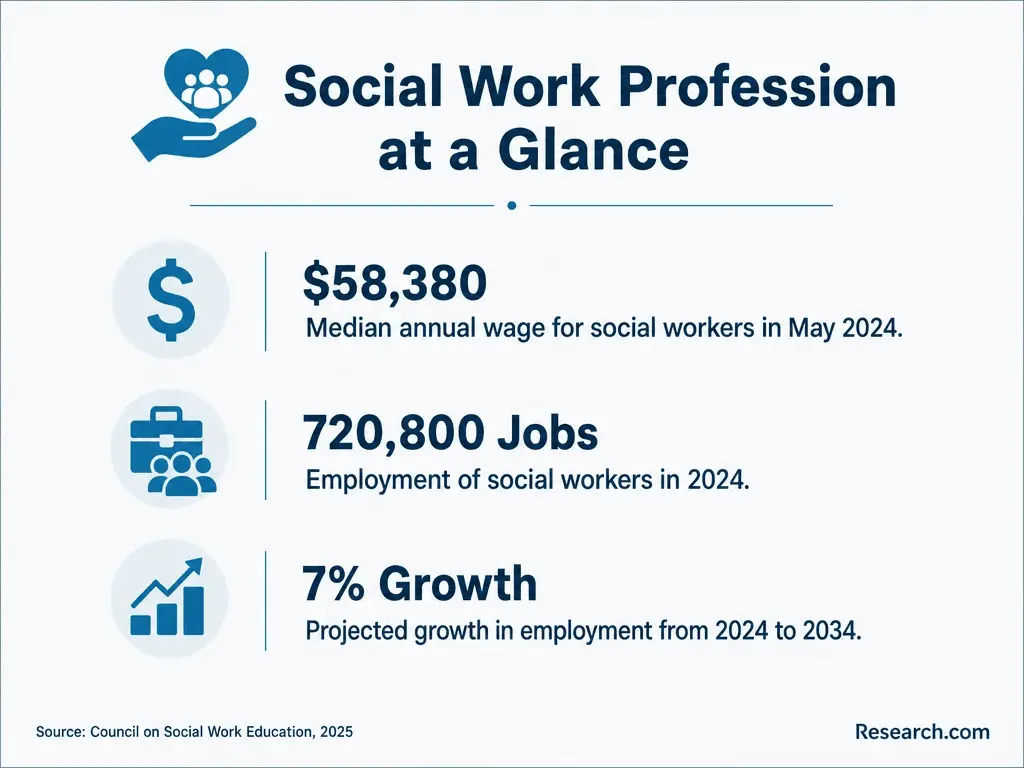
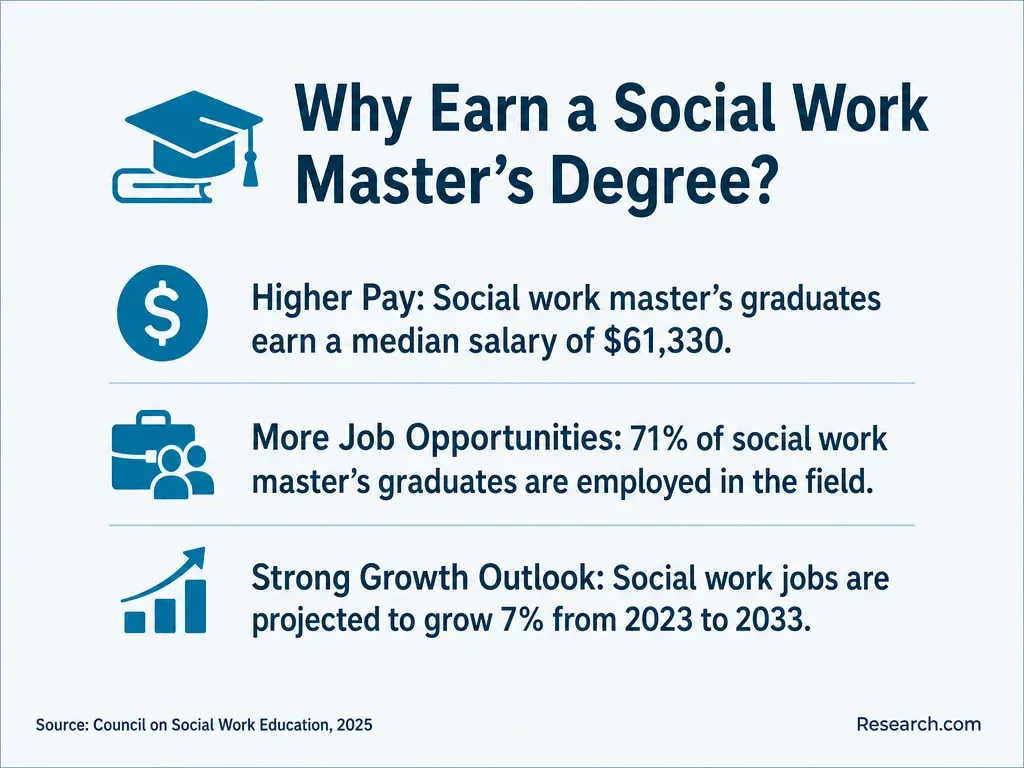
The U.S. Bureau of Labor Statistics figures below are occupation-wide May 2025 median annual wages and projected employment changes for 2025-2035. They are not starting salaries or outcomes promised to graduates of a clinical MSW program:
| BLS occupation | Median annual wage | Projected employment growth |
| Child, family, and school social workers | $59,550 | 4% |
| Healthcare social workers | $67,880 | 8% |
| Mental health and substance abuse social workers | $60,280 | 10% |
These categories can help you compare broad settings, but geography, employer, role, experience, and licensure also affect pay. Use social work master's salary geography as a prompt to investigate local openings and their actual credential requirements before estimating a return on your degree.
How can prospective clinicians compare MSW programs for policy and clinical preparation?
Choose a program that lets you connect systems analysis to competent client service - not one that merely lists both "policy" and "clinical" in its catalog.
Request a policy syllabus, the clinical course sequence, and the field manual. Then ask where students practice translating a service-access problem into an ethical, evidence-informed response.
Use the same questions with each school so that appealing descriptions become comparable evidence:
- Which policy assignments examine implementation and client access, and who gives feedback?
- How are clinical placements identified, approved, and supported, and what happens if a site falls through?
- What live skills sessions, field schedules, and location restrictions apply to my cohort?
- Which accreditation status and state-board requirements should I verify for my intended practice location?
Pay particular attention to choosing an MSW program with structured field support: a strong policy paper cannot compensate for a placement that lacks suitable learning tasks or instruction. If your aim is policy analysis rather than clinical social work, also compare relevant public policy or public health programs before committing to an MSW.
Other Things You Should Know About Social Work
No. Policy study asks students to examine rules, evidence, values, and consequences. An assignment may call for a reasoned recommendation, not party affiliation.
Usually, a class assignment can be shared if it uses public information and the student owns the work. Check school and agency rules first, and remove confidential or identifying material.
That depends on who controls the rule. A field instructor can help a student distinguish agency procedure from funder requirements, insurer terms, or law and identify the appropriate decision-maker.
Not generally. Targeted training may be worthwhile for a specific job, but clinicians can use policy literacy gained through MSW coursework, field learning, and supervised practice without a separate certificate.
- Interprofessional Education and Collaboration Among... - PMC https://pmc.ncbi.nlm.nih.gov/articles/PMC7305974/
- Health, Housing, and Service Supports for Three Groups of People Experiencing Chronic Homelessness | ASPE https://aspe.hhs.gov/reports/health-housing-service-supports-three-groups-people-experiencing-chronic-homelessness-0
- Teaching at the Intersection of Community Engagement and Program Evaluation | cdc.gov https://www.cdc.gov/pcd/issues/2025/24_0405.htm
- Patient Rights and Ethics - StatPearls - NCBI Bookshelf https://www.ncbi.nlm.nih.gov/books/NBK538279/
- 7. BHSA Components and Requirements | ca.gov https://policy-manual.mes.dhcs.ca.gov/behavioral-health-services-act-county-policy-manual/LIVE/7-bhsa-components-and-requirements
- Accreditation & Competencies | Boston University https://www.bu.edu/ssw/about/accreditation-competencies/
- Policy & Political Social Work | umich.edu https://ssw.umich.edu/academic-programs/msw/pathways/policy-and-political-social-work
- Advanced Curriculum and Electives | rutgers.edu https://catalogs.rutgers.edu/generated/ssw_1315/pg100.html