2027 MSW Intensive Weekend Courses: Travel, Preparation, and Field Education Planning
Audited and Verified:
Our Editorial and Data Verification Process
Research.com uses government datasets, official education statistics and primary institutional information to support its career and degree guides. Our review process checks factual accuracy, occupational definitions, source dates and the requirements associated with the credentials discussed.
How This Article Was Fact-Checked
Our editorial team verifies salary estimates, employment projections, education requirements and program information against original data providers and official organizations. Salary figures are checked against the relevant occupational definitions and reporting periods. Information about licensure, accreditation and required in-person training is reviewed separately.
Fact-checked and verified on:

Co-Founder and Chief Data Scientist
A weekend MSW schedule can make graduate study possible alongside a job, but it does not confine the degree to weekends. Travel, preparation, live skills work, and agency field hours can occupy much of the remaining week. This guide is for prospective students—especially working adults and caregivers—compared to intensive weekend options. It explains how to test a program's calendar against your work and household commitments, plan an approved placement, estimate the full cost, and verify that the degree supports your intended social work career.
Key Things You Should Know
- "Weekend" usually describes scheduled classes, not the entire workload; request every required campus date, live session, and field term before enrolling.
- Field education follows an agency-approved schedule that may require weekday hours, even when coursework meets on weekends; a current job counts only if the MSW program approves it as a placement.
- Compare total cost, not tuition alone: recurring travel, lodging, caregiving, and reduced paid hours can change which format is affordable.
What are MSW intensive weekend courses, and how do they work?
An MSW intensive weekend course concentrates scheduled teaching into longer blocks, often combining discussion, role-play, skills assessment, and group work. Reading, assignments, online activities, and field education happen outside those blocks. "Weekend" is a scheduling description, not a separate type of MSW credential.
Formats vary: one program may meet on campus on recurring weekends, while another uses occasional in-person intensives alongside online classes. Ask for a term-by-term calendar, including Friday sessions, attendance rules, live online meetings, and the dates when field education begins. Students seeking control over weekday study hours can also consider comparing self-paced and structured MSW coursework; neither format necessarily makes live skills work or placement hours optional.
How often do MSW weekend intensives require travel, and how should students plan?
There is no standard travel frequency. Required visits may occur regularly throughout a term or in fewer, longer blocks; orientation, skills labs, and final assessments may add separate trips. A published "online" label does not establish that a program is travel-free.
Build the travel plan from required dates rather than an average month. Before accepting an offer, request the full calendar and check these commitments against work shifts, caregiving, and placement obligations:
- Mark each required arrival and departure time, including Friday and evening activities.
- Calculate door-to-door travel time and decide whether a late return leaves enough rest before work or field.
- Confirm attendance, weather disruption, illness, and make-up policies before buying nonrefundable travel.
Distance also affects whether the degree route is practical. If you do not yet hold a bachelor's degree, investigate BSW entry pathways for adult learners before budgeting for graduate-school trips.
How do students arrange field placements around weekend MSW courses and work?
Start with the MSW field office, not an independent agreement with an agency. The program must approve the site, learning activities, field instruction, schedule, and documentation. Agencies set service hours around clients and staff; a weekend class schedule does not guarantee a weekend placement.
Ask when each placement starts, how many hours must be completed during each field term, and which days and times local agencies can supervise students. Then compare that schedule with your paid work. A weekday job may require reduced hours, a changed shift, or employer support. An employment-based placement may be possible, but the school must approve how its educational tasks and evaluation meet field requirements; ordinary job duties do not automatically count. For questions about who finds a site and what happens if a match falls through, review online MSW placement responsibilities before enrollment.
Field education is part of the degree. It is not the same as post-degree supervised experience that a state may require for independent clinical licensure.
The useful comparison is not simply where lectures occur. The table shows how each format may affect travel and scheduling; the school's actual calendar and field policy control:
| Format | Potential scheduling advantage | Constraint to verify |
| Online | Less routine classroom travel | Required live sessions, residencies, and locally available field sites |
| Hybrid | Some coursework completed remotely | Frequency and length of campus intensives |
| Campus-based weekends | Predictable in-person class blocks | Recurring commute or lodging and time away from home |
A nearby campus program may be easier for a working parent than a distant "mostly online" program with costly residencies. Conversely, a remote option may fit someone who has dependable local field support but cannot commute regularly. When comparing social work degrees before enrollment, compare the exact MSW track—not an institution's general online offerings—and obtain its attendance and field policies in writing.
Treat each intensive as the visible portion of a longer learning cycle. Reserve study time before the meeting for readings and case material, and time afterward for assignments and feedback. Arrange meals, transport, caregiving, and work coverage early enough that a delayed trip does not disrupt the whole weekend.
Skills exercises may involve sensitive practice scenarios. Follow program rules for confidentiality and recording; do not use identifiable information from work or the field in class without authorization. Keep course requirements and placement records organized separately. If clinical practice is your goal, checking social work clinical hour categories can help you avoid mistaking student field hours for qualifying post-degree supervision, which is governed by the relevant state board.
Weekend scheduling does not create a uniform admissions standard. Traditional or foundation MSW tracks generally admit applicants with a qualifying bachelor's degree from a range of disciplines; advanced-standing tracks have separate prior social work education requirements. Programs may review academic records, writing, references, service experience, and stated prerequisites. Field onboarding requirements can arise after admission.
Ask admissions to confirm your eligibility for the specific weekend track, not merely the university. If a prerequisite or GPA is a concern, compare published policies and ask about permitted ways to demonstrate readiness; MSW programs with flexible admission criteria are worth investigating, but flexible admission does not waive field or graduation standards.
Completion time depends on the course sequence, enrollment pace, and placement availability. A weekend timetable can spread coursework across more terms than a full-time weekday route; "intensive" does not necessarily mean faster. Request a term-by-term plan showing course dates, field terms, breaks, and the earliest realistic graduation date.
Advanced standing can shorten the MSW sequence for applicants with a qualifying BSW who meet the program's criteria; a bachelor's degree in another field does not ordinarily substitute for that preparation. Schools may also set rules about BSW accreditation and recency. For a clearer comparison of eligibility and sequencing, see online guides on understanding advanced standing versus standard admission. Do not budget around a shortened route until the program has confirmed your admission to it.
There is no reliable single weekend-MSW price: tuition, required fees, credit loads, and the number of travel weekends differ by school and track. Compare written program estimates for the same entry route and expected completion pace. The following cost categories capture expenses that a tuition quote can miss:
- Tuition, program fees, books, technology, and any required campus or skills-lab charges
- Transportation, lodging, meals away from home, and parking for each required visit
- Field-site travel, screening or onboarding expenses, caregiving, and paid hours reduced during placement
For a workable household estimate, multiply the cost of one trip by the required trips in each term, then add field-related expenses and lost earnings. Ask whether aid or employer assistance applies to your enrollment pace and expenses; do not assume reimbursement or a paid placement. A doctorate is not a remedy for an inconvenient MSW schedule. If a later leadership or research goal genuinely calls for one, treat planning the cost of a social work doctorate as a separate decision.
Verify the exact MSW program and your intended entry cohort in the Council on Social Work Education's program directory, then confirm the school's current status and any relevant track details with the program. Institutional accreditation and CSWE programmatic accreditation answer different questions; neither alone grants a license.
Next, check the licensing board in the state where you intend to practice. Ask whether the degree meets that board's education rules and what additional application, examination, or supervised-experience steps apply to the license category you want. Also ask the school whether it can enroll you and support field placement in your location.
If you are still exploring roles for master's-prepared social workers, identify the target role first: its employer and state requirements determine which licensing questions matter. MSW graduation does not itself authorize independent clinical practice.
What careers, salaries, and job prospects are available to MSW graduates?
MSW graduates work in healthcare, behavioral health, schools, child and family services, community programs, and administration. Duties and entry requirements differ: a program-coordination role may not require a clinical license, while independent psychotherapy requires state-specific authorization beyond the degree.
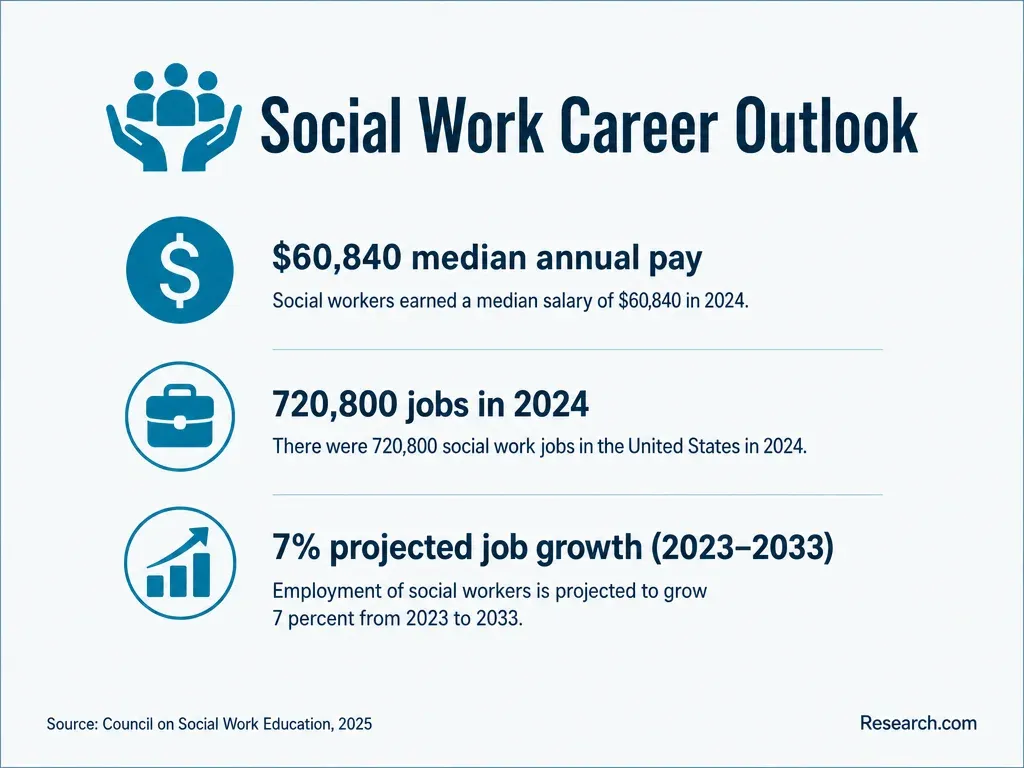
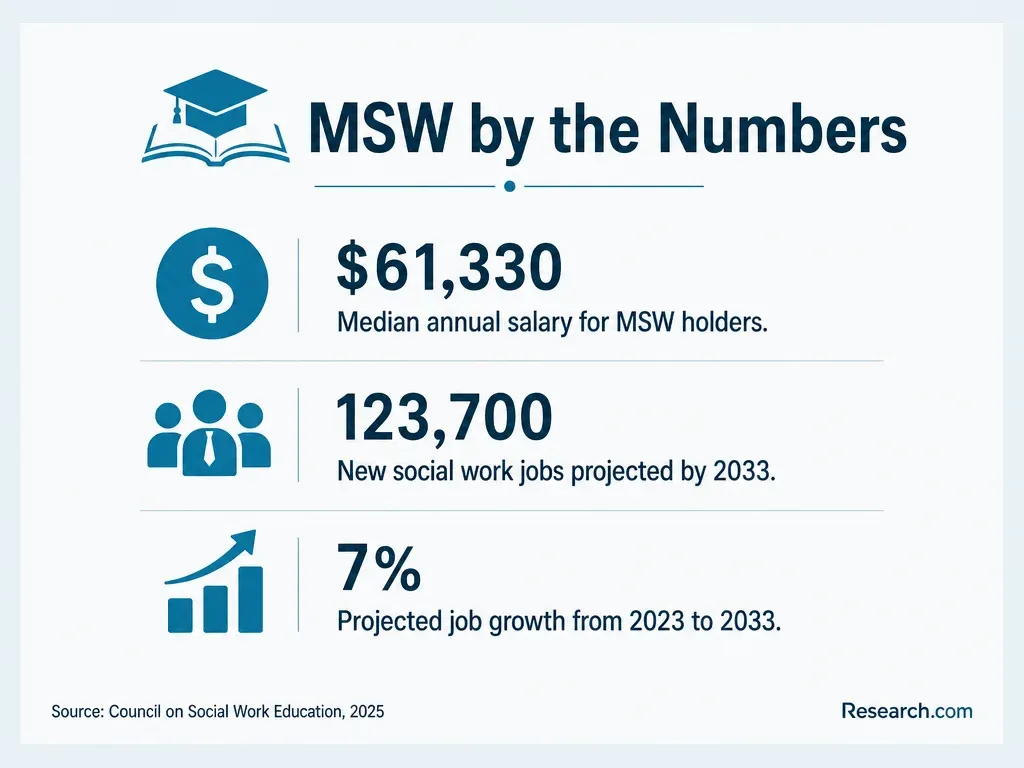
The U.S. Bureau of Labor Statistics figures below describe occupations, not starting pay or guaranteed outcomes for MSW graduates. They are useful for comparing broad markets, alongside the qualifications and pay listed in local job postings.
| Occupation | Median annual pay, May 2025 | Projected employment growth, 2025-2035 |
| Child, family, and school social workers | $59,550 | 4% |
| Healthcare social workers | $67,880 | 8% |
| Mental health and substance abuse social workers | $60,280 | 10% |
Use these figures as context when judging whether the cost and disruption of weekend study fit your target work. Pay also varies by location, setting, experience, and license; social work earnings across different state markets can inform a geographic comparison without predicting an individual offer.
Other Things You Should Know About Social Work
Only if the program permits it. Ask whether remote attendance is an approved substitute, whether skills activities must be completed later, and how absences affect progression.
Do not assume so. Recording may be limited by participation, privacy, or skills-assessment rules; confirm what materials are available if you miss a session.
That depends on course sequencing, space, and school policy. Get written guidance on whether a switch would delay coursework or field education.
Follow the school's cancellation and attendance procedures. Ask in advance how it communicates changes and whether a required in-person activity will be rescheduled.
- Education Requirements For Licensure (LCSW) | nysed.gov https://www.op.nysed.gov/professions/licensed-clinical-social-worker/faq-education-requirements-licensure
- Cost of Attendance (Budget) | 2025-2026 Federal Student Aid Handbook https://fsapartners.ed.gov/knowledge-center/fsa-handbook/2025-2026/vol3/ch2-cost-attendance-budget
- Licensed Clinical Social Worker | floridasmentalhealthprofessions.gov https://floridasmentalhealthprofessions.gov/licensed-clinical-social-worker/
- More about the Field Placement | Online MSW@Denver https://onlinemsw.du.edu/curriculum/field-internships/placement-options/
- LCSW Licensure Information | Florida Gulf Coast University https://www.fgcu.edu/mariebcollege/socialwork/licensure
- Student Domestic Travel - Policies - Campus Offices | Academic Advising and Registration Office https://campus.collegeforcreativestudies.edu/policy/student-domestic-travel/
- MSW Program Options: Intensive Weekend | rutgers.edu https://socialwork.rutgers.edu/academics/master-social-work-msw/msw-program-options/intensive-weekend
- MSW Field Practicum Placement | UIndy https://uindy.edu/cebs/pllsswc/social-work/msw-field-practicum
- Master of Social Work | MSW Program | Fordham Graduate School of Education https://www.fordham.edu/graduate-school-of-social-service/academics/master-of-social-work/
- Placement Process FAQ | Syracuse University Online Master's Programs https://onlinegrad.syracuse.edu/social-work/admitted/field-faq/