2027 MSW Dual Degrees: Coordinating Course Sequences, Field Education, and Costs
Audited and Verified:
Our Editorial and Data Verification Process
Research.com uses government datasets, official education statistics and primary institutional information to support its career and degree guides. Our review process checks factual accuracy, occupational definitions, source dates and the requirements associated with the credentials discussed.
How This Article Was Fact-Checked
Our editorial team verifies salary estimates, employment projections, education requirements and program information against original data providers and official organizations. Salary figures are checked against the relevant occupational definitions and reporting periods. Information about licensure, accreditation and required in-person training is reviewed separately.
Fact-checked and verified on:

Co-Founder and Chief Data Scientist
An MSW dual degree can connect social work practice with public health, law, business, or policy, but coordinating two schools' calendars, field requirements, and tuition rules can erase the expected time savings.
This guide is for prospective MSW students and working professionals deciding whether a combined program serves a specific career goal. It explains how to compare course sequences, obtain an approved field placement, calculate the full cost, and check whether both awards provide qualifications you will actually use.
Key Things You Should Know
- An MSW dual degree awards two distinct degrees; shared courses may reduce duplicated study, but neither school's required courses or the MSW field sequence automatically disappear.
- Compare written term-by-term plans and field approvals before enrolling: a placement relevant to both disciplines counts toward each degree only if both programs approve it under their own rules.
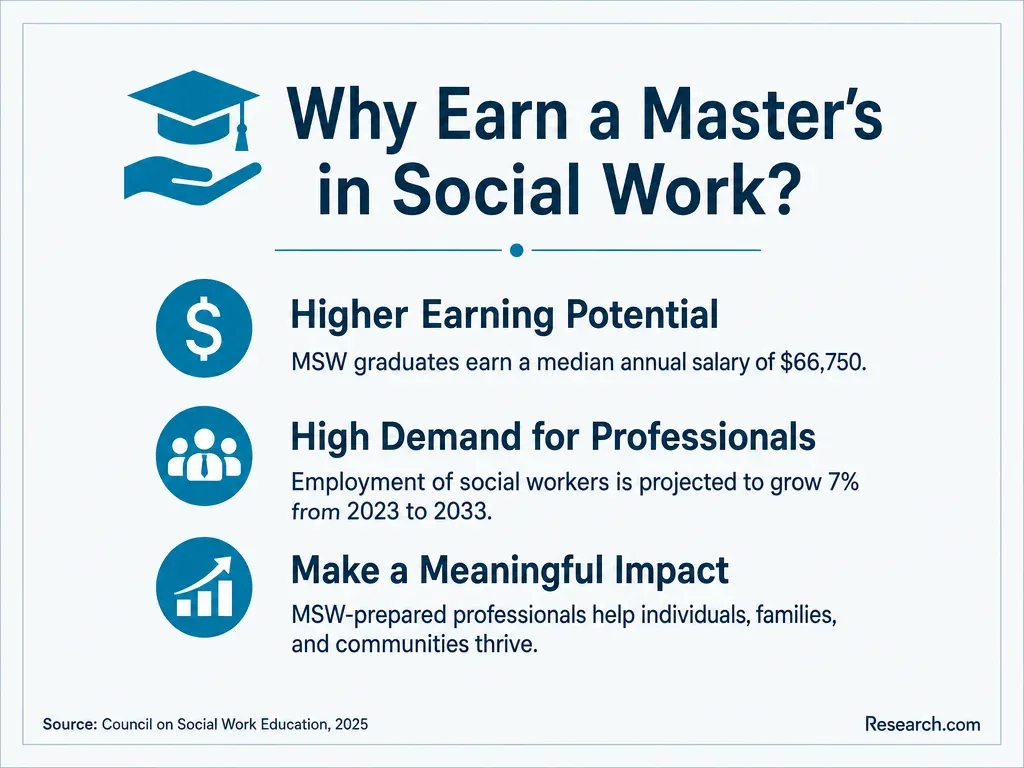
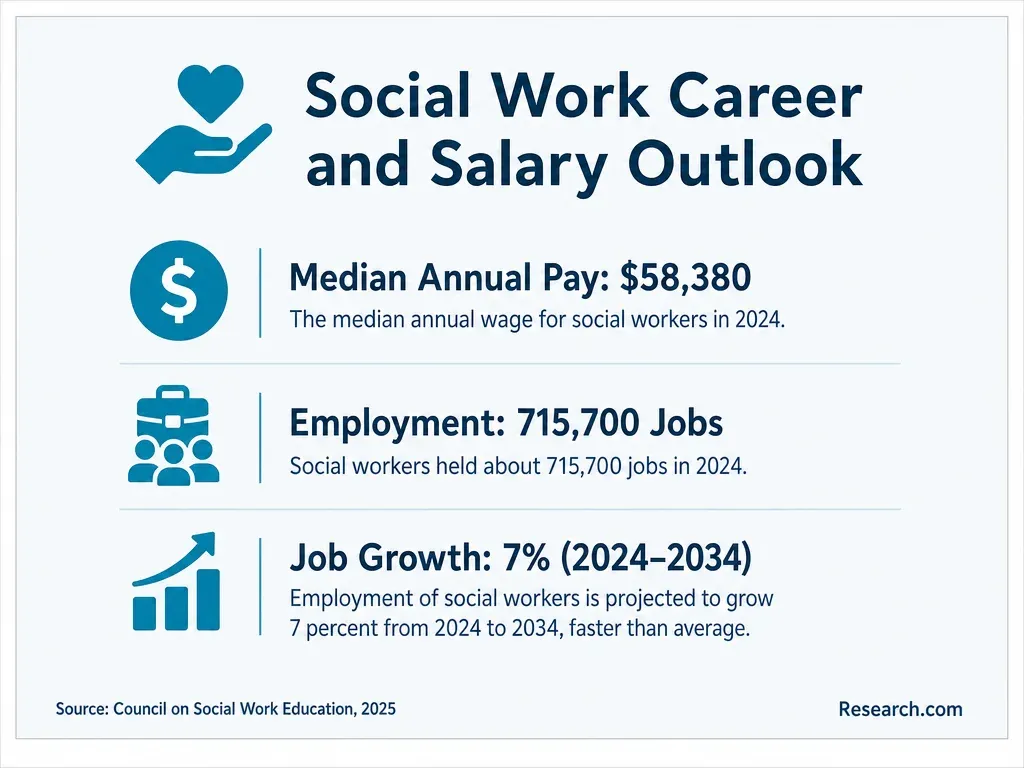
- Price both schools' charges and the earnings you may forgo during field education. For context, BLS reports a $61,780 median annual wage for social workers across specialties in May 2025, not a salary premium for dual-degree graduates.
What is an MSW dual degree, and how does it differ from separate degrees?
An MSW dual degree is an approved pathway to a Master of Social Work and a second, separately awarded degree. The schools coordinate some enrollment, scheduling, or credit-sharing rules. That differs from independently completing two programs, where a course taken for one degree may not apply to the other and the schedules may not be designed to fit together.
The advantage is planned integration, not an automatic discount. A dual-degree student may still complete every required social work competency and the second school's professional curriculum. Ask for the number of credits each degree requires alone, the number each requires in the combined pathway, and precisely which courses satisfy both.
If you want only one field of practice, a single MSW with relevant electives or a certificate may be more direct. Students still comparing entry routes can start by exploring academic pathways in online social work.
What MSW dual degree combinations are available, including MSW/MPH, MSW/JD, and MSW/MBA?
The useful combination depends on the job's actual duties. These examples compare the second degree's contribution with a reason to consider a less extensive route; availability and degree names vary by university.
| Combination | Potential fit | When to question the second degree |
| MSW/MPH | Population health, prevention, health equity, or evaluation alongside social work practice | The target role primarily involves individual service delivery and does not require substantial public health methods |
| MSW/JD | Work spanning legal systems, advocacy, and social services | The goal is legal literacy or policy advocacy rather than qualifying to practice law |
| MSW/MBA | Agency operations, finance, or organizational leadership informed by service delivery | Management experience or targeted finance training meets the employer's requirements |
| MSW/MPA or MPP | Public administration, policy analysis, or government program leadership | The intended position values agency experience more than a second graduate credential |
An MSW/JD does not itself authorize legal practice; bar admission has separate jurisdictional requirements. Likewise, an MPH, MBA, or policy degree does not expand a social work license.
Compare job descriptions before assuming that two awards are necessary. For a closer look at social work master's skills across career settings, distinguish the skills employers request from the degrees they explicitly require.
How are courses sequenced in MSW dual degrees, and how long do programs take?
There is no universal dual-degree calendar. A program may start with MSW foundation courses, begin with the partner degree, or interleave both. Students then complete specialized MSW work, field education, and any second-degree practicum, clinical, or capstone requirements. A qualifying BSW graduate may be considered for advanced standing under the MSW program's rules; another bachelor's degree does not automatically qualify.
Request a term-by-term plan for your entry route, not a promotional minimum. It should show required course order, prerequisites, field terms, summer enrollment, and which courses are offered only once a year. Compare the plan with your realistic work and caregiving schedule:
- Mark courses that must precede field education or partner-school electives.
- Identify terms requiring concurrent classes, placement hours, and live skills sessions.
- Ask what happens if a course is full, a placement starts late, or you study part time.
- Confirm whether the published completion time assumes summer study or a particular starting term.
Sharing credits can shorten a combined pathway relative to completing the same two degrees separately, but a scheduling conflict can offset that benefit. If online study is under consideration, comparing online MSW program lengths can provide context; verify the dual-degree sequence separately.
MSW field education is supervised curricular learning tied to social work competencies, not simply time spent at a service agency. A placement at a health department, legal-services organization, or nonprofit may also advance the second degree's goals.
It counts toward both programs' requirements only when each program approves the site, activities, supervision, and documentation. A second-degree internship may need to remain separate.
Before accepting an offer, ask the MSW field office and partner school to explain who finds placements, whether one site can meet both sets of objectives, and who resolves conflicting calendars or evaluations.
Request written guidance on the learning agreement, field instructor qualifications, any separate task supervisor, field seminar, travel, onboarding, and placement availability near you. Employment-based learning requires school approval; an existing job or prior volunteer hours do not count automatically.
Field schedules deserve special attention if you must retain paid work. An online class schedule does not make an agency's daytime hours flexible. For examples of online MSW field coordination models, focus on which placement responsibilities the school actually accepts. MSW field instruction is also distinct from post-degree supervised experience required for some clinical licenses.
No single price describes MSW dual degrees. The second school may charge a different per-credit rate, and credit-sharing rules do not establish what tuition will be billed.
This comparison shows the cost categories to obtain from each program before judging whether the combined route is cheaper than two separate degrees.
| Cost category | What to verify |
| Tuition and mandatory fees | Credits billed by each school, tuition rate by term, summer charges, and fees during field terms |
| Placement and attendance | Travel, parking, screenings, insurance requirements, technology, and required campus visits |
| Time and household costs | Reduced paid hours, childcare, and any additional term caused by course or placement scheduling |
| Financing | Scholarship renewal rules, assistantship workload, employer reimbursement, borrowing eligibility, and loan interest |
Calculate net total cost for each pathway: tuition and fees plus necessary attendance and living-related changes, minus confirmed grants or employer support. Compare the resulting amount with a single MSW and with two separately completed degrees.
Ask the financial aid offices how enrollment across schools is handled, which institution administers aid, and whether a scholarship applies during partner-school-heavy terms. An assistantship can help only if its funding and work hours fit the course and field schedule. For a price benchmark, see online MSW tuition comparisons, then obtain a dual-degree-specific estimate.
Check the MSW program's CSWE accreditation status for the cohort you would enter, the institution's accreditation, and any relevant status of the partner professional program. Accreditation of the university alone is not the same as CSWE accreditation of its MSW program. The MSW school should also confirm that shared credits and the proposed field sequence satisfy its degree requirements.
For a licensed social work role, consult the board in the state where you intend to practice. It determines applicable education, examination, supervised-experience, and application requirements.
An MSW degree does not itself issue a license; neither a dual degree nor an MSW field placement automatically substitutes for post-degree clinical supervision or grants independent psychotherapy authority. A JD, similarly, does not replace state bar requirements.
Students who may move or study remotely should check the intended practice jurisdiction before paying a deposit. This guide to checking online MSW alignment with licensing goals can help frame the questions, but the relevant board and programs remain the authorities for an individual plan.
Format is a property of both degree programs, not just the MSW. A dual pathway advertised as online may include live classes, campus intensives, in-person skills assessment, or a partner degree available only on campus. Both formats normally require approved field learning in an agency or another setting the school accepts.
Online study may reduce commuting to class, while campus study may make cross-school meetings and local agency connections easier. Neither format resolves conflicting class times or guarantees a placement near home.
Ask for one combined weekly schedule showing synchronous sessions, group work, field days, travel, and any residency. If flexibility is decisive, compare that schedule with exploring flexible online graduate social work study; even a largely asynchronous MSW may have fixed field and live-practice commitments.
Applicants commonly need acceptance by both programs, sometimes through separate applications and deadlines. The MSW may evaluate academic preparation, writing, references, and relevant service experience; the partner school applies its own criteria.
Tests and prerequisite courses are program-specific, so check the published requirements rather than assuming a GRE, statistics course, or work history is universally required.
A bachelor's degree outside social work can be a route into a traditional or foundation MSW. Advanced standing is a separate decision based on qualifying prior social work education and the particular school's rules; work experience or a related major alone does not guarantee it.
Confirm whether rejection by one school ends dual-degree eligibility, whether you could still enter the other program, and whether admission must occur in the same term. If MSW admission criteria are your main obstacle, research less restrictive social work master's admission options without assuming that an easier entry route also offers the desired dual degree.
The strongest case for a dual degree is a role that repeatedly uses both disciplines—for example, social work and population-health evaluation, legal-system advocacy, or agency financial management.
Some jobs require a social work license; others emphasize policy, operations, or research experience instead. A second degree is not proof of eligibility for a particular job or a guaranteed salary increase.
The U.S. Bureau of Labor Statistics reports these May 2025 median annual wages and 2025-2035 employment projections. They describe occupations, not MSW dual-degree graduates; the right comparison depends on the work you intend to do.
| BLS occupation | Median annual wage, May 2025 | Projected growth, 2025-2035 |
| Social workers, all specialties | $61,780 | 6% |
| Healthcare social workers | $67,880 | 8% |
| Mental health and substance abuse social workers | $60,280 | 10% |
These figures cannot isolate an MSW/MPH, MSW/JD, or MSW/MBA pay effect. Compare actual job postings for credential requirements and likely pay in your location, then weigh the second degree against its full cost and time commitment.
For someone who already has an MSW and seeks advanced practice leadership, a later doctorate or targeted management training may fit better than another master's degree; a guide to lower-cost doctoral social work programs can help assess that distinct route.
How can you compare and choose a reputable MSW dual degree program?
Compare programs using the same intended job, entry route, and study pace. The most revealing document is a written plan that connects both degrees' courses, field requirements, and charges, not separate brochures describing each award in isolation.
Ask each pair of schools for the following evidence before committing:
- A combined degree audit identifying shared courses, separately required credits, and the expected term of each course.
- Written field guidance explaining site approval, supervision, scheduling, and whether any placement can meet both programs' requirements.
- A term-by-term cost estimate, including fees and the conditions attached to scholarships, assistantships, or employer support.
- Confirmation of MSW accreditation status, partner-program status where relevant, and the route's fit with the state board and employers you are targeting.
- Policies for delayed placements, changed course offerings, part-time enrollment, and leaving one degree without losing progress in the other.
Compare any funded offer by its net value and its effect on field availability. In particular, check MSW assistantship work expectations and funding before treating an award as free time or guaranteed support.
Choose the dual degree when both credentials are relevant, the combined schedule is feasible, and its added cost is justified by your target role; otherwise, a single MSW may be the sounder decision.
Other Things You Should Know About Social Work Programs
Possibly, but credit-sharing requires a formal arrangement or explicit approval from both institutions. Without one, plan on meeting each school's requirements separately.
You may be able to continue toward the other award, but shared-credit, residency, tuition, and aid rules can change. Request a revised degree audit and aid estimate before withdrawing.
Only if both programs approve its learning objectives, supervision, assessment, and credit. An interdisciplinary topic alone does not make a project count twice.
That depends on each school's catalog-year and transition policies. Keep the written degree plan and ask both registrars or program directors how changes affect your remaining requirements.
- Academic Years, Academic Calendars, Payment Periods, and Disbursements | 2024-2025 Federal Student Aid Handbook https://fsapartners.ed.gov/knowledge-center/fsa-handbook/2024-2025/vol3/ch1-academic-years-academic-calendars-payment-periods-and-disbursements
- Levels and Eligibility Requirements | North Carolina Social Work Certification and Licensure Board https://www.ncswboard.gov/levels-and-eligibility-requirements/
- Mapping Dual-Degree Programs in Social Work and Public Health: Results From a National Survey - PMC https://pmc.ncbi.nlm.nih.gov/articles/PMC5036576/
- Types of Financial Aid: Grants, Work-Study, and Loans | studentaid.gov https://studentaid.gov/understand-aid/types
- Social Work, M.S.W. and Applied Behavior Analysis, M.S. Dual Degree: SLU - Saint Louis University https://www.slu.edu/social-work/academics/social-work/social-work-msw-applied-behavior-analysis-ms-dual-degree.php
- The Difference Between the Advanced Standing and Traditional MSW Program https://onlinemsw.fsu.edu/blog/online-msw-traditional-vs-advanced-program
- Social Welfare Master of Social Work Degree Program | University at Albany https://www.albany.edu/graduate-bulletin/social-welfare-msw.php
- Advanced Standing | rutgers.edu https://catalogs.rutgers.edu/generated/ssw_1315/pg24.html
- What to Expect in the Pitt MSW Field Practicum and Placement Process https://msw.pitt.edu/articles/pitt-msw-field-practicum-and-placement-what-to-expect/
- MSW / MPH Program Details - School of Social Work https://ssw.uga.edu/degrees-programs/dual-degree/msw-mph/