2027 Mindfulness-Based Approaches in Social Work: Education and Competence in Social Work Settings
Audited and Verified:
Our Editorial and Data Verification Process
Research.com uses government datasets, official education statistics and primary institutional information to support its career and degree guides. Our review process checks factual accuracy, occupational definitions, source dates and the requirements associated with the credentials discussed.
How This Article Was Fact-Checked
Our editorial team verifies salary estimates, employment projections, education requirements and program information against original data providers and official organizations. Salary figures are checked against the relevant occupational definitions and reporting periods. Information about licensure, accreditation and required in-person training is reviewed separately.
Fact-checked and verified on:

Co-Founder and Chief Data Scientist
Mindfulness can help social workers notice stress, listen attentively, and offer appropriate coping practices, but knowing an exercise is not the same as being qualified to use it with clients. For students and early-career practitioners, the important decision is how much education, supervised practice, and specialized training their intended role requires.
This guide explains what social work programs teach, where mindfulness fits in field education and employment, and how to assess credentials, ethical risks, costs, and career options without mistaking a short course for clinical authority.
Key Things You Should Know
- Mindfulness is a practice tool, not a social work license or a substitute for assessment, consent, supervision, and appropriate referrals.
- A BSW or MSW can develop foundational competence; delivering a structured clinical intervention may require additional training and state-specific clinical authority.
- For context, the U.S. Bureau of Labor Statistics reports a May 2025 median annual wage of $61,780 for social workers overall, not a salary attributable to mindfulness training.
What are mindfulness-based approaches in social work?
Mindfulness means deliberately attending to present-moment experience with curiosity rather than immediately reacting to it. In social work, it can describe a practitioner's reflective attention, a brief client-selected grounding exercise, or a structured intervention taught under a defined protocol. Those are different levels of responsibility.
A social worker might pause before a difficult meeting, invite a willing client to notice their feet on the floor, or, if appropriately trained and authorized, deliver a longer mindfulness-based program.
Mindfulness-based stress reduction and mindfulness-based cognitive therapy are examples of structured programs; familiarity with their names does not qualify someone to deliver them.
Research on mindfulness-based interventions is promising for some outcomes, but effects vary by population and intervention. A practice should fit the client's goals and circumstances rather than be treated as universally helpful.
Mindfulness also differs from a complete social work response. A breathing exercise cannot resolve unsafe housing, a benefits interruption, or an inaccessible service. Students comparing social work degree pathway overview options should look for education that connects individual skills with person-in-environment assessment and practical advocacy.
What education and training do social workers need to use mindfulness-based approaches?
The required preparation depends on what the worker intends to do. Personal use of mindfulness for reflection does not require a social work degree. Offering a brief exercise within a social services role calls for competence, client choice, supervision, and agency approval.
Providing psychotherapy or a structured clinical treatment requires training appropriate to the method and authority to perform that work under state law.
A BSW generally prepares students for generalist practice, including engagement, assessment, ethics, and field learning. A traditional or foundation MSW admits students from eligible bachelor's backgrounds beyond social work; an advanced-standing MSW is intended for applicants with qualifying social work education under the program's rules.
Neither award automatically establishes mindfulness-treatment competence or independent clinical authority. For someone already qualified for their target role, focused training and consultation may be more useful than another degree.
Ask a prospective program whether students can practice a technique, receive observed feedback, and discuss when not to use it. Applicants with an admissions barrier, such as unavailable academic referees, can review MSW entry options without traditional reference letters, then verify each school's current requirements. An easier application is not evidence of stronger clinical training.
How do CSWE accreditation and state licensing requirements affect social work careers?
CSWE accredits social work degree programs; state boards determine license eligibility and permitted practice within their jurisdictions. Institutional accreditation, CSWE program accreditation, graduation, examination eligibility, license issuance, and independent clinical authority are separate matters.
Before enrolling, confirm the exact program's accreditation status for the relevant cohort and ask the board in the state where you intend to work how that education fits its rules.
A student choosing between MSW routes can use an MSW entry pathway comparison guide to understand the educational distinction, but the school decides advanced-standing eligibility. Field education completed for a degree does not automatically replace any post-degree supervised experience required for clinical licensure.
These distinctions matter particularly when mindfulness moves from general support into psychotherapy. Neither an MSW concentration nor a mindfulness certificate expands a license's legal scope. Check current board rules, supervision requirements, and employer policy before offering or advertising a clinical service.
Ethical use begins with an appropriate purpose, an invitation rather than a requirement, and room to stop. Some people find inward attention, closed eyes, or stillness uncomfortable or distressing.
A worker should not assume that a technique is trauma-informed merely because it is described as calming. Accessible alternatives, cultural and religious preferences, privacy, and the client's own goals all matter.
For example, a case manager might ask whether a client wants a short pause before discussing a stressful application. The worker should remain prepared to proceed without the exercise and still address the application itself.
A clinician considering a structured intervention must additionally work within their competence, license, supervision arrangements, and applicable treatment and documentation policies.
The NASW Code of Ethics offers professional guidance, but confidentiality, consent, records, and reporting duties also depend on law and setting. Consult a supervisor when a technique causes concern or exceeds the role. The broader MSW education and career pathway connections can help clarify why an intervention appropriate to one job may be outside another worker's duties.
What are the salary and job outlook for social workers?
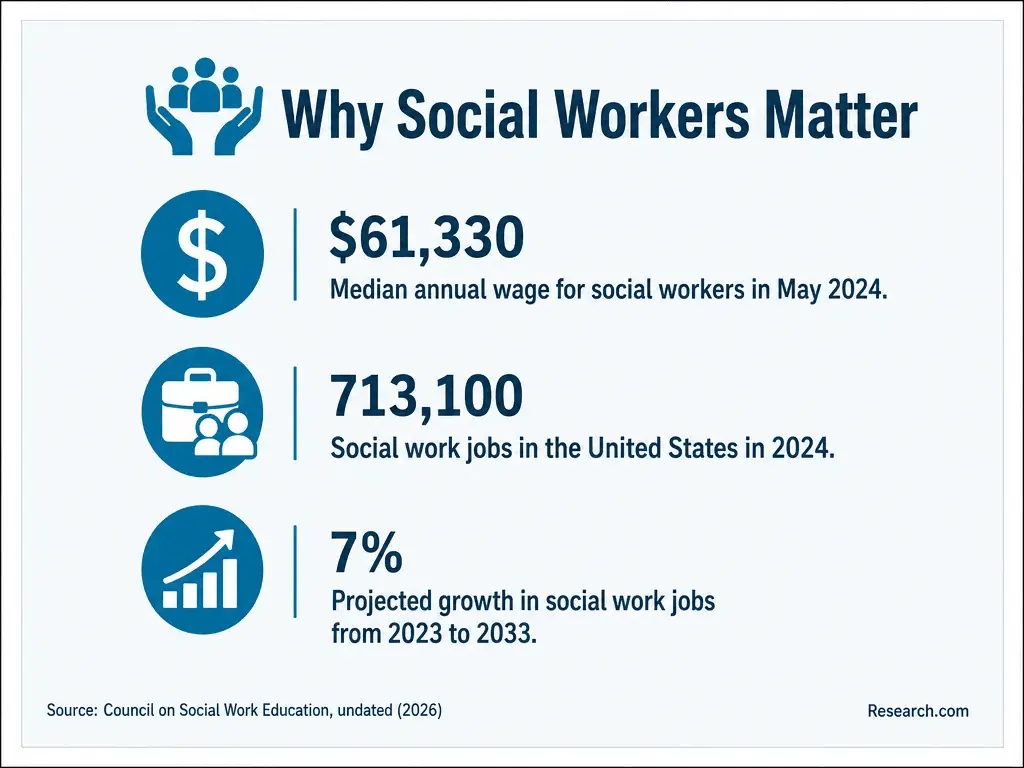
The U.S. Bureau of Labor Statistics reports the following May 2025 median annual wages and projected employment changes for 2025-2035. These occupational categories are more informative than a purported "mindfulness social worker" salary, which is not a distinct BLS occupation:
| BLS occupation | May 2025 median annual wage | Projected employment change, 2025-2035 |
| Social workers, all specialties | $61,780 | +6% |
| Child, family, and school social workers | $59,550 | +4% |
| Healthcare social workers | $67,880 | +8% |
| Mental health and substance abuse social workers | $60,280 | +10% |
The figures describe broad occupations, not pay for an MSW graduate, a particular license, or mindfulness training. Location, employer, experience, and duties can change an individual offer substantially.
Use state-level salary context for MSW careers alongside actual local job postings, then weigh any expected earnings against education costs and time away from paid work.
Other Things You Should Know About Social Work
Not necessarily. Check the course prerequisites. Personal practice may help you understand an exercise, but it does not replace instruction, feedback, or competence in using it with others.
No. Mindfulness can be taught in secular terms. Practitioners should still respect a client's beliefs and avoid assuming that any exercise is culturally neutral or welcome.
Possibly, if the school and agency approve an appropriately scoped learning objective. Obtain permission before involving clients or using agency information, and report learning rather than claiming unverified outcomes.
Not simply because the exercise was used. Billing depends on the payer's rules, the covered service, documentation, the clinician's qualifications, and applicable law. Check with the employer and payer before submitting a claim.
- Mindfulness-Based Interventions for Anxiety and Depression | nih.gov https://pmc.ncbi.nlm.nih.gov/articles/PMC5679245/
- Table 2. Scope of Practice, by Mental Health Provider Type | congress.gov https://www.congress.gov/crs_external_products/R/HTML/R43255.web.html
- What Is the Difference Between Psychologists, Psychiatrists and Social Workers? | apa.org https://www.apa.org/ptsd-guideline/patients-and-families/psychotherapy-professionals
- Clinical Social Worker vs Therapist | Palo Alto University https://paloaltou.edu/resources/blog/clinical-social-worker-vs-therapist
- MSW Core Competencies - Department of Social Work | Graduate Program (MSW) https://socialwork.appstate.edu/academic-programs/graduate-program-msw/msw-core-competencies
- The Nine CSWE Social Work Competencies | texascollege.edu https://www.texascollege.edu/the-nine-cswe-social-work-competencies
- Social Work Competencies: Advanced Level of Practice | Crown Family School of Social Work, Policy, and Practice https://crownschool.uchicago.edu/node/1435