2027 Long-Term Care Social Worker: Responsibilities, Education, and Career Fit
Audited and Verified:
Our Editorial and Data Verification Process
Research.com uses government datasets, official education statistics and primary institutional information to support its career and degree guides. Our review process checks factual accuracy, occupational definitions, source dates and the requirements associated with the credentials discussed.
How This Article Was Fact-Checked
Our editorial team verifies salary estimates, employment projections, education requirements and program information against original data providers and official organizations. Salary figures are checked against the relevant occupational definitions and reporting periods. Information about licensure, accreditation and required in-person training is reviewed separately.
Fact-checked and verified on:

Co-Founder and Chief Data Scientist
Long-term care social workers help residents and families navigate decisions that extend far beyond medical treatment: adjusting to a facility, protecting choice, coordinating services, and planning for transitions. If you are considering this career, the key distinction is between the work you want to do and the credential a particular facility and state require.
This guide explains the day-to-day role, education and licensing routes, pay and outlook, and the workplace questions worth asking before you commit to a job or degree.
Key Things You Should Know
- Long-term care social workers support residents' psychosocial needs, care planning, family communication, and transitions; they do not replace nurses, clinicians, or resident advocates.
- A large federally certified nursing facility - one with 120 or more beds - must employ a qualified social worker full time, but its federal qualification allows certain human services bachelor's degrees plus specified supervised healthcare experience; state rules and job requirements may be stricter.
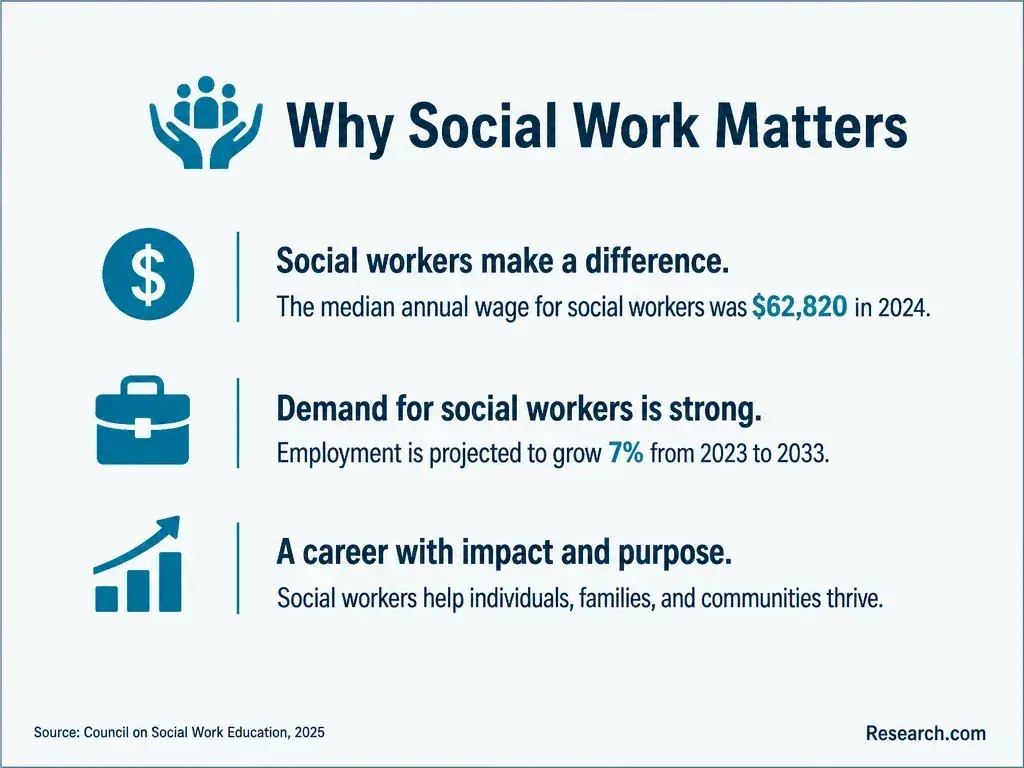
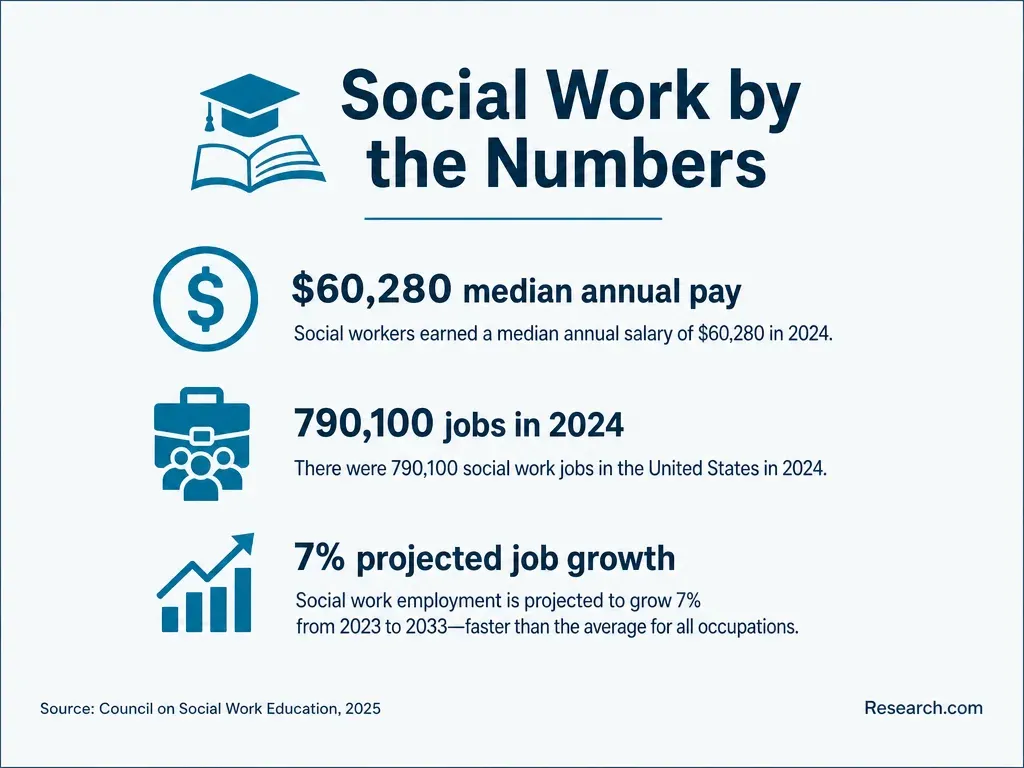
- The closest broad pay benchmark is healthcare social workers: the U.S. Bureau of Labor Statistics reports a May 2025 median annual wage of $67,880 and projects 8% employment growth from 2025 to 2035. Neither figure describes nursing-home jobs alone.
What does a long-term care social worker do?
A long-term care social worker addresses the social and emotional circumstances that affect a resident's well-being. In nursing facilities, that can mean learning the resident's preferences, contributing to an interdisciplinary care plan, helping resolve concerns, connecting people with benefits or community services, and coordinating a move to another care setting when appropriate. Similar work occurs in assisted living, continuing care communities, and other aging-services organizations, although staffing rules and job descriptions differ.
The work is both resident-facing and administrative. A social worker might meet with a new resident about the loss of independence, include a chosen family member in a care conference with the resident's permission, document follow-up, and coordinate with nursing or rehabilitation staff. They must take residents' choices seriously even when relatives and staff disagree. They should also know when a concern requires a clinical referral, a supervisor's involvement, or action under facility policy and applicable reporting rules.
Ask prospective employers how much time the position reserves for direct resident contact versus discharge coordination, documentation, and covering vacancies. If you are still studying, comparing online MSW field coordination models can help you ask whether a school can arrange learning opportunities with older adults and interdisciplinary care teams - not merely any available placement.
What degree do you need to become a long-term care social worker?
There is no single degree requirement for every long-term care position. For federally certified nursing facilities with 120 or more beds, the federal staffing rule requires a full-time qualified social worker. Its definition includes a bachelor's degree in social work or a human services field, such as gerontology or psychology, plus one year of supervised social work experience in a healthcare setting working directly with individuals. That rule is a facility staffing standard, not a promise that every applicant qualifies for a particular job or may use a protected professional title.
A BSW is a direct route to generalist social work preparation. An MSW may be preferred or required for positions involving more complex responsibilities, supervision, or employer-defined clinical duties. A person with another qualifying bachelor's degree may have a route into some social-services jobs, but should check the exact posting, state rules, and experience requirement before paying for another degree. If the goal is licensed clinical practice, an MSW may be part of the route, followed by additional state-specific steps; neither degree alone grants independent clinical authority.
A DSW or PhD is generally unnecessary for resident-facing entry. Someone considering senior practice leadership should compare the actual promotion requirements with the expense of further study; budget planning for a social work practice doctorate is relevant only if that advanced qualification serves a defined career goal.
Do long-term care social workers need a license or certification?
Not every long-term care social-services job requires a social work license. Requirements depend on the state, the employer, the job title, and the duties. A state may regulate use of "social worker" or specify qualifications for facility staff; an employer may prefer a licensed applicant even where the particular position does not require one. Providing psychotherapy or practicing independently under a clinical social work title is a separate question governed by state licensing rules.
Before applying, compare the posting with the state social work board's current rules and the state agency that regulates the facility. Ask the employer whether licensure is required at hire, whether a provisional or other category is accepted, and which duties are reserved for licensed staff. Voluntary aging-related training or certification can support professional development, but it does not substitute for a required state license. If an online MSW is part of your plan, check online MSW program eligibility by intended state before enrolling.
BLS projects 8% employment growth for healthcare social workers from 2025 to 2035, compared with 6% for social workers across all specialties. These are national occupational projections, not a forecast of openings in nursing facilities or a guarantee that a particular community will be hiring.
For a realistic local outlook, check recent facility postings for recurring requirements and ask employers whether vacancies reflect expansion, turnover, or a difficult-to-fill schedule. Compare pay against tuition and time away from work rather than assuming growth will repay an MSW. A review of online MSW costs and career outcomes is most useful when paired with the qualifications and wages of jobs you would actually pursue.
What are the admission requirements for social work degree programs?
BSW applicants generally apply to a college and may face a separate application or progression requirements for the social work major. Traditional MSW programs accept applicants with bachelor's degrees in various fields, subject to each school's academic and application standards. Advanced-standing MSW admission generally requires a qualifying BSW and may include recency or grade conditions; experience in a nursing facility does not by itself replace that requirement.
Expect schools to review transcripts and, depending on the program, an essay, references, a résumé, relevant experience, or specified prerequisites. Field onboarding can have separate conditions after admission. If you are changing careers from healthcare or human services, explain what you have learned from that work and what social work education would add. For a shortlist, comparing MSW GPA and prerequisite policies is a starting point; obtain each program's current written eligibility rules before applying.
Other Things You Should Know About Social Work
No. A facility social worker is part of the care team. A long-term care ombudsman is an independent advocate who helps residents address concerns about their care and rights.
Not simply by holding the job. The social worker can help communicate the resident's wishes and identify the authorized decision-maker; consent and decision-making authority depend on applicable law and the resident's circumstances.
Bring the resident's questions and priorities, contact information the resident agrees to share, and any relevant information about supports or an authorized representative. Ask how the resident will be included in decisions.
The social worker should listen to the resident, clarify who has decision-making authority, and seek appropriate team or supervisory guidance. Family preferences do not automatically override a resident's rights or choices.
- A Role for Social Workers in Improving Care Setting Transitions | nih.gov https://pmc.ncbi.nlm.nih.gov/articles/PMC5479582/
- Levels and Eligibility Requirements | North Carolina Social Work Certification and Licensure Board https://www.ncswboard.gov/levels-and-eligibility-requirements/
- eCFR:: 42 CFR Part 483 -- Requirements for States and Long Term Care Facilities https://www.ecfr.gov/current/title-42/chapter-IV/subchapter-G/part-483
- Social Work Salaries: Career Paths & Earning Potential | Virginia Commonwealth University https://onlinesocialwork.vcu.edu/blog/social-work-careers-salary-earning-potential/
- Understanding Social Worker Salary Ranges | Binghamton University, State University of New York https://careertools.binghamton.edu/blog/2025/03/04/understanding-social-worker-salary-ranges-what-to-expect-and-how-to-advance-your-career/
- Five Ways High Caseloads Hinder Social Work | Walden University https://www.waldenu.edu/online-masters-programs/master-of-social-work/resource/five-ways-high-caseloads-hinder-social-work
- Medical Social Worker - Explore Healthcare Careers | Mayo Clinic College of Medicine and Science https://college.mayo.edu/academics/explore-health-care-careers/careers-a-z/medical-social-worker/
- The social worker in interdisciplinary care planning | Johns Hopkins University https://pure.johnshopkins.edu/en/publications/the-social-worker-in-interdisciplinary-care-planning/
- Stress and burnout among social workers - a relation mediated by coping styles | Nature Index https://www.nature.com/articles/s41599-025-05780-1
- Essential Skills and Traits for Social Workers | buffalo.edu https://socialwork.buffalo.edu/admissions/is-social-work-right-career-for-me/list-of-essential-skills-in-social-work.html