2027 Homeless Outreach vs Supportive Housing Social Work: Comparing Service Models
Audited and Verified:
Our Editorial and Data Verification Process
Research.com uses government datasets, official education statistics and primary institutional information to support its career and degree guides. Our review process checks factual accuracy, occupational definitions, source dates and the requirements associated with the credentials discussed.
How This Article Was Fact-Checked
Our editorial team verifies salary estimates, employment projections, education requirements and program information against original data providers and official organizations. Salary figures are checked against the relevant occupational definitions and reporting periods. Information about licensure, accreditation and required in-person training is reviewed separately.
Fact-checked and verified on:

Co-Founder and Chief Data Scientist
Homeless outreach and supportive housing both help people secure and maintain housing, but the work happens at different points in that process. Outreach often starts with repeated contact in public spaces; supportive housing work usually centers on ongoing services after someone enters housing. For students, career changers, and early-career social workers, that difference affects daily routines, safety, supervision, and the training worth pursuing. This comparison explains how the roles operate, what employers may require, and how to test your fit before committing to a degree or job.
Key Things You Should Know
- Outreach emphasizes engagement before housing; supportive housing emphasizes tenancy stability and client-directed services after placement. Many agencies connect the two rather than treating them as competing approaches.
- A social work degree is not required for every position. Entry-level outreach and housing case-management jobs may accept other backgrounds; clinical duties and protected social work titles can require a state license.
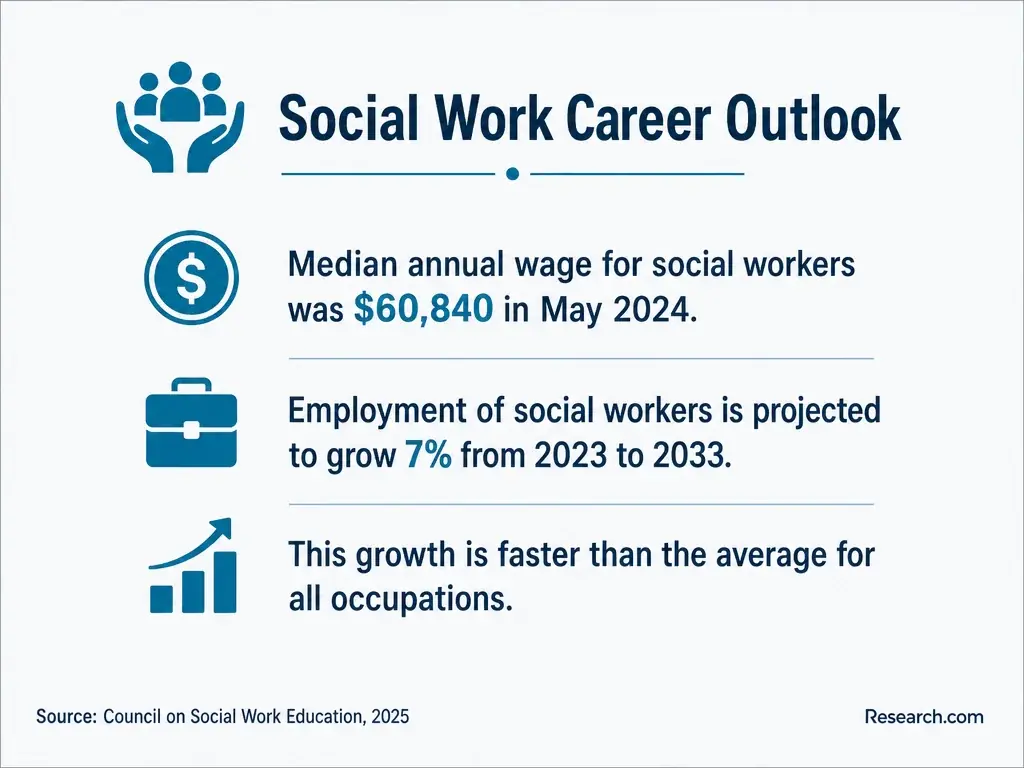
- Compare actual job postings, not just titles. BLS reports a $61,780 median annual wage for social workers across specialties in May 2025, but that figure does not describe every outreach worker or housing case manager.
How do homeless outreach and supportive housing social work differ?
Homeless outreach brings services to people experiencing homelessness, often before they have requested formal help. Staff build trust, assess immediate needs, and connect people with housing access systems, healthcare, benefits, and other resources. Supportive housing pairs housing with voluntary or otherwise program-defined support services intended to help residents maintain tenancy and pursue their own goals. Its exact eligibility and service rules depend on the housing program and funder.
The distinction is the worker's starting point, not the worthiness or complexity of the people served. This comparison shows how that starting point changes the job.
| Decision factor | Homeless outreach | Supportive housing |
| Typical setting | Streets, shelters, encampments, vehicles, and community locations | Residents' homes, housing sites, offices, and community locations |
| Primary relationship task | Establish contact and sustain engagement without assuming immediate acceptance of services | Maintain a working relationship while supporting tenancy and other resident-chosen goals |
| Common constraints | Travel, changing locations, weather, uncertain contact, and field safety | Housing rules, landlord relationships, maintenance issues, and ongoing caseload demands |
| Useful fit signal | Comfort with mobile, unpredictable work and gradual trust-building | Interest in sustained case coordination and housing-system problem-solving |
Choose outreach if you prefer meeting people where they are and can tolerate uncertain timelines. Choose supportive housing if you value continuing relationships and practical tenancy work. Some positions combine both; when choosing among online social work programs, ask whether field partners expose students to both sides of that transition.
What do social workers do in each service model?
Outreach staff may make repeated visits, offer supplies or referrals, help people navigate coordinated entry where it operates, and collaborate with shelters, healthcare teams, and housing providers. Engagement is not the same as promising an immediate housing placement. Workers must respect refusals, document contacts appropriately, and follow agency safety and confidentiality procedures.
In supportive housing, staff may help residents address benefits interruptions, connect with healthcare, understand tenancy obligations, respond to conflicts, or plan around an eviction risk. They should distinguish their support role from the landlord's authority and avoid making services feel coercive when participation is voluntary. Neither role automatically includes psychotherapy or independent clinical assessment.
For either model, ask an employer who handles crises, how paired visits and after-hours coverage work, what records staff must keep, and whether supervisors have housing-specific experience. Students can use MSW practicum site coordination questions to find placements with observable engagement, housing coordination, and supervision - not merely an agency whose name mentions homelessness.
What degree do you need for homeless outreach or supportive housing work?
Start with the duties and employer requirements, not the highest available degree. Some outreach worker, peer-support, navigator, and housing case-manager positions accept relevant experience or a human services background without a social work degree. A BSW provides generalist social work preparation and supervised field education; it can be a strong route into roles that specifically request a social work background. A guide to accredited undergraduate social work study can help you compare BSW options if that credential matches your target postings.
An MSW is more relevant when positions require graduate-level social work preparation, specialized practice, or eligibility for a state social work license. Applicants with a bachelor's degree in another field can generally pursue a traditional or foundation MSW if admitted; advanced standing normally requires a qualifying social work bachelor's degree and satisfaction of the program's additional rules. Neither route makes a graduate an independently licensed clinician upon graduation.
For a career changer, prior experience in community health, benefits navigation, advocacy, or property services may support an entry-level transition. Before paying for another degree, compare several local postings: if your target duties do not require a BSW, MSW, or license, supervised agency training may be the more direct next step.
The U.S. Bureau of Labor Statistics does not publish a single wage or growth series for "homeless outreach social workers" or "supportive housing social workers." Employers classify these jobs in different occupations. The following BLS social work figures provide context, not a pay comparison between the two service models.
| BLS occupation | May 2025 median annual wage | Projected employment growth, 2025-2035 |
| Social workers, all specialties | $61,780 | 6% |
| Mental health and substance abuse social workers | $60,280 | 10% |
| Healthcare social workers | $67,880 | 8% |
Those occupational categories may include workers serving people experiencing homelessness, but they also include many other settings. Non-social-work outreach and housing jobs may fall outside them entirely. For a useful comparison, collect local postings with similar degree, license, hours, and supervisory requirements; compare base pay with travel time, on-call duties, benefits, and advancement. Understanding location differences in MSW earnings can add geographic context, but it cannot substitute for an offer from a specific agency.
BSW applicants typically begin with institutional admission and may later need separate admission to the social work major or field sequence. Traditional MSW programs consider applicants from other bachelor's disciplines, although prerequisites and application materials vary. Advanced-standing MSW admission is a separate decision based on qualifying prior social work education and program-specific criteria - not simply relevant work experience.
Review each program's current requirements for transcripts, grades, essays, references, prerequisites, and field onboarding. If you are changing careers, describe transferable service or advocacy experience honestly while identifying what you still need to learn. Admission-focused online MSW comparisons can help identify options, but confirm requirements with each program before applying; an accessible admissions route does not guarantee admission or an appropriate housing placement.
How long do social work degrees take, and what do they cost?
A full-time BSW commonly fits within a four-year bachelor's degree, while a traditional full-time MSW often takes about two years after a bachelor's degree. Qualifying advanced-standing MSW students may have a shorter sequence. Part-time pacing, prerequisites, field scheduling, and transfer decisions can change any individual timeline.
For costs, compare each school's published tuition and fees using the credits you would actually need. Add books, screening, transportation, field-related lost wages, and possible licensing expenses. Request a written degree plan before assuming advanced standing or transfer credit will save money.
A DSW or PhD is generally unnecessary for entry into either service model. Doctoral study may serve a later leadership, practice-development, or research goal; even lower-cost online DSW programs represent an additional investment that should be judged against a specific role rather than treated as a housing-work requirement.
Other Things You Should Know About Social Work
Yes. Outreach experience can build engagement and referral skills. Ask prospective employers what tenancy-support knowledge, resident caseload experience, or housing-program training they expect.
No. A shelter generally provides temporary accommodation; supportive housing combines housing with services under a particular program model. Tenancy arrangements and service rules vary.
Ask about paired visits, check-in procedures, transportation, weather policies, incident reporting, and supervisor availability. Request the agency's actual protocols rather than relying on a general assurance that staff are supported.
Ask how many residents a worker supports, how needs are assessed, what administrative duties are included, and who responds to urgent tenancy issues. A caseload number alone does not reveal workload complexity.
- Improve Effectiveness of Homelessness Response Systems | United States Interagency Council on Homelessness https://www.usich.gov/federal-strategic-plan/improve-effectiveness-homelessness-response-systems
- Supportive housing for chronically homeless individuals - PMC https://pmc.ncbi.nlm.nih.gov/articles/PMC5734984/
- Homelessness Outreach Teams are being implemente | austintexas.gov https://services.austintexas.gov/edims/document.cfm
- 7. BHSA Components and Requirements | ca.gov https://policy-manual.mes.dhcs.ca.gov/behavioral-health-services-act-county-policy-manual/LIVE/7-bhsa-components-and-requirements
- Review of the New York City Department of Homeless Services' Programs and Services https://comptroller.nyc.gov/reports/review-of-the-new-york-city-department-of-homeless-services-programs-and-services/
- Human Services and Housing Supports to Address Family Homelessness: Promising Practices in the Field | ASPE https://aspe.hhs.gov/reports/human-services-housing-supports-address-family-homelessness-promising-practices-field-0
- A new day for housing and homelessness services in... - Metro https://www.oregonmetro.gov/stories/new-day-housing-and-homelessness-services-clackamas-county
- Housing Plus Services in Public Housing: A Narrative Review of Approaches and Evidence - Andrew Foell, 2026 https://journals.sagepub.com/doi/10.1177/10443894241296359
- Key Elements of Effective Street Outreach | pdx.edu https://omeka.pdx.edu/exhibits/show/outreach/keyelements
- Supportive Housing 101 | Corporation for Supportive Housing https://www.csh.org/supportive-housing-101/