2027 Foster Care Social Worker: Responsibilities, Education, and Career Fit
Audited and Verified:
Our Editorial and Data Verification Process
Research.com uses government datasets, official education statistics and primary institutional information to support its career and degree guides. Our review process checks factual accuracy, occupational definitions, source dates and the requirements associated with the credentials discussed.
How This Article Was Fact-Checked
Our editorial team verifies salary estimates, employment projections, education requirements and program information against original data providers and official organizations. Salary figures are checked against the relevant occupational definitions and reporting periods. Information about licensure, accreditation and required in-person training is reviewed separately.
Fact-checked and verified on:

Co-Founder and Chief Data Scientist
Foster care work brings together child safety, family support, court deadlines, and decisions that can change a child's life. If you are considering the role - whether you already work in human services or are choosing a degree - you need to know more than its job title. This guide explains the daily responsibilities, realistic entry routes, licensing differences, pay, and working conditions.
It also shows how to evaluate a social work program without assuming that an MSW, an online degree, or clinical training is required for every foster care position.
Key Things You Should Know
- Foster care workers coordinate services and document children's safety and well-being; their authority and duties depend on the agency and state.
- Some child welfare jobs accept a bachelor's degree in a related field, while positions titled social worker or involving clinical services may require a social work degree and state license.
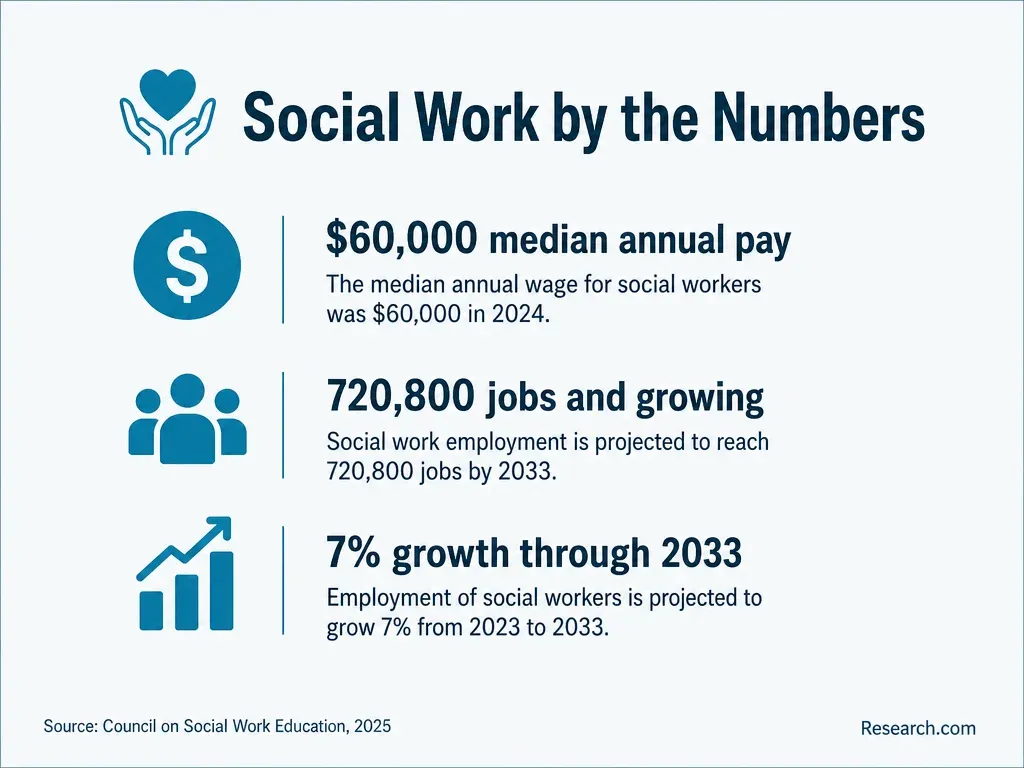
- The U.S. Bureau of Labor Statistics reports a $59,550 median annual wage for child, family, and school social workers in May 2025 and projects 4% employment growth from 2025 to 2035; neither figure predicts pay or openings at a particular foster care agency.
What does a foster care social worker do?
A foster care social worker helps coordinate care for a child living away from their parent or usual caregiver. Depending on the agency, the position may be called a foster care caseworker, permanency worker, placement worker, or child welfare social worker. Some workers are employed by public child welfare departments; others work for contracted agencies. Job titles do not establish identical duties or legal authority across states.
Typical work includes visiting children and caregivers, assessing needs and safety within agency procedures, arranging medical and educational services, supporting family contact, helping parents access services, documenting progress, and preparing information for case reviews or court.
Workers may coordinate with relatives, foster parents, schools, attorneys, and clinicians while pursuing the permanency goal established through the child welfare process. That goal may involve reunification, guardianship, or adoption; the worker does not decide a court outcome alone.
Foster care case management is not the same as providing psychotherapy. If your goal is to treat children or families clinically, comparing clinical Master of Social Work pathways is more relevant than assuming a foster care position will provide clinical practice. In either role, confidentiality, careful records, cultural responsiveness, and consultation about safety concerns are essential.
How do you become a foster care social worker?
Start with actual vacancies in the state and agency where you want to work. A public-agency caseworker classification may accept several bachelor's majors, while a position using a protected social worker title may require a social work degree or license. Your existing experience in education, healthcare, community services, or family support can strengthen an application, but it does not replace a required credential.
A practical entry sequence is:
- Compare several local job postings for degree requirements, license rules, driving and travel expectations, on-call duties, and civil-service eligibility.
- Choose the least extensive qualifying education route, then seek approved field experience or entry-level work with children and families.
- Complete the employer's screening, orientation, safety, documentation, and child welfare training before taking on assigned duties.
- Ask how new workers receive supervision, caseload support, and consultation on complex family and court matters.
If you already hold a bachelor's degree outside social work, a traditional or foundation MSW may be possible without earning a second bachelor's degree. A non-BSW degree generally does not qualify you for advanced standing; program-specific social work master's eligibility comparisons can help you identify which entry route to ask about.
What degree do foster care social workers need?
There is no single degree requirement for every foster care job. The answer depends on the employer's classification, the state's title and licensing rules, and whether the work is case management, clinical treatment, or supervision. Compare education against the job you intend to apply for - not against the most advanced degree available.
The routes below show where additional education is most likely to change your options.
| Education route | Potential fit | Important limit |
| Related bachelor's degree | Some child welfare caseworker and family-service roles | May not meet social worker title, license, or MSW advanced-standing requirements |
| BSW | Generalist social work preparation and roles that specify a social work degree | Does not itself confer a state license |
| Traditional or foundation MSW | Graduate social work preparation for applicants with an eligible bachelor's degree | Clinical authority requires any applicable license and additional requirements |
| Advanced-standing MSW | A shorter MSW route for applicants with a qualifying BSW who meet program rules | Not available solely on the basis of related work or a different major |
If postings you want accept your current degree, employer training and relevant experience may be more direct than another degree. If they require a BSW or MSW, compare social work degree options and program formats against that requirement. A DSW or PhD is not an entry credential for foster care casework; consider doctoral study only for a distinct later goal, such as practice leadership or research.
The closest broad federal wage category is child, family, and school social workers, which includes workers outside foster care. The U.S. Bureau of Labor Statistics reports a May 2025 median annual wage of $59,550 for that occupation and projects 4% employment growth from 2025 to 2035. The median means half of workers in the occupation earned more and half earned less; it is not a starting salary or a foster care-specific figure.
Actual offers depend on the state, public-sector pay grade or agency contract, experience, required credentials, and duties. A job classified as social and human service assistant may fall under a different wage category altogether. For a realistic decision, compare local postings' pay ranges with travel, on-call expectations, benefits, and advancement rules. Social work salary differences across states offer geographic context, but they cannot substitute for an offer from your target employer.
How long does a social work degree take, and what does it cost?
A full-time BSW commonly follows a four-year bachelor's sequence, though accepted transfer credit can change the time remaining. A traditional MSW often takes about two years of full-time study; an eligible student may complete an advanced-standing MSW in a shorter sequence. Part-time enrollment, course availability, and placement schedules can extend any route. Confirm the school's actual credit and field requirements rather than relying on a typical timeline.
Calculate total cost to completion, not tuition alone: include required fees, books, screening, placement travel, technology, and any reduction in paid work during field education. Compare that figure with the qualifications in local job postings. If your current bachelor's degree already qualifies you for the role you want, entering the workforce and using employer-supported training may cost less than earning an MSW first.
Doctoral tuition is not a necessary foster care entry expense. If you later pursue practice leadership, online DSW study with cost in mind requires a separate assessment of tuition, time away from work, and whether the credential serves a specific career goal.
Other Things You Should Know About Social Work
No. Agencies use different job titles and qualifications. Check the position's classification and your state's rules before describing an unlicensed role as licensed social work.
No worker makes that decision alone. Workers document information and make recommendations within an agency and legal process; courts and authorized parties have distinct responsibilities.
Possibly, but an agency must assess conflicts of interest, confidentiality, and assignment restrictions. Ask the employer about its policy before accepting a position or placement.
It may. Visits, family schedules, urgent needs, and on-call rotations vary by role. Request the expected schedule and after-hours policy during the hiring process.
- State of Delaware - Child Welfare Caseloads Report https://courts.delaware.gov/forms/download.aspx
- DFPS - A Parent's Guide To Foster Care https://www.dfps.texas.gov/Child_Protection/Foster_Care/Parents_Guide.asp
- Permanency | Child Welfare Information Gateway https://www.childwelfare.gov/topics/permanency
- Assessing the Context of Permanency and Reunification in the Foster Care System | ASPE https://aspe.hhs.gov/reports/assessing-context-permanency-reunification-foster-care-system
- Essential Skills and Traits for Social Workers | buffalo.edu https://socialwork.buffalo.edu/admissions/is-social-work-right-career-for-me/list-of-essential-skills-in-social-work.html
- Foster Care Social Worker | CU Online https://online.campbellsville.edu/career-outcomes/foster-care-social-worker/
- Types of Social Workers: Exploring the Many Fields in Which They Serve | UMass Global https://www.umassglobal.edu/blog-news/types-of-social-workers
- Types of Social Work | socialworkers.org https://www.socialworkers.org/News/Facts/Types-of-Social-Work
- Social Worker Jobs in Child Welfare: Roles, Pay, Day-to-Day | socialworkers.org https://joblink.socialworkers.org/career-resources/find-the-job-5/social-worker-jobs-in-child-welfare-roles-pay-day-to-day-65