2027 Documenting Referral Outcomes in Social Work: Closing the Communication Loop
Audited and Verified:
Our Editorial and Data Verification Process
Research.com uses government datasets, official education statistics and primary institutional information to support its career and degree guides. Our review process checks factual accuracy, occupational definitions, source dates and the requirements associated with the credentials discussed.
How This Article Was Fact-Checked
Our editorial team verifies salary estimates, employment projections, education requirements and program information against original data providers and official organizations. Salary figures are checked against the relevant occupational definitions and reporting periods. Information about licensure, accreditation and required in-person training is reviewed separately.
Fact-checked and verified on:

Co-Founder and Chief Data Scientist
A referral is not complete merely because a phone number was given or an application was sent. For social workers and human services staff, the next decision is what to check, when to follow up, and how to record the result without overstating what happened.
This guide explains closed-loop referrals, provides an adaptable outcome note, and shows how to handle unanswered contacts, service barriers, and confidentiality. Students and early-career practitioners can use it to build a documentation process that supports client choice and gives the next team member a reliable starting point.
Key Things You Should Know
- Record the referral, the follow-up attempt, and the verified outcome as separate events; "referral sent" does not mean "service received."
- Use a small set of clear statuses, such as pending, appointment scheduled, service started, declined, unavailable, and unable to confirm, and document the evidence behind each status.
- Share only information permitted by the client's authorization and applicable rules; assign an owner and a next review date to every unresolved referral.
What are closed-loop referrals in social work?
A closed-loop referral is a referral process in which someone checks what happened after connecting a client with another service and records the result.
The loop may end with confirmed service, an informed decision to decline, a documented alternative, or a clear explanation that the outcome could not be verified. It does not require a successful enrollment to be closed honestly.
Consider the difference between "housing program information provided," "application submitted," and "housing assistance approved." Each describes a different stage, and only the last confirms that assistance was approved.
A reliable record preserves those distinctions so the client does not have to reconstruct the process for every new worker. Referral coordination is part of many roles described in understanding work opportunities associated with an MSW, although a specific job's duties depend on its setting and qualifications.
What information should social workers document about referral outcomes?
Document enough to show what the client wanted, what the worker did, what is known, and what remains uncertain. Agency templates and setting-specific rules may require additional fields, but a useful referral record separates the following facts:
- Purpose and choice: The need or client-identified goal, options discussed, and whether the client agreed to the referral.
- Referral details: The receiving organization or program, contact method, date, eligibility or access requirements discussed, and information shared under the applicable authorization.
- Follow-up evidence: Who contacted whom, when, by what permitted method, and what the client or provider actually reported.
- Outcome and next action: A specific status, its source, any barrier or alternative, the person responsible for the next step, and a review date if unresolved.
Use attributed language when verification is incomplete: "Client reports attending an intake" is more precise than "services established" if the program has not confirmed enrollment. Record relevant barriers, such as cost, language access, transportation, waitlists, or eligibility, without assigning blame.
For students learning these habits, a guide to accredited undergraduate social work study can help distinguish generalist preparation from the agency-specific recordkeeping learned in placement and onboarding.
How do social workers follow up and close the referral loop?
Set the follow-up plan when making the referral rather than waiting for the client to reappear. Timing should reflect urgency, client preference, program response times, workload, and agency policy; a routine waitlist inquiry and a time-sensitive discharge need should not automatically share a schedule:
- Agree with the client on the referral goal, preferred contact method, and who will take the first step.
- Send or facilitate the referral using an approved channel, and record what was actually transmitted.
- Set an owner and review date; use agency procedures for escalation when a time-sensitive need is not progressing.
- Check with the client and, when authorized and appropriate, the receiving organization; distinguish a scheduled appointment from attendance or service initiation.
- Record the verified result, address barriers or offer an alternative with the client, and close or reassign the task according to agency policy.
A "warm handoff" may make access easier, but it is not proof that services began. Students can practice this distinction with their field instructor; MSW field placement support and student responsibilities matter when evaluating whether a program can help them develop supervised coordination skills.
The following is a fictional training example, not a real client record or a required agency format. It shows an outcome that can be closed without claiming the referred service was delivered.
Referral outcome note: Client requested help locating a food assistance program and agreed to receive contact information for Community Pantry A. On April 3, worker provided the program's public intake number and discussed its stated intake hours; no client information was sent to the program.
On April 8, client reported calling and learning that intake appointments were unavailable this month. Worker offered information about Community Pantry B; client chose to call independently and requested no provider contact by the worker.
Outcome for Community Pantry A: unavailable, based on client report. Worker will ask at the next scheduled contact whether the client wants further assistance. No food assistance receipt has been verified.
The note identifies its information source, respects the client's choice, and leaves the new option open rather than silently treating it as completed.
It is a service-coordination note, not a record of qualifying clinical supervision or practice hours. Readers tracking a separate licensure pathway should distinguish it from clinical hours and social work professional preparation.
Permission to discuss options with a client is not automatically permission to disclose their information to another organization. Before sharing, check the legal basis, the client's authorization when required, its scope and duration, and the agency's approved communication method. Record the authorization or other permitted basis without copying unnecessary sensitive details into a referral log.
Rules vary by setting and information type. Health records, substance use treatment information, school records, and child welfare records can be subject to different federal, state, and agency requirements. Some disclosures may be permitted or required without authorization; a general article cannot determine that for an individual case.
Consult a supervisor, privacy officer, or current governing policy when uncertain. Limit access to the tracking record, and avoid placing sensitive details in unsecured email, calendar descriptions, or shared spreadsheets.
Ethical confidentiality duties and legal permission to practice are separate questions. For a student or practitioner assessing a degree-to-license pathway, verifying social work degree recognition with a state board is necessary; documentation training alone does not establish license eligibility or scope.
What are the career options, salaries, and job outlook for social workers?
Referral follow-through is relevant in healthcare discharge planning, child and family services, behavioral health, housing, and community agencies. The work may involve coordinating services, identifying access barriers, documenting outcomes, and communicating with other providers within the worker's role.
Employers may seek a BSW, an MSW, a particular state license, or adjacent human services experience; the job posting and governing rules matter more than the referral task alone.
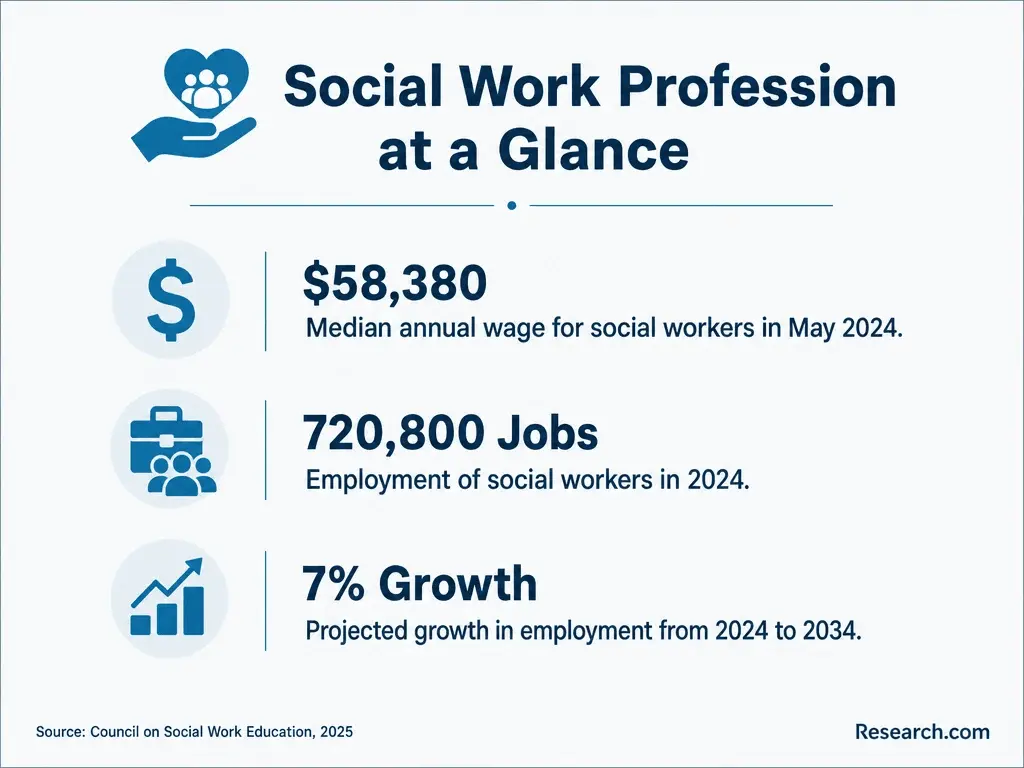
U.S. Bureau of Labor Statistics figures below provide occupational context, not a salary prediction for a referral coordinator, new graduate, or license holder. The categories span different employers, duties, and qualifications:
| BLS occupation | May 2025 median annual pay | Projected employment growth, 2025-2035 |
| Child, family, and school social workers | $59,550 | 4% |
| Healthcare social workers | $67,880 | 8% |
| Mental health and substance abuse social workers | $60,280 | 10% |
Use those figures to compare occupational settings, then examine local job requirements, caseloads, supervision, and documentation time. A state-level social work pay comparison guide can add geographic context, but neither state nor national medians guarantee an individual offer.
Other Things You Should Know About Social Work
Follow the agency's retention schedule and applicable state, federal, contract, and record-type rules. Do not set a personal deletion schedule for case notes or trackers.
Clients may have rights to request access or an amendment under applicable law and agency policy. Route the request through the official records process; do not quietly overwrite the original entry.
Often, yes, if the employer permits the role and provides appropriate training and supervision. Documentation duties do not confer a protected social work title or clinical practice authority.
Use a clearly labeled fictional or otherwise properly approved example. Removing a name alone may not adequately protect a real client or satisfy agency restrictions on record use.
- Health center strategies to document and track social needs referrals in the EHR - PMC https://pmc.ncbi.nlm.nih.gov/articles/PMC11972823/
- Section 3: Client Intake Process | mcleancountyil.gov https://www.mcleancountyil.gov/DocumentCenter/View/28072/Section-3-Referrals
- Informed Consent - StatPearls - NCBI Bookshelf - NIH https://www.ncbi.nlm.nih.gov/books/NBK430827/
- eCFR:: 42 CFR Part 2 -- Confidentiality of Substance Use Disorder Patient Records https://www.ecfr.gov/current/title-42/chapter-I/subchapter-A/part-2
- Summary of the HIPAA Privacy Rule | hhs.gov https://www.hhs.gov/hipaa/for-professionals/privacy/laws-regulations/index.html
- NASW Standards for Social Work Case Management | nycourts.gov https://www.nycourts.gov/reporter/webdocs/nasw_standards_socialwork_casemgt.htm
- Closed-Loop Referrals (CLR) Implementation Guidance - DHCS https://www.dhcs.ca.gov/file/2-10-2024-clr-all-comer-webinar-pdf/
- Social care best practices: Learnings from a technology-enabled closed-loop referral network | SIREN https://sirenetwork.ucsf.edu/tools-resources/resources/social-care-best-practices-learnings-technology-enabled-closed-loop
- NASW Standards for Social Work Case Management | socialworkers.org https://www.socialworkers.org/Practice/NASW-Practice-Standards-Guidelines/NASW-Standards-for-Social-Work-Case-Management