2027 Cost-Effectiveness Analysis in Social Work Research: Comparing Resources and Program Outcomes
Audited and Verified:
Our Editorial and Data Verification Process
Research.com uses government datasets, official education statistics and primary institutional information to support its career and degree guides. Our review process checks factual accuracy, occupational definitions, source dates and the requirements associated with the credentials discussed.
How This Article Was Fact-Checked
Our editorial team verifies salary estimates, employment projections, education requirements and program information against original data providers and official organizations. Salary figures are checked against the relevant occupational definitions and reporting periods. Information about licensure, accreditation and required in-person training is reviewed separately.
Fact-checked and verified on:

Co-Founder and Chief Data Scientist
A social work program can improve outcomes and still be the wrong investment if its added benefits do not justify the resources it consumes. Cost-effectiveness analysis helps researchers and agency leaders compare alternatives using a defined outcome, a consistent accounting of costs, and evidence about who benefits.
This guide is for social work students, evaluators, and human services professionals deciding how to study or use the method. You will learn how to design a defensible comparison, interpret its results, and decide whether you need a social work degree, targeted methods training, or a research-focused pathway.
Key Things You Should Know
- Cost-effectiveness analysis compares the difference in costs with the difference in a shared outcome; it does not establish that the cheapest program is best.
- An illustrative program costing $130,000 and producing 80 successful outcomes, compared with one costing $90,000 and producing 60, has an incremental cost of $2,000 per additional successful outcome.
- Comparable populations, a stated time horizon, credible outcome evidence, and sensitivity and equity analyses matter more than a precise-looking ratio; an MSW or doctorate is not required for every evaluation job.
What is cost-effectiveness analysis in social work research?
Cost-effectiveness analysis (CEA) compares the resources used by two or more options with their effects measured in the same nonmonetary unit. A housing agency might calculate the cost per additional household remaining stably housed after 12 months. A child welfare agency might compare the cost per additional family meeting a prespecified reunification outcome. The alternatives must be realistic choices, such as a new program versus existing services - not a hypothetical absence of support when that is neither ethical nor feasible.
CEA differs from cost-benefit analysis, which assigns monetary values to benefits, and from cost-minimization, which assumes outcomes are equivalent. It also differs from a program's average cost per participant: an agency deciding whether to replace an existing service needs to know what the additional spending achieves. If programs pursue fundamentally different goals, a single cost-per-outcome ranking may be misleading.
The unit of analysis must follow the decision. Evaluating whether a clinical training investment improves service outcomes, for example, is different from comparing tuition for online clinical social work education pathways. Neither the training cost nor a graduate's credential, by itself, demonstrates improved client outcomes.
How do researchers conduct a cost-effectiveness analysis of social work programs?
Start with the decision the agency can actually make and specify the comparison before examining results. The following sequence keeps the analysis tied to that decision rather than to whichever data are easiest to collect.
- Define alternatives and population: Specify eligibility, usual services, referral pathways, implementation sites, and whether clients can receive both options.
- Choose perspective and horizon: Decide whose costs count - agency, public funder, participants, or society - and how long costs and outcomes will be followed.
- Prespecify outcomes: Select a meaningful primary measure, its denominator, assessment dates, and how missing observations will be handled.
- Estimate effects credibly: Use a randomized design where feasible or a well-justified comparison design; assess baseline differences, selection into services, and changes occurring outside the program.
- Collect resource use and prices: Record actual staff time, training, overhead, participant burdens, and other costs consistent with the chosen perspective.
- Calculate incremental results and test assumptions: Report cost and effect differences, uncertainty, subgroup findings, and implementation limitations alongside any ratio.
Agency records can support an evaluation only if access, privacy safeguards, data quality, and appropriate institutional or agency oversight are established. A university, agency, or institutional review board may need to determine whether a project is research, program evaluation, or quality improvement; the label alone does not settle obligations. For student-led work, placement access and approved learning tasks must be confirmed before planning data collection. Resources on planning local placements through an online MSW program may help students assess logistical support, but enrollment never substitutes for agency permission to use records.
Which costs and outcomes are measured in social work program evaluations?
Include costs that differ between the alternatives and fall within the declared perspective. Distinguish a budget expense from an opportunity cost: donated space may not appear in an agency ledger but still uses a resource that could serve another purpose. The table shows common measures and the decision each one supports.
| Measure | Examples | Important qualification |
| Program costs | Staff time, benefits, supervision, training, technology, space, administration | Allocate shared overhead consistently; avoid counting the same expense twice. |
| Other service costs | Emergency shelter, hospital use, contracted care, referrals | Include only when the perspective covers these services and use is measured reliably. |
| Participant and family costs | Travel, caregiving, time away from work | Relevant to a societal perspective; these costs may be absent from agency accounts. |
| Program outcomes | Stable housing, school attendance, service engagement, validated well-being measure | Define success in advance and report both the count and its denominator. |
Use the same price year and costing rules for each option. Salaries in a budget should reflect the actual staffing mix and local compensation, not a national median substituted for an agency payroll figure. For geographically dispersed projects, social work salary differences across states illustrate why one wage assumption may poorly represent every site.
A narrow outcome can hide important trade-offs. More service engagement, for instance, is not automatically better well-being; record adverse effects and access barriers separately. State whether the estimate reflects everyone offered the program or only those who participated, because those denominators answer different questions.
The incremental cost-effectiveness ratio (ICER) is (cost of new option − cost of comparator) ÷ (outcomes with new option − outcomes with comparator). It expresses the extra cost per extra unit of effect. Compare costs and effects for the same population and period; when follow-up spans multiple years, explain any discounting of future amounts.
Consider a hypothetical evaluation of two services, each offered to 100 eligible households over 12 months. These figures demonstrate the calculation; they are not observed agency findings.
| Option | Total cost | Households meeting stable-housing outcome |
| Existing service | $90,000 | 60 of 100 |
| New service | $130,000 | 80 of 100 |
The new service costs $40,000 more and produces 20 additional successful outcomes: $40,000 ÷ 20 = $2,000 per additional household meeting the outcome. Whether that is worthwhile depends on the decision-maker's budget, the value placed on the outcome, competing uses of funds, and confidence in the estimated difference. If a new option costs less and works better, it dominates the comparator; if it costs more and works worse, it is dominated. When effects are equal or their estimated difference is near zero, a ratio can be undefined or unstable - report the underlying differences instead.
The same incremental logic can inform education decisions, but the outcome must be defensible. A shorter route is not automatically more effective: online MSW timelines for working students describe scheduling possibilities, not evidence that accelerated study produces better practice or research outcomes.
Good examples specify both a realistic alternative and an outcome that matters to the people served. These are illustrative study designs, not claims of proven program results.
| Decision | Possible comparison | Primary effectiveness measure | Key interpretation risk |
| Housing support | Enhanced navigation versus existing referral services | Additional households stably housed at 12 months | Housing supply may change independently of service quality. |
| Child welfare support | Intensive family support versus standard case management | Additional children meeting a prespecified safe, sustained permanency outcome | A faster case closure alone may not indicate safety. |
| Agency workforce development | New staff training plus supervision versus existing onboarding | Additional staff meeting a validated practice-competency standard | Competency scores may not establish better client outcomes. |
Educational programs can also be evaluated, provided researchers do not confuse access measures with service effects. For example, comparing online social work degree programs on tuition alone is not a CEA of client services. An education-focused analysis would need comparable student cohorts, total educational costs, and a prespecified outcome such as completion; claims about later client outcomes would require additional evidence.

An overall ICER can conceal who receives the benefits and who bears the costs. Report access, retention, outcomes, and participant burdens across relevant groups when sample size and privacy protections allow. An option with a favorable average ratio might worsen access for rural clients, people who need language assistance, or those unable to attend during work hours. Equity is not necessarily captured by adding these differences to one numerical score; decision-makers can report them alongside the ICER and set explicit access requirements.
Uncertainty comes from sampling, missing records, uncertain staff time, shifting service prices, and assumptions about what would have happened without the program. Vary influential inputs, examine plausible missing-data scenarios, and report uncertainty around both incremental costs and effects. If conclusions reverse when a modest assumption changes, the honest finding is that the choice is sensitive - not that the most favorable scenario has been proved.
Capacity to conduct evaluations has an equity dimension, too: small agencies may lack protected staff time or funds for advanced study. Before financing a doctorate solely to learn CEA, compare employer-supported methods training, collaboration with an evaluator, and the total price of a program. Listings of lower-cost online DSW programs can inform that comparison, but a lower advertised tuition does not establish lower total cost or stronger evaluation training.
The right route depends on whether you need social work practice preparation, an advanced research role, or simply stronger evaluation skills. The ranges below are broad planning guides for full-time study, not promises about a particular school or an applicant's transfer credit.
| Route | Typical entry consideration | Planning length | Cost items to check |
| BSW | Institutional admission and, where applicable, admission to the social work major | Often about four years from first-year entry | Tuition, fees, field travel, and reduced work time |
| Traditional MSW | Bachelor's degree; program-specific academic and application requirements | Often about two years full time | Foundation and specialized study, field costs, and foregone earnings |
| Advanced-standing MSW | Qualifying BSW and program-specific eligibility review | Often about one year full time | Intensive course and field schedule, fees, and lost work hours |
| DSW or PhD | Program-specific prior degree, experience, research preparation, and faculty-fit criteria | Varies substantially by program and dissertation or project progress | Tuition or funding terms, required work, research expenses, and continuation costs |
| Standalone methods training | Prerequisites vary by course or certificate | Varies; may be completed alongside employment | Course price, software access, and time for applied practice |
Admissions officers can clarify statistics prerequisites, writing samples, prior service expectations, and available research opportunities. Applicants exploring attainable entry requirements for MSW applicants should still verify the exact track and its field expectations; admission does not guarantee access to a preferred agency dataset or evaluation project.
Compare total cost to completion, not price per credit alone. Request a program-specific estimate covering fees, required visits, placement travel, technology, and likely changes to paid work. For doctoral offers, get funding duration, work obligations, and continuation charges in writing. If the immediate goal is to calculate and explain ICERs at an agency, a supervised project or targeted methods course may be a better first expense than another degree.
What careers use cost-effectiveness analysis in social work, and what do they pay?
CEA appears in program evaluator, research associate, policy analyst, quality-improvement, and agency leadership work. Duties may include defining outcomes with community partners, obtaining authorized data, costing service delivery, testing assumptions, and explaining results to funders without overstating causality. Some positions require an MSW or social work experience; others prioritize quantitative skills and may accept public health, policy, economics, or related preparation. Clinical licensure is not generally a prerequisite for analyzing program costs, although it may be required for separate practice duties.
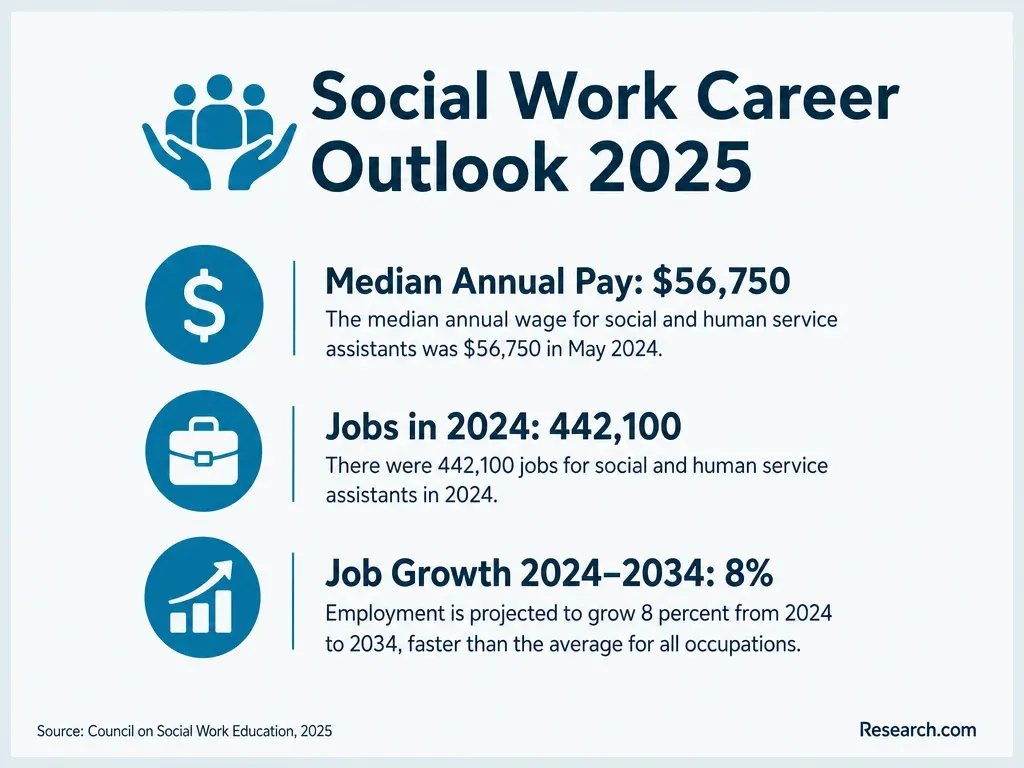
Wage data should match the job being considered. The U.S. Bureau of Labor Statistics reports a May 2025 median annual wage of $61,780 for social workers across specialties and projects 6% employment growth from 2025 to 2035. Those figures describe a broad occupation, not a salary or growth forecast for program evaluators, MSW graduates, or doctoral researchers. Employers may classify evaluator roles under other occupations; compare the actual job description, location, pay grade, and required qualifications. For a broader view of roles, see exploring professional opportunities after MSW study.
If you already work in human services, a practical next step is to propose a small, approved comparison using a clearly defined outcome and nonidentifiable or properly authorized data. Ask a supervisor or research partner to review the comparator, costing perspective, and privacy plan. That work can reveal whether your next gap is statistical training, agency leadership experience, an MSW for a target role, or sustained doctoral research preparation.
Other Things You Should Know About Social Work
Possibly, but describe it as transferred evidence rather than a local result. Check whether the population, usual services, implementation, outcome definition, and follow-up period are sufficiently similar, then test how the decision changes under less favorable effects.
There is no universal minimum. Sample planning depends on the expected outcome difference, variation, study design, missing data, and precision needed for the decision. Seek statistical input before collecting records.
No. A carefully audited spreadsheet can support a simple comparison. More complex designs and uncertainty analyses may warrant statistical software, reproducible code, and independent review.
Include people responsible for services, finance, data governance, and evaluation, as well as community or participant representatives when appropriate. They can identify missing costs, misleading outcomes, privacy concerns, and implementation barriers before a funding decision is made.
- Cost-Benefit Analysis versus Cost-Effectiveness... - PMC - NIH https://pmc.ncbi.nlm.nih.gov/articles/PMC10001534/
- Cost-Effectiveness Analysis | POLARIS https://www.cdc.gov/polaris/php/economics/cost-effectiveness.html
- Cost-Effectiveness Analysis - HERC https://www.herc.research.va.gov/include/page.asp
- Cost-effectiveness analysis - Health system efficiency - NCBI https://www.ncbi.nlm.nih.gov/books/NBK436886/
- categories and approaches to costing | Implementation Science https://link.springer.com/article/10.1186/s13012-021-01172-6
- Cost effectiveness analysis | betterevaluation.org https://www.betterevaluation.org/methods-approaches/methods/cost-effectiveness-analysis
- The cost of caregiving is hard to measure. Here's a way to do it well. | Institute for Health Metrics and Evaluation https://www.healthdata.org/news-events/insights-blog/acting-data/cost-caregiving-hard-measure-heres-way-do-it-well