2027 Completing an MSW in One State and Seeking Licensure in Another
Audited and Verified:
Our Editorial and Data Verification Process
Research.com uses government datasets, official education statistics and primary institutional information to support its career and degree guides. Our review process checks factual accuracy, occupational definitions, source dates and the requirements associated with the credentials discussed.
How This Article Was Fact-Checked
Our editorial team verifies salary estimates, employment projections, education requirements and program information against original data providers and official organizations. Salary figures are checked against the relevant occupational definitions and reporting periods. Information about licensure, accreditation and required in-person training is reviewed separately.
Fact-checked and verified on:

Co-Founder and Chief Data Scientist
Choosing an MSW program across state lines can affect more than where you attend classes. The state where you plan to practice decides whether your education qualifies for a license, what else you must complete, and when you may begin clinical work. This guide is for prospective MSW students, new graduates, and social workers planning a move.
It explains how to check a program before enrolling, arrange field education, apply for an initial license, and avoid mistaking a degree - or another state's license - for permission to practice.
Key Things You Should Know
- Yes. An MSW earned in one state can support licensure in another, but the intended licensing state's board decides whether your education and other qualifications meet its rules.
- Check three separate matters before enrolling: the program's accreditation, its ability to support field education where you live, and the destination board's requirements for your intended license category.
- MSW field hours do not automatically count as post-degree clinical supervision; an out-of-state license also does not automatically authorize practice after a move or across a state line.
Can you earn an MSW in one state and become licensed in another?
Yes. Social work licensure is issued by states, not by the state where a university happens to be located. A graduate of an appropriately accredited MSW program may be eligible to apply elsewhere, provided the destination state accepts the education and the applicant meets its requirements for the specific license sought.
That distinction matters because "licensed social worker" is not one uniform credential. States use different license titles and may set different rules for entry-level MSW practice, supervised clinical practice, and independent clinical practice. Graduation, eligibility to sit for an exam, passing an exam, and issuance of a license are separate events.
For MSW licensure alignment before enrollment, start with the board in the state where you expect to work - not only the program's description of its graduates' options.
How do MSW accreditation and coursework requirements vary by state?
The Council on Social Work Education (CSWE) accredits social work programs; institutional accreditation applies to the university as a whole. Many boards look for a CSWE-accredited MSW, but applicants should check the destination board's exact educational rule, including how it treats the program's accreditation status for their graduation cohort. A school's ability to enroll a student in a state is a separate question from that state's acceptance of the degree for licensure.
Some jurisdictions impose additional coursework or training requirements, or require applicants to document particular content. Ask the board which rules apply to your intended license category, then ask the program how it documents compliance.
A clinical concentration is useful preparation but is not itself a clinical license. Likewise, social work master's entry routes explained can help you distinguish traditional and advanced-standing study; the board still evaluates the resulting degree under its own rules.
How do you apply for social work licensure after earning an out-of-state MSW?
Apply to the board in the state where you seek authorization to practice. Its current application materials - not the university's graduation checklist - control the process. Requirements depend on whether you are seeking an initial MSW-level license, a license to practice clinically under supervision, or independent clinical licensure.
Use this sequence to identify potential obstacles before graduation:
- Identify the destination state's exact license title and review its education, exam, background-check, and supervision rules.
- Ask the program and board how to verify your degree, accreditation, required coursework, and any state-specific training.
- Confirm when the board permits you to apply or register for an exam, and arrange official transcripts and other required records.
- Submit the application and required documentation through the board's stated process; wait for the required license or other authorization before performing regulated duties.
If you have not yet chosen a program, do not confuse an accessible admissions process with an easy licensing process. Information on exploring less competitive MSW admission pathways may help you build a school list, but the destination board's standards should remain a separate screening test.
Often, but not automatically. An online program may be based in one state and place students with approved agencies in another. The university must be able to enroll and support the student where required, approve the site and field instructor, and oversee learning and evaluation. The agency must also have capacity for suitable tasks, supervision, and onboarding.
Before paying a deposit, ask the field office whether it supports placements in your intended state, who identifies and approves sites, what happens if a placement falls through, and whether skills labs or campus visits require travel. A paid job or self-arranged site counts only if the program approves it under its field policies. Compare online MSW placement responsibilities before enrollment rather than assuming that online coursework makes field hours remote or self-scheduled.
A placement near a future employer can help you learn the local service system. It does not, by itself, establish licensing eligibility or substitute for post-degree supervised clinical experience.
For independent clinical licensure, states commonly require qualifying experience after the MSW, but their rules differ on required hours, time frames, clinical duties, supervisor credentials, supervision frequency, and documentation. Some also specify what license or authorization you must hold while accumulating experience. There is no safe nationwide hour count to use as a personal plan.
Compare the rules of the state where supervision will occur with those of any state where you might later seek a clinical license. Ask whether that later board accepts experience earned elsewhere and what records it needs.
Keep signed supervision agreements, logs, supervisor credentials, and employment records as required; reconstructing them years later may be difficult. Guidance on understanding required experience in clinical social work can help frame those questions, but only the relevant board can decide what it credits.
These comparisons matter when you can choose where to earn the degree, but none replaces a destination-board check. Traditional MSW programs generally accept applicants from a range of bachelor's disciplines and include foundation study. Advanced-standing tracks are designed for applicants with qualifying prior social work education under the program's rules; relevant employment or a different human-services degree does not automatically qualify.
The table shows the main trade-offs to investigate before comparing advertised completion dates or tuition totals.
| Factor | Traditional MSW | Advanced-standing MSW |
| Entry qualification | Qualifying bachelor's degree; program-specific admissions criteria | Qualifying BSW or recognized equivalent, subject to program rules |
| Course sequence | Foundation and specialized study | Typically a shortened sequence emphasizing specialized study |
| Cost and scheduling | More required study may increase tuition and field-related opportunity costs | Fewer required credits may reduce total charges, but intensive pacing can constrain paid work |
| Licensure question | Does the resulting MSW and its documented coursework meet the intended board's rules? |
Compare total required credits and tuition, mandatory fees, field travel, lost earnings, and any required campus visits - not just the per-credit price. Budget-conscious MSW study options are most useful when compared on the same total-cost assumptions and screened for placement support and licensing fit.
Exam rules depend on the state and license category. Where an Association of Social Work Boards (ASWB) exam is required, the board determines eligibility and which exam level applies. Passing it is not the same as receiving a license.
Applicants may also face board application and renewal fees, transcript charges, background-check costs, and later expenses associated with clinical supervision. Check official board and ASWB information for current amounts rather than budgeting around another state's fee schedule.
Processing times depend on application completeness, transcript and verification delivery, exam scheduling, background checks, and board workload.
If a job offer depends on licensure, ask the employer which duties are permitted before issuance and plan for a delay rather than assuming a graduation date is a start date. Students exploring assistantship support for online MSW education should also keep educational funding separate from their post-graduation exam, application, and supervision budgets.
How do social work careers, salaries, and job outlook vary by state?
A destination state affects both legal eligibility and the jobs worth pursuing. Hospitals, schools, public agencies, and behavioral health employers may seek different combinations of MSW education, state licensure, supervised experience, and setting-specific qualifications. Compare actual postings in the place you intend to work, including whether a role permits practice under supervision while you work toward a clinical license.
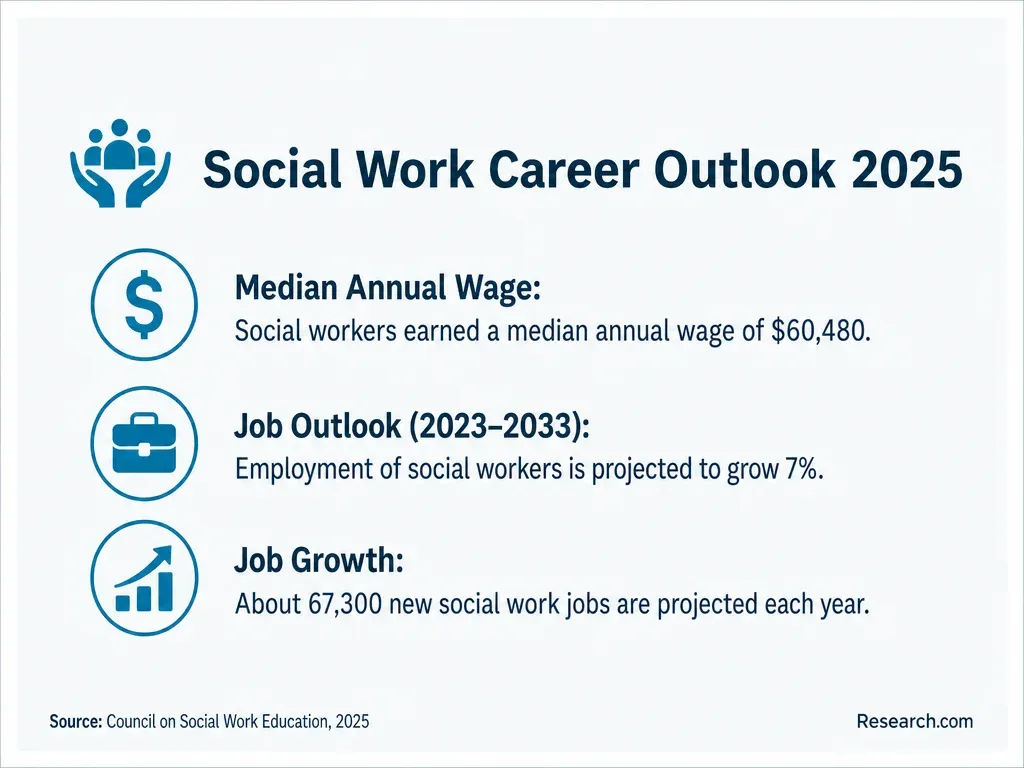
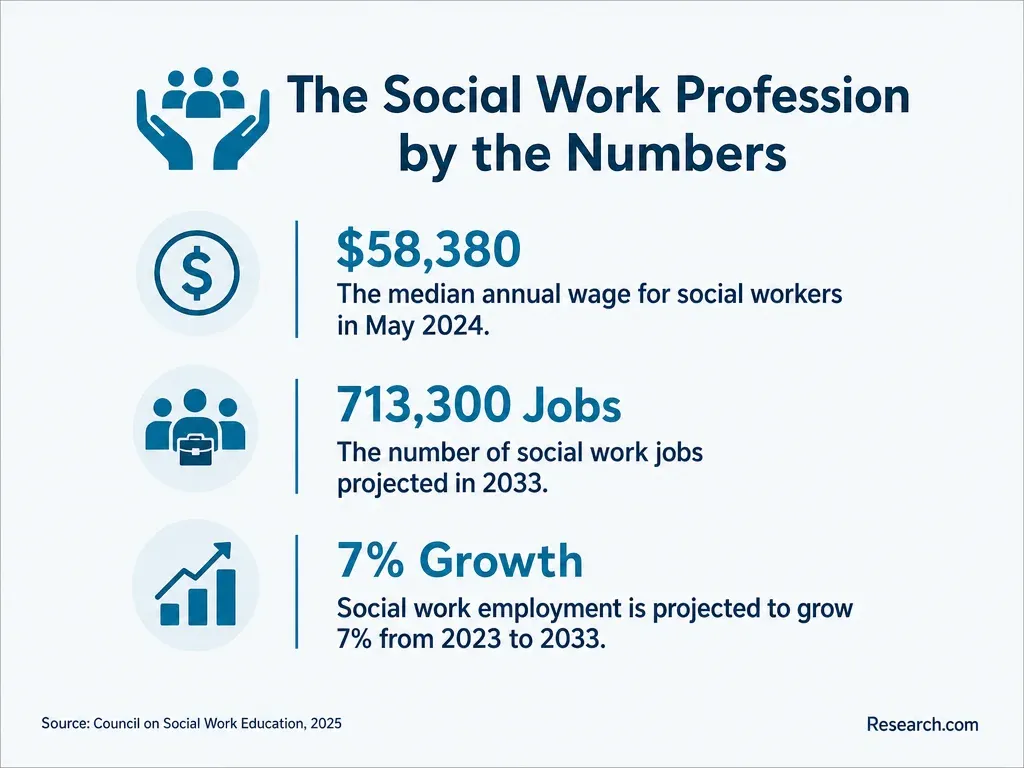
National Bureau of Labor Statistics figures provide context, not a state salary offer. For May 2025, the median annual wage was $59,550 for child, family, and school social workers, $67,880 for healthcare social workers, and $60,280 for mental health and substance abuse social workers. Projected national employment growth from 2025 to 2035 was 4%, 8%, and 10%, respectively.
These occupational categories include workers with varied qualifications and experience; they do not predict an individual MSW graduate's pay or openings in a particular state.
Use state-level salary context for MSW careers alongside local job postings, housing costs, public-sector pay scales, and the cost of obtaining the license your target work requires. A higher posted salary may be less attractive if the role requires independent clinical licensure you have not yet earned.
Other Things You Should Know About Social Work
Yes, especially if you may move. Retain syllabi, field evaluations, and records of specialized training; a future board may ask for details beyond an official transcript.
It can delay record matching. Follow the board's instructions for documenting names used on transcripts, exam records, and prior licenses.
Generally, you can submit separate applications, but each board has its own eligibility rules, fees, and documentation requirements. Check each process before paying.
Keep copies in a secure location you can access after leaving, consistent with board rules and confidentiality obligations. Obtain required supervisor signatures promptly; do not retain identifiable client information in a personal licensing file.
- Licensing across state lines | hhs.gov https://telehealth.hhs.gov/licensure/licensing-across-state-lines
- Licensure - Kentucky Board of Social Work https://bsw.ky.gov/Pages/Licensure.aspx
- Licensed Clinical Social Worker | floridasmentalhealthprofessions.gov https://floridasmentalhealthprofessions.gov/licensed-clinical-social-worker/
- Eligibility Requirements for the Practice of Social Work | njconsumeraffairs.gov https://www.njconsumeraffairs.gov/sw/Pages/eligibilityrequirements.aspx
- Virginia Board of Social Work - Social Work Compact https://www.dhp.virginia.gov/Boards/SocialWork/PractitionerResources/SocialWorkCompact/
- Title 201 Chapter 23 Regulation 160 | Legislative Research Commission https://apps.legislature.ky.gov/law/kar/titles/201/023/160/14948/
- Colorado Social Work Applications and Forms https://dpo.colorado.gov/SocialWork/Applications
- Chapter 39D. Social Work Licensure Compact | delaware.gov https://delcode.delaware.gov/title24/c039d/index.html
- Social Work Licensing By State - WNMU https://socialwork.wnmu.edu/social-work-licensing-by-state/
- Getting licensed in another state or province | Association of Social Work Boards https://www.aswb.org/licenses/how-to-get-a-license/getting-licensed-in-another-state-or-province/