2027 Community Organizing in Social Work: Core Skills and Graduate Education Choices
Audited and Verified:
Our Editorial and Data Verification Process
Research.com uses government datasets, official education statistics and primary institutional information to support its career and degree guides. Our review process checks factual accuracy, occupational definitions, source dates and the requirements associated with the credentials discussed.
How This Article Was Fact-Checked
Our editorial team verifies salary estimates, employment projections, education requirements and program information against original data providers and official organizations. Salary figures are checked against the relevant occupational definitions and reporting periods. Information about licensure, accreditation and required in-person training is reviewed separately.
Fact-checked and verified on:

Co-Founder and Chief Data Scientist
Community organizing turns concerns about housing, benefits, safety, or service access into collective action led by the people affected. For social workers and career changers, the education decision is not simply whether to earn an MSW: it is whether a program will develop organizing skills, provide a relevant field placement, and qualify you for the roles you want.
This guide explains the work, compares graduate pathways and program formats, and shows what to verify before committing time and money.
Key Things You Should Know
- Community organizing centers residents' collective priorities and power; outreach or delivering services alone is not the same thing.
- A BSW or relevant experience can support entry-level work, while a macro-focused MSW may help with advanced roles; most organizing jobs do not require independent clinical licensure.
- The U.S. Bureau of Labor Statistics reports a May 2025 median wage of $61,780 for social workers overall and projects 6% employment growth from 2025 to 2035, but neither figure describes community organizers specifically.
What is community organizing in social work?
Community organizing is the process of building relationships among people affected by a shared issue, identifying goals they choose, developing local leadership, and acting together to change conditions or decisions. A social worker might help tenants convene around unsafe housing, support residents preparing to address a city agency, or connect neighborhood groups working to improve access to services. Residents - not the professional - should define the priorities and retain meaningful decision-making power.
Organizing differs from case management, which coordinates services for particular people, and from advocacy conducted solely on someone else's behalf. An organizer may use both approaches, but the distinctive aim is durable collective capacity and influence. If you are still choosing an undergraduate route, exploring BSW programs with accessible entry policies can help you assess social work preparation; it is not the only route into community-based work.
What skills do social workers need for community organizing?
Effective organizers listen before proposing solutions. They need to identify who is affected, who has decision-making authority, which organizations already hold trust, and where barriers such as language, disability access, transportation, or work schedules limit participation. They also need to facilitate disagreement without treating one vocal participant as the voice of an entire community.
The most useful skills work together in a cycle of engagement, action, and accountability:
- Relationship-building and facilitation: Conduct one-to-one conversations, run accessible meetings, share leadership, and make room for competing priorities.
- Power and policy analysis: Identify decision-makers, budgets, procedures, and realistic opportunities to influence them.
- Collective planning: Help participants set goals, assign responsibilities, select tactics, and reassess when conditions change.
- Ethical judgment and evaluation: Obtain appropriate consent before sharing stories, protect confidential information, recognize conflicts of interest, and track whether participants gained influence - not just how many attended.
Course materials can introduce these methods, but observed facilitation, feedback, and reflection are harder to replace. If scheduling matters, compare asynchronous learning in social work master's education with any required live skills sessions; asynchronous lectures do not make organizing practice self-paced.
What degrees prepare social workers for community organizing careers?
Start with the job you want. Community organizations may hire experienced organizers without a social work degree, while positions titled social worker or combining organizing with social work services may require a BSW, MSW, or state license. A degree is most valuable when its field learning and employer recognition address a gap you cannot readily close through work experience or targeted training.
The routes below differ in what they add - not simply in academic level.
| Route | Best fit for organizing | Key limitation to check |
| BSW | Generalist social work preparation and entry-level practice | Some leadership or social worker positions prefer or require an MSW |
| Traditional or foundation MSW | Graduates of other disciplines seeking social work foundations and specialized macro study | Includes foundation coursework and field education, even with substantial prior organizing experience |
| Advanced-standing MSW | Eligible graduates of qualifying social work bachelor's programs seeking specialized study | Prior experience or a bachelor's in another field does not itself establish eligibility |
| MPH, MPA, or targeted training | Public health campaigns, government administration, or a specific organizing skill without a social work job requirement | Does not substitute for qualifying social work education where a role or license requires it |
A macro or community-practice MSW may offer organizing, policy, and management study, but the concentration name alone does not establish the quality of its placements. Compare comparing graduate social work entry-track requirements before assuming a shorter route is available. A DSW generally serves experienced practitioners pursuing advanced practice or leadership; a PhD is usually a better match for original research. Neither is ordinarily necessary to begin organizing.
For a BSW or MSW, verify the specific program's Council on Social Work Education accreditation status and its applicability to your enrollment and graduation dates. Institutional accreditation and CSWE programmatic accreditation are different. Also check whether the school can enroll you and support an approved field placement in your location.
Many organizing and policy positions do not require a clinical license. Nevertheless, a state may regulate use of the social worker title, require a license for certain positions, or set distinct rules for nonclinical practice. An MSW does not itself issue a license or authorize independent psychotherapy. If you want to retain a path into licensed practice, consult your intended state board and the guide to MSW education and state licensing expectations before enrollment. Academic field education is not interchangeable with post-degree supervised experience a board may require.
Delivery format matters less than access to people, supervision, and a suitable placement. Online coursework may reduce commuting, while campus study may make local partnerships easier to investigate; neither format guarantees an organizing placement or schedule flexibility.
Use the same questions for both formats so that a convenient class schedule does not obscure a weak field plan.
| Feature | What to verify | Why it matters for organizing |
| Practice instruction | Live facilitation exercises, feedback, group projects, and required campus visits | Organizing depends on interpersonal practice, not lectures alone |
| Field placement | Who identifies sites, approves tasks, and provides qualified field instruction | A general service placement may offer little collective-action experience |
| Location and schedule | Placement geography, agency hours, travel, and accessibility | Local relationships take time to build, often during business hours |
| Macro offerings | Course availability, faculty interests, and actual recent placement examples | A concentration label does not guarantee each course or site every term |
Ask the field office how many recent students pursued community-focused placements, what tasks they performed, and what happened when a site fell through. Choosing an MSW program with structured field support is particularly important if you cannot leave your region or arrange a placement independently.
Useful coursework connects social welfare policy, community practice, group facilitation, organizational change, research, and program evaluation. Look for assignments that require students to analyze a real decision process and explain whose perspectives are missing, while respecting agency and community rules about access to information.
A strong placement could be with a tenant coalition, neighborhood organization, community development group, or public agency that genuinely involves residents in decisions. Tasks might include listening sessions, meeting facilitation, policy analysis, or evaluating participation. Ask whether the learning agreement includes organizing competencies, who supervises the work, and how residents' consent and confidential information will be protected. Attendance at meetings alone is weak evidence of competence; feedback on decisions, relationships, and ethical conduct is more useful.
A paid job or volunteer position counts toward MSW field education only if the program approves the site, duties, supervision, and documentation. When comparing social work degree formats and learning expectations, examine these field requirements alongside coursework rather than assuming online study removes on-site obligations.
Traditional MSW programs commonly consider a bachelor's degree, transcripts, recommendations, a statement of purpose, and evidence of readiness for graduate writing and field learning. Specific GPA, prerequisite, test, and experience rules vary by school. Applicants from public health, education, sociology, or other fields can seek a traditional MSW; organizing experience can strengthen an application but does not replace required foundation study.
Advanced-standing applicants must meet the program's requirements for a qualifying prior social work degree and any recency or grade rules. Ask admissions staff to confirm your entry track in writing. Before applying, describe a concrete organizing problem you have encountered, what affected people wanted, your actual role, and what you still need to learn. Also ask the field office about screening, placement timing, and transportation requirements, which may differ from admissions conditions.
Applicants considering a guide to accelerated online MSW education should check entry-track eligibility first: an accelerated schedule cannot turn a non-BSW degree into advanced-standing eligibility.
Traditional MSW study generally includes foundation and specialized sequences; eligible advanced-standing students typically complete a shorter specialized sequence. Full-time and part-time schedules, course availability, and placement timing determine the actual calendar. Ask each school for a term-by-term plan for your entry track rather than relying on an advertised minimum.
Compare total cost using tuition for the credits you must take plus mandatory fees, books, technology, placement travel, screening, and any required campus visits. Add the earnings you may forgo during field education. An inexpensive per-credit rate can be less attractive if placement travel or reduced work hours strain your budget. Request the school's current published charges and a personalized aid estimate; do not assume a paid or employment-based placement is available.
Lower-tuition Master of Social Work pathways are worth comparing, but weigh the full cost against field support and the roles you can realistically pursue. If an employer accepts existing experience plus focused training, an MSW may not offer enough additional value for an organizing-only goal.
What are the salary and job outlook for community organizing careers?
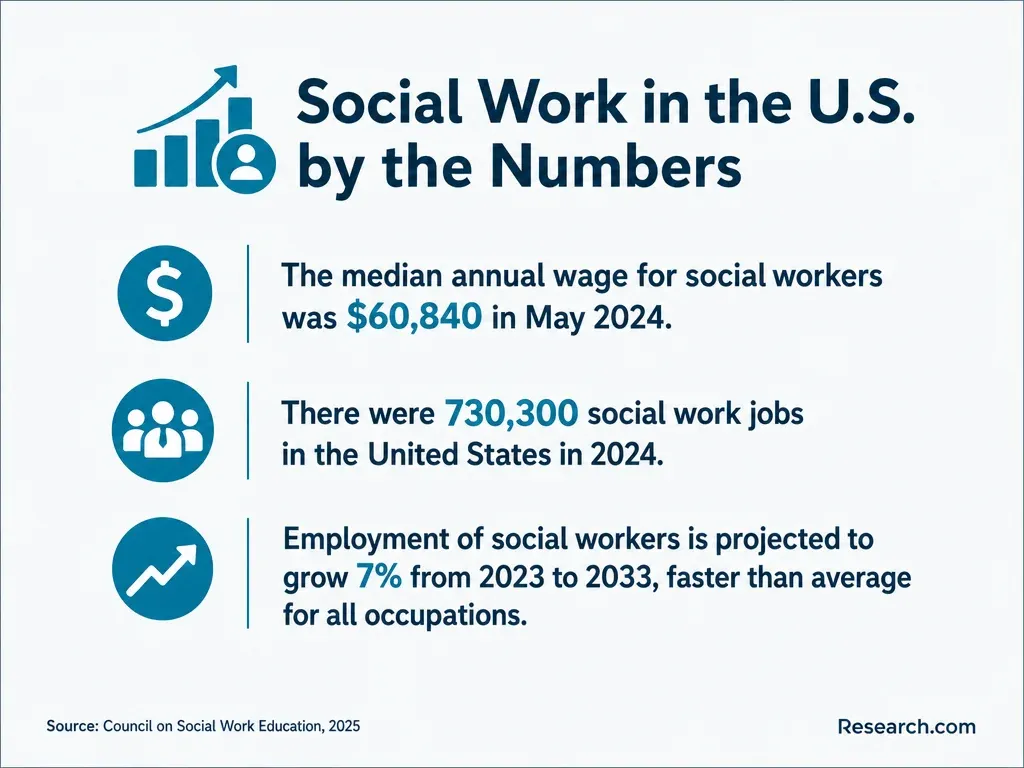
There is no single U.S. Bureau of Labor Statistics occupation called "social work community organizer." As context - not an organizer salary benchmark - the BLS reports a May 2025 median annual wage of $61,780 for social workers across specialties and projects 6% growth from 2025 to 2035. Many organizer, advocacy, and engagement jobs fall outside that occupation, so those figures cannot predict pay or openings for a particular position.
Compare actual postings by location, employer type, duties, required credentials, and hours. A campaign role with evening meetings or grant-dependent funding may have different compensation and stability from a government social work position. Comparing pay locations for master's-prepared social workers can provide geographic context, but use the occupation and job description - not the degree alone - to judge whether a salary comparison fits.
Other Things You Should Know About Social Work
It can involve policy advocacy, but permissible activities depend on the employer, funding conditions, job duties, and applicable law. Clarify organizational rules before using work time, resources, or a professional title in political activity.
Use accessible, repeated opportunities for input rather than relying on meeting attendance or a few spokespersons. Document how priorities were set and how dissenting views affected decisions.
Not merely because the cause is important. Follow applicable confidentiality law, professional duties, and agency policy; obtain appropriate, informed permission before any disclosure and consider whether sharing could expose the person to harm.
Attend meetings of an established local group, listen to its stated priorities, and ask how newcomers can contribute. This builds context before you choose training or propose a campaign.
- Ethical Dilemmas in Community-Based Participatory Research | nih.gov https://pmc.ncbi.nlm.nih.gov/articles/PMC2219570/
- Full article: Community Organizing for Social Justice | tandfonline.com https://www.tandfonline.com/doi/full/10.1080/01609513.2012.656233
- Section 5. Ethical Issues in Community Interventions | ku.edu https://ctb.ku.edu/en/table-of-contents/analyze/choose-and-adapt-community-interventions/ethical-issues/main
- Field Education Sites - School of Social Work | Communication Sciences and Disorders https://healthprofessions.ucf.edu/socialwork/field-education-new/field-sites/
- Community Organizing (CORG) | University of Connecticut https://socialwork.uconn.edu/masters-social-work/communityorganizing/