2027 Collaborative Care in Social Work: Roles, Communication, and Professional Preparation
Audited and Verified:
Our Editorial and Data Verification Process
Research.com uses government datasets, official education statistics and primary institutional information to support its career and degree guides. Our review process checks factual accuracy, occupational definitions, source dates and the requirements associated with the credentials discussed.
How This Article Was Fact-Checked
Our editorial team verifies salary estimates, employment projections, education requirements and program information against original data providers and official organizations. Salary figures are checked against the relevant occupational definitions and reporting periods. Information about licensure, accreditation and required in-person training is reviewed separately.
Fact-checked and verified on:

Co-Founder and Chief Data Scientist
A referral alone does not ensure that a client receives care. Social workers often help clients, clinicians, schools, and community agencies turn separate services into a workable plan. That coordination makes collaborative care an important skill for students, career changers, and early-career practitioners considering where to train or work.
This guide explains what social workers do on teams, how they communicate without compromising client rights, and which degrees, placements, and credentials fit different roles. It also shows what to check before choosing a program or accepting a job.
Key Things You Should Know
- Collaborative care pairs shared goals and planned follow-up with clear responsibility for each task; it is more than sending referrals between agencies.
- A BSW can prepare graduates for generalist coordination, while many clinical team roles require an MSW and state-specific licensure; neither degree alone grants independent clinical authority.
- The U.S. Bureau of Labor Statistics reports a May 2025 median annual wage of $67,880 for healthcare social workers, but that occupation-wide figure does not predict an individual graduate's pay.
What is collaborative care in social work?
Collaborative care is a way of organizing services around a person's goals rather than expecting that person to navigate disconnected systems alone.
In social work, it can mean coordinating with healthcare professionals, schools, housing providers, benefits offices, family members, and community organizations - with the client's participation and appropriate permission. Teams agree on responsibilities, share relevant information within lawful limits, and check whether the plan is working.
The term also has a narrower healthcare meaning: the Collaborative Care Model integrates behavioral health into primary care through defined roles, systematic follow-up, and psychiatric consultation. Not every interdisciplinary team uses that model.
When evaluating a placement or job, ask whether "collaborative care" means a formal model with assigned functions or a broader expectation to coordinate services.
Joining a team rarely calls for doctoral education. An experienced social worker considering cross-agency program design might examine affordable advanced social work degree options, but leadership experience or targeted implementation training may be a more direct route.
What roles do social workers play on collaborative care teams?
A social worker's contribution depends on the setting, job description, license, and available supervision. Across settings, social workers bring a person-in-environment perspective: they consider how health, relationships, finances, discrimination, housing, and service rules affect a client's options.
The following examples show why a team title alone cannot establish the qualifications or authority a role requires:
| Team function | Typical social work contribution | Qualification to check |
| Care coordination | Assess practical barriers, connect services, track referrals, and follow up with the client. | Employer's degree and experience requirements; clinical licensure may not be required. |
| Clinical behavioral health care | Provide assessment or treatment within the worker's authorized scope and coordinate with medical providers. | State license category, supervision, and employer privileges. |
| Discharge or transition planning | Help plan services after hospitalization or a change in care setting. | Healthcare-setting requirements and the specific job description. |
| Community or systems work | Identify service gaps, strengthen referral partnerships, or improve access procedures. | Program, policy, and partnership experience; a clinical license may be unnecessary. |
For a closer look at job titles and settings, see social work master's roles and employment settings. Compare postings by actual duties, caseload, supervision, and credentials, not by title alone.
How do social workers communicate with clients and other care professionals?
Effective communication starts with the client's priorities. A social worker can explain each team member's role in accessible language, ask what the client wants shared, and confirm who will follow up.
With colleagues, useful updates state the agreed goal, a relevant change or barrier, the action requested, the person responsible, and the follow-up date. This is more actionable than a note saying only that a referral was made.
Privacy sets limits on teamwork. Consent, confidentiality law, record-access rules, and agency policy determine what may be shared; requirements differ by setting and jurisdiction.
Workers should use approved communication systems, document decisions accurately, and consult a supervisor when a disclosure, safety concern, or reporting obligation is unclear. Professional ethics guide judgment but do not replace governing law.
Students can practice these handoffs in supervised placements rather than assuming classroom role-play proves readiness. When comparing programs, social work master's placement support comparison guide can help frame questions about sites where students can observe team meetings and receive feedback on documentation.
Before enrolling, verify the institution's accreditation and the specific BSW or MSW program's Council on Social Work Education accreditation status for the relevant program and cohort. Then check the licensing board in the state where you intend to practice.
A school determines graduation requirements; a state board determines license eligibility and scope. An employer may impose additional hiring or credentialing rules.
State license categories, examinations where required, supervisor qualifications, and permitted clinical activities vary. Academic field education is not the same as post-degree supervised clinical practice.
If independent clinical work is the goal, use the board's current rules alongside a guide to checking social work clinical hour categories; do not assume that every job duty or supervisor will qualify.
Ask the board which education and supervised experience it accepts before relying on a program's general licensure claims. Graduation, exam eligibility, passing an exam, license issuance, and independent practice are separate milestones.
Useful preparation connects human behavior and social environments, policy, ethics, research literacy, assessment, and intervention with supervised practice.
Courses in healthcare, behavioral health, schools, or community practice can deepen setting-specific knowledge, but their titles matter less than opportunities to coordinate with other disciplines and evaluate follow-through.
In field education, look for a learning agreement that allows supervised participation in team meetings, client-centered planning, referrals, and appropriate documentation.
A field instructor should help the student reflect on boundaries and receive feedback; the school's faculty liaison helps oversee the educational placement. Students should not treat observation, simulation, or placement hours as independent clinical competence.
Field sequences can differ substantially between traditional and advanced-standing MSW routes. Comparing advanced standing and standard MSW pathways can help applicants identify questions to ask about the preparation and placement experiences they would actually receive.
What are the salary and job outlook for social workers?
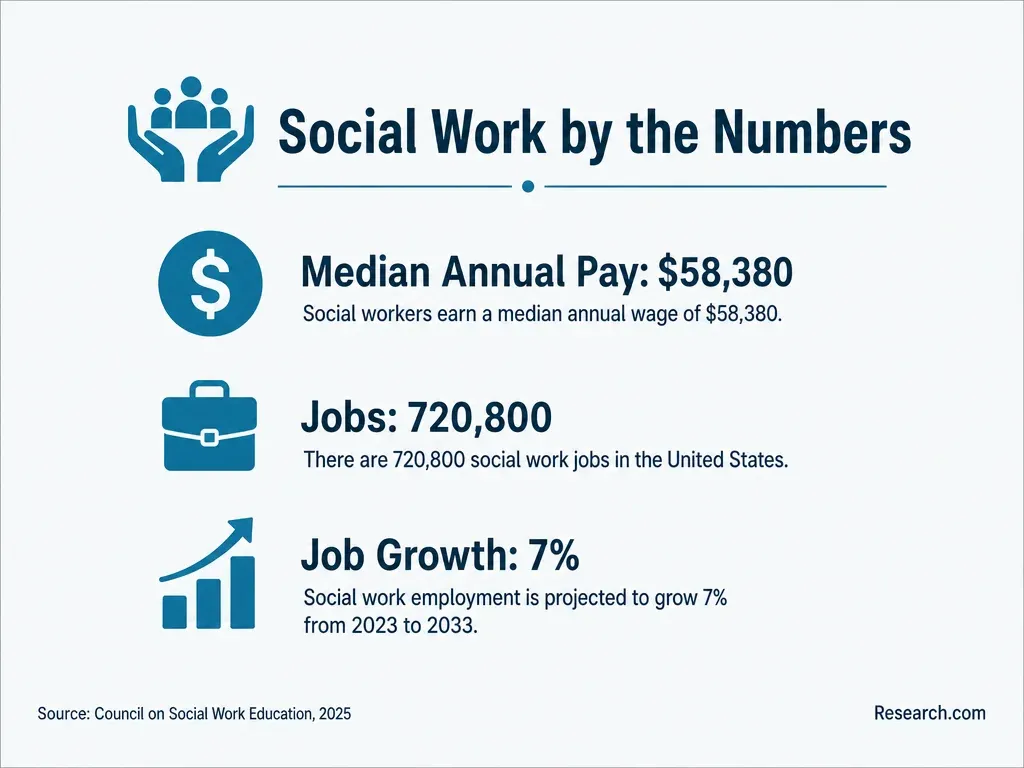
U.S. Bureau of Labor Statistics figures distinguish occupations that may participate in collaborative care. These May 2025 median annual wages and 2025-2035 employment projections are national occupation-level measures, not offers for a particular degree, license, or team role:
| BLS occupation | May 2025 median annual wage | Projected employment growth, 2025-2035 |
| Child, family, and school social workers | $59,550 | 4% |
| Healthcare social workers | $67,880 | 8% |
| Mental health and substance abuse social workers | $60,280 | 10% |
| Social workers, all specialties | $61,780 | 6% |
Use the occupation matching the work you seek, then compare local postings by credentials, setting, schedule, and experience. For a more location-specific starting point, see planning an MSW career with regional salary context. Projected growth indicates demand across an occupation; it does not guarantee a position or make an expensive degree worthwhile on its own.
Other Things You Should Know About Social Work
Leadership depends on the setting and task. A clinician may direct treatment decisions while a social worker coordinates services or follows up on access barriers. Ask the employer how decisions and responsibilities are assigned.
Generally, clients should be involved in decisions and can express preferences or decline offered services. The worker should explain options and document the discussion while following applicable consent, safety, reporting, and agency requirements.
The team can discuss available alternatives with the client, clarify any immediate needs, and assign someone to follow up. It should not document an unavailable service as though the client received it.
Teams can review measures such as completed referrals, timely follow-up, and client-reported barriers, alongside outcomes relevant to their setting. They should interpret results cautiously: a completed referral does not necessarily mean a client's needs were met.
- Care Coordination | Agency for Healthcare Research and Quality https://www.ahrq.gov/ncepcr/care/coordination.html
- Social Determinants of Health (SDOH) | cdc.gov https://www.cdc.gov/about/priorities/why-is-addressing-sdoh-important.html
- 6: Confidentiality | United States Department of Justice https://www.justice.gov/elderjustice/mdt-guide-toolkit/6-confidentiality
- Methods and Effectiveness of Communication Between... - PMC https://pmc.ncbi.nlm.nih.gov/articles/PMC7910528/
- Principles of Collaborative Care - AIMS Center https://aims.uw.edu/principles-of-collaborative-care/
- Integrating Social Needs Into Health Care Practice - Penn LDI https://ldi.upenn.edu/our-work/research-updates/integrating-social-needs-into-health-care-practice-evidence-and-barriers/
- NASW Standards for Social Work Practice in Health Care Settings | socialworkers.org https://www.socialworkers.org/Practice/NASW-Practice-Standards-Guidelines/NASW-Standards-for-Social-Work-Practice-in-Health-Care-Settings