2027 Assertive Community Treatment in Social Work: Social Work Team Functions and Career Preparation
Audited and Verified:
Our Editorial and Data Verification Process
Research.com uses government datasets, official education statistics and primary institutional information to support its career and degree guides. Our review process checks factual accuracy, occupational definitions, source dates and the requirements associated with the credentials discussed.
How This Article Was Fact-Checked
Our editorial team verifies salary estimates, employment projections, education requirements and program information against original data providers and official organizations. Salary figures are checked against the relevant occupational definitions and reporting periods. Information about licensure, accreditation and required in-person training is reviewed separately.
Fact-checked and verified on:

Co-Founder and Chief Data Scientist
Assertive community treatment (ACT) social work is not a standard office-based caseload job. It involves shared responsibility for people with serious mental illness, frequent community contact, and close coordination with clinical and peer staff. For students, new graduates, and career changers, the decision is whether that work fits their skills - and which education or license an employer actually requires.
This guide explains ACT team functions, realistic entry routes, field preparation, workplace questions, and salary context so you can evaluate both programs and job offers.
Key Things You Should Know
- ACT teams deliver coordinated, community-based services to people with serious mental illness; a social worker may handle engagement, housing and benefits barriers, care coordination, and clinical work only within their authorized scope.
- There is no single national ACT social worker credential: jobs may accept a BSW, require an MSW, or require a state license, depending on duties, funding rules, and jurisdiction.
- The closest BLS comparison, mental health and substance abuse social workers, had a $60,280 median annual wage in May 2025 and projected 10% employment growth from 2025 to 2035 - not an ACT-specific pay or hiring forecast.
What is assertive community treatment in social work?
Assertive community treatment is an intensive, team-based approach for people with serious mental illness who need more coordinated support than conventional office-based services may provide. Rather than relying primarily on clients to attend separate appointments, an ACT team provides services where people live and spend time. The team shares responsibility for ongoing support, including behavioral health care and practical needs such as housing and access to benefits.
"Assertive" describes proactive outreach and continuity, not permission to override a person's rights or preferences. Programs operate under state rules, payer requirements, agency policies, and individual service plans; their staffing and availability differ. If ACT is one of several roles you are considering, connecting a social work master's degree to career goals can help distinguish this team-based setting from other social work work.
What does a social worker do on an ACT team?
An ACT social worker helps turn a shared treatment plan into workable support in the community. Depending on the job and qualifications, duties can include building relationships with people who have had difficult experiences with services, assessing social and environmental barriers, coordinating housing or benefits assistance, supporting family communication with consent, and documenting contacts and changes in need.
Some MSW-prepared, appropriately licensed staff also provide clinical assessment or psychotherapy. Others focus on service coordination, advocacy, or rehabilitation. The job title alone does not establish authority to diagnose, provide psychotherapy, or practice independently. A social worker should know when to involve the team's prescriber, nurse, substance use specialist, or supervisor rather than treating every concern as an individual caseload task.
Before accepting a role, ask what portion of the week is spent on community visits, documentation, team meetings, crisis coverage, and travel. Compare that answer with your training: online social work qualifications and career directions are useful to explore, but online coursework does not replace supervised practice in community settings.

Who is on an ACT team, and how do members work together?
ACT teams commonly bring together a team leader, psychiatric prescriber, nurses, behavioral health professionals, substance use and employment specialists, peer support staff, and social workers or other case-management staff. Exact staffing depends on the program's governing standards. The distinction for applicants is that members coordinate services for a shared group of clients rather than simply exchanging referrals.
For example, a social worker who learns that housing instability is disrupting care can bring that information to the team. A nurse may address medication-related concerns, a peer specialist may offer support grounded in lived experience, and the social worker may coordinate housing resources. Each person remains responsible for their own professional scope, confidentiality obligations, and documentation.
A student seeking ACT exposure should ask whether a placement provides supervised participation in team meetings and community work, not just an agency name associated with ACT. When comparing graduate social work placement coordination options, ask who secures an appropriate site and qualified field instructor, particularly if local ACT positions are limited.
There is no universal ACT degree requirement. The appropriate route depends on the actual position, its permitted duties, and state and payer rules. The comparison below helps separate a route into team-based services from a route toward licensed clinical responsibilities.
| Preparation | Potential ACT fit | Important limit |
| BSW | Generalist social work, outreach, and service-coordination positions where accepted | Does not itself authorize independent clinical practice |
| Traditional or foundation MSW | Graduate route for applicants with a qualifying bachelor's degree in another field | Degree completion alone does not confer a license |
| Advanced-standing MSW | Potentially shorter MSW route for applicants with a qualifying social work bachelor's degree who meet program rules | A psychology, counseling, or human services bachelor's degree does not automatically qualify |
| Relevant non-social-work degree | May qualify for designated peer, rehabilitation, employment, or support positions | Does not necessarily qualify someone for a position designated for a social worker |
Read local postings before enrolling: compare the required degree with the tasks you want to perform, not just the ACT label. If you already hold a bachelor's degree, MSW pathway differences by prior degree matter more than whether a program advertises a behavioral health concentration. A DSW or PhD is generally unnecessary for entry to direct-service ACT work.
Some ACT positions require a state social work license; others accept graduates who work within an employer-defined role and applicable law. Requirements may also differ within one team: a clinical therapist position may require an MSW and a specified license, while a service-coordination position may not. There is no single nationwide ACT certification that substitutes for a required state license.
Distinguish graduation, eligibility to apply for a license, license issuance, and independent clinical authority. States set license categories, examination and supervised-experience rules where applicable, and practice boundaries. An MSW field placement is not automatically post-degree supervised clinical experience.
Before selecting a degree, use the target state board's current requirements alongside employer postings; checking professional eligibility when choosing an MSW is especially important if you expect to provide clinical services.
What are the salary and job outlook for ACT social workers?
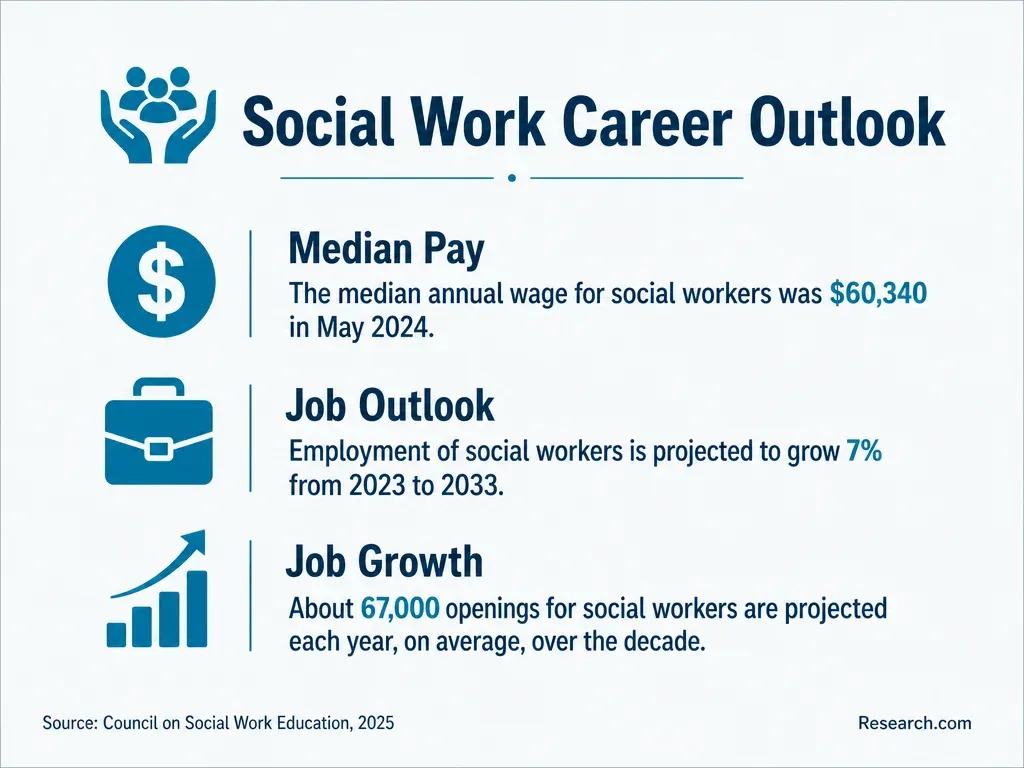
The Bureau of Labor Statistics does not publish a separate ACT social worker salary. Its mental health and substance abuse social workers category is a useful, imperfect comparison for many ACT social work positions: the May 2025 median annual wage was $60,280, and projected employment growth was 10% from 2025 to 2035. Those figures cover the occupation across settings, not ACT teams specifically; some ACT jobs may instead align more closely with other social work or human services categories.
Evaluate offers using the stated salary alongside license requirements, geographic pay, travel reimbursement, on-call duties, supervision, and workload. An occupation-wide median cannot predict your starting pay or the return on an MSW. For regional context, comparing pay locations for master's-prepared social workers can inform a search, but verify the actual employer's range and the cost of working in that location.
Other Things You Should Know About Social Work
Often, but the client's preferences, consent, applicable privacy rules, and the service plan govern what the team can share and how family members participate.
ACT uses persistent, respectful outreach, not automatic authority to compel participation. The team should follow applicable law, the person's rights, and agency procedures when engagement is difficult.
No. ACT offers ongoing community-based support and coordination. Teams follow their service and crisis procedures when needs exceed what they can safely provide.
Transition planning depends on the person's needs, preferences, program criteria, and available services. Teams generally coordinate follow-up care rather than treating discharge as an end to all support.
- Assertive Community Treatment | hhs.gov https://preventionservices.acf.hhs.gov/programs/754/show
- The critical ingredients of assertive community treatment - PMC https://pmc.ncbi.nlm.nih.gov/articles/PMC4471983/
- Assertive Community Treatment (ACT) | pa.gov https://www.pa.gov/agencies/dhs/resources/mental-health-substance-use-disorder/assertive-community-treatment
- Social Work Competencies: Advanced Level of Practice | Crown Family School of Social Work, Policy, and Practice https://crownschool.uchicago.edu/node/1435
- NASW Standards for Social Work Practice in Health Care Settings | socialworkers.org https://www.socialworkers.org/Practice/NASW-Practice-Standards-Guidelines/NASW-Standards-for-Social-Work-Practice-in-Health-Care-Settings
- Behavioral Health program list | CARF International https://carf.org/accreditation/programs/behavioral-health/behavioral-health-program-list/
- Mental Health Services - Assertive Community Treatment (ACT) https://www.dhs.state.mn.us/id_058151/
- Assertive Community Treatment (ACT) | Cleveland Clinic https://my.clevelandclinic.org/health/treatments/assertive-community-treatment-act