2027 Adult Protective Services vs Geriatric Case Management: Responsibilities Compared
Audited and Verified:
Our Editorial and Data Verification Process
Research.com uses government datasets, official education statistics and primary institutional information to support its career and degree guides. Our review process checks factual accuracy, occupational definitions, source dates and the requirements associated with the credentials discussed.
How This Article Was Fact-Checked
Our editorial team verifies salary estimates, employment projections, education requirements and program information against original data providers and official organizations. Salary figures are checked against the relevant occupational definitions and reporting periods. Information about licensure, accreditation and required in-person training is reviewed separately.
Fact-checked and verified on:

Co-Founder and Chief Data Scientist
Adult protective services and geriatric case management both serve older adults, but they operate under different authority and answer to different goals. That distinction matters if you are choosing a job, field placement, or degree: safeguarding investigations are not the same work as ongoing care coordination.
This guide compares daily responsibilities, collaboration, qualifications, compensation, and training so you can identify the role that fits your skills - and avoid paying for a credential your target employer does not require.
Key Things You Should Know
- APS responds to reports of suspected abuse, neglect, exploitation, or self-neglect under state law; geriatric case management assesses needs and coordinates ongoing support, usually without investigative authority.
- Qualifications depend on the position and state: a BSW, MSW, nursing degree, or related background may fit particular jobs, but neither title universally requires an independent clinical social work license.
- Neither job title has its own national BLS wage category. For context, the supplied BLS figures put the May 2025 median at $61,780 for social workers overall and $67,880 for healthcare social workers - not guaranteed pay for either role.
How do adult protective services and geriatric case management responsibilities differ?
Adult protective services (APS) is a public safeguarding function. An APS worker receives or follows up on reports concerning adults covered by state law, assesses allegations and immediate safety needs, documents findings, and connects people with protective or supportive services. Authority, eligibility, investigation procedures, and available interventions vary by state.
Geriatric case management - often called aging life care or geriatric care management - centers on an older adult's continuing needs and preferences. A care manager may assess functioning and living arrangements, develop a service plan, coordinate medical and community resources, communicate with an authorized family member, and monitor whether the plan still works. The role may be based in an agency, health system, or private practice.
The comparison below separates a role's usual purpose from the powers an employer or state may actually grant.
| Responsibility | APS worker | Geriatric case manager |
| Primary task | Respond to a report and assess suspected maltreatment or self-neglect | Arrange and monitor services around an agreed care plan |
| Source of authority | State law and public agency policy | Employer role, service agreement, and client authorization |
| Typical time horizon | Case response and disposition, with referrals as appropriate | Ongoing coordination, sometimes through repeated reassessment |
| Key boundary | Cannot assume every reported adult lacks decision-making rights | Cannot investigate on behalf of APS or override an adult's decisions |
Both roles require careful documentation, cultural responsiveness, and respect for an adult's wishes. APS may have investigative duties, but a report does not itself establish abuse or incapacity. Care managers may recognize concerning conditions, but they should follow applicable reporting law and agency policy rather than conduct their own protective investigation. For a broader view of how these duties fit social work employment, see MSW education and career pathway connections.
When do adult protective services and geriatric care managers work together?
Collaboration may begin when a care manager notices possible financial exploitation, unsafe conditions, or unmet basic needs and makes a report under applicable rules. It may also begin after APS determines that an adult could benefit from ongoing coordination. APS addresses its safeguarding responsibilities; the care manager helps arrange services the adult accepts or that are otherwise lawfully authorized.
For example, APS might assess a report that an older adult is not receiving needed care. A care manager could then coordinate transportation, home services, and follow-up appointments if engaged to do so. Neither professional should assume that the other can disclose a complete case file: consent, confidentiality law, and agency policy govern information sharing. Disagreement with an adult's choices alone is not permission to bypass those rules.
Students interested in this handoff can ask whether an aging-services or APS placement offers supervised exposure to referrals and interdisciplinary work. The social work master's placement support comparison guide can help frame questions about how programs arrange suitable field sites; a school must still approve the specific placement and learning tasks.
What degrees qualify you for APS or geriatric case management careers?
There is no single national degree rule for either job title. APS hiring follows state or local classifications, which may accept social work or another relevant discipline for some positions and require an MSW for others. Geriatric case management employers may seek social workers, nurses, or professionals with other aging-services experience. Read the required qualifications for the specific vacancy before choosing another degree.
A BSW offers generalist social work preparation that can fit some entry-level public or community roles. An MSW can expand access to positions seeking advanced assessment, supervision, or specialized practice; a person with a non-social-work bachelor's degree can generally apply to a traditional or foundation MSW if the program's criteria are met. Advanced-standing MSW tracks instead require a qualifying prior BSW or a specifically accepted equivalent under program rules. Neither an MSW nor an aging concentration automatically supplies investigative authority or independent clinical privileges.
If you already work in healthcare, benefits navigation, or community services, your experience may support a direct move into a qualifying care-coordination position. Compare actual vacancies before investing in graduate school. Social work degree planning for prospective students is useful when a BSW or MSW is genuinely needed for the jobs you want.
Not universally. An APS job may be a public-agency position with its own training and civil-service requirements rather than a role requiring independent clinical licensure. A geriatric case manager may work under a social work or nursing license, an employer's qualifications, or a voluntary specialty credential. Requirements change with the state, job duties, use of a protected professional title, and whether the worker performs regulated clinical activities.
Ask employers which credential is required, which is preferred, and which tasks require a license. If you intend to provide psychotherapy or independently perform other reserved clinical functions, consult the relevant state licensing board; degree completion, field hours, and voluntary certification do not grant that authority. Likewise, an APS badge does not give a privately employed care manager APS powers.
If the positions you want require an MSW as a step toward a state license, check admissions feasibility as well as board rules. Comparing MSW GPA and prerequisite policies can help you identify programs to investigate, but admission and eventual licensing eligibility are separate decisions.
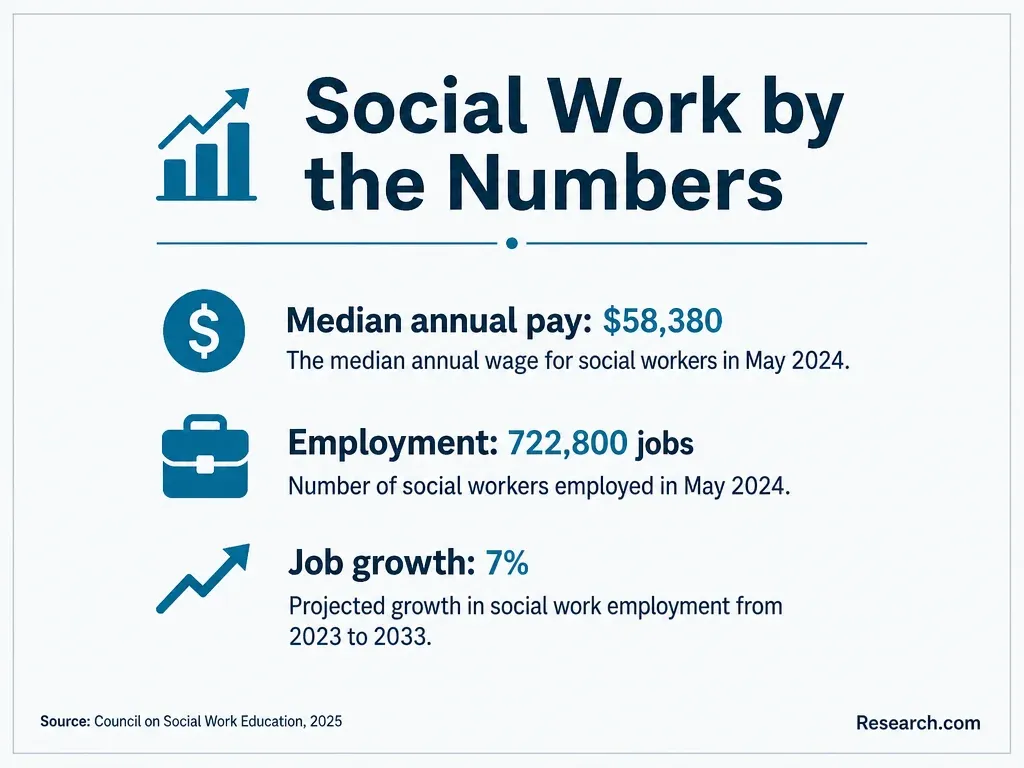
National wage data cannot produce an APS-versus-geriatric-care-manager pay ranking: the Bureau of Labor Statistics (BLS) classifies workers by occupation, not these two job titles. A social worker coordinating older adults' hospital care may fit the healthcare social worker category; an APS position may fall under another social worker classification or a different occupation, depending on its duties.
These BLS social work figures provide context, not offers or degree-specific outcomes. Compare local postings with matching duties, qualifications, and employment arrangements before estimating your likely pay.
| BLS occupation | May 2025 median annual wage | Projected employment growth, 2025-2035 | Use in this comparison |
| Social workers, all specialties | $61,780 | 6% | Broad benchmark; does not isolate APS |
| Healthcare social workers | $67,880 | 8% | Relevant to some healthcare-based aging roles, not all care managers |
APS compensation may be shaped by public pay grades, union agreements, and location. Geriatric case management pay may vary with the employer, caseload, and whether work is salaried or privately contracted; billing revenue is not the same as take-home pay. The MSW career compensation by state comparison offers geographic context, but the relevant local job classification remains the better basis for a decision.
For either path, useful preparation includes aging and disability services, human behavior and social environments, benefits systems, assessment, ethics, documentation, and interdisciplinary communication. APS candidates should also learn about adult safeguarding, interviewing, risk assessment, and the limits of investigative authority. Care-management candidates benefit from care planning, healthcare navigation, caregiver dynamics, and service monitoring.
Look for an approved BSW or MSW field placement where supervision connects classroom concepts to real duties. An APS placement may expose a student to intake and case processes within agency rules; an aging-services placement may offer supported assessment and referral work. Neither placement guarantees permission to investigate independently. Employment, volunteering, and simulations do not automatically satisfy a school's field requirements, and field education is distinct from post-degree clinical-license supervision.
A shorter program is only useful if its course sequence and field schedule remain workable. When comparing online MSW program lengths, ask how many days or hours each week must be available for placement, live skills work, and supervision - not just when lectures can be viewed.
A BSW commonly follows a four-year undergraduate plan, although accepted credits and course sequencing can change the remaining time. A traditional MSW commonly takes about two years of full-time study; advanced-standing tracks are shorter for eligible BSW graduates. Part-time enrollment takes longer, and field-placement availability can affect the calendar in any format.
There is no responsible single tuition figure for "the" APS or care-management pathway. Compare each school's total tuition and fees alongside books, technology, travel, screenings, and any required campus visits. Include income you may forgo while completing field education. A program with lower tuition can cost more overall if placement hours substantially reduce paid work. Evaluating the value of lower-cost MSW programs is most useful when you compare total costs with the qualifications and local pay of jobs you can realistically pursue.
What employers and advancement opportunities are available in each career?
APS workers typically work within state, county, or locally administered public systems, sometimes alongside contracted partners. Advancement may include senior investigator, supervisor, training, quality improvement, or program administration roles, subject to civil-service rules. Evaluate caseload, travel, safety procedures, documentation demands, and supervisory support - not just the job title.
Geriatric case managers may work for aging-service agencies, health systems, nonprofits, or private care-management practices. Experienced staff may move into complex-case coordination, team leadership, program management, or a carefully evaluated independent business. Private practice adds contracting, privacy, referral, and financial responsibilities; it does not confer clinical or APS authority.
For either path, an MSW may help with particular promotions, but a doctorate is rarely the most direct step into frontline work. If your longer-term goal is agency leadership or practice improvement and you are considering a DSW, budget planning for a social work practice doctorate can help you weigh that additional investment against experience or targeted professional development.
Other Things You Should Know About Social Work
Rules differ by state. Ask the relevant APS agency how it accepts reports and handles a reporter's identity; do not assume anonymity or confidentiality is guaranteed.
It depends on the service and employer. Some coordination is part of an agency or healthcare role, while privately hired care managers may charge clients or families. Confirm fees, covered services, and who is authorized to contract.
Not automatically. Disclosure depends on applicable law, consent or other legal authority, and agency policy. The professionals should share only information they are permitted to exchange.
Ask about relevant training, experience with the adult's needs, any claimed license or certification, fees, communication practices, and how the manager handles consent, privacy, and conflicts of interest.
- Adult Protective Services | ny.gov https://ocfs.ny.gov/programs/adult-svcs/aps/
- Adult Protective Services - Department of Health and Human Services - Montgomery County, MD https://www.montgomerycountymd.gov/department-health-human-services/about-us/aging-disability-services/adult-protective-services
- Adult Protective Services (APS) | ca.gov https://www.cdss.ca.gov/inforesources/adult-protective-services
- Examining Adult Protective Services Outcomes - PMC - NIH https://pmc.ncbi.nlm.nih.gov/articles/PMC9579456/
- 1004 Guiding Principles in Adult Protective Services | ga.gov https://pamms.dhs.ga.gov/das/aps-5500-manual/1004-guiding-principles/
- Mandated Reporters of Abuse in Adults Aged 60+ | mass.gov https://www.mass.gov/info-details/mandated-reporters-of-abuse-in-adults-aged-60
- 10000 Providing and Arranging for Services | texas.gov https://www.dfps.texas.gov/handbooks/APS/Files/APS_pg_x10000.asp
- Report abuse, neglect, exploitation or self-neglect | illinois.gov https://ilaging.illinois.gov/protectionadvocacy/abuse-reporting.html
- Adult Protective Services Policy | wv.gov https://bss.wv.gov/media/20616/download
- Adult Protective Services Functions and Grants Programs | Federal Register https://www.federalregister.gov/documents/2024/05/08/2024-07654/adult-protective-services-functions-and-grants-programs