
Best HVAC Technician Training Programs & Trade Schools in Florence for 2027
Audited and Verified:
Our Editorial and Data Verification Process
Research.com uses government datasets, official education statistics and primary institutional information to support its career and degree guides. Our review process checks factual accuracy, occupational definitions, source dates and the requirements associated with the credentials discussed.
How This Article Was Fact-Checked
Our editorial team verifies salary estimates, employment projections, education requirements and program information against original data providers and official organizations. Salary figures are checked against the relevant occupational definitions and reporting periods. Information about licensure, accreditation and required in-person training is reviewed separately.
Fact-checked and verified on:

Co-Founder and Chief Data Scientist

Reviewed by Karolina Broda
Fact-Checker and Data Verification
Choosing HVAC training in Florence, Kentucky, means deciding whether to pay for school, earn while learning, or combine both. The U.S. Bureau of Labor Statistics projects 10.9% national employment growth for heating, air conditioning, and refrigeration mechanics and installers from 2025 to 2035 - but that is not a forecast for Florence. The Research.com team of data scientists created the Best HVAC Technician Trade Schools in Florence for 2027 ranking to help students identify programs worth considering. This guide explains how to compare their practical training, costs, credentials, and routes into work.
Key findings about HVAC technician degrees in Florence
- For Florence, Kentucky, compare a hands-on school program with a paid, supervised apprenticeship or employer training; a similarly named certificate may offer very different amounts of field practice.
- The U.S. median annual wage for HVAC mechanics and installers was $61,010 in May 2025, according to the U.S. Bureau of Labor Statistics. It is a national, all-experience benchmark - not expected starting pay in Florence.
- Training completion alone does not authorize refrigerant work or independent contracting. Check the U.S. Environmental Protection Agency's Section 608 certification rules and Kentucky's HVAC licensing requirements against your intended job.
Table of Contents
- Best HVAC Technician Training Programs & Trade Schools in Florence for 2027
- What can I expect from an HVAC technician trade school program in Florence?
- Where can I work with an HVAC technician trade school training in Florence?
What can I expect from an HVAC technician trade school program in Florence?
Expect instruction in heating, air conditioning, ventilation, and refrigeration systems, followed by supervised practice diagnosing faults and making repairs. A useful entry-level program lets students work with electrical controls, motors, airflow measurements, piping, and actual equipment - not just watch demonstrations. Ask how many scheduled hours are spent in the lab and whether an employer placement is included; similarly titled programs need not offer equivalent practice.
Gateway Community and Technical College is a local public-college option to investigate, but applicants should confirm the current catalog's HVAC credential, campus location, schedule, and lab arrangements before assuming a particular offering is available in Florence. Private career training and paid employer or registered-apprenticeship routes may also fit. A short course aimed only at a fast certification that pays well is not automatically a substitute for supervised installation and troubleshooting experience.
Where can I work with an HVAC technician trade school training in Florence?
Graduates can seek supervised entry-level work with residential service and installation contractors, commercial building-maintenance teams, refrigeration-service businesses, and facilities operators. Florence's position in Northern Kentucky also makes the wider Cincinnati-area job market relevant: a job across the state line may expand options, but its commute and the rules governing the work should be checked before accepting it.
Residential service emphasizes customer visits, diagnostics, and seasonal demand; commercial refrigeration and building systems can require different equipment knowledge and schedules. Ask prospective employers which tasks a new hire may perform under supervision, whether they pay for additional training, and what experience they expect before independent service calls.
The U.S. Bureau of Labor Statistics reports a May 2025 national median annual wage of $61,010 for heating, air conditioning, and refrigeration mechanics and installers. That occupational median includes experienced workers and is not a Florence wage estimate or a promise of pay after school. A local offer will depend on experience, service versus installation work, on-call duties, overtime, and the employer.
For a realistic return-on-investment comparison, request current entry-level pay ranges from employers recruiting in Northern Kentucky. Compare expected earnings with your current pay, training time, lost work hours, aid, debt, and the time it could take to complete training. A paid apprenticeship can change that calculation even if it takes longer than a classroom program.
Length depends on the credential and schedule. A focused certificate may take one or more terms; a broader diploma or associate degree generally takes longer. A registered apprenticeship combines related instruction with paid, supervised work over a multi-year period. These are pathways with different amounts of practice, not merely faster and slower versions of the same credential.
Before comparing completion dates, obtain each program's published clock or credit hours, lab hours, field-placement requirements, and part-time sequence. Ask whether documented prior training can earn credit or advanced standing. Marketing about accelerated degrees is not a useful measure of how quickly someone becomes competent at HVAC fieldwork: the shortest calendar route may still leave substantial supervised learning to do on the job.
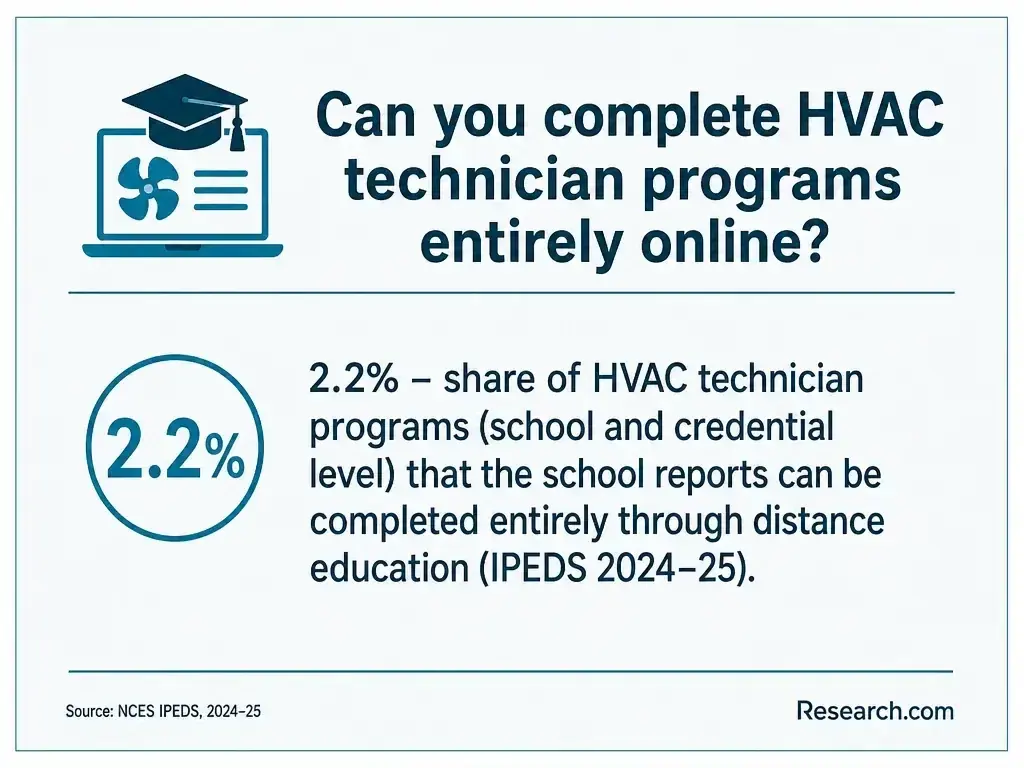
Online coursework can cover refrigeration theory, electrical concepts, codes, and system diagrams. It cannot, by itself, show that a student can use instruments safely, diagnose a live system, or perform supervised repairs. A hybrid program can work for a Florence student who needs scheduling flexibility if its in-person labs and any work placement are accessible.
Compare formats by asking where and when you will practice, who assesses your skills, and whether you must find your own worksite. An online certification program that pays well in another field should not be used as evidence that remote HVAC coursework alone makes someone job-ready or eligible for a required credential.
There is no dependable single Florence-wide average that covers college programs, private training, and paid apprenticeships on comparable terms. Ask each provider for a current written estimate rather than choosing from advertised tuition alone.
The amount you need to finance depends on what is included in the quoted price. Check these items before comparing offers:
- Tuition and mandatory program, lab, and registration fees.
- Tools, protective equipment, books, software, and consumable materials.
- Certification-test fees, travel to labs or worksites, and earnings forgone while attending.
- Grants, scholarships, eligible aid, employer contributions, or wages during paid training.
Ask Gateway Community and Technical College or any other provider to identify which charges are mandatory and whether the specific program qualifies for federal aid. Being among schools that accept FAFSA does not establish that every short-term program is aid-eligible; Federal Student Aid eligibility depends on the institution, program, and student. Kentucky workforce offices may also be able to identify training assistance for eligible applicants.
The award could be a school certificate, diploma, or associate degree, depending on the program. A registered apprenticeship has its own completion credential and work-based training structure. An employer may instead document competencies learned on the job. Ask for the exact credential name and a list of skills assessed; the word "HVAC" on an award does not establish what equipment you have practiced on.
Keep three distinctions clear: a school award documents completed education; U.S. Environmental Protection Agency Section 608 certification addresses regulated refrigerant-handling work; and a Kentucky HVAC license concerns work covered by state licensing law. None automatically substitutes for another, according to the U.S. Environmental Protection Agency and the Kentucky Department of Housing, Buildings and Construction.
Entry rules vary by provider and route. A school may require an application, evidence of prior schooling, a placement assessment, or prerequisites for technical coursework. Employers and apprenticeship sponsors may use interviews and screen for the ability to travel to jobsites and perform the work safely. Do not assume admission to a school also secures an apprenticeship position or employment.
Request the published admissions checklist and ask whether any tools, driver's license, worksite screening, or prior experience are required before - not after - the first term. If you already have related work experience, ask how it is documented for placement or credit; do not assume a school's advanced standing also counts toward Kentucky licensing experience.
A strong curriculum links electrical diagnostics, refrigeration-cycle theory, airflow, controls, installation, preventive maintenance, and jobsite safety to repeatable hands-on tasks. Students should learn to read wiring diagrams, take measurements, identify faults, explain repair choices, and document work. The U.S. Bureau of Labor Statistics describes installation, maintenance, and repair as core activities of the occupation.
Ask to see the lab equipment and skills assessments. For a student interested in commercial refrigeration rather than mainly residential heating and cooling, the range of systems used in training matters more than a broad program title. Because equipment and refrigerants change, ask how the curriculum covers current refrigerant-handling practices and safe service procedures.
Requirements depend on the tasks and the level of responsibility. The U.S. Environmental Protection Agency requires appropriate Section 608 technician certification for people who handle regulated refrigerants in covered equipment; certification types correspond to equipment categories. A school's completion certificate is not Section 608 certification.
Kentucky regulates HVAC work through its Department of Housing, Buildings and Construction, including journeyman and master HVAC licensing. Supervised entry routes differ from qualifying to perform licensed work or operate as a contractor. Before paying for training, ask the department which registration, documented experience, examination, and licensing steps apply to your intended role, and ask the program how it supports - not guarantees - those steps. If you plan to work across the Ohio state line, verify that state's rules separately; Kentucky eligibility should not be assumed to transfer.
Choose the route that supplies the practice, credential, and regulatory preparation your target employer expects at a total cost you can manage. A public-college program may suit someone who wants a structured curriculum; a paid apprenticeship or employer route may better suit someone ready to learn at a worksite. Neither provider type establishes value on its own.
Use the ranking to form a shortlist, then verify the decisive details directly:
- Ask what credential is awarded, where labs occur, and how many supervised practical hours are scheduled.
- Request a written, all-in cost estimate and the current schedule; account for commuting and reduced working hours.
- Check institutional accreditation, any relevant program recognition, state school authorization, and Section 608 preparation separately.
- Ask employers or apprenticeship sponsors whether they recognize the training and what new hires still need to learn.
- Compare your likely completion and financing scenarios rather than treating national median wages as your starting salary.
Red flags include an "entirely online" job-readiness claim with no practical assessment, unclear fees, or a promise that graduation automatically grants a license. If a provider cannot explain its hands-on component or document its claims, keep comparing.
A common progression is supervised installation or maintenance work, then more independent service and diagnosis as experience and required credentials accumulate. Technicians may focus on residential systems, commercial HVAC, or refrigeration; later opportunities can include lead technician, service supervisor, or contracting work, subject to Kentucky's applicable licensing rules. These are possible paths, not automatic promotions.
Match training to the first role you actually want. Someone aiming for refrigeration service should ask about relevant equipment practice and Section 608 preparation; someone pursuing a paid apprenticeship should ask when classroom instruction begins and how work experience is documented. Lists of top paying bachelor degrees are not a sound earnings benchmark for this trade - the relevant comparison is between HVAC entry routes, their costs, and the jobs they prepare you to pursue.
The U.S. Bureau of Labor Statistics projects 10.9% growth for heating, air conditioning, and refrigeration mechanics and installers nationally from 2025 to 2035. That signals a growing occupation nationwide, not a guaranteed opening or the same growth rate in Florence. The practical test is whether contractors and facilities employers within your commuting range are hiring for the systems your program teaches.
Review current Northern Kentucky postings before enrolling: note whether they seek trainees, require service experience, or specify refrigerant certification. Recheck near completion, since openings and employer requirements can change over the course of training.
Best HVAC Technician Training Programs & Trade Schools in Florence for 2027
Investing in training is a consequential decision, so the Research.com team evaluates programs against others in the same occupation and location rather than treating unlike options as interchangeable. The Best HVAC Technician Trade Schools in Florence for 2027 ranking includes only programs with completions reported to IPEDS. That makes it useful for comparing reported school programs, but it does not mean an unlisted apprenticeship, employer program, or other provider is unavailable or lower quality.
The best-program ranking evaluates student outcomes, earnings and return on investment, costs and debt, and quality and recognition. Programmatic accreditation or occupation-relevant industry recognition receives 20% of the score; institutional accreditation receives 10%; and student support services receive 10%. The remaining 60% covers completion and full- and part-time retention, earnings one year after completion relative to annual attendance cost, tuition, attendance cost, debt - including debt among students who withdrew - and federal loan default rates. Those indicators receive entropy-based weights, giving more weight to measures that differ more across programs. A separate most-affordable ranking scores only tuition, attendance cost, median debt, and default rates using entropy-based weights; accreditation and other quality indicators are not part of that score.
The team draws on the following sources to check reported outcomes, costs, and recognition. Some recognition sources cover other trades or health programs rather than HVAC specifically; their inclusion among ranking sources does not imply that an HVAC program needs approval from them.
- IPEDS database - reported institutional and program completions, costs, and outcomes.
- National Center for Education Statistics - federal education data and definitions.
- College Scorecard database - available cost, debt, and earnings measures.
- Peterson's database - supplementary school and program information.
- Commission on Accreditation of Allied Health Education Programs (CAAHEP) - recognition information where relevant to an evaluated occupation.
- Accrediting Bureau of Health Education Schools (ABHES) - recognition information where relevant.
- Commission on Dental Accreditation (CODA) - recognition information where relevant.
- Dental Assisting National Board (DANB) - occupation-specific recognition information where relevant.
- National Center for Construction Education and Research (NCCER) - construction-training and industry-credential information relevant to some trades.
- Apprenticeship.gov Partner Finder - information about apprenticeship alternatives.
The ranking can narrow a shortlist; it cannot verify that a particular course supplies enough supervised work, prepares students for refrigerant certification, or meets Kentucky licensing rules. Confirm those points directly before enrolling. More detail on the approach is available in Research.com's methodology.
# 2 position

Frequently asked questions about HVAC technician programs in Florence
Is HVAC trade school worth it in Florence?
It can be if the program offers substantial practical training, a manageable total cost, and a credible route to local entry-level work. Compare it with paid apprenticeships or employer training before borrowing.
Can I become an HVAC technician through an apprenticeship instead?
Yes. A registered apprenticeship combines paid supervised work with instruction, but entry and available placements depend on the sponsor. Ask how its credential and documented experience support your intended work.
Can I complete HVAC training entirely online?
You can study some theory online, but equipment handling and troubleshooting require in-person practice. Verify the labs or worksite component of any online or hybrid offer.
Does a school certificate let me handle refrigerants?
No. The U.S. Environmental Protection Agency requires appropriate Section 608 certification for covered refrigerant-handling work. Ask how a program prepares you for the relevant exam.
Will a Florence program automatically qualify me for a Kentucky HVAC license?
No. Kentucky licensing depends on the role and applicable requirements, including documented experience and examinations. Confirm your intended route with the Kentucky Department of Housing, Buildings and Construction before enrolling.
- U.S. Bureau of Labor Statistics - Heating, Air Conditioning, and Refrigeration Mechanics and Installers
Used to verify salary, employment outlook, and typical education requirements.
https://www.bls.gov/ooh/installation-maintenance-and-repair/heating-air-conditioning-and-refrigeration-mechanics-and-installers.htm - NCCER - Accredited Training
Used to verify programmatic accreditation or industry recognition of programs.
https://www.nccer.org/ - NATE - Certification
Professional certification reference for graduates of this occupation.
https://natex.org/ - Gateway Community and Technical College - official website
Official school website (programs, tuition, admissions).
https://gateway.kctcs.edu/index.aspx