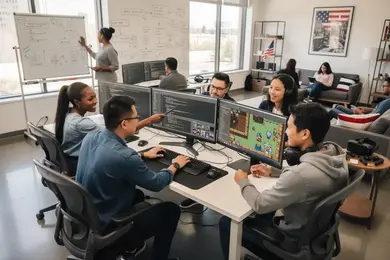
2027 Real-Time Development Careers Growing Fast Beyond Traditional Gaming

Co-Founder and Chief Data Scientist
Real-time engines are moving from game studios into hospitals, factories, classrooms, film sets, defense labs, and architecture firms. The career question is no longer just "Can I make games? " but "Where else can game-engine skills pay off? " The U. S. Bureau of Labor Statistics projected 17% growth for software developers from 2023 to 2033, far faster than average. This guide helps students, career changers, and creative technologists compare roles, degrees, skills, salaries, and school options before investing time and money.
Key Things You Should Know
- Real-time development uses game-engine, 3D graphics, simulation, XR, networking, and interactive software skills in industries such as healthcare, manufacturing, architecture, defense, automotive, education, and film.
- BLS data published in 2024 projected 17% growth for software developers from 2023 to 2033, and May 2024 wage data placed the median annual wage for software developers at $133,080.
- The strongest education path is usually a bachelor's degree plus a portfolio, but certificates, associate degrees, master's programs, and bootcamp-style upskilling can work when they match a specific technical target.
What are real-time development careers beyond gaming?
Real-time development is the practice of building interactive digital systems that respond immediately to user input, sensor data, physics, animation, artificial intelligence, or networked events. In traditional gaming, that means a player moves, shoots, speaks, or explores and the game reacts instantly. Beyond gaming, the same idea powers flight simulators, surgical training tools, virtual production stages, digital twins, product configurators, immersive training, and augmented reality maintenance systems.
The key difference is the end goal. A game may optimize for entertainment and retention, while a non-game real-time system often optimizes for training accuracy, safety, visualization, cost reduction, or decision support. The underlying tools can still be familiar: Unreal Engine, Unity, C++, C#, Python, 3D math, animation systems, shaders, cloud services, and user experience design.
The table below shows where game-engine skills commonly transfer and why that matters when choosing a degree or building a portfolio.
| Industry | Real-time application | What employers usually value |
| Healthcare | Surgical simulation, patient education, anatomy visualization, therapy tools | Accuracy, accessibility, privacy awareness, human-centered design |
| Manufacturing | Digital twins, robotics visualization, operator training, factory layout simulation | Systems thinking, sensor data, performance optimization, 3D workflow skills |
| Architecture and construction | Interactive building walkthroughs, design visualization, safety training | 3D modeling pipelines, lighting, client presentation, BIM familiarity |
| Film and media | Virtual production, real-time previs, LED volume workflows | Rendering, camera systems, lighting, technical art, production problem-solving |
| Defense and public safety | Mission rehearsal, emergency response simulation, equipment training | Reliability, scenario design, networking, security-aware development |
| Automotive | Driver simulation, interface prototyping, autonomous system visualization | Physics, UX, data visualization, hardware integration |
Healthcare is a good example of why career fit matters. If you want to build interactive patient education tools, real-time development may fit; if you want to work directly in food science, wellness counseling, or clinical nutrition pathways, a nutrition degree online may be the more direct academic route.
Which real-time development jobs are growing fastest?
The fastest-growing real-time development opportunities are usually not labeled "game developer." They often appear under software developer, XR engineer, simulation engineer, technical artist, digital twin developer, visualization engineer, AI simulation developer, or virtual production technician. That means students should search job boards by skills and tools, not only by the word "game."
Because BLS does not publish a single occupational category for "real-time developer," the best evidence comes from related occupations and employer demand. BLS data published in 2024 projected 17% growth for software developers from 2023 to 2033, which supports strong demand for interactive software skills across industries, though local hiring varies by region and specialization.
The table below compares high-potential career directions and the type of portfolio evidence that can help a graduate compete for them.
| Role | Where it is growing beyond games | Typical work | Portfolio signal |
| Simulation software developer | Defense, aviation, healthcare, manufacturing, robotics | Builds interactive training, physics, data-driven scenarios, and real-time system behavior | A working simulator with realistic constraints, documentation, and performance testing |
| XR developer | Training, healthcare, field service, education, retail, enterprise collaboration | Develops augmented, virtual, or mixed reality experiences for headsets, mobile devices, or spatial computing platforms | An XR prototype that solves a real task, not just a visual demo |
| Technical artist | Virtual production, architecture visualization, product visualization, animation pipelines | Connects artists and programmers by optimizing assets, shaders, animation, and engine workflows | Before-and-after optimization examples, shader work, tools, and art-to-engine pipelines |
| Digital twin developer | Smart buildings, factories, logistics, energy, transportation | Creates interactive models connected to operational data or simulated system states | A dashboard or 3D environment that visualizes changing data in real time |
| Real-time graphics programmer | Automotive, visualization, simulation, tools, advanced rendering | Works on rendering, shaders, performance, lighting, and low-level graphics systems | Rendering demos with profiling notes and clear explanations of trade-offs |
| Virtual production technical director | Film, advertising, broadcast, live events | Supports real-time sets, camera tracking, LED volumes, previs, and production workflows | Production-ready scenes, lighting tests, camera workflows, and collaborative credits |
A common mistake is treating all real-time careers as the same. An XR developer may need UX testing and device constraints, while a graphics programmer may need linear algebra, C++, shaders, and performance profiling. A technical artist may be hired because they can communicate across art, design, and engineering teams.
What education do real-time development jobs require?
Most real-time development jobs do not require a state license, but they do require proof of skill. For software-heavy roles, a bachelor's degree in game development, computer science, software engineering, simulation, interactive media, or a related field is often the safest baseline. For art-heavy technical roles, a degree in game art, animation, digital media, or graphic design can work if it includes engine-based production and scripting.
The right credential depends on how technical the target job is. A student aiming for real-time rendering will need deeper programming and math than a student aiming for virtual production support or level design. Advanced AI simulation, procedural systems, and intelligent agents may also justify graduate study; students focused on that direction can compare an online masters in AI with a game programming or computer science master's program.
The table below summarizes common education routes and when each one makes sense.
| Education path | Best fit | Main advantage | Main limitation |
| Certificate or bootcamp | Career changers adding Unity, Unreal, XR, or technical art skills | Fast, focused, portfolio-oriented | May not satisfy degree preferences for software engineering roles |
| Associate degree | Students seeking lower-cost entry into programming, game art, or interactive media | Can reduce cost before transfer | May require a bachelor's degree for stronger advancement options |
| Bachelor's degree | Most students pursuing developer, designer, technical artist, or simulation roles | Broadest entry-level credibility and time to build a portfolio | Higher time and cost commitment |
| Master's degree | Students targeting AI, graphics research, advanced simulation, data-heavy visualization, or leadership | Can deepen specialization and support career pivots | Not always necessary for entry-level game-engine roles |
Before enrolling, compare the curriculum against job descriptions. If postings ask for C++, Unreal, networking, shaders, or optimization and the program emphasizes only general media theory, it may not prepare you for the role you want.
Which game development degrees lead to these careers?
Game development degrees can lead to careers beyond gaming when they combine technical depth, production practice, and a portfolio that shows transferable problem-solving. The degree title matters less than the skills students can demonstrate, but different programs create different career options.
The table below helps match common degree types with real-time career goals.
| Degree type | Strongest career fit | Look for these curriculum features |
| Bachelor's in game programming | Software developer, gameplay programmer, simulation developer, XR developer | C++, C#, data structures, game engines, physics, AI, networking, optimization |
| Bachelor's in game design | Systems designer, interaction designer, learning simulation designer, serious games designer | Prototyping, user testing, systems design, level design, narrative systems, production courses |
| Bachelor's in game art or animation | Technical artist, 3D artist, virtual production artist, visualization specialist | 3D modeling, rigging, animation, lighting, shaders, engine integration, asset optimization |
| Bachelor's in computer science with game development electives | Graphics programmer, software engineer, tools developer, AI simulation developer | Algorithms, software architecture, computer graphics, math, systems programming, electives in engines or visualization |
| Interactive media or digital media degree | XR designer, UX-focused real-time developer, educational technology developer | Human-computer interaction, prototyping, web technology, media production, accessibility |
Students interested in real-time visualization but less interested in deep coding should not overlook design-centered programs. For example, an online graphic design bachelor degree may be a better fit for visual communication, interface design, motion graphics, or brand-focused 3D experiences, especially when paired with engine electives or self-directed Unity and Unreal projects.
A practical way to choose is to start with the job title you want, collect 10 current postings, and highlight repeated requirements. If the same tools, languages, and portfolio expectations appear again and again, those should become your program-selection checklist.
Is an online or campus program better for game development?
Online and campus game development programs can both work, but they serve different students. The better option depends on your schedule, budget, need for equipment, learning style, internship access, and how much structure you need to finish complex projects.
Cost is often the first filter. College Board's 2024 Trends in College Pricing reported average published tuition and fees of $11,610 for in-state students at public four-year institutions and $43,350 at private nonprofit four-year institutions for 2024-25. Those figures do not include every cost a student may face, but they show why format, transfer credits, residency status, and institutional aid can change the return on investment.
The table below compares online and campus options from a decision-making perspective.
| Factor | Online program may be better when... | Campus program may be better when... |
| Schedule | You work, have caregiving responsibilities, or need asynchronous classes | You want fixed studio time, lab access, and in-person accountability |
| Equipment | You already have a capable workstation and reliable internet | You need labs, motion capture, VR hardware, sound rooms, or production spaces |
| Collaboration | The program has strong remote production tools and team-based capstones | You learn best through in-person critique, studio culture, and hands-on teamwork |
| Networking | The school has online career fairs, remote internships, and active alumni channels | The campus is near studios, simulation employers, film production, or tech hubs |
| Cost control | You can avoid relocation, commuting, or housing expenses | Campus scholarships, state aid, or local internship income make the total cost competitive |
Use these steps before choosing a format. They help prevent the common mistake of picking the most convenient program without checking whether it supports portfolio development.
- Ask whether students complete team-based engine projects, not just isolated assignments.
- Confirm whether the program supports the tools used in your target roles, such as Unreal, Unity, C++, C#, Blender, Maya, Houdini, Git, Perforce, or cloud collaboration platforms.
- Review student portfolios and capstone reels to see whether graduates build work comparable to entry-level job expectations.
- Compare total cost, including fees, software, hardware, housing, transportation, and lost work time.
- Ask career services how they support internships, employer critiques, alumni referrals, and portfolio reviews for online students.

What courses are in a game programming curriculum?
A strong game programming curriculum should teach students how real-time systems work, not just how to follow engine tutorials. Employers usually want graduates who can debug, collaborate, optimize, document, and explain trade-offs under production constraints.
The table below shows the course areas that matter most for real-time development careers beyond traditional games.
| Course area | Why it matters | Career relevance |
| Programming foundations | Builds fluency in variables, control flow, object-oriented design, debugging, and version control | Essential for software, tools, XR, and simulation roles |
| Data structures and algorithms | Improves performance, scalability, and problem-solving | Important for technical interviews and complex systems |
| Game engines | Teaches scene management, physics, animation, scripting, UI, asset pipelines, and deployment | Directly applicable to Unity, Unreal, simulation, and XR work |
| Computer graphics and shaders | Explains rendering, lighting, materials, GPU concepts, and visual performance | Critical for technical art, visualization, and graphics programming |
| Math for games and simulation | Covers vectors, matrices, collision, physics, interpolation, and spatial reasoning | Needed for XR, physics, robotics visualization, and real-time interaction |
| AI and procedural systems | Supports agents, decision systems, content generation, pathfinding, and simulation behavior | Useful in training systems, games, autonomous simulation, and adaptive environments |
| Networking and multiplayer systems | Teaches synchronization, latency, replication, and client-server design | Valuable for collaborative training, remote simulation, and networked XR |
| Production studio or capstone | Builds teamwork, scope control, agile workflows, testing, and presentation skills | Often the strongest portfolio evidence for entry-level hiring |
Students who like real-time systems but want to work more with analytics, operational data, or digital twin dashboards may need stronger data skills than a typical game curriculum provides. In that case, comparing a game development program with the cheapest masters in data science can clarify whether a technical visualization or analytics route offers a better long-term fit.
What admissions requirements do game development programs use?
Admissions requirements vary by school and degree level, but game development programs often look for academic readiness, creative potential, technical interest, and evidence that the applicant understands the workload. Selective programs may also review portfolios, essays, or prior programming experience.
Typical undergraduate requirements include the items below. Always confirm details with the school because requirements can differ for first-year, transfer, online, international, and adult learners.
- High school diploma, GED, or equivalent credential.
- Official transcripts from high school and any colleges attended.
- Minimum GPA or placement requirements, especially for math or programming sequences.
- Application essay or statement of purpose explaining interest in games, simulation, interactive media, or software development.
- Portfolio, creative samples, or project examples for art, design, animation, or competitive programs.
- Letters of recommendation for some programs, especially private or selective institutions.
- English proficiency documentation when required by the institution.
Graduate programs usually expect a bachelor's degree and may require programming samples, a portfolio, prerequisite coursework, a resume, a statement of goals, or faculty review. Students without a technical undergraduate degree should ask whether bridge courses are available and whether those courses add time or cost.
Watch for red flags during admissions conversations. These warning signs do not always mean a program is poor, but they should prompt deeper questions.
- The school emphasizes "dream job" language but cannot show recent student projects, capstones, or employer connections.
- The curriculum lists game development broadly but does not specify engines, programming languages, production tools, or portfolio expectations.
- Admissions staff cannot explain transfer credit policies, total cost, accreditation, or hardware requirements clearly.
- The program promises salary outcomes or job placement rather than explaining typical career support and outcome limitations.
- Online students have fewer portfolio reviews, career services, or team production opportunities than campus students.
How long does a game development degree take?
The time required for a game development degree depends on credential level, enrollment intensity, transfer credit, prerequisites, and whether the program uses traditional semesters or accelerated terms. Full-time students can move faster, but part-time study may be more realistic for working adults.
The table below gives typical timelines. These are planning ranges, not promises, because individual schedules depend on school calendars and course availability.
| Credential | Typical completion time | Best for | Planning caution |
| Certificate | Several months to 1 year | Adding a specific tool or portfolio skill | May not be enough for software developer roles that prefer degrees |
| Associate degree | 2 years full time | Lower-cost start, transfer planning, entry-level media or QA roles | Credits should be checked against bachelor's transfer requirements before enrollment |
| Bachelor's degree | 4 years full time | Most entry-level developer, designer, technical artist, and interactive media roles | Team projects and portfolio milestones should begin before the final year |
| Master's degree | 1 to 2 years full time | Specialization in AI, graphics, simulation, research, leadership, or career pivoting | Prerequisite gaps can add extra courses for nontechnical applicants |
Students who want to finish faster should focus on controllable factors. The most practical acceleration options are listed below.
- Transfer general education credits from an accredited college when the receiving school confirms they apply to the degree plan.
- Choose a program with year-round course availability if prerequisites are sequenced tightly.
- Ask whether prior learning, professional certifications, military training, or portfolio review can reduce elective requirements.
- Avoid overloading technical courses if doing so would weaken portfolio quality or delay graduation through failed prerequisites.
The biggest timeline mistake is assuming the degree alone is the finish line. Real-time development hiring often depends on a portfolio, so students should plan project milestones every term instead of waiting until the capstone.
What salary can real-time development graduates expect?
Salary expectations depend on role, region, industry, portfolio quality, programming depth, employer size, and whether the job is closer to software engineering, art production, simulation, or media. Median wage data is useful for orientation, but it should not be read as an entry-level guarantee.
The table below uses May 2024 BLS wage data for related U.S. occupations. These categories are broader than real-time development, but they help students compare salary contexts for different career directions.
| Related occupation | May 2024 median annual wage | How it connects to real-time development |
| Software developers | $133,080 | Simulation engineering, engine programming, XR development, tools programming, interactive systems |
| Computer and information research scientists | $140,910 | Advanced graphics, AI simulation, human-computer interaction, research-heavy visualization roles |
| Special effects artists and animators | $99,060 | Real-time animation, virtual production, technical art, 3D visualization, cinematic workflows |
| Web developers and digital designers | $95,380 | Interactive interfaces, web-based 3D, product configurators, UX-heavy visualization |
| Computer systems analysts | $103,790 | Digital twin planning, enterprise simulation, systems integration, stakeholder requirements |
The strongest salary strategy is to align your education with higher-value constraints. Employers often pay more for candidates who can combine engine skills with software architecture, math, cloud deployment, performance optimization, AI, data integration, or domain knowledge in healthcare, manufacturing, defense, or automotive systems.
Be cautious with salary claims from schools, influencers, or bootcamps. Ask whether reported outcomes include only graduates who responded to surveys, whether the jobs are full time, whether freelance income is included, and whether the figures reflect your region and target role.
How do you choose an accredited game development school?
Accreditation should be one of the first checks when choosing a game development school. In the U.S., institutional accreditation helps determine eligibility for federal financial aid and can affect credit transfer, graduate school admission, and employer confidence. Programmatic accreditation is less common for game development than for fields such as nursing or engineering, so students should focus first on institutional legitimacy and then on program quality.
The table below separates accreditation checks from quality checks because both matter, but they are not the same thing.
| What to check | Why it matters | What to ask |
| Institutional accreditation | Supports aid eligibility, transferability, and basic institutional credibility | Is the school accredited by an agency recognized by the U.S. Department of Education or CHEA? |
| State authorization for online study | Online programs must be authorized to serve students in applicable states | Can I enroll from my state, and are there any location-based restrictions? |
| Transfer credit policy | Can reduce cost and time, but only if credits apply to the degree | Which credits apply to major requirements versus free electives? |
| Portfolio outcomes | Shows whether students produce work aligned with real hiring expectations | Can I review recent student reels, capstones, games, simulations, or XR projects? |
| Faculty experience | Industry-aware instructors can teach current workflows and review portfolios effectively | Who teaches engine, programming, technical art, and production courses? |
| Career services | Real-time careers often require networking, internships, and portfolio critique | What support exists for internships, employer feedback, alumni networking, and remote students? |
Use a structured comparison before applying. The following steps can help you avoid choosing a school based only on branding or convenience.
- Verify institutional accreditation through official databases, not just school marketing pages.
- Map every required course to your target job skills, including programming languages, engines, math, production, and portfolio development.
- Calculate total cost after scholarships, transfer credits, fees, hardware, software, housing, and transportation.
- Review student work from the last two years to see whether projects look current and technically credible.
- Ask how many courses require team production, critique, version control, testing, and shipped builds.
- Compare career support for your exact format, because online and campus students may receive different levels of access.
A good program should be able to explain what students build, how they are evaluated, where alumni work, and how the curriculum stays current. If a school cannot answer those questions clearly, keep comparing options.
Other Things You Should Know About Game Programming & Development
Python helps with tool scripting, pipeline automation, and data handling in studios using Unreal Engine and Unity. Employers often expect basic scripting, file I/O, and API work. In 2027, many teams use Python for build tools, asset validation, and workflow automation rather than for the final real-time product.
Not always, but a bachelor's degree is often the strongest entry-level path for software-heavy roles. A certificate or associate degree can work for focused skill-building, especially when paired with a strong portfolio, but some employers prefer or require a four-year degree.
Choose based on your target role. Unity is common in mobile, education, prototyping, and some XR workflows. Unreal is widely used in high-end visualization, virtual production, architecture, automotive, and advanced 3D work. Learning core programming, math, and engine concepts matters more than memorizing one tool.
In 2027, AI enhances real-time development careers by automating repetitive tasks, enabling developers to focus on creative aspects. AI tools assist in optimizing workflows and improving efficiencies, rather than replacing human skills. AI and real-time development increasingly complement each other across industries beyond traditional gaming.
References
- Game Development Career Pathways | CG Spectrum https://www.cgspectrum.com/career-pathways/game-development
- Game Design Requirements: Skills, Portfolio & Entry Guide | BSBI https://www.berlinsbi.com/blog/game-design-requirements-what-you-need-to-know-before-you-apply
- 7 Steps to Become A Game Developer in 6 Months (Few Talk About #7 Enough!) https://www.kwalee.com/blog/how-to-become-a-game-developer-in-6-months
- We help game developers learn and grow https://gamedev.tv/
- How long does it take for a beginner to become a full-time solo developer with Godot? https://forum.godotengine.org/t/how-long-does-it-take-for-a-beginner-to-become-a-full-time-solo-developer-with-godot/93653
- Training for Job Entry and Career Development | Infobase https://infobase.com/blog/facts-on-file/fergusons-career-guidance-center/training-for-job-entry-and-career-development/
- Software Development Statistics for 2026: Key Facts & Trends https://www.itransition.com/software-development/statistics
- This website is not available in your country https://www.eurotechjobs.com/article/766/educational-requirements-for-tech-jobs-degrees-certifications-and-skills
- What graduate salary can I expect in an IT job? https://targetjobs.co.uk/careers-advice/information-technology/what-graduate-salary-can-i-expect-it-job
- What training do you need to work in digital? - Sup de Pub https://www.supdepub.com/en/guide/what-training-do-you-need-to-work-in-digital/