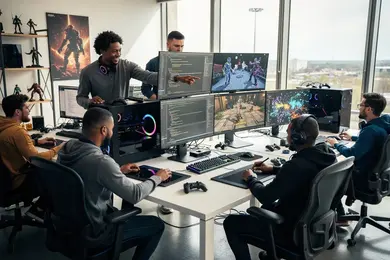
2027 Gameplay Programmer vs Engine Programmer vs Technical Designer: Which Path Pays More?

Co-Founder and Chief Data Scientist
Choosing between gameplay programming, engine programming, and technical design is really a choice between creative implementation, deep systems engineering, and design-focused problem solving. It matters because the U. S. Bureau of Labor Statistics reported a $133,080 median annual wage for software developers in May 2024, but game roles do not pay evenly across specialties. This guide is for students, career changers, and junior developers who want a practical comparison of pay, training, skills, timelines, and hiring outlook so they can pick the path with the best fit and strongest return.
Key Things You Should Know
- Engine programmers usually have the highest ceiling because they work on rendering, performance, networking, tools, memory, and platform-level systems that require advanced C++, math, and low-level debugging.
- Gameplay programmers often sit in the middle: they can earn strong software salaries, especially in AAA and live-service studios, but compensation depends heavily on technical depth, studio budget, and shipped-game experience.
- Technical designers are often paid less than programmers at the same seniority, but the role can be a better fit for people who want to blend scripting, systems design, prototyping, and player-experience decisions rather than specialize in software architecture.
Which role pays more: gameplay programmer, engine programmer, or technical designer?
Engine programmer generally pays the most, gameplay programmer usually comes next, and technical designer often pays the least among the three. The reason is not that one role is more important than another; it is that the labor market prices scarce technical specialization differently. Studios need engine programmers who can solve difficult performance, graphics, memory, build-system, and platform problems that directly affect whether a game can ship on target hardware.
Gameplay programmers are also highly technical, but the role covers a wider range of work. Some gameplay programmers build complex combat, AI behavior, physics interactions, and networked features, while others focus on implementing designer-facing features in an existing engine. Technical designers are closer to the design pipeline: they prototype, tune, script, and connect game systems, but they may not be expected to own production-grade C++ architecture.
The table below summarizes how these three paths usually compare for U.S. candidates. Because the BLS does not publish separate national medians for "gameplay programmer," "engine programmer," or "technical designer," the salary ranking should be used as a market-direction guide rather than a guaranteed outcome.
| Role | Typical pay position | Why employers pay that way | Best fit |
| Engine programmer | Highest overall ceiling | Requires advanced C++, systems thinking, optimization, debugging, graphics, networking, and hardware awareness | People who enjoy deep technical problems more than content implementation |
| Gameplay programmer | Strong pay, often below engine at senior levels | Requires coding skill plus collaboration with designers, artists, animators, and QA to create shippable player-facing features | People who want to code mechanics, tools, AI behaviors, combat, abilities, and game systems |
| Technical designer | Often lower than programming roles, with exceptions for senior systems specialists | Combines scripting, design logic, prototyping, balancing, and workflow support rather than deep software engineering | People who want to design interactive systems and use technical tools without becoming full-time software engineers |
If pay is the primary deciding factor, engine programming is the strongest bet. If you want the best balance of creative game impact and software compensation, gameplay programming may be the better match. If you care more about systems design, rapid prototyping, and player experience than maximizing pay, technical design can be the more satisfying path.
What does each game development role actually do?
These roles often collaborate on the same feature, but they own different parts of the work. For example, a new traversal system might require an engine programmer to improve animation performance, a gameplay programmer to implement movement behavior, and a technical designer to tune jump timing, camera feel, and level constraints.
| Role | Core responsibility | Common daily work | Deliverables |
| Gameplay programmer | Turns gameplay ideas into working features | Implementing mechanics, fixing bugs, integrating animations, building AI behavior, supporting designers, writing tools | Combat systems, character abilities, interaction systems, mission logic, AI behaviors, UI-connected features |
| Engine programmer | Builds and improves the technology that the game runs on | Profiling performance, optimizing memory, improving rendering, maintaining build systems, debugging crashes, supporting platforms | Rendering systems, physics support, networking layers, editor tools, platform features, engine performance improvements |
| Technical designer | Bridges design ideas and technical implementation | Prototyping in visual scripting, tuning values, creating design tools, documenting systems, testing player experience | Playable prototypes, design scripts, ability setups, encounter logic, balancing data, workflow improvements |
A helpful way to think about the difference is ownership. Gameplay programmers usually own production code for player-facing systems. Engine programmers own the underlying technology and performance. Technical designers own how systems behave, feel, and support design intent. In smaller studios, one person may cover more than one of these areas, which can be great for learning but can also blur job titles when comparing salaries.

What degree or training do employers prefer for these roles?
Employers usually prefer a bachelor's degree in computer science, software engineering, game programming, or a closely related technical field for gameplay and engine programming roles. A game development degree can work well if it includes strong programming, math, algorithms, data structures, and portfolio-based production experience. For technical design, employers may accept game design, interactive media, computer science, or hybrid programs if the candidate can show strong scripting and system-building ability.
Cost matters when choosing training. The College Board's 2024-2025 pricing data placed average published tuition and fees at $11,610 for in-state students at public four-year colleges and $43,350 at private nonprofit four-year colleges. That gap means the "best" program is not always the most prestigious one; it is often the program that gives you strong projects, internships, faculty feedback, and manageable debt.
The table below compares common training options by fit and trade-off. Use it to decide whether you need a full degree, a focused certificate, or a portfolio-driven route.
| Training path | Best for | Strengths | Trade-offs |
| Computer science bachelor's degree | Gameplay and engine programming candidates | Strong foundation in algorithms, systems, software engineering, and math | May require self-directed game projects to prove game-specific ability |
| Game programming bachelor's degree | Students who want a games-focused curriculum from the start | Can combine C++, engines, gameplay systems, production, and portfolio work | Quality varies widely; accreditation and course depth are essential |
| Game design or interactive media degree | Technical designers and systems designers | Supports prototyping, design theory, level design, and scripting | May not be enough for programming-heavy roles unless paired with coding depth |
| Certificate, bootcamp, or self-study | Career changers with prior technical or design experience | Lower time commitment and faster portfolio building | Harder for entry-level candidates if they lack shipped projects or formal fundamentals |
Students leaning toward technical design, UI systems, or visual communication may also compare an online graphic design degree with game design or programming options, but visual design alone is not a substitute for scripting, engine work, or systems thinking.
Which skills and programming languages matter most for each path?
The most valuable skills depend on which role you choose. Engine programmers need the deepest computer science and systems knowledge; gameplay programmers need strong coding plus collaboration with designers; technical designers need enough scripting and logic to prototype and tune systems without blocking production.
| Path | Most important technical skills | Common languages and tools | Portfolio proof employers want |
| Gameplay programmer | Object-oriented programming, debugging, gameplay architecture, AI behavior, physics integration, UI connections, source control | C++, C#, Unreal Engine, Unity, Blueprints, Perforce, Git | Playable mechanics, combat systems, AI demos, multiplayer prototypes, clean code samples |
| Engine programmer | Algorithms, data structures, memory management, rendering, multithreading, profiling, optimization, platform constraints | C++, HLSL/GLSL, Unreal Engine source, custom engines, profiling tools, build systems | Renderer demos, optimization case studies, engine tools, platform or performance improvements |
| Technical designer | Systems design, visual scripting, logic, tuning, documentation, rapid prototyping, communication with engineers and designers | Blueprints, C#, Lua, Python, Unity, Unreal Engine, spreadsheets, scripting tools | Playable prototypes, scripted encounters, ability systems, level logic, design documents with implementation notes |
AI is also changing expectations. It is not replacing these roles wholesale, but it is increasing the value of developers who can use AI-assisted tools responsibly, evaluate generated code, automate repetitive workflows, and understand procedural content systems. Students who want a deeper technical foundation in machine learning, simulation, or AI tooling can compare AI degrees online with traditional computer science and game programming programs.
If you are choosing what to learn first, prioritize fundamentals before flashy tools. A practical sequence looks like this:
- Learn programming fundamentals in C++ or C# and build small finished projects.
- Study data structures, algorithms, math for games, debugging, and source control.
- Choose Unreal or Unity and build role-specific portfolio pieces.
- Publish a clear portfolio with videos, build downloads, code samples, and short explanations of your decisions.
- Get feedback from developers, revise your work, and remove weak projects that dilute your strongest samples.
Are online game programming programs respected by employers?
Yes, online game programming programs can be respected by employers, but the format matters less than evidence of skill. Hiring managers usually care about whether you can write maintainable code, solve production problems, collaborate on a team, and show finished work. A weak on-campus program will not help much, and a strong online program with rigorous projects can be valuable.
Online study is strongest for disciplined learners who can build outside class, participate in team projects, and seek feedback. It can be weaker for students who need in-person studio labs, local networking, hardware access, or structured accountability. Technical designers who become interested in learning systems, training games, or educational simulations may also explore instructional design masters online, especially if they want to work at the intersection of interactivity, learning, and user experience.
Before enrolling in an online program, check whether it provides the conditions employers actually value. The following questions can help you separate credible options from programs that overpromise:
- Is the institution accredited by an agency recognized by the U.S. Department of Education or the Council for Higher Education Accreditation?
- Does the curriculum require C++, C#, algorithms, data structures, math, engine work, and team production rather than only introductory game design?
- Can students graduate with several polished portfolio pieces, including at least one team-based project?
- Do instructors have game industry, software engineering, or technical design experience relevant to the courses they teach?
- Does the school publish realistic career support details instead of implying that a degree alone will get you hired?
A common mistake is choosing an online program because it has "game" in the title. Look past branding and inspect syllabi, faculty, student work, transfer policies, total cost, and career services. Employers rarely reward the program name by itself; they reward demonstrated ability.

What courses should a strong game development program include?
A strong game development program should build both technical fundamentals and game-specific production experience. For programmers, the biggest red flag is a curriculum that teaches engines but not software foundations. For technical designers, the biggest red flag is a design curriculum that never requires scripting, data logic, implementation constraints, or collaboration with engineers.
The table below shows the courses that matter most and why they affect employability.
| Course area | Why it matters | Most relevant path |
| Programming I-II and object-oriented programming | Builds the coding foundation for maintainable gameplay and tools work | Gameplay programmer, engine programmer |
| Data structures and algorithms | Supports efficient systems, technical interviews, and scalable problem solving | Gameplay programmer, engine programmer |
| Computer graphics and rendering | Prepares students for visual systems, shaders, optimization, and engine work | Engine programmer |
| Game physics and simulation | Supports movement, collisions, environment interaction, and believable systems | Gameplay programmer, engine programmer |
| Game AI and behavior systems | Helps with enemies, NPC decision-making, pathfinding, tactics, and systemic gameplay | Gameplay programmer, technical designer |
| Game engines and tools development | Teaches how developers build workflows, editors, pipelines, and reusable systems | Engine programmer, gameplay programmer |
| Level design and systems design | Supports pacing, constraints, player goals, and gameplay loops | Technical designer |
| Team production or capstone | Creates portfolio evidence and teaches collaboration across disciplines | All three paths |
Programs that include documentation, asset organization, and knowledge-management practices can also help students who enjoy technical pipelines and information systems. If that interest grows beyond games into digital archives, research systems, or information organization, a masters in library science can be an adjacent graduate path rather than a replacement for game programming training.
When reviewing a curriculum, look for depth, not just course titles. A course called "game programming" could mean serious C++ systems work, or it could mean beginner scripting. Ask for sample assignments, capstone examples, engine requirements, and how student work is evaluated.
How long does it take to prepare for each career path?
Preparation time depends on your starting point, the role you want, and how much portfolio work you complete. A four-year bachelor's degree is the standard route for many entry-level programming candidates, but some career changers with prior software experience can move faster. Technical design can sometimes be entered through design, QA, modding, or scripting-heavy portfolio work, but strong candidates still need production-ready examples.
The table below gives realistic preparation timelines. These are planning ranges, not rules, because prior coding experience, transfer credits, internships, and portfolio quality can change the timeline substantially.
| Path | Typical preparation time | What must be ready before applying | Common first role |
| Gameplay programmer | 2-4 years for students building from scratch; faster for experienced programmers | Playable projects, C++ or C# strength, engine experience, debugging ability, team project evidence | Junior gameplay programmer, tools programmer, junior software engineer in games |
| Engine programmer | 3-5 years because the role requires deeper systems and math preparation | Advanced C++, optimization examples, graphics or systems demos, strong CS fundamentals | Junior engine programmer, graphics programmer, tools programmer, software engineer |
| Technical designer | 1-4 years depending on design background and scripting ability | Playable prototypes, scripting examples, design documentation, tuning examples, collaboration evidence | Associate technical designer, junior systems designer, level scripter, QA-to-design transition role |
If you are starting from zero, do not rush to apply with unfinished projects. Game hiring is portfolio-sensitive, and one polished, playable project usually says more than several incomplete demos. A practical goal is to finish small projects first, then build one role-specific showcase that proves you can do the work advertised in entry-level job descriptions.
What do these roles typically pay at entry, mid, and senior levels?
U.S. pay varies by studio size, region, remote policy, union or nonunion environment, platform, and whether the employer competes with broader tech companies for talent. The BLS software developer median of $133,080 in May 2024 is a useful benchmark, but game-specific titles may fall above or below it depending on specialization and seniority.
The table below gives practical U.S. planning bands commonly used for career comparison. Treat them as directional ranges, not promises, and verify current postings in your target city or remote market before making a financial decision.
| Role | Entry-level planning range | Mid-level planning range | Senior-level planning range | Pay notes |
| Gameplay programmer | $70,000-$95,000 | $95,000-$135,000 | $135,000-$180,000+ | Higher pay is more likely with C++, multiplayer, AI, tools, live-service, or shipped AAA experience |
| Engine programmer | $85,000-$115,000 | $120,000-$165,000 | $165,000-$220,000+ | Rendering, optimization, networking, platform, and engine architecture skills can command premium compensation |
| Technical designer | $60,000-$85,000 | $85,000-$120,000 | $120,000-$160,000+ | Senior technical systems designers can earn more when they own complex tools, scripting frameworks, or live-game systems |
Compensation can also include bonuses, profit sharing, stock, relocation support, or overtime rules, but these vary widely. When comparing offers, look at total compensation, cost of living, stability, project stage, crediting policy, mentorship, and whether the role builds skills that transfer to future studios or broader software jobs.
What job outlook exists for game programmers and technical designers?
The outlook is strongest for candidates who can compete as software developers, not only as fans of games. The BLS projects employment for software developers to grow 15% from 2024 to 2034, which is much faster than the average for all occupations. For game career planning, that means strong technical fundamentals create optionality: the same skills can support games, simulation, AR/VR, tools, entertainment technology, and non-game software roles.
Game industry hiring can be cyclical. Studios expand during production and live-service growth, then contract when projects are canceled, funding tightens, or publishers reorganize. That volatility makes transferable skills especially important. C++, C#, Python, debugging, version control, systems design, profiling, networking, and tools development can help candidates move across studios or into adjacent industries.
Current trends affecting these roles include AI-assisted workflows, procedural content tools, cross-platform development, live-service operations, remote collaboration, and growing demand for performance optimization across PC, console, mobile, cloud, and handheld devices. Engine programmers benefit when studios need technical efficiency. Gameplay programmers benefit when teams need scalable interactive systems. Technical designers benefit when fast prototyping and designer-friendly tools become production advantages.
The safest career strategy is to build a portfolio that shows both specialization and flexibility. A gameplay programmer should show shipped-feeling mechanics, not only tutorials. An engine programmer should show measurable technical improvements. A technical designer should show that design choices were implemented, tested, tuned, and documented.
How do you choose an accredited school for game programming?
Accreditation matters because it affects credit transfer, federal financial aid eligibility, graduate school options, and employer confidence in the institution. It does not guarantee that a game program is strong, but lack of recognized accreditation is a serious red flag for degree-seeking students.
Use this step-by-step process before committing to a school:
- Confirm institutional accreditation through the U.S. Department of Education or Council for Higher Education Accreditation databases.
- Review the actual curriculum, not just marketing pages, and check for programming depth, math, engines, team projects, and portfolio requirements.
- Ask admissions for recent student work, capstone examples, internship support, faculty qualifications, and career-services details.
- Compare total cost, including fees, software, hardware, housing, transportation, interest, and the cost of extra semesters if courses are sequenced tightly.
- Check transfer-credit rules, prior-learning policies, online attendance expectations, and whether courses are offered often enough to graduate on schedule.
- Contact current students or alumni when possible and ask whether the program prepared them for interviews, production work, and portfolio reviews.
Common mistakes include choosing the most expensive program assuming it has the best return, ignoring accreditation, relying only on rankings, enrolling without reviewing student portfolios, and assuming a degree will overcome a weak portfolio. A better approach is to compare the program's cost against the quality of work you can realistically produce by graduation.
If you are deciding between multiple schools, prioritize the one that gives you the strongest combination of accredited status, rigorous technical coursework, feedback from qualified instructors, team-based projects, internship access, and manageable debt. For game careers, the program should help you leave with proof of ability, not just completed credits.
Other Things You Should Know About Game Programming & Development
In 2027, engine programming tends to offer higher salaries due to technical complexity, while gameplay programming and technical design allow for more creative input. For those seeking both high pay and creativity, technical design often provides a balanced combination, though compensation may vary.
Yes. Most engine programmer job postings require strong C++ skills, plus multithreading, data structures, and performance debugging. Many also ask for 2 to 5 years of professional experience, knowledge of profiling tools such as PIX or RenderDoc, and familiarity with console or PC engine architecture.
No. Many employers accept computer science, software engineering, interactive media, or related degrees if your portfolio is strong. For programming roles, technical fundamentals and finished projects often matter more than having "game development" in the degree title.
References
- CourseCareers https://coursecareers.com/blog-posts/15-careers-you-can-start-with-no-experience-or-degree
- The Video Game Designer Job Outlook | NEIT https://www.neit.edu/blog/video-game-designer-job-outlook
- Page not found | Career Analysts http://www.careeranalysts.co.uk/prices/
- How to choose game developer jobs: 13 best professions for earning insane profits https://kreonit.com/company-and-hiring/game-developer-jobs/
- Choosing Your Code Path: What Programming Language Should I Learn? https://www.bloomtech.com/article/best-coding-language-to-learn
- What Employers Want: The Battle Between Skills and Degrees - The EvoLLLution https://evolllution.com/programming/credentials/what-employers-want-the-battle-between-skills-and-degrees
- 8 Best Game Development Courses for 2025: Build Your Dream Game — Class Central https://www.classcentral.com/report/best-game-development-courses/
- Which programming language should I learn for the target industry sector, and how much time does it take? https://nextgenlearning.org.uk/which-programming-language-should-i-learn-for-the-target-industry-sector-and-how-much-time-does-it-take/
- What Is a Video Game Designer? | Skills and Career Paths https://www.computerscience.org/careers/video-game-designer/
- Job Level Classification (2025): Frameworks & Best Practices https://nativeteams.com/blog/job-level-classification