2027 What Jobs Can You Get With an MLIS in Knowledge Organization?

Co-Founder and Chief Data Scientist
An MLIS can prepare you to organize information, but the job titles - and the qualifications behind them, vary widely. The U.S. Bureau of Labor Statistics reports a May 2025 median annual salary of $68,270 for librarians and media collections specialists, a category that includes some, but not all, knowledge organization work.
If you are considering an MLIS or choosing courses within one, this guide connects specific jobs to their daily tasks, hiring requirements, pay context, and practical training. It will help you decide whether the degree fits your target role and what to look for in a program.
Key Things You Should Know
- MLIS graduates can pursue cataloging, metadata, taxonomy, digital collections, and related roles; employers do not require an MLIS for every one of them.
- BLS projects 2.6% employment growth for librarians and media collections specialists from 2025 to 2035; that broad projection is not a forecast for catalogers or metadata specialists alone.
- Choose a program by checking actual courses, applied projects, accreditation, and total cost, not by assuming a knowledge organization course is a formal concentration.
What is knowledge organization in library and information science?
Knowledge organization is the work of describing, classifying, and connecting information so people and systems can find and use it. A cataloger might make books discoverable in a library catalog; a metadata specialist might describe photographs in a digital collection; a taxonomist might define the categories used to navigate an organization's website.
The work goes beyond assigning keywords. It involves choosing consistent terms, identifying creators and subjects, maintaining relationships among records, and checking whether descriptions support equitable access. Authority control, for example, helps bring records about the same person or organization together even when names appear in different forms.
Knowledge organization overlaps with, but is not identical to, archives, records management, or knowledge management. Archivists also make collections discoverable, but their responsibilities can include appraisal, arrangement, and preservation. Records managers focus on how long organizational records must be kept and how they are disposed of. A job title may combine these functions, so read the duties rather than relying on the label.
What jobs can you get with an MLIS in knowledge organization?
An MLIS can support several career paths, but titles are not standardized across employers. The comparison below shows what each role commonly does and how to interpret the degree requirement before applying.
| Role | Typical work | How the MLIS fits |
| Cataloging or technical services librarian | Creates and maintains catalog records, subject access, and name authorities. | Often relevant to professional librarian positions; check each posting's degree requirement. |
| Metadata librarian or specialist | Designs descriptions and improves discovery across digital collections or repositories. | May be required or preferred in libraries; other employers may accept equivalent experience or another degree. |
| Taxonomist or information architect | Builds categories, labels, and relationships that help users navigate content. | One possible preparation route alongside information science, UX, and related experience. |
| Digital collections specialist | Coordinates descriptive metadata, digitization workflows, and access to digital materials. | Useful for library-based roles; technical and project experience may carry substantial weight. |
| Archival description specialist | Creates finding aids and descriptions that help researchers locate archival materials. | Relevant when paired with archival training; some positions favor substantial archives experience. |
Entry points may include cataloging assistant, library technician, digitization assistant, or metadata project work. These positions can build experience, but a paraprofessional job is not automatically a path to a professional librarian opening. Conversely, experienced workers in content operations or data management may qualify for adjacent taxonomy roles without returning for an MLIS.
For competitive specialist positions, examine required experience as closely as the degree line. A posting seeking experience with a particular repository, subject domain, or language may present a higher barrier than its job title suggests. That distinction also matters when comparing difficult library careers to break into.
How much can you earn with an MLIS in knowledge organization?
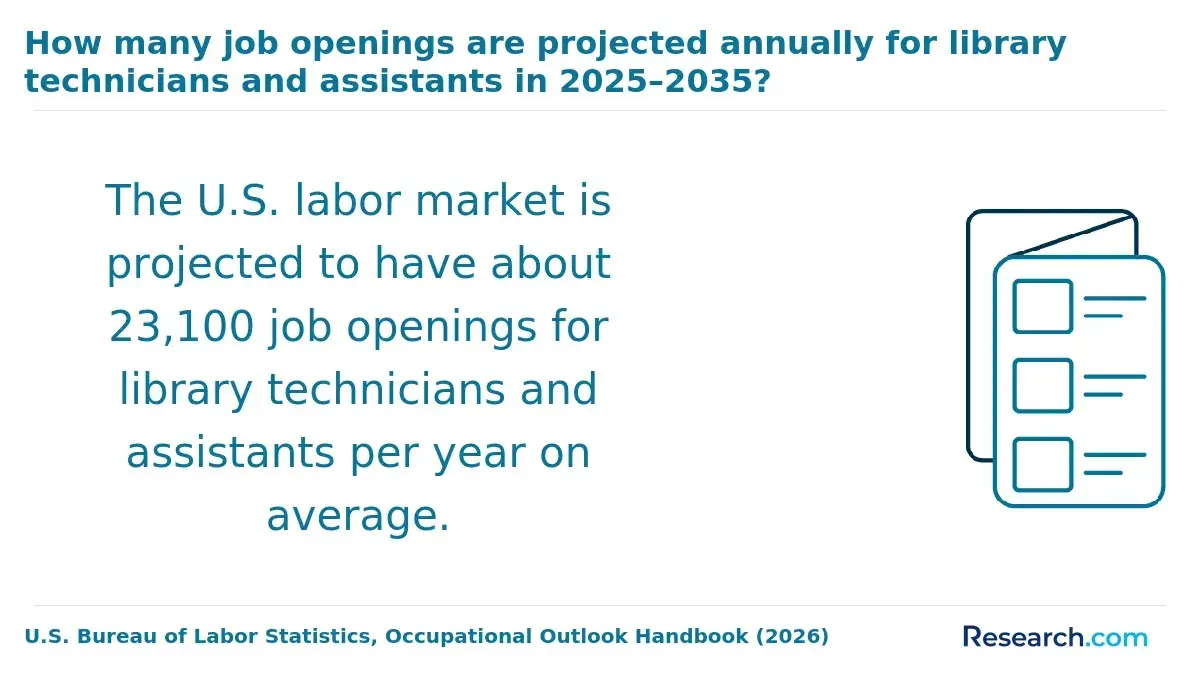
There is no single salary for "knowledge organization." BLS occupational figures provide a useful U.S. benchmark, but they cover entire occupations - not MLIS graduates or the specific job titles in the table above. The following May 2025 medians and 2025-2035 projections help put library and archives paths in context.
| BLS occupation | Median annual salary, May 2025 | Projected job growth, 2025-2035 |
| Librarians and media collections specialists | $68,270 | 2.6% |
| Archivists | $64,550 | 3.4% |
| Library technicians | $44,580 | −6.4% |
The gap between the librarian and technician medians illustrates why the level of the position matters when weighing graduate-school costs. It does not show how much an individual would gain from an MLIS: pay also depends on employer, location, duties, and experience. BLS does not provide a comparable median here for taxonomy or metadata specialist titles, so avoid treating a broader librarian figure as their expected salary.
If earnings are central to your decision, compare actual postings for your target role and location with your likely education costs. An online library degree earnings comparison can help frame that trade-off, but published occupational medians are not program-specific graduate outcomes.
What coursework does an MLIS knowledge organization program include?
Relevant MLIS coursework commonly addresses information organization, cataloging, classification, metadata, and information retrieval. Course titles alone are not enough: review descriptions and assignments to see whether students create and revise records, map between schemas, or evaluate how users search.
For library cataloging, look for instruction in MARC, a format for exchanging catalog records, and RDA, guidance used to describe resources. For digital collections, Dublin Core and metadata mapping can be useful. Courses on taxonomies, linked data, or BIBFRAME may be valuable for particular roles, but not every employer uses them. A strong elective plan reflects the systems used in your target jobs rather than the longest possible list of standards.
Applied work is especially useful when it produces something you can discuss in an interview: a small cataloging set with documented decisions, a digital-collection metadata plan, or a taxonomy revised after user testing. If you prefer to demonstrate learning through projects, compare how programs assess work; an online library science progress by skill approach may suit you, provided its actual curriculum covers your intended specialization.
Check whether relevant courses are required or elective and when they are offered. A catalog listing does not mean an elective will run during your enrollment.
Which industries hire MLIS knowledge organization graduates?
Libraries are an obvious destination: academic, public, school, government, law, and medical libraries all need information to be described and discoverable. The mix of duties differs. A large academic library may have a dedicated metadata unit, while a smaller library may combine cataloging with reference, systems, or collection work.
Museums and archives organize collections and digital objects, though those jobs may call for collections-specific or archival experience. Universities and research organizations also manage institutional repositories and research outputs. Outside cultural institutions, publishers, vendors, and organizations with large content collections may hire people to develop taxonomies or improve search and navigation.
Target the setting as well as the title. A taxonomy role in a company may emphasize product content and user research, while a metadata role in a library may emphasize catalog records and shared standards. The MLIS is an advantage only when its training matches those duties.
What skills do knowledge organization employers look for?
Employers look for evidence that you can make consistent descriptive decisions and explain their effect on discovery. Technical familiarity matters, but so do close reading, documentation, collaboration, and the judgment to recognize when an existing category or subject term poorly represents a collection.
Useful evidence might include records you created and checked for consistency, a brief explanation of a metadata-mapping decision, or a taxonomy with notes on how users would find information through it. Remove confidential information from any portfolio sample and state what you did personally on a group project.
Some roles call for spreadsheet work, data cleanup, scripting, or familiarity with a library management system or digital asset platform. Others prioritize subject expertise or additional languages. AI-assisted description can make review skills more important: a generated subject term still needs checking against the item, local practice, and accessibility goals. Read several current postings for your intended role before deciding which technical skill to learn next.
Do you need an ALA-accredited MLIS for knowledge organization jobs?
Not universally. Some professional librarian postings require a master's degree from an American Library Association (ALA)-accredited program; others accept an equivalent LIS degree or specify relevant experience. Taxonomy, content, and other adjacent roles may accept different degrees altogether. Follow the requirement in the jobs you actually want rather than assuming one rule covers the field.
ALA accredits eligible master's programs, not a university as a whole or a particular knowledge organization elective. An institution's accreditation therefore does not establish that its MLIS is ALA-accredited. Check the current ALA directory for the exact program and ask the school how its named degree - whether MLIS, MLS, Master of Information, or another title - relates to that listing.
If school librarianship is also an option, check the relevant state education authority separately. State certification or endorsement requirements are distinct from ALA program accreditation, and an online MLIS alone should not be assumed to meet them.
What certifications support a knowledge organization career?
A certification can supplement an MLIS or work experience, but there is no single certification required across cataloging, metadata, and taxonomy jobs. Choose one only after checking whether employers in your target setting recognize it and whether its content fills a genuine skills gap.
For archives-focused work, the Academy of Certified Archivists' Certified Archivist credential and the Society of American Archivists' Digital Archives Specialist Certificate are examples to investigate. They serve different purposes and have their own requirements; neither substitutes automatically for the experience or education specified in a job posting.
For a library cataloging or taxonomy goal, a well-documented project using the relevant standards may be more persuasive than an unrelated certificate. Compare the credential's eligibility, cost, continuing obligations, and fit with the positions you want before enrolling.
How long and how much does an MLIS program take?
Duration depends on required credits, course load, elective scheduling, and whether a practicum or culminating project is required. Online delivery does not necessarily mean self-paced study or that every needed course is available each term. Ask for a sample schedule based on your intended enrollment pace, especially if you need specialized electives.
To estimate gross program cost, multiply the required credits by the tuition rate that applies to you, then add mandatory fees and likely expenses such as materials, travel, and practicum costs. Compare that figure with grants or employer support to estimate your out-of-pocket cost; any amount you borrow is a separate financing decision. Do not assume an online student receives an in-state rate.
For a quick cost screen, quick cheap online masters library science options are worth examining, but a shorter or lower-priced program is useful for this career only if you can take the courses and complete the projects you need. Confirm current tuition, fees, course timing, and financial-aid eligibility directly with each school before committing.
How should you choose an MLIS knowledge organization program?
Start with the job postings you would realistically apply to after graduation. If they require an ALA-accredited degree, verify the program in the current ALA directory. Then distinguish a formally named concentration from a set of relevant electives or an individually arranged project; each can be useful, but they are not the same promise.
Before applying, request a workable course sequence and examples of recent applied opportunities. Ask whether students can take cataloging and digital metadata courses within their expected timeline, what tools they use, and whether a practicum can be completed in a setting accessible to you. Compare total estimated costs using the same assumptions for each school.
Geography can affect tuition comparisons even for online students. A low cost library science masters South comparison may help identify programs to examine, but verify the rate you qualify for rather than relying on a headline price.
Choose the MLIS when your target positions value it and you can build relevant experience without taking on an unmanageable cost. If the jobs you want accept other backgrounds and you already have substantial content or technical experience, a focused course, certificate, or work project may be the better first step.
Other Things You Should Know About Library Science
Often, yes. Your undergraduate major need not necessarily be library science. Check each program's published admissions requirements and explain how your prior subject knowledge or work experience connects to your goals.
Not for every role. Some positions focus on descriptive standards and quality control; others involve data cleanup or scripting. Use target job postings to decide whether coding should be part of your preparation.
Some metadata and taxonomy tasks can be done remotely, but jobs involving physical collections, local systems, or on-site collaboration may require attendance. Check both the job posting and any practicum arrangements rather than assuming digital work is remote.
It can be, especially if you can identify the records, standards, quality checks, and supervision involved. Describe the scope of your work accurately; volunteer experience does not automatically satisfy a posting that requires professional-level experience.
References
- Controlled Vocabularies - Metadata Basics https://guides.lib.utexas.edu/metadata-basics/controlled-vocabs
- Careers in Information and Library Science | Southern Connecticut State University https://www.southernct.edu/academics/information-library-science/careers
- Library Science Careers - UW Information School https://ischool.uw.edu/programs/mlis/careers
- How to Become a School Librarian: Your Complete Career Guide | Syracuse University https://ischool.syracuse.edu/how-to-become-a-school-librarian/
- Job Titles and Responsibilities - SJSU - School of Information https://ischool.sjsu.edu/post/job-titles-and-responsibilities-special
- What Can You Do With a Library Science Degree? | Syracuse University Online Master's Programs https://onlinegrad.syracuse.edu/information-science/mslis/library-science-careers/
- Non-traditional jobs for librarians | American Library Association https://www.ala.org/educationcareers/careers/paths/jobtypes/privatesector