
2027 What Jobs Can You Get With an MLIS in Government Information?

Co-Founder and Chief Data Scientist
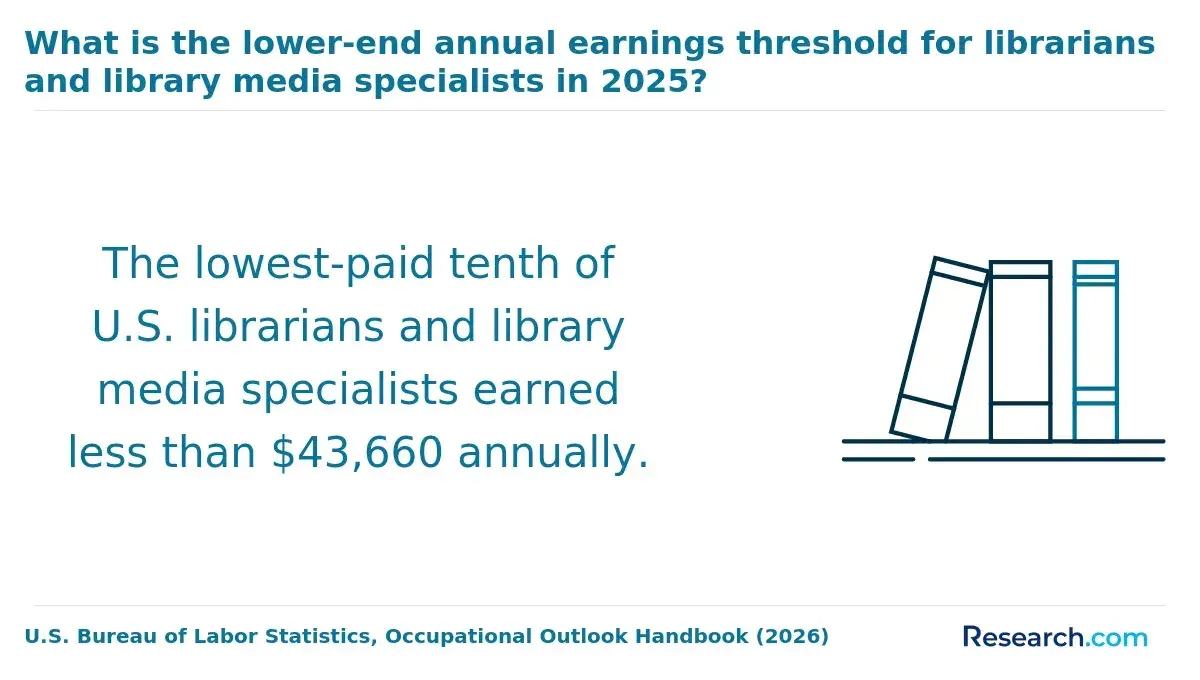
An MLIS can lead to work with government information, but the right degree path depends on whether you want to help people find public documents, preserve agency records, or manage information inside an agency. The U.S. Bureau of Labor Statistics reports a May 2025 median annual salary of $68,270 for librarians and media collections specialists, though that figure covers many settings, not just government jobs.
This guide compares roles, qualifications, pay, and program choices so you can decide whether an MLIS - and which kind of preparation - fits your goal.
Key Things You Should Know
- MLIS graduates can pursue government documents librarianship, agency library work, archives, and records management; information-access roles may also consider applicants with other backgrounds.
- Archivists had a May 2025 median annual salary of $64,550 across industries, while projected growth for librarians and media collections specialists is 2.6% from 2025 to 2035; neither figure predicts a government applicant's outcome.
- Check the specific master's program's ALA accreditation, then verify its relevant electives and applied opportunities separately. An information-management course alone does not establish a government information specialization.
What jobs can you get with an MLIS in government information?
An MLIS can prepare you to help the public use government publications or to organize information created by public institutions. The strongest fit depends on the work you want to do: reference service, preservation, or internal information management.
The roles below overlap, but their employers and hiring requirements differ. Use the distinctions to identify which job descriptions - and which qualifications - to investigate.
| Role | Typical work | How an MLIS fits |
| Government information librarian | Helps users locate, evaluate, and cite government publications and data | Often relevant to professional librarian positions in public or academic libraries |
| Agency librarian or information specialist | Supports staff research, collections, databases, and access to agency information | May be required or accepted alongside other relevant degrees, depending on the vacancy |
| Government archivist | Appraises, describes, preserves, and provides access to records with enduring value | Can provide archival preparation, particularly with relevant coursework and experience |
| Records management specialist | Develops classification, retention, retrieval, and disposition practices | One possible qualification; employers may also value records, legal, or technology experience |
| Freedom of Information Act (FOIA) specialist | Processes federal records requests under applicable disclosure rules | Information-organization skills can help, but legal and policy knowledge are central |
Do not assume every role with "information" in its title requires an MLIS. Read the vacancy's education and experience requirements before choosing a degree primarily for that job.
What does a government information librarian do?
A government information librarian connects people with authoritative public information. A typical request might involve finding a historical agency report, tracing a regulation to its source, or helping someone distinguish an official dataset from a third-party summary. The librarian explains where information came from and how to use it without substituting for a lawyer, benefits counselor, or other licensed professional.
Many such librarians work in academic or public libraries rather than inside agencies. Some support collections associated with the Federal Depository Library Program, which helps make U.S. government publications available to the public. Daily work can include reference interviews, research guides, instruction, collection maintenance, accessible digital discovery, and outreach to people unfamiliar with government sources.
Increasingly, useful documents are scattered across changing websites, databases, and archived versions. Being able to document a source's date, provenance, and accessibility is therefore as important as knowing where to search.
What qualifications do government information careers require?
Requirements follow the position, not a universal government-information credential. Professional librarian postings commonly specify a library and information science master's degree or equivalent qualifications. Archival, records, and disclosure jobs may accept different degrees or relevant experience. Library technician roles are distinct from professional librarian positions and may not require a master's degree.
An MLIS, MLS, Master of Science in Library Science, or Master of Information may serve a similar educational purpose, but the degree title alone does not establish eligibility. Check the employer's exact wording and the individual program's accreditation. An internship or demonstrable experience with public records can strengthen an application, but it does not override a stated hiring requirement.
If you already work in a library or public agency, part-time study may let you build relevant experience while enrolled. Compare the full cost and schedule of an affordable part time MLIS degree rather than assuming a lower per-credit price means a lower total cost.
Which government agencies hire MLIS graduates?
Federal opportunities can include libraries, archives, records offices, research units, and information-access teams. The National Archives and Records Administration is an example of an archival and records-focused employer; the Library of Congress offers library and collections-related roles. Individual executive agencies may also maintain libraries or information services. These examples describe potential settings, not a promise that vacancies are available.
State and local governments employ staff in state libraries and archives, legislative research services, court libraries, and municipal records offices. Academic and public libraries also hire government information librarians, even though the librarian's employer is not a government agency. If public-facing research appeals to you more than internal records compliance, include those libraries in your search.
Look beyond the title "government information librarian." Search for the function - such as reference, archives, records, or disclosure - and read each posting's duties, location, eligibility rules, and required experience.
What skills does an MLIS program teach for government careers?
Relevant MLIS training combines finding information with making it usable over time. Reference and information-literacy courses develop the ability to clarify a request and teach someone to evaluate a source. Knowledge-organization courses address descriptive metadata: structured information that helps users find and identify a document. Archives and records courses may cover appraisal, retention, preservation, and access.
Those foundations matter in different ways across roles. A librarian may need to explain why a revised agency webpage differs from an older report. An archivist may need to preserve context so future users can understand a record. A records specialist may need to organize material so staff can retrieve it and follow an approved retention schedule.
Technology skills should support those responsibilities, not replace judgment. Search tools and AI-assisted discovery can help locate material, but professionals still need to check provenance, accuracy, accessibility, and any privacy restrictions before relying on a result.
How does an online MLIS prepare you for government information work?
An online MLIS can teach research, metadata, records, and digital-access skills through remote coursework. Its usefulness for government work depends on what you can actually study and practice - not simply on whether classes are online. A local library, archive, or agency project may provide experience with real users or records while you study remotely.
Confirm whether classes are asynchronous or meet at set times, how often relevant electives run, and whether any practicum requires an approved site or in-person hours. Online delivery does not automatically mean every requirement can be completed from home.
If you have previous coursework and want to avoid repeating it, investigate an online information science transfer pathway. Ask each program whether it accepts graduate-level transfer credit, how much can apply to the degree, and whether transferred courses can satisfy specific requirements.
What courses should you take for government information careers?
Start with the job function you want, then examine the program's current catalog. For public-facing librarianship, prioritize government information, reference, information literacy, and digital collections where offered. For archives, look for appraisal, archival description, and digital preservation. For records work, look for records management, information governance, and courses addressing policy or systems.
Course titles are not enough: compare descriptions, prerequisites, and recent schedules. A listed elective may not run when you need it, and a relevant elective is not necessarily a formal concentration. Ask whether a project or practicum could involve government publications or records, and whether you would leave with work you can appropriately show in a portfolio.
Speed is a separate consideration. If you are weighing the shortest accredited library science degree, check whether its course sequence still leaves room for the electives and experience your target jobs call for.
How much do government information professionals earn?
Pay varies by occupation, employer, location, and experience. The following U.S. Bureau of Labor Statistics figures are May 2025 medians for entire occupations across industries; they are not government-only salaries or MLIS graduate outcomes.
| BLS occupation | Median annual salary, May 2025 | What to keep in mind |
| Librarians and media collections specialists | $68,270 | Includes jobs beyond government information |
| Archivists | $64,550 | Includes archives in multiple employment settings |
| Library technicians | $44,580 | Represents a different occupational category from professional librarians |
For a realistic pay comparison, use the salary range in actual vacancies for your location and qualifications. Weigh it against tuition, required fees, and earnings you might give up while studying. Broader comparisons of the highest paying MLIS specializations can suggest alternatives, but a higher occupational median does not mean a new graduate can enter that role or earn that amount.
What is the job outlook for government information careers?
The Bureau of Labor Statistics projects 2.6% employment growth for librarians and media collections specialists from 2025 to 2035. That is a broad occupational projection, not a forecast for government information vacancies. Openings in a particular agency or region also depend on budgets, turnover, and how positions are classified.
Build a search around several related functions rather than one exact title. A candidate interested in public access might consider depository-library reference alongside agency library work; someone interested in the records lifecycle might compare archives with records management. This widens the set of relevant vacancies without treating unlike jobs as interchangeable.
Before enrolling, sample current postings in the places you could work. Record which qualifications are required, which are preferred, and whether the tasks appeal to you. If the jobs you want consistently favor another degree or substantial technical experience, an MLIS may not be the most direct investment.
How do you choose an accredited MLIS program for government work?
First, verify the specific master's program in the current American Library Association directory of accredited programs. A university's institutional accreditation is not the same thing as ALA accreditation. Accreditation also does not certify that a government-information elective, concentration, internship, or online format is available.
Then compare programs against your target role. Check required courses, relevant electives and their recent availability, opportunities for applied work, and whether the format fits your schedule. Ask career services how they support applications to the kinds of employers you seek; MLIS programs with strong career support are worth investigating, but confirm what that support includes for government-focused students.
Finally, calculate expected tuition using required credits and the rate that applies to you, then add mandatory fees and any travel or practicum costs. Compare that total with your budget and the qualifications in real vacancies. Choose a program because its verified training fits your intended work - not because its marketing uses a government-related term.
Other Things You Should Know About Library Science
Not necessarily. Clearance requirements depend on the position and the information it handles. Check the individual vacancy rather than assuming all agency library or records jobs require clearance.
No. Works prepared by U.S. federal employees as part of their official duties generally lack U.S. copyright protection, but a government publication can contain third-party material with separate rights. State and local government works may have different rules.
Start with USAJOBS and individual agency career pages. Search multiple job titles, then check each announcement's duties, eligibility, location, and application instructions.
Do not assume so. Many are career positions, but appointment types vary. The vacancy announcement should identify the hiring path and any conditions that apply.
References
- General Schedule Qualification Standards | U.S. Office of Personnel Management https://www.opm.gov/policy-data-oversight/classification-qualifications/general-schedule-qualification-standards/
- Archives and Records Management Resources https://www.archives.gov/research/alic/reference/archives-resources/questions-about-archives.html
- Security Clearance FAQs - United States Department of State https://www.state.gov/security-clearance-faqs
- Library Science Careers - UW Information School https://ischool.uw.edu/programs/mlis/careers
- Careers in Libraries and Information Science - Subject Guides https://guides.library.unlv.edu/libjobs/careers
- How to Become a Librarian: Steps, Skills & Career Tips | Syracuse University https://ischool.syracuse.edu/how-to-become-a-librarian/
- VLA Jobline https://www.vla.org/jobline
- Types of Library & Information Science Degree Programs | Librarian Certification https://www.librariancertification.com/types-of-library-information-science-degree-programs/
- Over 100 obsolete or redundant federal job titles flagged for OPM consolidation effort - Federal News Network https://federalnewsnetwork.com/workforce/2026/04/over-100-obsolete-or-redundant-federal-job-titles-flagged-for-opm-consolidation-effort/


