2027 Post-Master's AGACNP Certificates for Nurses in Maryland: Gap Analysis and Acute Care Clinicals
Audited and Verified:
Our Editorial and Data Verification Process
Research.com uses government datasets, official education statistics and primary institutional information to support its career and degree guides. Our review process checks factual accuracy, occupational definitions, source dates and the requirements associated with the credentials discussed.
How This Article Was Fact-Checked
Our editorial team verifies salary estimates, employment projections, education requirements and program information against original data providers and official organizations. Salary figures are checked against the relevant occupational definitions and reporting periods. Information about licensure, accreditation and required in-person training is reviewed separately.
Fact-checked and verified on:

Co-Founder and Chief Data Scientist
A post-master's adult-gerontology acute care nurse practitioner (AGACNP) certificate can prepare a Maryland nurse for a new advanced practice population focus, but the certificate's length depends on what the nurse has already studied and what the program still requires.
The consequential decisions are whether prior graduate courses count, where supervised acute care placements will occur, and whether the completed track supports certification and Maryland practice. This guide helps experienced RNs and APRNs compare those requirements before committing to a program or assuming bedside experience will replace clinical training.
Key Things You Should Know
- A receiving school's documented gap analysis - not an applicant's job title - determines which graduate courses and supervised AGACNP experiences remain.
- National nurse practitioner education standards call for at least 750 direct patient care clinical hours; confirm the hours, specialty distribution, and credit given for prior work under the specific program's rules.
- Compare Maryland options by certificate availability, approved acute care placements, total remaining credits and costs, and eligibility for the intended national certification and Maryland APRN authorization.
What is a post-master's AGACNP certificate in Maryland?
A post-master's AGACNP certificate is graduate education for an RN who already holds a nursing master's degree or another graduate credential accepted by the school. It prepares the nurse to assess, diagnose, and manage adults with acute, complex, or critical illness within the nurse practitioner role. The school awards a certificate rather than a second master's degree; the certificate itself does not grant certification or a license.
Entry background matters. An already-certified family nurse practitioner may have completed graduate assessment, pharmacology, and pathophysiology but still need acute care population-focused courses and supervised encounters. An ICU RN with a non-APRN MSN may need substantially more NP preparation despite extensive bedside expertise. A nurse whose prior education is outside the graduate nursing credentials a school accepts must ask about another entry route.
For an RN still working toward a bachelor's degree, comparing no-traditional-clinical RN-to-BSN options addresses a different step: completing an undergraduate credential does not substitute for graduate AGACNP education.
What are Maryland's requirements for AGACNP certification and licensure?
Think of this as three separate decisions. First, the school determines whether its completed AGACNP track meets its academic and clinical requirements. Next, a national certifying organization determines eligibility for its adult-gerontology acute care NP examination. Finally, the Maryland Board of Nursing determines whether the applicant meets Maryland's requirements to practice in the advanced role.
The relevant national credentials include the American Nurses Credentialing Center's AGACNP-BC and AACN Certification Corporation's ACNPC-AG. Their application rules are not identical. Before enrollment, ask the school which examination or examinations its post-master's certificate prepares graduates to seek, and check the certifier's current eligibility criteria.
For Maryland practice, confirm the board's current RN-license, graduate-preparation, national-certification, application, and any other applicable requirements directly with the board; do not rely on the certificate award as proof of authorization.
Population focus is consequential: one-year FNP admission requirements concern family primary care preparation, not AGACNP certification or acute care scope. Prior FNP certification may inform a school's gap analysis, but it does not authorize a change in NP population focus by itself.
Which Maryland schools offer post-master's AGACNP certificate programs?
The University of Maryland School of Nursing in Baltimore and the Johns Hopkins School of Nursing in Baltimore are Maryland institutions to investigate for post-graduate adult-gerontology acute care NP study. Track names, admissions cycles, and whether a certificate - not only an MSN or DNP option - is open can change. Confirm the exact credential and entry term with each school before treating either as an available application option.
This comparison identifies what to request rather than presenting unverified tuition or clinical-placement promises. Ask both schools for a written evaluation of your transcript and clinical history.
| Maryland institution to check | Decision-critical confirmation |
| University of Maryland School of Nursing | Whether its AGACNP post-master's certificate is admitting your entry cohort; required credits, acute care placements, and campus attendance |
| Johns Hopkins School of Nursing | Whether its AGACNP post-degree certificate accepts your prior graduate credential; remaining coursework, clinical geography, and on-site requirements |
For a Maryland resident, an out-of-state program may also be possible if it accepts Maryland students, can approve Maryland clinical sites, and supports the intended certification and state application. Affordable graduate pathways to NP preparation can broaden an initial search, but a low-cost general NP listing is not evidence that a post-master's AGACNP track is available or suitable.
There is no safe single-hour answer for every applicant. National Task Force nurse practitioner education standards specify a minimum of 750 direct patient care clinical hours for NP programs. A certificate school must determine how those standards apply to its curriculum and the applicant's documented prior preparation; a certifying organization may state its own eligibility minimum.
The number printed on one school's plan should not be treated as the number another school will require you to complete.
A formal gap analysis should distinguish prior supervised graduate NP hours from RN employment, simulation, and independent APRN practice. Even when previous hours are documented, the school must assess whether they demonstrate the adult-gerontology acute care population-focus competencies that remain to be learned. An ICU job can strengthen clinical readiness without automatically becoming academic clinical credit.
For a useful comparison, request the remaining direct-care hours in writing, the required settings and patient encounters, preceptor qualifications, faculty oversight, and who secures each approved site. A nurse considering another population focus can compare the distinct post-master's family NP clinical training requirements; FNP hours are not automatically interchangeable with AGACNP hours.
AGACNP study applies graduate assessment, pathophysiology, and pharmacology to acute and complex adult illness. Population-focused courses commonly address diagnostic reasoning, treatment planning, deterioration and escalation, care transitions, and management across hospital-based and other acute care services. Supervised practice connects those decisions to real patients, documentation, consultation, and evaluation by approved preceptors and faculty.
The gap analysis affects the curriculum: a previously certified APRN may repeat fewer foundational courses than a graduate of a leadership or education MSN, while both may need substantial AGACNP-specific study. A nonclinical doctorate serves a different objective; nonclinical DNP specialization options should not be mistaken for preparation for a new NP population focus.
Expect schools to assess an active RN license, an acceptable graduate nursing credential, graduate transcripts, academic standing, and the fit between prior preparation and the AGACNP track. Schools may also request a résumé, references, a statement of purpose, and evidence of relevant nursing practice. A current APRN certification can be valuable evidence, but it is not necessarily an admission requirement or a waiver of acute care coursework.
Send the program detailed syllabi for advanced assessment, pharmacology, and pathophysiology; prior NP course descriptions; and records of supervised clinical hours, populations, settings, and preceptors. Ask for a written, applicant-specific plan showing accepted prior work and remaining courses before estimating your completion date. Admission and clinical placement can involve different checks, including site agreements and compliance documents.
An ADN-prepared RN without an accepted graduate credential needs a different starting point. Nursing master's bridges for ADN graduates may help identify that earlier step, but a bridge alone is not assurance of admission to an AGACNP certificate.
Duration and price depend on the individual gap analysis, credit charges, course sequencing, clinical-site availability, and whether the nurse studies full time or part time.
A nurse with applicable graduate NP coursework may have fewer classes remaining than a nurse with a non-APRN MSN, yet both must complete the school's required acute care preparation. Without an individualized study plan and the entry term's published rates, a precise Maryland-wide cost or completion-time estimate would be misleading.
Build a budget using remaining credits × the applicable per-credit tuition, then add mandatory program and university fees, books, compliance checks, travel or lodging for campus visits and clinicals, certification and application charges, and any reduced work hours. Ask whether delayed placement creates additional enrollment charges. Compare written totals under the same assumptions, not headline tuition rates alone.
For a BSN-prepared nurse who has not yet earned an MSN, cost-focused MSN pathways for bachelor's-prepared nurses concern an earlier educational decision. Confirm that any proposed MSN actually includes AGACNP preparation if that is the intended outcome.
Some programs deliver substantial coursework online or in a hybrid format, but AGACNP preparation still requires approved, supervised direct patient care. Online classes do not mean remote clinicals, guaranteed Maryland placements, or freedom from scheduled simulation, live sessions, and campus visits. An out-of-state school must also accept Maryland residents and be able to support clinical education in the locations where the student intends to train.
Before enrolling, obtain the school's written answers about Maryland enrollment eligibility, required on-site dates, who finds and approves preceptors, clinical-site agreements, and what happens if a placement falls through. Nurses balancing shift work should ask when clinical days occur, not just whether lectures are asynchronous.
If the intended role is psychiatric rather than acute care, psychiatric nurse practitioner study on a budget is a separate comparison. A PMHNP track does not prepare a nurse for AGACNP certification.
After obtaining the required certification and Maryland practice authorization, an AGACNP may seek roles caring for adults with complex or acute illness in settings such as hospital specialty services, critical care, or other employer-defined acute care practices. Actual duties depend on state law, credentialing, privileges, the care team, and demonstrated competencies.
A certificate graduate entering a new NP focus should expect role-specific onboarding rather than immediate independent mastery.
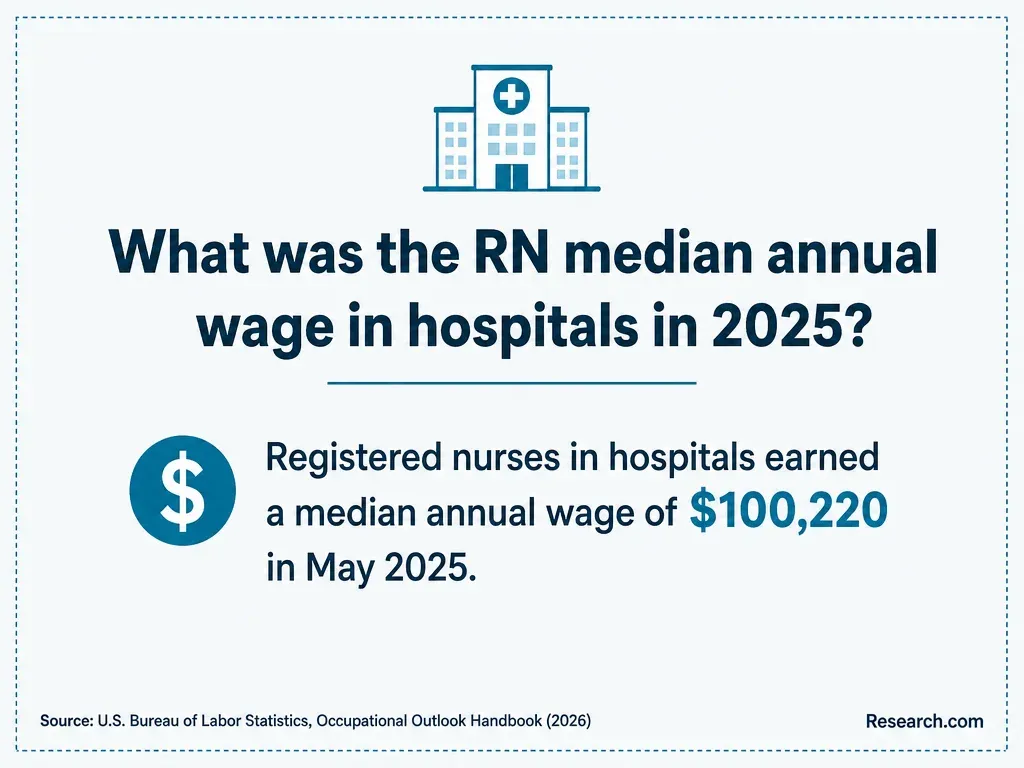
The U.S. Bureau of Labor Statistics reports wages for the broader nurse practitioner occupation, not a separate Maryland AGACNP certificate-graduate salary. That distinction matters: an occupation-wide figure cannot predict an acute care offer. Compare local postings and written offers for base pay, shifts, call, differentials, benefits, orientation, and prior APRN experience before calculating a return on the certificate.
A DNP is not inherently required for every AGACNP job. Once a nurse has the preparation needed for the intended clinical role, DNP programs organized by completion time may be relevant to a separate doctoral-development goal, not a shortcut around population-focused preparation.
How can nurses choose an accredited AGACNP certificate program?
Start by verifying the institution's accreditation and the applicable nursing program accreditation, including whether the post-graduate certificate and AGACNP track fall within the accreditor's stated scope. Then separately verify certification-exam preparation, Maryland enrollment and practice implications, and clinical-site arrangements. Institutional accreditation, nursing accreditation, national certification eligibility, and state authorization answer different questions.
Request comparable written answers from each school. The following checks expose the differences most likely to change your decision:
- Obtain an individualized gap analysis listing accepted courses and clinical work, remaining credits, direct-care hours, and the expected course sequence.
- Confirm the exact certificate award, applicable accreditation scope, intended national certification pathway, and Maryland enrollment and clinical eligibility.
- Identify who arranges approved Maryland sites and preceptors, required patient populations, campus visits, and the contingency plan for placement delays.
- Calculate total expected charges and lost work time using the individualized plan, then ask which costs could change if completion takes longer.
If the applicant's real goal is doctoral study rather than a new acute care NP role, planning applications to accessible DNP programs is a different exercise. For AGACNP practice, favor the program that can document a feasible clinical and credentialing path - not merely the shortest advertised certificate.
Other Things You Should Know About Nursing
No. CCRN recognizes qualifying critical care nursing expertise; it does not replace graduate NP population-focused preparation, national AGACNP certification, or state authorization.
Yes, if the nurse independently meets each certifying organization's requirements and maintains the applicable state authorizations. The credentials represent different population-focused preparation.
No. Practice authority generally depends on the patient's location and that jurisdiction's rules. Verify the other state's licensure and telehealth requirements before providing care.
No. Certifying organizations require renewal under their current rules. Maryland licensure or recognition and employer privileges have separate maintenance requirements.
- Advanced Practice Registered Nursing | Maryland.gov Enterprise Agency Template https://health.maryland.gov/mbon/pages/advanced-practice-index.aspx
- Program Eligibility, Written Arrangements, and Distance Education | 2024-2025 Federal Student Aid Handbook https://fsapartners.ed.gov/knowledge-center/fsa-handbook/2024-2025/vol2/ch2-program-eligibility-written-arrangements-and-distance-education
- Advanced Practice Registered Nurse (APRN) | Virginia Board of Nursing https://www.dhp.virginia.gov/Boards/Nursing/PractitionerResources/AdvancedPracticeRegisteredNurse/
- Accelerated AG-ACNP Certificate FAQ | Mount Carmel College of Nursing https://www.mccn.edu/tuition-and-financial-aid/tuition-and-fees
- Adult-Gerontology Acute Care Nurse Practitioner Certificate | Virginia Commonwealth University https://nursing.vcu.edu/academics/certificates/adult-gerontology-acute-care-nurse-practitioner/
- DNP: Adult-Gerontology Acute Care Nurse Practitioner | University of Maryland School of Nursing https://www.nursing.umaryland.edu/academics/doctoral/dnp/dnp-adult-gerontology-acute-care-nurse-practitioner/
- Certificate: Adult-Gerontology Acute Care Nurse Practitioner | gwu.edu https://nursing.gwu.edu/programs/certificate/adult-gerontology-acute-care-nurse-practitioner
- Adult-Gerontology Acute Care Nurse Practitioner Certificate (AGAC-NP) | Purdue Global https://www.purdueglobal.edu/degree-programs/nursing/acute-care-nurse-practitioner-certificate/
- Course Equivalency & Credit Substitution (Graduate Programs) | Current Students https://students.nursing.uw.edu/policies/policy-1-8-course-equivalency-credit-substitution-graduate-programs/
- Adult Gerontology Acute Care Nurse Practitioner (AGACNP) (Post-Master's Certificate) | Bradley University Catalog https://catalog.bradley.edu/graduate/programs/adult-gerontology-acute-care-nurse-practitioner-agacnp-postmasters-certificate-online/