2027 Online Psychology Programs With Paid Applied Projects Instead of Unpaid Internships

Co-Founder and Chief Data Scientist
Choosing an online psychology program is harder when you need experience but cannot afford an unpaid internship. Paid applied projects can provide portfolio evidence, supervised workplace exposure, and sometimes wages, but they do not automatically satisfy clinical training rules. The U.S. Bureau of Labor Statistics projects 6% employment growth for psychologists from 2024 to 2034, faster than the average for all occupations. This guide helps prospective students identify legitimate paid-project options, verify what counts toward their goal, and avoid paying for a program that does not support licensure or employment plans.
Key Things You Should Know
- Paid applied projects are usually employer-sponsored assignments, research assistantships, apprenticeships, or paid field placements; they are not a standard substitute for every required psychology practicum or internship.
- A bachelor's degree can support many non-licensed behavioral, research, human-services, and people-operations roles, while independent psychologist licensure generally requires a doctoral degree, supervised postdoctoral experience, and state-specific examinations.
- The Bureau of Labor Statistics projects 6% growth in psychologist employment from 2024 to 2034, but students should evaluate a program by its verified placement partners, supervision model, total cost, and licensure disclosures - not by a promise of paid experience.
What are online psychology programs with paid applied projects and how do they work?
An online psychology program with paid applied projects combines remote academic coursework with work that addresses an authentic organizational, research, or community need and provides compensation to the student. The payment may come from an employer, research grant, workforce program, work-study allocation, or partner organization rather than from the college itself.
These programs are most common in applied, non-licensure tracks. A student might analyze anonymous employee-survey data for an organization, help a faculty lab recruit research participants, assist a behavioral-health agency with nonclinical program evaluation, or complete a paid role as a human-services aide while taking related courses online. The school may award course credit for the work, assess a project deliverable, or simply help students obtain the role.
"Paid project" is not a regulated degree category. It can mean very different things from one school to another, so ask whether compensation is guaranteed, who employs the student, how many hours are expected, and whether the placement is optional. A capstone based on a simulated case is valuable academically but is not the same as paid client-facing experience.
The strongest fit is usually for working adults, career changers, and students targeting organizational, research, community-program, or behavioral-support roles. It is less suitable for someone who expects a paid project to replace mandatory clinical practicum hours in a counseling, social work, school psychology, or doctoral psychology pathway.
How do paid applied projects replace traditional unpaid internships in psychology programs?
Paid applied learning can replace an unpaid internship only when the program and, where relevant, an external regulator accept the activity for the same educational purpose. In non-licensure psychology programs, a paid job or sponsored project may often fulfill an experiential-learning, internship, practicum, or capstone requirement if it has approved learning objectives, qualified supervision, documented hours, and faculty evaluation.
The practical distinction is whether the experience is educationally supervised rather than merely paid. The comparison below shows why students should request written confirmation before accepting a placement.
| Experience model | Who typically pays | Best use | Key limitation |
| Employer-sponsored project | Employer or project sponsor | Portfolio work in HR, research, UX, program evaluation, or community services | May not count for course credit without prior approval |
| Paid internship or cooperative education role | Employer | Structured work experience tied to a course | Availability, schedule, and location vary by partner |
| Research assistantship | Faculty grant, institution, or work-study program | Research methods, data handling, recruitment, and poster preparation | Funding can be limited and competitive |
| Required clinical practicum or internship | Often unpaid, although exceptions exist | Training for regulated clinical pathways | Must meet program, accreditor, and licensing-board standards |
For a paid experience to serve as an approved alternative, students should complete these steps before work begins:
- Ask the program director whether the role can meet the specific course or practicum requirement.
- Obtain written approval of learning objectives, supervisor qualifications, hours, confidentiality expectations, and evaluation method.
- Confirm whether the employer's work schedule can accommodate seminars, supervision, and documentation deadlines.
- Keep signed hour logs, supervisor evaluations, project artifacts, and any required reflections.
A common mistake is accepting a paid behavioral-health job and assuming it will satisfy a future clinical internship. Employment can strengthen an application and build useful skills, but clinical hour requirements are often narrower than an employer's job description.
Are online psychology programs with paid projects accredited and eligible for licensure?
A general online bachelor's or master's degree in psychology is usually not, by itself, a path to independent psychologist licensure. In most states, a prospective licensed psychologist needs a qualifying doctoral degree, required supervised experience, and successful completion of state-required examinations. Counseling, marriage and family therapy, behavior analysis, social work, and school psychology have separate educational and licensing rules.
Before enrolling, verify the exact credential required for the job you want with the licensing board in the state where you plan to practice. Then ask the school for its public professional-licensure disclosure, including whether an online format is designed to meet requirements in your state. Do not rely on a recruiter's verbal assurance or assume that accreditation at one degree level extends to another.
What degree levels offer online psychology programs with paid applied project options?
Paid applied options can appear at every degree level, but the purpose changes substantially. Undergraduate programs emphasize career exploration and foundational skills; graduate programs may use projects to deepen specialization; doctoral clinical programs have tightly governed field-training requirements that a general paid project may not replace.
The following comparison helps match the credential to the type of paid experience and career goal you have in mind.
| Degree level | Typical paid applied option | Common outcome | When it makes sense |
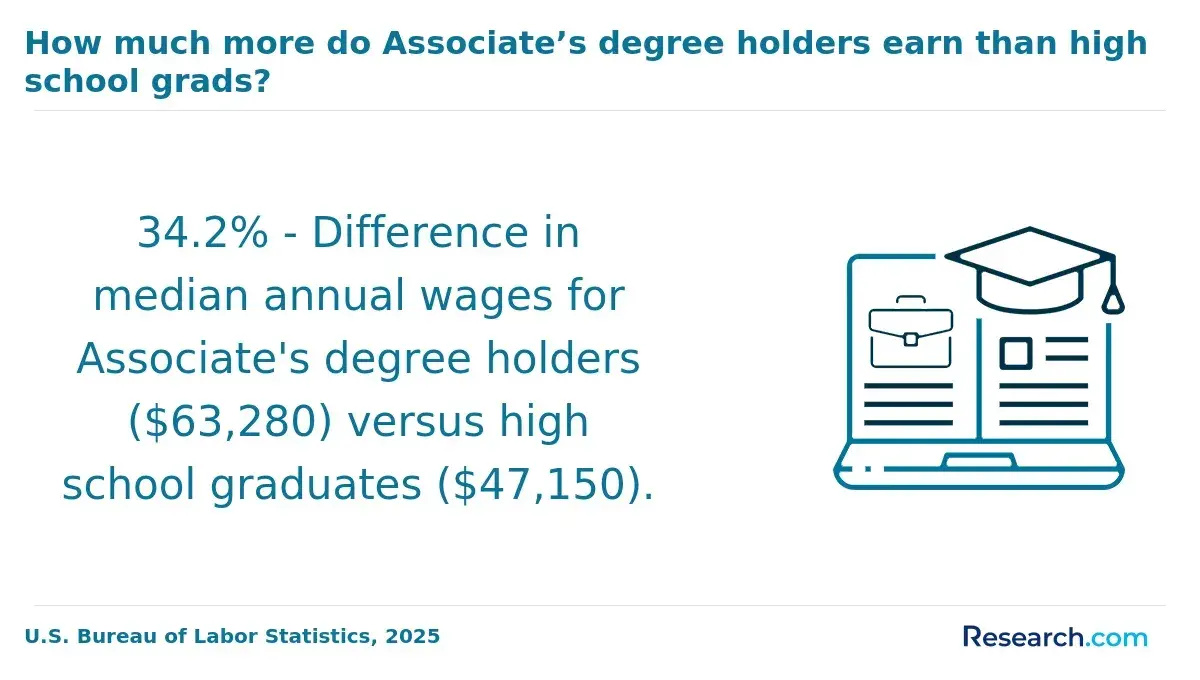
| Associate degree or transfer pathway | Entry-level human-services work, work-study, or community project | Preparation to transfer or seek support roles | Useful for lower-cost exploration, but limited for psychology-specific advancement |
| Bachelor's degree | Paid internship, research assistantship, HR or program-evaluation project | Entry-level behavioral, research, customer-insight, or people-operations work | Best for broad career entry and a portfolio |
| Master's degree | Employer consulting project, advanced research role, or supervised fieldwork | Specialized applied roles or preparation for further study | Best when the specialization matches a defined occupation |
| Doctoral degree | Funded research, assistantship, or approved training placement | Psychologist, researcher, faculty member, or specialist role | Necessary for many psychologist licensure goals |
Students beginning with a two-year pathway should distinguish a transfer-oriented psychology curriculum from a short, job-focused credential. Exploring associates degrees online can help identify flexible entry options, but confirm transferability and whether the coursework supports the bachelor's program you ultimately need.
A bachelor's degree is the most practical level for students seeking paid project experience without a clinical licensure objective. A master's degree makes more sense when it leads to a defined specialty, such as industrial-organizational psychology, research, or a separate licensed profession with its own approved practicum structure. Students set on independent clinical practice should start by mapping the doctoral and state-licensure route rather than choosing a program based on project pay alone.
How do online and campus psychology programs compare for paid applied learning?
Online programs can make paid applied learning more accessible for employed students because coursework may be asynchronous and local employers can sometimes serve as placement sites. Campus programs may offer easier access to faculty labs, nearby research centers, and established internship networks. Neither format is automatically better; the deciding factor is the quality and reach of the school's placement infrastructure.
This comparison focuses on factors that affect whether paid experience will be realistic alongside your studies.
| Decision factor | Online program | Campus program | Best choice |
| Schedule flexibility | Often supports evening or asynchronous coursework | May require daytime attendance | Online for students maintaining work or caregiving duties |
| Local placement access | May require students to find an approved site near home | Often draws from nearby partner organizations | Choose the program with verified partners in your area |
| Research access | Can include remote data, literature, and virtual lab tasks | May provide more in-person lab opportunities | Campus can be stronger for hands-on lab-intensive goals |
| Clinical preparation | May require in-person local placement despite online classes | May coordinate local training sites directly | Choose the format approved for your intended license |
| Professional networking | Requires deliberate virtual and local networking | Built through faculty, peers, and events | Either can work when career services are active and specific |
Military-affiliated learners should also ask whether deployments, transfers, and benefit-processing timelines can be accommodated while completing local fieldwork. Comparing online military colleges may be useful, but students should separately verify that a psychology placement can be completed where they are stationed.
Do not choose online solely because it seems easier. A remote degree still requires consistent time for group work, data analysis, supervision meetings, and project deadlines. Conversely, do not choose campus solely for networking if commuting costs or rigid schedules would prevent you from participating in the opportunities offered.
What coursework and project types are typical in paid applied psychology programs?
Strong applied psychology curricula build a sequence: students first learn psychological theory and ethical reasoning, then research and data skills, and finally apply those skills through a supervised project. Employers generally value evidence that a candidate can frame a question, protect sensitive information, analyze findings, and communicate recommendations clearly.
Coursework commonly prepares students for the following project categories:
- Research methods and statistics projects, such as cleaning de-identified data, conducting literature reviews, or creating a research poster under faculty supervision.
- Industrial-organizational projects, such as analyzing engagement survey results, job-task information, training feedback, or retention patterns for an employer.
- Community and human-services projects, such as evaluating program participation, developing resource guides, or supporting outreach under appropriate nonclinical supervision.
- User and consumer research projects, such as interview coding, survey design, usability observations, and insight summaries.
- Behavioral-health support projects, such as administrative coordination or psychoeducation materials, provided the student does not perform work reserved for licensed professionals.
Expect courses in introductory psychology, developmental psychology, social psychology, abnormal psychology, cognition, research methods, statistics, ethics, and writing. Depending on the concentration, students may also study organizational behavior, health psychology, learning, assessment concepts, diversity, or program evaluation.
AI tools are increasingly relevant to research workflows, survey coding, literature organization, and workforce analytics. Students should learn to document tool use, check outputs for bias and errors, and follow privacy rules. Uploading identifiable client, employee, or participant information to an unapproved AI system can violate project agreements and ethical obligations.
What are admission requirements for online psychology programs featuring paid applied projects?
Admission requirements depend primarily on degree level, not on whether a program advertises paid applied learning. Schools may admit students to the academic program first and later require a separate application, background check, interview, or employer approval for a placement. A paid project partner may also set its own eligibility standards.
Applicants should expect the following categories of requirements and verify them for each institution:
- For associate or bachelor's entry: high school completion or equivalent, application materials, and transcripts; transfer applicants may need official college records.
- For master's entry: a bachelor's degree, transcripts, a stated minimum GPA or holistic review standard, and sometimes a résumé, statement of purpose, or recommendations.
- For doctoral entry: graduate-level preparation or prerequisites, research fit, recommendations, writing samples, interviews, and potentially more selective review.
- For placements: eligibility to work in the United States when required by the employer, background screening, immunizations or training for some sites, confidentiality agreements, and schedule availability.
Frequent start dates can help students begin coursework sooner, but they do not ensure immediate access to a paid placement. If timing is important, review online colleges starting soon and ask the psychology department when students become eligible for field experience.
Transfer students should request a written transfer-credit evaluation and compare remaining research-methods and statistics requirements. Another common mistake is overlooking placement prerequisites until the final term, when a background check, required training, or limited employer opening can delay graduation.
How much do online psychology programs with paid projects cost, and what financial aid exists?
The cost of an online psychology degree includes more than tuition. Students should calculate tuition and mandatory fees, technology, textbooks, proctoring, travel to local placements, background checks, insurance if required, and any income lost by reducing work hours. A paid project can offset some expenses, but it should not be treated as guaranteed funding unless the school provides a written offer or employment agreement.
For context, the National Center for Education Statistics reported average published tuition and fees of $11,610 for in-state students at public four-year institutions and $43,350 at private nonprofit four-year institutions for 2024-25. Published price is not the same as net price: grants, scholarships, employer assistance, and residency status can materially change what an individual pays.
The main funding routes are worth comparing before borrowing:
- FAFSA-based federal aid, including grants, work-study eligibility, and federal student loans for eligible students.
- Institutional scholarships and need-based grants, which may have separate application deadlines.
- Federal or institutional work-study positions, including some research or community-service roles where available.
- Employer tuition assistance or reimbursement, especially for students already working in human services, healthcare administration, research, or HR.
- Veterans education benefits and state workforce programs for eligible learners.
Students prioritizing lower total cost can compare most affordable online colleges, then request the psychology program's net-price estimate and a full list of field-placement charges. The lowest per-credit tuition is not always the lowest-cost choice if it has poor transfer policies, requires extensive travel, or provides no placement support.
To assess return on investment, compare the total amount you expect to pay with the entry-level jobs the degree realistically supports in your location. Ask whether the paid project is a wage-paying job, a stipend, work-study, or merely a course assignment; each has different tax, aid, and scheduling implications.
What careers, roles, and salaries can follow from paid applied psychology training?
Paid applied psychology training can help candidates show work readiness, but career outcomes depend on degree level, location, prior experience, employer requirements, and whether a role is regulated. A bachelor's degree does not qualify someone to diagnose or independently treat mental-health conditions, yet it can support many roles that use research, communication, behavioral insight, and program-support skills.
The U.S. Bureau of Labor Statistics reported a median annual wage of $94,310 for psychologists in May 2024. This figure covers an occupation that generally requires advanced training and does not represent the expected pay for a new psychology bachelor's graduate. Use it to understand the value of the licensed or doctoral pathway, not as a promise attached to an undergraduate program.
These examples show how project experience may translate into job-search evidence.
| Possible role | Typical education context | How a paid project can help | Licensure note |
| Human-services assistant or behavioral-health support worker | Associate or bachelor's degree, depending on employer | Demonstrates documentation, referral, outreach, and ethical-boundary skills | Must work within employer and state scope-of-practice rules |
| Research assistant or coordinator | Bachelor's degree; advanced roles may require graduate study | Provides evidence of data collection, protocol adherence, and reporting | Licensure is generally not required |
| HR, talent, or people-analytics assistant | Bachelor's degree often preferred | Builds survey, training, and organizational-data portfolio samples | Licensure is generally not required |
| Program evaluator or community-program coordinator | Bachelor's or master's degree, depending on responsibility | Shows measurement, stakeholder communication, and outcome-reporting ability | Licensure may be needed only for clinical duties |
| Psychologist | Doctoral degree and supervised training | Research and approved clinical training contribute to preparation | State licensure is generally required for independent practice |
Build a portfolio that protects confidentiality: include de-identified analyses, a research poster, a project brief, a methods summary, or a supervisor-approved description of your contribution. Students interested in clinical work should pursue roles that build relevant exposure while continuing toward the specific graduate credential and supervised training their state requires.
How can students evaluate and choose reputable online psychology programs with paid projects?
Choose a program by verifying its actual experience model, not by relying on promotional language. The best option is one that aligns with your target role, has transparent academic and financial information, and can document how students obtain supervision and placements.
Use these questions in an admissions call or email, and save the answers in writing for side-by-side comparison:
- Is paid applied work guaranteed, competitive, optional, or entirely student-arranged?
- What proportion of eligible students obtain a paid placement, and what were the most recent placement job titles and employers?
- Who pays the student, what is the expected hourly commitment, and can the work be completed in my state?
- Can a current job be approved for credit, and what documentation is required before I enroll in the course?
- Who supervises the project, how often do they meet with students, and what qualifications do they hold?
- What fees apply beyond tuition, including background checks, travel, software, insurance, or placement administration?
- Does this degree meet educational requirements for my intended license in my state, and where is that disclosure published?
- What are the graduation, retention, career-support, and transfer-credit policies for online students?
Red flags include vague claims that students "may have opportunities," refusal to identify the employer or supervision model, pressure to enroll before receiving licensure information, and statements that a general psychology degree leads directly to therapist or psychologist status. Also be cautious if a school labels a simulation, volunteer activity, or unpaid course assignment as a paid placement without identifying the compensation source.
A sound final comparison weighs four items together: total net cost, verified project access, fit with your career target, and academic or professional eligibility. Students seeking nonclinical careers may reasonably prioritize flexibility and a strong project portfolio. Students seeking a regulated clinical career should prioritize approved curriculum and field training even when a placement is unpaid.
Other Things You Should Know About Psychology
Yes. Online psychology graduates may pursue roles in human services, research support, customer insights, HR, program coordination, and related fields. Outcomes depend on the degree level, local employers, relevant experience, and the skills demonstrated through coursework and projects. It does not automatically qualify a graduate for independent clinical practice.
Usually not. Some programs connect students with paid employer partners, while others require students to compete for jobs or arrange an approved placement locally. Ask whether pay, placement, hours, and supervision are guaranteed in writing before treating the opportunity as part of your financial plan.
Sometimes. The job must be approved by the school and meet the course's learning objectives, supervision, documentation, and hour requirements. For licensure-related clinical training, an ordinary paid job may not meet the program's or state board's more specific standards.
No. In the United States, independent psychologist practice generally requires a doctoral degree, supervised professional experience, examinations, and state licensure. A bachelor's degree can be a useful foundation for entry-level applied roles or graduate study.
References
- Internship at Happiness Academy - Happiness Academy https://happiness-academy.eu/internship/
- Master of Applied Psychology | Taught Postgraduate Programmes | Study | Department of Applied Social Sciences https://www.polyu.edu.hk/apss/study/taught-postgraduate-programmes/master-of-applied-psychology/