Online MBA in Technology Management: Admissions Guide for Nonbusiness Bachelor's Graduates

Co-Founder and Chief Data Scientist
A nonbusiness bachelor's degree can be an asset in technology management, but it may leave you wondering whether you meet MBA admissions requirements or need business coursework first. This guide is for graduates in fields such as engineering, computer science, healthcare, and the humanities who want to move toward technology-focused management. It explains what schools may require, how to identify preparation gaps, and what to check before applying - so you can decide whether an online MBA is the right next step or whether a more targeted option would serve you better.
Key Things You Should Know
- A nonbusiness bachelor's degree does not automatically disqualify you; check each program's degree, experience, prerequisite, and testing policies.
- Your preparation needs depend on your background: technical expertise may strengthen your application, while accounting or finance may require additional study.
- Compare total cost, scheduling, and career access - not just admission odds. The $126,520 median wage for US management occupations in May 2025 is not a predicted MBA graduate salary.
What is an online MBA in technology management?
An online MBA in technology management is a broad graduate business degree with coursework focused on leading technology-related products, projects, operations, or organizational change.
The MBA core typically covers subjects such as accounting, finance, strategy, and organizational behavior. Technology management coursework applies business decisions to issues such as innovation, digital transformation, technology investment, and governance.
Program labels matter. A formally designated technology management concentration is different from a general MBA with a technology elective.
Neither is necessarily a substitute for advanced software engineering, data science, or cybersecurity training. Before applying, inspect the required courses and degree requirements to see whether the program teaches the management capabilities you actually want.
Can nonbusiness bachelor's graduates enroll in a technology management MBA?
Many MBA programs consider applicants with bachelor's degrees outside business, although eligibility is set by each school. Admissions committees may value disciplinary expertise and evidence that you can work across technical and nontechnical teams.
A computer science graduate might bring product-development knowledge; a healthcare graduate might understand clinical technology adoption. Neither background creates an identical set of business-coursework gaps.
The distinction is between eligibility and readiness. The table shows how prior study can affect preparation without assuming that any subject is a universal admissions prerequisite.
| Prior background | Potential strength | Business preparation to assess |
| Engineering or computer science | Technical analysis and technology delivery | Managerial accounting, marketing, and organizational behavior |
| Sciences or healthcare | Evidence-based decisions and sector knowledge | Corporate finance, pricing, and business strategy |
| Humanities or social sciences | Communication, research, and stakeholder analysis | Accounting, quantitative analysis, and financial decision-making |
If your grades are a concern as well as your major, review each school's stated policy rather than assuming you are ineligible. A comparison of online MBA programs for low-GPA applicants can help you identify policies to investigate, but it does not replace checking the current requirements of a technology management program.
What are the admission requirements for an online technology management MBA?
Requirements vary by university. Common application components include an accredited or otherwise accepted bachelor's degree, transcripts, a résumé, a statement of purpose, and sometimes recommendations or an interview.
Schools differ on minimum GPA, professional experience, GMAT or GRE policies, and whether introductory business courses must be completed before or during the MBA. Do not treat a test waiver or the absence of stated prerequisites as a promise of admission.
For nonbusiness graduates, the strongest application connects existing work to a credible management goal. These steps help distinguish an official requirement from preparation that could make your application stronger:
- Check the current program page for degree eligibility, experience expectations, tests, deadlines, and any foundation courses.
- Compare your transcripts and work history with the curriculum, especially accounting, finance, and quantitative courses.
- Ask admissions whether missing preparation affects eligibility, adds credits, or can be completed after enrollment.
- Use your statement and résumé to show leadership, cross-functional work, and a specific reason for studying technology management.
If you need a broader starting point, information on choosing online MBA programs with accessible admissions acceptance rates may help you build a comparison list. Admission rates alone say little about whether a particular curriculum or applicant support system fits you.
Accreditation applies to the institution or business school, not automatically to every program described as a technology management MBA. For a US program, verify the institution's accreditation through the accreditor and check that it is recognized by the US Department of Education or the Council for Higher Education Accreditation.
A business school may also hold specialized accreditation, such as AACSB, ACBSP, or IACBE; that is distinct from institutional accreditation.
Check the school's current accreditation status, the scope of the business-school accreditation, and whether the online MBA is offered by that school. Accreditation is an important quality and eligibility check, but it does not establish that a concentration is offered online, that credits will transfer, or that employers will prefer one program over another.
Expect a management core alongside technology-focused courses or electives. Depending on the school, the core may include managerial accounting, finance, marketing, operations, strategy, and leadership.
Relevant specialization work might examine technology strategy, innovation, information systems management, analytics for decisions, or change management. A capstone or applied project may be available, but its format and availability need to be checked.
For applicants without business coursework, the key distinction is whether introductory material is built into the MBA, offered as separate foundation courses, or expected before enrollment.
Ask whether those courses carry credit toward graduation and add to the bill. If you have prior graduate business study, a graduate business transfer-credit guide can help frame your questions; the receiving university decides which credits, if any, count toward its MBA.
Completion time depends on required credits, course sequencing, enrollment pace, and any foundation work. An accelerated route may reduce calendar time but compress weekly work; part-time study can be easier to combine with employment while extending the period over which you pay tuition and fees. Ask for a course plan based on your actual background rather than relying on an advertised fastest-completion time.
Compare the total expected cost: required credits multiplied by the applicable tuition rate, plus mandatory fees, materials, and any required travel. Foundation courses may increase that total. Employer tuition assistance can reduce your personal expense, but confirm approval rules and reimbursement timing before committing. Financing costs also matter if you borrow.
Published prices change and may be quoted per credit, course, term, or entire program. Use the same cost basis when comparing schools; budget-conscious MBA program choices can be a starting point, not a substitute for a current, individualized cost estimate. A cheaper MBA is not necessarily better value if it lacks the coursework or career support you need.
Online and campus-based MBAs can teach similar business concepts, but their schedules and access to professional opportunities may differ. The comparison below highlights what to verify rather than assuming that either delivery mode works the same way at every school.
| Factor | Online MBA | Campus-based MBA |
| Schedule | May allow remote study, but can still require live sessions and group meetings | Usually requires travel to scheduled classes and events |
| Career access | May suit advancement with a current employer; recruiting and networking access vary | May make in-person recruiting and peer interaction easier, depending on the program |
| Practical projects | May use remote team projects or work-based assignments | May provide in-person team projects or employer events |
If you plan to keep working, ask when live classes and group work occur and whether any campus visits are mandatory. If you hope to change industries or functions, compare access to internships, employer recruiting, alumni, and career advising - not just course delivery.
For a Texas-focused search, online MBA programs in that market offer a starting point for investigating local fit; verify each program's current technology management curriculum and format directly.
An online technology management MBA may support a move from specialist work into roles involving budgets, teams, products, or organizational decisions. Plausible paths include technology project or program management, IT management, product management, and technology-focused operations or consulting.
The best path depends heavily on what you have already done: an engineer who has coordinated releases may be closer to product or program management than an applicant with no technology delivery experience.
Employers often expect function-specific experience in addition to management education. An MBA does not by itself qualify someone to lead a complex IT department, design secure systems, or become a senior executive.
If your goal is a deeply technical role, a specialized degree, targeted training, or relevant projects may be more direct. If your goal is to manage technical work, look for MBA projects that let you demonstrate decisions about resources, stakeholders, and results.
There is no reliable single salary for "technology management MBA graduates." Pay depends on occupation, experience, employer, location, and responsibilities - not simply the degree title.
The US Bureau of Labor Statistics reports a $126,520 median annual wage for management occupations in May 2025, compared with $50,980 for all occupations. That management figure covers workers across many roles and education backgrounds; it is not a starting salary or an MBA earnings premium.
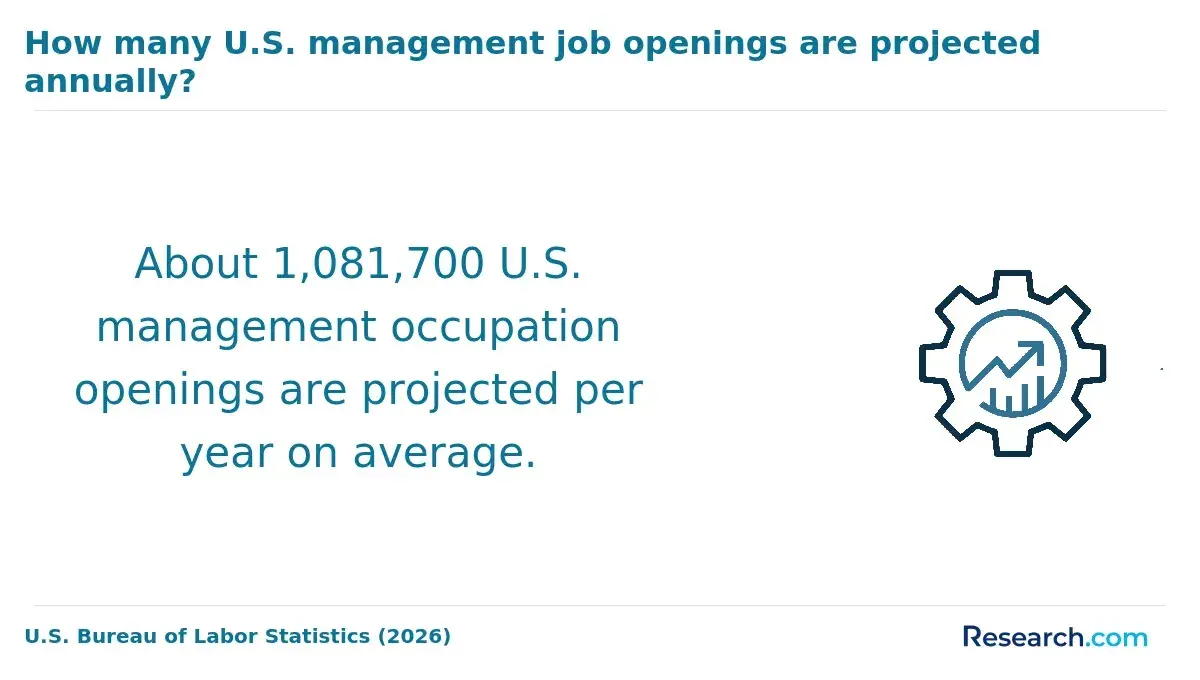
Management employment is projected to grow faster than the average for all occupations from 2025 to 2035, with about 1.1 million openings projected annually on average from growth and replacement needs.
Those openings are not reserved for MBA holders. For a useful personal comparison, identify the occupation and location you are targeting, then weigh realistic pay prospects against program cost and the experience employers request.
Do technology management MBA graduates need professional certifications?
Professional certifications are not a universal admission or graduation requirement for a technology management MBA. Whether one is useful depends on the job: a project-management credential may help demonstrate established project practice, while a cloud or security credential may matter when a role calls for specific technical knowledge. Certification eligibility, exams, and renewal rules are set by the issuing organization.
Choose the credential for a documented skill or hiring requirement, not as a generic addition to the MBA. For someone who already has a business or management foundation and needs one specific technical capability, a focused certification or employer training may be a more efficient next step than another degree.
Other Things You Should Know About MBA
Some schools consider applicants who will graduate before MBA enrollment. Confirm the deadline for submitting your final transcript and proof of degree completion.
That depends on the school's rules, course availability, and your progress through the degree. Ask whether changing concentrations would add courses or delay graduation.
Diploma wording varies by institution. Ask the registrar how the degree and any concentration appear on both the diploma and transcript.
Yes, if you intend to use that benefit. Confirm eligible schools, covered expenses, grade requirements, reimbursement timing, and any obligation to remain employed.
- Education requirements - Virginia Board of Accountancy https://boa.virginia.gov/cpa-exam/requirements/
- Eligible educational institution | Internal Revenue Service https://www.irs.gov/credits-deductions/individuals/eligible-educational-institution
- GRE and GMAT Test Score and Waiver Options | umn.edu https://carlsonschool.umn.edu/graduate/resources/gre-gmat-test-score-waivers
- Online Business Degree | AACSB Accredited - Online Programs | Adelphi University https://onlineprograms.adelphi.edu/programs/bs-bachelor-business/
- Online MBA Technology Management | Digital Innovation | Longwood Online https://online.longwood.edu/business/mba/technology-management/
- Does the GMAT/GRE waiver affect my application? - Carey Blog https://blog.carey.jhu.edu/article/does-the-gmat-gre-waiver-affect-my-application
- MBA Prerequisites | Messiah University https://www.messiah.edu/grad-business/courses-and-curriculum/mba-prerequisites
- The Application Process | Humanities Academic Services Center https://hasc.washington.edu/application-process
- What Are the Requirements to Get Into Business School Graduate Program? | Freeman News https://freemannews.tulane.edu/2025/01/30/what-are-the-requirements-to-get-into-business-school-graduate-program