
Online MBA in Sustainability: Admissions Guide for First-Time Managers

Co-Founder and Chief Data Scientist
Your first management role may have put you in charge of people, budgets, or operational decisions before you received formal training in any of them. If your team also faces energy, supply-chain, or other sustainability challenges, an online MBA may look like a way to build both sets of skills while you keep working.
This guide explains what admissions committees may expect from an early-career manager, how to prepare a credible application, and how to decide whether a sustainability-focused MBA is the right next step.
Key Things You Should Know
- First-time managers can be credible applicants when they demonstrate responsibility and results; managerial tenure is not a universal admissions requirement.
- Check whether sustainability is a formal concentration, a group of electives, or simply a program theme before applying.
- Budget for the full degree and assess career fit: the $126,520 median wage for US management occupations in May 2025 is not an expected salary for sustainability MBA graduates.
What is an online MBA in sustainability?
An online MBA in sustainability combines a broad business-management core with coursework on how organizations manage environmental and social impacts, resource use, and long-term business risks. Sustainability may be an officially named concentration, a set of electives, or a theme within a general MBA. The distinction matters: one related course does not amount to a formal specialization.
For a first-time manager, the potential value is learning to connect a sustainability proposal to a budget, operating target, and team decision - not just learning the vocabulary of environmental, social, and governance (ESG) issues. When comparing online study options for online MBA in sustainability, inspect the required courses and how students apply them, rather than relying on the program title.
Is an online sustainability MBA accredited and recognized?
An online MBA can be a recognized graduate degree, but accreditation belongs to the institution or business school, not automatically to every advertised concentration. Confirm that the university holds recognized institutional accreditation. Then check whether the business school or MBA has specialized accreditation, such as AACSB, ACBSP, or IACBE, if that distinction matters to your employer or future schools.
Verify both claims in the relevant accreditor's directory and confirm that the online MBA is covered. Specialized accreditation can help you compare programs, but it does not certify your personal sustainability expertise. If cost is a constraint, lower-cost graduate business programs MBA programs offer another starting point for comparing accredited options; still verify each program's current price and sustainability coursework.
What careers can you pursue with an MBA in sustainability?
The most realistic near-term path for a new manager is often broader responsibility within a function they already know. An operations manager might lead a waste-reduction initiative; a procurement manager might evaluate supplier risks; a finance manager might help assess the costs of an energy investment. These projects build evidence of management ability while developing sustainability experience.
A move into a dedicated sustainability or ESG role is possible, but employers may seek experience with reporting, emissions measurement, regulation, or a particular industry. An MBA alone does not establish that expertise or confer senior-leadership responsibility. Sector context also matters: someone managing facilities or procurement in a hospital may find MBA programs for health-system leaders more relevant than a general sustainability concentration.
The MBA core typically develops managerial accounting, finance, strategy, operations, organizational behavior, and decision-making. For a first-time manager, coursework on budgeting, communication, conflict, and organizational change may be as immediately useful as the sustainability electives.
Depending on the school, those electives may examine sustainable supply chains, climate-related business risk, stakeholder engagement, governance, or how to evaluate sustainability investments. A project tied to your workplace can be particularly useful if you can define a business problem, obtain appropriate data, and show how you would manage implementation. Review course descriptions: management-level sustainability study is not necessarily advanced training in carbon accounting, environmental science, or regulatory compliance.
There is no universal admissions standard for online sustainability MBAs. Schools set their own policies for academic records, work experience, testing, recommendations, and deadlines. A first-time manager should separate those published requirements from qualities that could make an application stronger.
The following comparison shows what to check and where your early management experience may be useful.
| Admissions area | What varies by program | What a first-time manager can demonstrate |
| Education and preparation | Bachelor's degree rules, GPA policies, and possible foundation coursework | Readiness for quantitative business work, regardless of undergraduate major |
| Professional experience | Minimum experience, preferred experience, or no stated threshold | Scope of decisions, projects, and team responsibilities - not just a manager title |
| GMAT or GRE | Required, optional, waived under stated conditions, or not considered | Evidence of academic readiness through relevant coursework or work results |
| Application materials | Resume, essays, recommendations, interview, and deadlines | A specific management challenge and a credible reason for studying sustainability |
Prepare the application around evidence rather than claiming expertise you have not yet developed. These steps are useful even when a school does not require every item:
- Compare each program's published requirements and deadlines, including its exact testing and work-experience policy.
- Document decisions you influenced: budget size or resource constraints, stakeholders, actions, and measurable results where available.
- Identify gaps in accounting, finance, or quantitative work and ask whether the program offers foundation courses or recommends preparation.
- Explain why the MBA's management core and its verified sustainability coursework serve your next responsibility better than a shorter course would.
If a program's stated experience preference exceeds yours, ask admissions whether applicants with substantial project or informal leadership experience are considered. Do not treat program selection for online MBA programs with accessible admissions acceptance rates as a substitute for checking whether a specific curriculum and cohort fit your goals.
Completion time depends on required credits, course sequencing, and whether you study part time or at an accelerated pace. For a new manager, the fastest route is not necessarily the most workable: a demanding term can coincide with performance reviews, budget cycles, or a new team's immediate needs. Ask how often courses run and whether pausing enrollment delays graduation.
Published tuition may be quoted per credit, course, term, or entire program. To compare offers, calculate tuition from each school's actual credit requirement and rate, then add mandatory fees, books and software, possible travel, and financing costs. Check whether employer assistance applies to the program and when reimbursement is paid. A guide to MBA programs with affordable tuition online MBA tuition and total cost can help frame that comparison, but your written cost estimate should come from each school.
An online MBA may let you keep earning and immediately apply lessons at work. It does not necessarily offer unrestricted scheduling: live sessions, group projects, and residencies can still conflict with management duties. A campus-based program may offer more in-person recruiting and informal networking, especially for someone attempting a substantial career change.
Ask both programs which career services, employer events, applied projects, and alumni opportunities are actually available to their students. If you plan to advance with your current employer, preserving your job may be the stronger advantage. If you need an internship or intensive recruiting access to enter a new function, compare those opportunities directly rather than assuming the two formats provide the same experience.
No single salary represents graduates of sustainability-focused MBAs. Compensation depends on the occupation, industry, location, prior experience, and level of responsibility. The US Bureau of Labor Statistics reports a $126,520 median annual wage for management occupations in May 2025. That figure describes workers across management jobs, not new managers, sustainability specialists, or MBA graduates; it should not be used as a post-degree pay forecast.
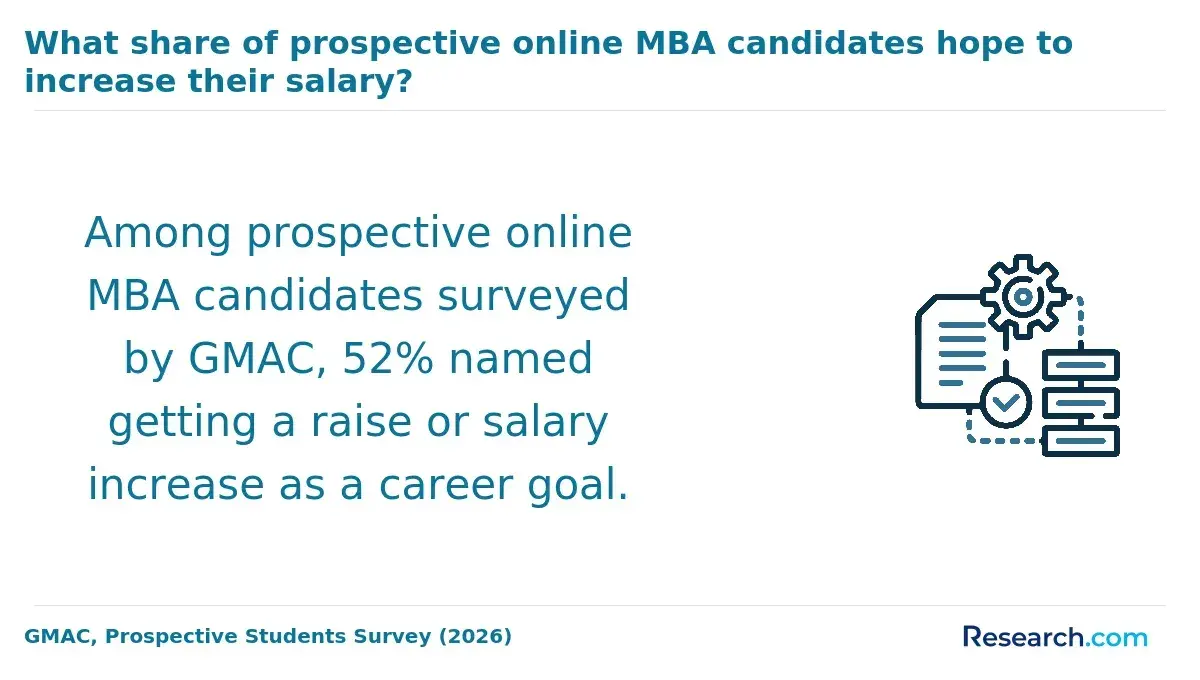
For a useful personal estimate, compare compensation for the specific roles you could plausibly pursue with your current experience. Ask programs for outcome data that distinguishes online students, career changers, and graduates at a similar career stage. A projected salary increase is most persuasive when a prospective employer or an established promotion path supports it.
Sustainability work spans operations, finance, procurement, reporting, and dedicated ESG teams, so it has no single occupational growth rate. The US Bureau of Labor Statistics projects about 1.1 million openings per year across management occupations from 2025 to 2035, including openings created when workers leave those occupations. That broad figure signals management hiring activity, not demand specifically for sustainability MBA graduates.
Look instead at postings in your target function and region. Note whether employers ask for people leadership, sector knowledge, reporting experience, technical measurement skills, or a combination. A first-time manager who can pair credible project results with the relevant skills will have a clearer case than one relying on the degree title alone.
Which certifications complement an MBA in sustainability?
A certification can address a narrower skills gap than an MBA. Depending on your intended work, consider training in greenhouse-gas accounting, building performance, supply-chain practices, or sustainability reporting. Check who issues the credential, its eligibility rules, assessment method, renewal requirements, and whether employers in your target role request it.
Choose the credential after defining the work you want to perform. If you need to manage a cross-functional team and investment decisions, MBA coursework may be more relevant. If you need to produce a technical emissions inventory, targeted training and supervised practice may be the more direct first step. Neither route automatically substitutes for experience.
Other Things You Should Know About MBA
Often, yes, subject to each school's experience policy. Explain the decisions you owned, the people you coordinated, and the outcomes rather than describing project leadership as formal supervision.
It may help if you want a recommendation, tuition support, or access to a workplace project. Check your employer's policies and decide how much to share before requesting assistance.
You can still identify relevant work in purchasing, facilities, operations, or risk management. Show why a specific business problem calls for sustainability knowledge without inventing a formal role.
Not without appropriate permission. Ask the school about alternative data or project formats, and follow your employer's confidentiality rules.
- Types of Financial Aid: Grants, Work-Study, and Loans | studentaid.gov https://studentaid.gov/understand-aid/types
- School-Determined Requirements | 2024-2025 Federal Student Aid Handbook https://fsapartners.ed.gov/knowledge-center/fsa-handbook/2024-2025/vol1/ch1-school-determined-requirements
- Leadership Development Assessments | U.S. Office of Personnel Management https://www.opm.gov/agency-services/training-and-development/for-individuals/leadership-development-assessments/
- Impact MBA Curriculum | CSU College of Business https://biz.colostate.edu/academics/graduate-programs/mba/impact-mba/curriculum
- What's the Difference Between Asynchronous and Synchronous Learning? | Ohio State Online https://online.osu.edu/content-hub/blogs/whats-the-difference-between-asynchronous-and-synchronous-learning/
- How Much Experience Is Required for an MBA? https://www.augsburg.edu/mba/mba-work-experience-requirements/
- Work Experience Requirements for the Wharton MBA | MBA Program https://mba.wharton.upenn.edu/work-experience/
- How to Decide Which Online Learning Format is Right for You | uvm.edu https://learn.uvm.edu/news/synchronous-vs-asynchronous-courses-learning/
- Curriculum Pathways | CBS Academics https://academics.business.columbia.edu/mba/academics/curriculum-pathways
- Online MBA in Corporate Sustainability - SOU https://online.sou.edu/degrees/business/mba/corporate-sustainability/


