
2027 Online Data Science Master's Programs for North Carolina Residents: In-State and National Options

Co-Founder and Chief Data Scientist
North Carolina residents can consider both a locally based online master's and programs offered by universities elsewhere in the U.S. The best choice depends less on the school's address than on its curriculum, total cost, scheduling, and whether it accepts students living in North Carolina. This guide compares relevant options and shows what to verify before committing to a program.
Key Things You Should Know
- Compare North Carolina-based programs with national online options; living in North Carolina does not, by itself, make an online degree cheaper.
- Wake Forest offers a North Carolina-based applied data science option; national choices include the University of Texas at Austin's online MS in Data Science and Georgia Tech's online MS in Analytics.
- The U.S. Bureau of Labor Statistics projects 35% growth in data scientist employment from 2025 to 2035, but that outlook does not predict an individual graduate's job prospects.
What are online data science master's programs for North Carolina residents?
These are graduate programs that a student living in North Carolina can complete primarily online, whether the university is in-state or elsewhere. They may be titled data science, applied data science, analytics, or statistics. Those titles overlap, but they do not promise the same coursework: an analytics degree may emphasize business decisions, while a statistics degree may offer more depth in inference and modeling.
Location matters when it changes tuition, access to campus resources, professional connections, or the timing of live classes. It does not necessarily change the credential or make a national program less relevant. If your goal is more business-focused than technical, explore master's degrees in data analytics alongside data science programs.
Which accredited online data science master's programs serve North Carolina students?
The following institutionally accredited universities offer relevant online degrees. This is a comparison shortlist, not a guarantee of current admission or enrollment eligibility: confirm the exact delivery format, North Carolina enrollment eligibility, and any required visits with each university before applying.
| University and online degree | Location-based consideration | Curricular fit to investigate |
| Wake Forest University - MS in Applied Data Science | North Carolina-based private university; do not assume a resident tuition discount | Applied projects, technical prerequisites, and opportunities to connect with local employers |
| North Carolina State University - Master of Statistics | North Carolina public-university option; compare the applicable online resident rate | Strong statistics interest; verify whether available computing and electives meet your data science goals |
| University of Texas at Austin - MS in Data Science | National online option; check its published online tuition policy rather than assuming a nonresident campus rate | Balance of computing, statistics, and machine learning |
| Georgia Institute of Technology - MS in Analytics | National online option; consider live-session timing if applicable | Analytics pathways and their fit with your target role |
NC State's degree is statistics, not a data science master's with an interchangeable title. Include it if statistical depth is your priority; compare its computing and project opportunities with those of the data science degrees before choosing it. Institutional accreditation establishes a university's recognized status, not that every program has identical content or that every course is available in every term.
How much do online data science master's programs cost in North Carolina?
There is no single North Carolina price. A resident rate may matter at an in-state public university, while a private university or a national program may use a different online pricing structure. Published tuition can also change by academic year; a comparable current total requires each school's tuition and mandatory fee schedule and the number of credits you will actually take.
Calculate the full budget as required credits × applicable tuition rate, plus mandatory fees and expected materials or technology costs. Add travel if an orientation, presentation, or other campus activity is required, and account for borrowing costs if you will finance the degree. Ask whether tuition is charged per credit or term, whether the online rate differs from the campus rate, and whether an employer will reimburse coursework. Comparing one school's tuition-only figure with another's tuition-and-fees estimate is a common - and avoidable - mistake.
Cost should be judged against the learning and career support you expect to use, not an assumed salary increase. An employer benefit can change the calculation substantially, but reimbursement rules may require a minimum grade or continued employment.
What are the admission requirements for an online data science master's?
Requirements vary by program. Expect a bachelor's degree and an application that may include transcripts, a résumé, a statement of purpose, and recommendations. Programs differ in whether they require prior calculus, linear algebra, statistics, programming, standardized tests, or professional experience. Read the admissions page for the specific online degree rather than relying on requirements for its campus counterpart.
If you have worked with data but lack a formal prerequisite, ask whether a graded college course will satisfy it; self-study may prepare you for the coursework without fulfilling an admissions rule. Applicants considering more AI-focused degrees can also examine AI graduate admission through foundation courses, while confirming separately what each data science program accepts.
What courses are included in an online data science master's curriculum?
Look for a combination of statistics, programming, data management, machine learning, and applied analysis. The meaningful differences are depth and practice: a dedicated database course is not the same as a brief introduction to SQL, and a substantial project provides different evidence of skill than a series of isolated assignments.
Compare required courses with electives you can realistically take online. For a data scientist role, check for model evaluation, uncertainty, and reproducible work. For AI-related roles, examine how a program addresses deployment, privacy, bias, and governance rather than treating an AI label as proof of that depth. AI master's programs with responsible AI content provide a useful contrast if governance is central to your goal.
How long does an online data science master's program take to complete?
Completion time depends on required credits, course availability, and how many classes you take at once. A published fastest-possible timeline may assume continuous enrollment or a heavier load than a working adult can sustain. Request a sample part-time sequence and check whether prerequisites delay access to advanced courses.
Also ask when required courses run, whether you can pause enrollment, and whether team projects or live sessions constrain your schedule. If work hours are your main constraint, compare approaches to master's-level data science study for working adults before choosing a pace based on advertised duration alone.
How do online and campus-based data science master's programs compare?
An online program can let a North Carolina resident keep a job and avoid relocating. A campus program may make in-person research, recruiting events, and informal faculty contact easier. Neither format is automatically stronger: compare access to the same courses, faculty guidance, career services, and projects, as well as any live attendance requirements.
For a national online degree, ask whether remote students can join employer events and alumni activities relevant to North Carolina. Those connections depend on actual access and participation, not merely the size of a university's network. Guidance on alumni relationship building in AI graduate education can help frame that question without assuming an online student receives the same opportunities as a campus student.
What careers can an online data science master's prepare you for?
Relevant paths include data scientist, machine learning practitioner, statistician, and analytics-focused roles, depending on coursework and prior experience. A North Carolina professional may find it useful to build projects around problems they know from work, but a local employer connection is not required for a national online degree to be valuable.
Match the program to the work you want to show employers. Someone moving from reporting into predictive modeling should seek substantial programming, statistics, and evaluated projects; someone aiming for statistical research may prefer greater inference depth. A degree alone does not replace demonstrable technical work or guarantee a change in role.
What salaries and job growth can data science graduates expect?
The U.S. Bureau of Labor Statistics reports a $120,230 median annual wage for data scientists in May 2025. That is an occupation-wide figure, not a starting salary or a measured outcome for graduates of any program in this comparison. Pay depends on experience, responsibilities, employer, and location; use actual job postings and any program-specific outcomes with a clear methodology when assessing likely opportunities.
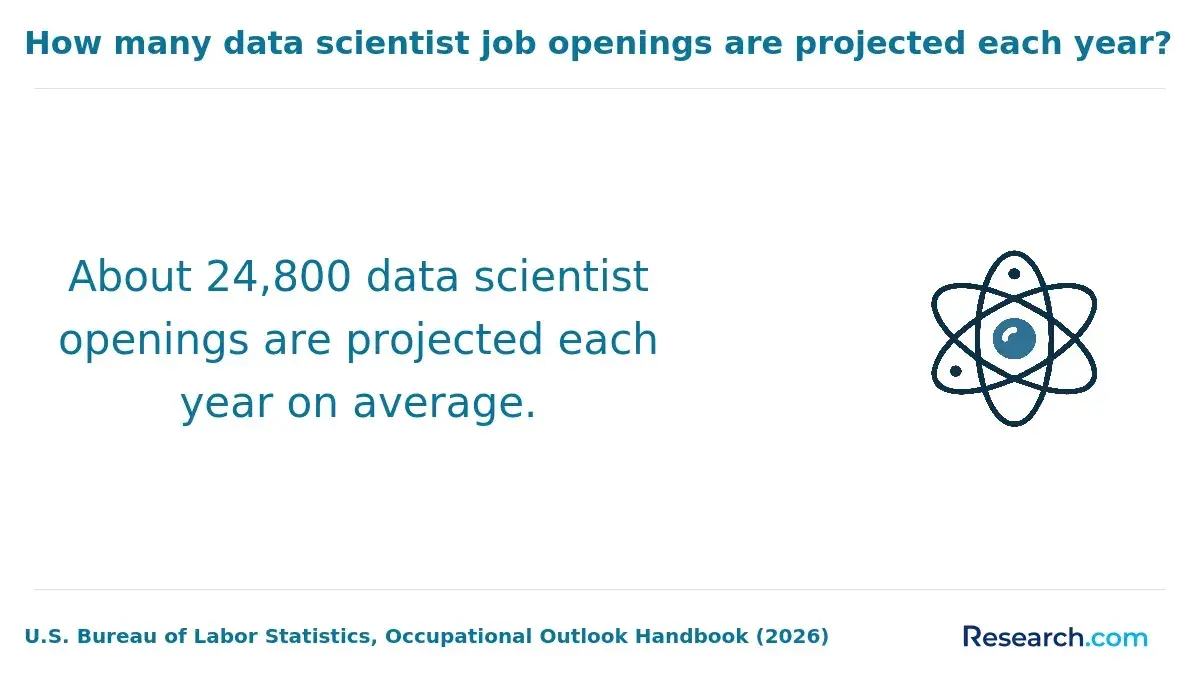
BLS projects data scientist employment growth of 35% from 2025 to 2035. The forecast indicates broad demand, but applicants will still compete for particular roles. Before paying for a degree, compare its total cost with the skills you lack and the jobs you could realistically pursue, rather than treating the national median as a promised return.
Do data science careers require licenses or professional certifications?
Data scientist roles generally do not require a North Carolina professional license. Employers may value particular software skills or certifications, but a certificate is not a substitute for the statistical reasoning, programming, and project work required by a role. If you plan to analyze data in a regulated field, check the employer's privacy and compliance requirements separately; those depend on the work and industry, not simply on where the university is located.
Other Things You Should Know About Data Science
Diploma and transcript wording is set by the university. Ask the registrar for a sample or its official policy if the distinction matters to you.
Only with appropriate employer permission and the program's approval. A public or properly de-identified dataset is often a safer starting point.
Possibly, but tell the university before moving. A change of residence can affect tuition classification or the institution's ability to enroll you in courses from the new state.
Opportunities differ by program and faculty. Ask whether remote students can work with researchers and whether such work is funded, credit-bearing, or available only by arrangement.
References
- Programmatic Accrediting Agencies | U.S. Department of Education http://www.ed.gov/laws-and-policy/higher-education-laws-and-policy/college-accreditation/programmatic-accrediting-agencies
- Cost of Attendance (Budget) | 2025-2026 Federal Student Aid Handbook https://fsapartners.ed.gov/knowledge-center/fsa-handbook/2025-2026/vol3/ch2-cost-attendance-budget
- Online Master of Data Science Admission Requirements at Rice https://csweb.rice.edu/academics/graduate-programs/online-mds/admissions
- M.S. admissions | Data Science https://cse.umn.edu/datascience/graduate-admission-requirements
- Graduate Admissions: How to Apply - Mathematical Sciences https://math.utdallas.edu/graduate/how-to-apply/
- Admissions | Mathematics MA/MS | Portland State University https://www.pdx.edu/math/admissions-mathematics-mams
- Online Master of Applied Data Science Tuition & Financial Aid | UNC-Chapel Hill online https://online.unc.edu/online-masters-programs/masters-data-science/admissions/tuition-financial-aid/
- Admission Requirements - UW Biostatistics https://www.biostat.washington.edu/apply/requirements
- Foundations of Data Science | The Graduate School https://grad.ncsu.edu/programs/foundations-of-data-science/
- Master of Science in Data Science | Department of Computer Science | ECU https://cet.ecu.edu/csci/master-data-science/


