2027 Online BA in Psychology - Addictions vs. a BA in Substance Use Counseling: Compare Curriculum, Cost, and Career Fit
Audited and Verified:
Our Editorial and Data Verification Process
Research.com uses government datasets, official education statistics and primary institutional information to support its career and degree guides. Our review process checks factual accuracy, occupational definitions, source dates and the requirements associated with the credentials discussed.
How This Article Was Fact-Checked
Our editorial team verifies salary estimates, employment projections, education requirements and program information against original data providers and official organizations. Salary figures are checked against the relevant occupational definitions and reporting periods. Information about licensure, accreditation and required in-person training is reviewed separately.
Fact-checked and verified on:

Co-Founder and Chief Data Scientist
If you want to work in addiction services, two similarly named bachelor's degrees can lead to different preparations. An online BA in Psychology-Addictions usually emphasizes psychological science and research; a BA in Substance Use Counseling is more likely to emphasize counseling skills and supervised fieldwork. Neither degree automatically qualifies you to practice independently. This comparison is for prospective and returning students choosing between the two. It shows how to evaluate curricula, total cost, online placement requirements, and state credential rules before committing to a program.
Key Things You Should Know
- For a defined addiction counseling job: A substance use counseling BA is generally the more direct choice, but only if its coursework and supervised experience meet the requirements of your state and target credential.
- For broader options: A psychology-addictions BA usually offers more research and psychology coursework; its concentration is not a counseling license.
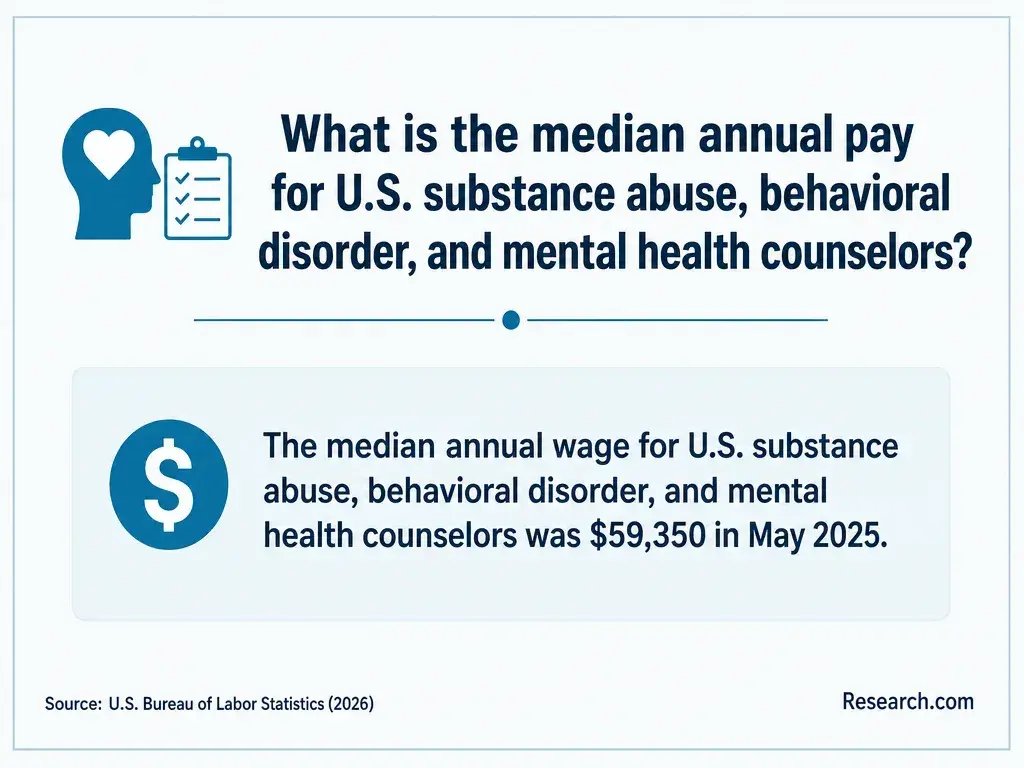
- For cost and career planning: A bachelor's degree commonly requires about 120 credits. The U.S. Bureau of Labor Statistics reports a $59,190 median annual wage for its combined counselor occupation - not for graduates of either degree.
What is the difference between a BA in Psychology-Addictions and a BA in Substance Use Counseling?
The distinction is disciplinary breadth versus occupational preparation. Psychology-addictions is typically a psychology major with addiction-focused courses. Substance use counseling is typically an applied major organized around helping skills, treatment systems, ethics, and field experience. Names alone cannot establish what either program teaches or whether it satisfies a credential requirement.
This comparison identifies the likely emphasis of each degree. Check the actual catalog and course descriptions before treating any feature as a program requirement.
| Decision factor | Psychology-addictions BA | Substance use counseling BA |
| Academic center | Psychological science, behavior, research, and addiction | Substance use services, counseling processes, and professional practice |
| Typical applied emphasis | May offer research, community work, or an elective internship | More likely to include skills practice and a supervised placement |
| Best initial fit | Students keeping research, support work, or further study open | Students targeting a specific addiction counselor credential |
| Key limitation | An addictions concentration does not establish counseling eligibility | A counseling title does not guarantee state approval or independent practice |
Psychology programs also vary substantially. Use psychology degree planning for prospective online students to frame a comparison, then confirm each candidate program's required courses and placement policies directly.
Which degree better prepares you for addiction counseling careers?
Choose the substance use counseling BA first if your goal is a state-recognized addiction counselor role and the program demonstrably covers that credential's education and supervised-training requirements. Ask the program for a course-by-course explanation of how it aligns with the rules in the state where you intend to work. A general statement that graduates are "prepared for counseling careers" is not enough.
Choose psychology-addictions if you want to study behavior and addiction while preserving more room for research, program evaluation, or other psychology-related work. It can support a later application to professional training, but you may have to complete missing counseling coursework or supervised hours separately. If your goal is licensed mental health counseling across a wider range of conditions, compare qualifying graduate programs rather than assuming either BA supplies that credential; an accredited mental health counseling program cost guide can help scope that separate investment.
Prior experience matters. Someone already employed in recovery services may need a state-approved set of courses or documented supervision, not a second bachelor's degree. Someone new to client-facing work may benefit more from a program with a well-supported placement than from a stronger-sounding concentration name.
What accreditation should you look for in an online addictions degree?
First, confirm that the institution holds accreditation recognized by the U.S. Department of Education or the Council for Higher Education Accreditation. This matters for federal-aid eligibility and can affect credit transfer and graduate admissions. Then check whether your state's addiction counselor board requires particular program approval, coursework, or recognition. Institutional accreditation does not, by itself, establish credential eligibility.
Do not look for APA accreditation as a test of either bachelor's degree: APA accreditation applies to specified professional psychology programs and training sites, not general psychology BAs. Likewise, recognition relevant to a counseling program must be checked against the exact program and credential - not inferred from another degree at the university. The same distinction matters when reviewing online forensic psychology programs and graduate outcomes: a specialty label is not proof of professional authorization.
Before paying a deposit, request the institution's accreditation status, the degree's official title, and a written explanation of any state-specific credential alignment. If you plan to work outside the school's home state, ask about your state.
Look beyond the number of addiction courses. The useful difference is what you will be able to demonstrate afterward: research literacy, supervised service skills, or both. Required courses are more dependable than electives that may not be offered before you graduate.
| Curricular area | More typical of psychology-addictions | More typical of substance use counseling |
| Foundations | Developmental, social, biological, and abnormal psychology | Addiction, recovery systems, co-occurring concerns, and service delivery |
| Methods | Statistics, research design, and interpretation of evidence | Practice documentation and evaluation of interventions; research depth varies |
| Helping skills | May introduce counseling theories | More likely to require interviewing, group-work concepts, ethics, and referral skills |
| Experiential learning | Research or community placement may be available | Supervised agency experience may be required |
Courses about diagnosis or treatment do not authorize a student to diagnose or provide therapy. For graduate-school plans, compare statistics and methods requirements with the intended next program. A research-oriented psychology master's differs from qualifying counselor training; budget-friendly online psychology graduate degrees are worth evaluating against that distinction, not by price alone.
Requirements vary by institution and by whether you enter as a first-year or transfer student. Schools generally ask for prior academic records and proof that you meet their undergraduate admission standards. Some applied majors may impose additional requirements before fieldwork, such as a background check, site onboarding, or prerequisite courses. Admission to the university does not necessarily mean admission to a placement.
Transfer students should request a degree audit showing not just credits accepted, but credits applied to general education, the major, and any placement prerequisites. This is especially important if prior human-services or psychology courses have similar names but different content. When comparing affordable online psychology degree programs, ask for a written estimate of remaining requirements rather than judging affordability from the advertised credit price.
A bachelor's degree commonly totals about 120 credits, often planned around four years of full-time study. Your actual timeline depends on accepted transfer work, how those credits satisfy requirements, course availability, and enrollment pace. A counseling placement can add a scheduling constraint even when lectures are asynchronous: the site may require fixed daytime hours and approved supervision.
For a realistic finish date, ask the school to map every remaining course by term and identify when placement can begin. A student balancing work or caregiving should also confirm live meetings, local-site availability, and part-time sequencing. Do not confuse an accelerated graduate-program advertisement with a shortened bachelor's pathway; forensic psychology one-year program value considerations, for example, concern a different degree level and career decision.
There is no reliable price advantage based on the major name alone. Compare the cost to finish: remaining credits multiplied by the applicable tuition rate, plus mandatory fees, materials, placement-related costs, and any travel. An online counseling degree may require local fieldwork, while a lower-priced psychology BA could become more expensive if you later need separate credential coursework. Conversely, paying more for counseling-focused classes has little value if they do not meet your state's rules.
Ask each school for a term-by-term estimate based on its evaluation of your credits. Confirm whether online tuition differs by residency, whether placement carries tuition or fees, and which expenses financial aid can cover. For aid questions specific to this pathway, consult funding an online bachelor's in substance abuse counseling; eligibility and award amounts still require confirmation with the school.
Either degree may support applications for supervised or nonclinical work in prevention, outreach, intake, care coordination, or recovery services, subject to employer requirements. Psychology-addictions may be especially useful for program-support or research-assistant roles that value methods and data skills. Substance use counseling may better match positions involving structured client contact under an approved credential and supervisor.
Job titles are less informative than duties. A recovery-support worker might help people navigate services and document contacts; a credentialed addiction counselor may have additional assessment or treatment responsibilities permitted by state law. Compare actual tasks and qualifications when comparing recovery support occupations. Neither BA makes its holder a licensed psychologist, nor does it establish permission to practice psychotherapy independently.
Requirements depend on the state and the level of practice. States may distinguish entry-level or supervised addiction counselor credentials from credentials permitting greater responsibility. Their rules can specify education content, supervised experience, examinations, application procedures, and continuing education. A national certification may be useful or required in some circumstances, but it does not replace state authorization where that authorization is required.
Start with the board or agency regulating the job in the state where you intend to work. Match its requirements to the program's exact courses and fieldwork, and ask whether hours earned while enrolled can count toward the intended credential. Also check whether the supervisor and placement site must meet particular standards. If the required pathway is graduate-level, compare the additional expense rather than assuming a bachelor's concentration closes the gap; bachelor's-level substance use counseling tuition and career value offer one starting point for that financial comparison.
What are the salaries and job outlook for addiction counseling careers?
The U.S. Bureau of Labor Statistics reports a $59,190 median annual wage in 2024 for the combined occupation of substance abuse, behavioral disorder, and mental health counselors. It projects 17% employment growth from 2024 to 2034. Those figures describe an occupation spanning different settings and qualification levels; they are not starting-pay estimates or employment outcomes for either BA.
For a useful local comparison, review postings for the precise credential you could hold after graduation, including their supervision and experience requirements. Avoid comparing that pay with salaries attached to a different specialty or degree: earning potential after a master's in forensic psychology, for instance, does not predict addiction counseling earnings. The better financial test is whether the program advances your target credential at a total cost you can justify.
Other Things You Should Know About Psychology
Possibly. Confirm that the school can enroll residents of your state and that any required placement can be approved near you. Enrollment permission and professional credential eligibility are separate questions.
Only if the program approves the site, duties, supervision, and timing. Existing employment does not automatically fulfill academic fieldwork or state-supervised-hour rules.
Not necessarily. Graduate programs set their own prerequisites. Strong grades, relevant methods coursework, and experience may matter more than the concentration's name.
It can be a more direct route to a specific peer-support role if your state and employers recognize it. Peer support has its own training and scope; it is not a substitute for an addiction counselor credential.
- An Overview of Accreditation of Higher Education in the United States | Congress.gov | Library of Congress https://www.congress.gov/crs-product/R43826
- Substance Use Disorder Professional (SUDP) | Washington State Department of Health https://doh.wa.gov/licenses-permits-and-certificates/professions-new-renew-or-update/substance-use-disorder-professional/certification-requirements
- Fast Facts: Tuition costs of colleges and universities (76) | ed.gov https://nces.ed.gov/fastfacts/display.asp
- STATE LICENSURE FOR SUBSTANCE USE DISORDER COUNSELING: IMPLICATIONS FOR BILLING ELIGIBILITY | ASPE https://aspe.hhs.gov/reports/state-licensure-substance-use-disorder-counseling-implications-billing-eligibility-0
- 7 FAQs About Substance Use Disorder Counselor Careers | Purdue Global https://www.purdueglobal.edu/blog/psychology/career-substance-use-disorder-counselor-faqs/
- Professional Licensure Disclosures | CT State https://ctstate.edu/professional-licensure-disclosures
- Applied Psychology: Addictions Studies, B.S. - CPS, CPSO | University of New Hampshire https://www.unh.edu/program/bachelor-science/applied-psychology-addictions-studies
- Professional Licensure - State Authorization Network https://wcetsan.wiche.edu/resources/professional-licensure
- Transferring Credit | Undergraduate Admissions | University of Houston https://www.uh.edu/undergraduate-admissions/apply/transfer/transferring-credit/
- Approved Fieldwork Site Application Process | The University of New Mexico https://coehs.unm.edu/departments-programs/ifce/counselor-education/fieldwork.html