2027 Online BA in Psychology - Addictions: How to Compare Student Support at Two Similarly Priced Schools
Audited and Verified:
Our Editorial and Data Verification Process
Research.com uses government datasets, official education statistics and primary institutional information to support its career and degree guides. Our review process checks factual accuracy, occupational definitions, source dates and the requirements associated with the credentials discussed.
How This Article Was Fact-Checked
Our editorial team verifies salary estimates, employment projections, education requirements and program information against original data providers and official organizations. Salary figures are checked against the relevant occupational definitions and reporting periods. Information about licensure, accreditation and required in-person training is reviewed separately.
Fact-checked and verified on:

Co-Founder and Chief Data Scientist
Two online psychology bachelor's programs can advertise similar tuition and an addictions focus while offering very different help when a required course fills up, a placement falls through, or work hours change. For prospective and returning students, those differences can affect both completion and the value of the degree.
This guide shows how to compare support using written policies, realistic scheduling scenarios, and program-specific evidence - not service names on a website. It also explains what the degree can and cannot prepare you to do in addiction-related work.
Key Things You Should Know
- When prices are close, favor the school that can document dependable major advising, required-course access, online tutoring, and help with any placement - not simply the longer list of services.
- Compare your remaining requirements and total estimated charges, not advertised tuition alone; a typical bachelor's degree requires about 120 semester credits, but accepted transfer credits may not satisfy major requirements.
- An addictions focus teaches relevant subject matter but does not itself qualify a graduate to diagnose, provide therapy, or hold a state-regulated addiction counseling credential.
What Is an Online Bachelor's Degree in Psychology With an Addictions Focus?
It is an undergraduate psychology degree that combines the discipline's foundations with study of substance use, prevention, recovery, and related service systems. "Addictions focus" might mean a formally recorded concentration, a set of electives, or simply an emphasis in the program description. The distinction matters if you want the specialization shown on your academic record or need particular courses for a later credential.
Start by comparing the exact degree title, catalog requirements, and required addictions courses. A broadly advertised focus may offer less relevant preparation than a general psychology major with stronger research methods, community partnerships, and accessible electives. Comparing online psychology degree curricula can help frame that review, but the school's catalog for your entry term controls your requirements.
Neither a BA nor an addictions concentration is a clinical qualification. If your aim is a specific counseling credential, begin with that credential's state rules rather than assuming the concentration's name establishes eligibility.
How Do You Compare Student Support at Similarly Priced Online Psychology Schools?
Compare support as a set of responses to foreseeable obstacles, not a count of offices or a claim of "personalized attention." Use the same scenario at both schools: you work during standard business hours, need a required psychology course next term, and may need help finding an approved addiction-services experience. Ask each school who would help, when help is available, and what happens if the first solution fails.
The following comparison separates a service's advertised existence from evidence that an online student can actually use it.
| Decision factor | Stronger evidence of support | Reason for caution |
| Major advising | A named advising contact, a degree plan, and a clear route for resolving course substitutions | Only general enrollment advising before admission |
| Course access | Published rotation of required courses and a documented backup when a course is unavailable | Frequent starts advertised without a major-course schedule |
| Online availability | Tutoring, library, and technical help at times that fit the student's schedule | Services limited to campus or business hours |
| Applied experience | Written eligibility rules, faculty oversight, and a defined site-approval process | "Internship opportunities" without a responsible coordinator or approval policy |
| Disruptions | Accessible leave, reentry, appeal, and complaint policies | Flexibility promised without written conditions |
Request answers by email and compare policies for the same entry term. If one school cannot confirm when required courses run, its lower fees or faster advertised pace may not compensate for a delayed graduation. This is especially important when considering accelerated psychology study for returning students: shorter terms only help when advising and course availability keep pace.
Which Accreditation Should an Online Addictions Psychology Program Have?
Confirm that the institution holds accreditation from an accreditor recognized by the U.S. Department of Education, and check that the status applies to the institution awarding your degree. Institutional accreditation is relevant to educational oversight, federal aid eligibility, and how other schools may evaluate coursework. It does not guarantee that every credit will transfer or that a state will accept the degree for a professional credential.
Do not reject a psychology BA because it lacks American Psychological Association accreditation: APA accreditation applies to specified professional psychology training programs and internships, not general bachelor's degrees in psychology. Nor should you assume that accreditation of a university makes its addictions courses satisfy a state addiction counseling board's requirements.
Ask a receiving institution or credentialing authority to assess the specific courses and degree if your next step depends on recognition. That distinction also matters when evaluating transfer options before psychology enrollment: the school granting the degree determines how accepted credits apply to its requirements.
Prioritize services that prevent a predictable interruption to your degree. For psychology students, that means major-specific academic advising, statistics and research-writing help, accessible library databases, disability accommodations, and reliable learning-platform support. Check whether appointments, tutoring, and live meetings are available outside your working hours; asynchronous classes do not make every support service asynchronous.
Career support deserves a closer look than a list of job-board features. Ask whether advisers help online students identify local nonclinical experience, prepare applications for community-service roles, and distinguish those jobs from licensed counseling positions. If an internship or capstone is required, establish who approves a site, whether an existing job can be considered, and what supervision and documentation are required. An employer's willingness to host you is not academic approval.
Students planning further study should also ask whether advisers help identify prerequisites and recommendation-letter opportunities. Support for a BA and support for psychology graduate programs with compressed schedules are separate questions; neither should be inferred from a school's general claim of flexibility.
Expect to examine psychology foundations alongside statistics, research methods, and subjects such as development, social behavior, and abnormal psychology. Addictions-related offerings may cover substance use, prevention, recovery systems, and ethical or cultural issues. The actual sequence and whether these courses are required vary by institution.
For this comparison, a course list is less useful than a term-by-term path. Find out when statistics and methods are offered, whether they precede advanced addictions courses, and whether the focus relies on electives that may not run regularly online. A school with fewer named addictions courses may serve you better if it reliably offers the required sequence and supports an appropriate applied project.
Check the concentration label rather than treating every related elective as equivalent. Even a program in another specialty, such as forensic psychology bachelor's study with accelerated pacing, may share core psychology courses while providing different advanced preparation. Coursework about disorders or counseling techniques does not authorize clinical practice.
Requirements depend on whether you are applying as a first-time undergraduate or a transfer student. Schools commonly request prior academic records; some have separate conditions for entry to the psychology major or for upper-level courses. Ask whether introductory psychology, statistics, or another prerequisite must be completed before you can follow the advertised schedule.
Returning students should obtain a written degree audit showing which credits meet general education, psychology major, concentration, and institutional residency requirements. "Credits accepted" is not the same as "requirements completed." The school has final authority over substitutions, and the result can change both remaining cost and graduation time.
If a later master's degree is part of your plan, check its prerequisites separately before choosing undergraduate electives. Comparing affordable MA and MS psychology programs online can help you identify future questions, but a nonclinical psychology master's is not automatically an addiction counseling qualification.
A bachelor's degree typically totals about 120 semester credits, but your remaining time depends on applied transfer credits, enrollment pace, prerequisite order, and how often required courses run. An accelerated course format does not guarantee an accelerated degree, particularly if an approved experience or a required elective is available infrequently.
To compare two similarly priced schools, obtain an estimate for your remaining degree: tuition for required credits, mandatory online and technology fees, materials, and any placement-related travel or unpaid time. Ask whether the estimate assumes full-time enrollment or a course load you cannot sustain. Compare aid offers and borrowing separately from the published price; eligibility and continued aid can depend on enrollment and academic progress.
A less expensive counseling-oriented bachelor's may be worth considering if your target state recognizes its coursework. Use lower-tuition bachelor's pathways in substance use counseling as an alternative to investigate, not evidence that a cheaper program will meet your state's credential rules.
Possible nonclinical paths include recovery-program support, prevention outreach, intake coordination, referral support, and research or program-assistance roles. Duties and hiring standards differ by employer and state. The strongest applicant can often show both relevant coursework and supervised experience with documentation, respectful communication, confidentiality, and appropriate referral boundaries.
Start with the job description rather than the concentration name. If a position requires a state substance-use counselor credential, determine whether your degree meets its educational rules and what additional supervision or examination is needed. If you already work in a community organization, an approved project or placement there may be more useful than changing jobs - but neither existing employment nor volunteer work automatically satisfies a school's experiential requirement.
Other specializations lead to different work, not interchangeable professional authority. For example, evaluating faster-paced forensic psychology master's degrees makes sense for a distinct justice-related goal, not as a shortcut into addiction treatment. If your goal is licensed therapy, plan around a qualifying professional pathway rather than a psychology BA alone.
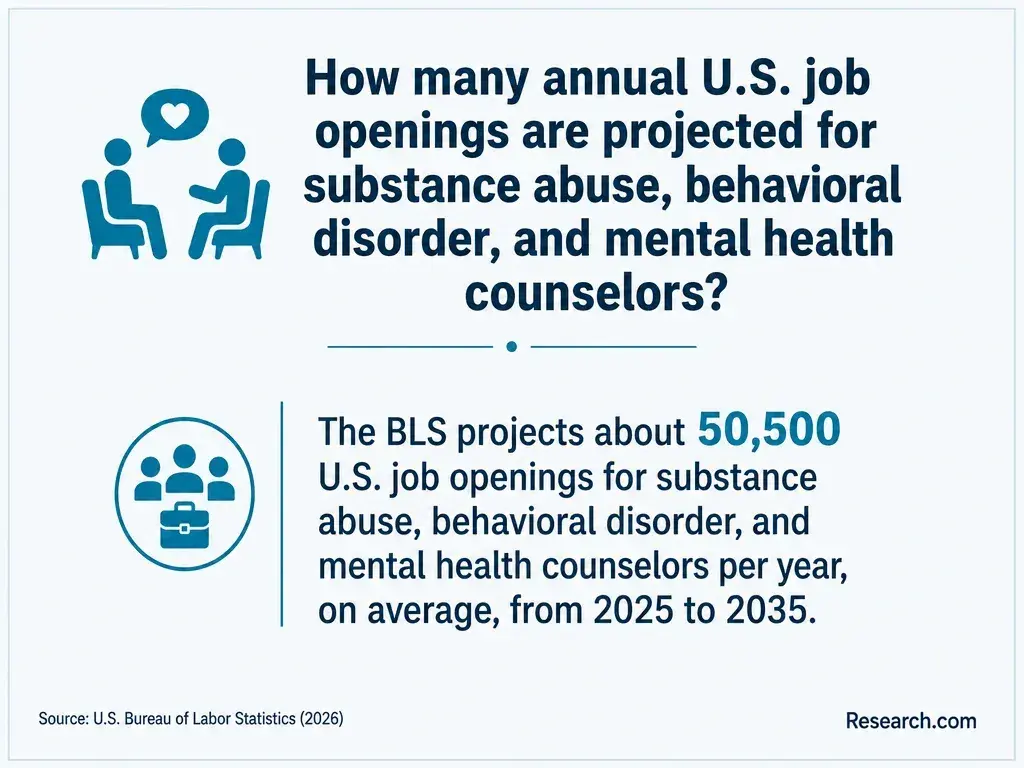
There is no single reliable salary or growth rate for "addictions psychology graduates." The U.S. Bureau of Labor Statistics reports employment data by occupation, not by bachelor's concentration. Its substance abuse, behavioral disorder, and mental health counselors category can help you assess a counseling occupation, but the category includes workers with different education and credential levels. Its occupation-wide median should not be presented as an entry-level BA outcome.
For a useful comparison, choose a job title you could actually pursue under your state's rules, then review the Bureau of Labor Statistics Occupational Outlook Handbook entry for that occupation and local postings for required credentials and pay. Compare those findings with each school's career support and any published graduate outcomes. If a school reports outcomes, ask which graduates were counted, over what period, and how many responded.
Do not justify additional education using a broad occupational salary figure alone. Forensic psychology one-year program value considerations illustrate the same caution for a different specialization: a shorter program or higher occupational median does not establish an individual graduate's return on investment.
What Licenses or Certifications Do Addiction Counseling Careers Require?
Requirements depend on the state, credential level, and duties. A state may specify acceptable education, addiction-related coursework, supervised experience, an examination, and ongoing requirements. Peer-support certification may follow a different route. Check the responsible state board or credentialing authority's rules for the exact title and work you intend to pursue before enrolling.
Send the authority the prospective program's degree title and course descriptions if eligibility is unclear, and seek a written answer where possible. Ask each school what it can document about past students' credential applications, while recognizing that another graduate's approval does not establish yours.
If your goal is independent psychotherapy rather than addiction-service support, investigate a qualifying professional degree and subsequent licensure steps. Choosing a shorter clinical mental health counseling master's still requires checking that program against the rules of the state where you intend to practice.
Other Things You Should Know About Psychology
Ask whether you can enroll as a nondegree student and whether the course would later apply to the major. Admission to a course does not guarantee admission to the degree or future credit applicability.
Request the relevant catalog policy or contact for the office responsible. If neither school can confirm a consequential requirement, treat the uncertainty as part of the comparison rather than assuming the problem will be resolved later.
Possibly, with course and employer approval. Establish what work is permitted and whether you may use any workplace information; employment does not grant automatic access to client data for coursework.
Yes, if the school can connect you. Ask about access to required courses and response times for support, while checking important claims against written policies. One student's experience may not represent every term or adviser.
- Academic advising in a university | Parents & Families | Oregon State University https://health.oregonstate.edu/success/parents/university-academic-advising
- Online Bachelor's Degree in Psychology in Addictions | Purdue Global https://www.purdueglobal.edu/degree-programs/psychology/bachelor-psychology-addictions/
- Academic Support Services Centers | Student Success | Hudson County Community College https://www.hccc.edu/student-success/tutoring-services.html
- Online Writing Center | Military Affairs https://www.liberty.edu/online/casas/writing-center/
- Online Psychological and Behavioral Health Degree | Illinois College https://www.ic.edu/behavioralhealth-online
- Earn Your B.S. in Addiction Studies Online | SUNY Empire https://sunyempire.edu/academics/undergraduate-academics/addiction-studies.html
- Human & Public Service | Fulton-Montgomery Community College https://fmcc.edu/component/tags/tag/human-public-service
- Technical Support - The University of Alabama - UA Online https://developonline.ua.edu/about-us/technical-support/
- Writing Center | vt.edu https://lib.vt.edu/study-learn/writing-center.html
- Online Substance Abuse Concentration | SNHU https://www.snhu.edu/online-degrees/bachelors/ba-in-human-services/substance-abuse