2027 Online BA in Psychology - Addictions for Corporate Trainers: What to Check Before Changing Careers
Audited and Verified:
Our Editorial and Data Verification Process
Research.com uses government datasets, official education statistics and primary institutional information to support its career and degree guides. Our review process checks factual accuracy, occupational definitions, source dates and the requirements associated with the credentials discussed.
How This Article Was Fact-Checked
Our editorial team verifies salary estimates, employment projections, education requirements and program information against original data providers and official organizations. Salary figures are checked against the relevant occupational definitions and reporting periods. Information about licensure, accreditation and required in-person training is reviewed separately.
Fact-checked and verified on:

Co-Founder and Chief Data Scientist
Corporate trainers already know how to teach adults, build trust, and evaluate learning. Moving into addiction services, however, may require knowledge of recovery systems, supervised experience, or a state-recognized credential - not simply a new degree.
This guide helps trainers assess whether an online BA in psychology with an addictions focus supports their target job. It covers realistic roles, clinical boundaries, program checks, time and cost, and ways to test the transition before committing to a bachelor's program.
Key Things You Should Know
- An addictions-focused psychology BA can support a move into prevention education, outreach, or recovery-program coordination, but it does not independently qualify someone to provide therapy or diagnose substance use disorders.
- For a trainer targeting a credentialed addiction-counselor job, state education and supervised-experience rules - not the degree's concentration name - determine whether the program is a suitable route.
- Compare the credits you still need, placement requirements, and total cost against a shorter credential or supervised entry-level role; many US bachelor's programs require about 120 semester credits in total.
What Is an Online Bachelor's Degree in Psychology With an Addictions Focus?
It is a psychology bachelor's degree whose curriculum includes substantial study of substance use, behavior change, prevention, and recovery. The addictions focus might be an officially named concentration, a set of electives, or a separate certificate; those designations are not interchangeable. A BA typically combines psychology courses with general education and electives, while the exact difference between a BA and BS depends on the school.
Online describes how coursework is delivered, not whether every requirement can be completed remotely. Check for live classes, campus visits, and locally arranged field experiences. When selecting an online psychology bachelor's program, confirm the degree and concentration printed on the academic record, then compare its addiction courses with the requirements of your intended job.
Can This Degree Help Corporate Trainers Change Careers?
Yes, particularly if the target is education or nonclinical program work. A trainer can bring facilitation, accessible materials, stakeholder communication, and evaluation skills to prevention programs or recovery organizations. The likely gaps are knowledge of addiction-service systems, culturally responsive communication, referral procedures, confidentiality, and the limits of a support role.
The best route depends on how far you want to move from training. This comparison separates an adjacent transition from a regulated one.
| Target | Value of the BA | Additional evidence to seek |
| Prevention or workforce education | Addiction science and research literacy can strengthen existing training skills. | Relevant projects, community partnerships, and employer-required prevention credentials. |
| Recovery-program coordination | Psychology study can provide useful context for services and evaluation. | Experience with referrals, documentation, and the organization's service population. |
| Addiction counseling | The BA may meet some educational criteria, depending on the state and program. | Board-approved coursework, supervised hours, examinations, and any required graduate degree. |
Before enrolling, examine actual postings in your region. If they seek training design and community experience rather than a psychology degree, an addiction-focused certificate and supervised volunteer work may be more direct. If a bachelor's is required and you have prior college credit, choosing an accelerated psychology degree route may be worth investigating - but verify the remaining requirements before assuming it will shorten your timeline.
What Careers Can You Pursue With an Addictions Psychology Bachelor's Degree?
Relevant opportunities include prevention educator, behavioral-health outreach worker, intake coordinator, recovery-program assistant, and human-services case aide. These titles do not have uniform requirements: one employer may value training experience, while another requires a particular credential, driving, background screening, or prior service work. Intake and case-support staff may document contacts and connect people with services; they do not thereby gain authority to diagnose or provide psychotherapy.
For corporate trainers, prevention education is often the closest functional match. Ask whether a posting involves designing instruction, delivering approved information, evaluating participation, or handling sensitive individual cases. The last responsibility may demand substantially different preparation and supervision.
Do not treat every psychology specialty as a route to the same jobs. For example, understanding pay and entry requirements in forensic psychology careers can help if you are also considering justice-system work, but a forensic pathway does not substitute for addiction-service qualifications.
Verify the institution's accreditation through its recognized accreditor and the US Department of Education's accreditation information, then check that the school itself awards the advertised degree. Employers can recognize a degree earned online, but accreditation alone does not prove that its addictions courses meet a state credential's rules or that a particular employer accepts it.
A common mistake is looking for APA accreditation of a general undergraduate psychology program. APA accreditation applies to specified professional psychology training programs, not broadly to psychology BAs. Counseling degrees have their own program-recognition questions; compare accredited mental health counseling education by program pace only if licensed counseling is your actual goal. Ask the relevant state board which program, courses, and supervised experiences it accepts before relying on a school's career claims.
Useful preparation combines psychological science with addiction-specific study. Look for research methods and statistics; learning, motivation, and development; substance use and co-occurring concerns as academic subjects; prevention and recovery systems; ethics; and culturally responsive communication. For a trainer, the differentiator is learning to evaluate evidence and communicate it without turning a workplace lesson into individualized treatment advice.
Inspect course descriptions rather than relying on the concentration label. Determine whether students practice evaluating prevention materials, interpreting research, or designing a nonclinical education project. If the curriculum is mostly broad psychology electives, undergraduate substance use counseling study on a budget offers a comparison point - but a counseling-oriented title still requires verification against state credential rules.
Requirements differ for first-year and transfer applicants. Schools commonly request prior transcripts and evidence of secondary-school completion or earlier college study; some set separate conditions for admission to the major. Corporate training experience may strengthen an application, but it usually does not replace academic requirements.
If you have prior college work, request an official degree audit showing which credits satisfy general education, psychology prerequisites, major courses, and the school's own residency requirement. An accepted credit does not necessarily fulfill a required course. Guidance on applying associate-level credits to psychology study can help you prepare questions, but only the admitting institution can evaluate your record. Ask specifically whether earlier statistics coursework counts and when remaining courses are offered.
The timeline depends more on applicable transfer credit, enrollment pace, and course scheduling than on the word "online." Many US bachelor's degrees require about 120 semester credits overall, but a school may require particular courses in sequence and a minimum number of credits completed there. Part-time study around a full-time training job can extend the schedule; a required field experience may also depend on site approval and available supervision.
Request a term-by-term plan using your evaluated credits. Ask whether addiction courses run every term, whether classes have fixed meeting times, and whether you must arrange an in-person site. Later graduate study is a separate timeline and credential decision: forensic psychology master's accelerated curriculum planning, for instance, concerns another specialty and will not shorten this BA or establish addiction-counselor eligibility.
There is no reliable single price for an online addictions-focused BA. Compare each school's remaining credits multiplied by its applicable tuition rate, then add mandatory fees, books, technology, and any travel or unpaid fieldwork costs. For a working trainer, reduced hours and the possibility of losing employer tuition assistance after a job change can matter as much as tuition.
Obtain written estimates based on an official credit evaluation, not the published price for a student starting with no credits. When comparing affordable psychology colleges online, check what the advertised rate excludes and whether your planned enrollment pace meets aid or employer-reimbursement conditions. A shorter, job-aligned credential may offer a better return if your target role does not require a bachelor's.
Requirements follow the state, job duties, and credential, not the degree title. States may distinguish addiction counselors, licensed mental health counselors, and peer recovery specialists, with different education, supervised practice, examination, and renewal rules. A psychology BA with addictions coursework does not itself authorize diagnosis, psychotherapy, or independent counseling.
Start with the credential named in local job postings. Compare its board-published course requirements with the school's actual syllabi, then ask who can supervise required experience and whether that experience can begin during the degree. Some prevention or education jobs may have employer training requirements rather than a clinical license. If a substance use counseling degree is the board-aligned route, investigate aid eligibility for online substance use counseling study alongside its credential fit; affordability does not establish eligibility to practice.
What Are the Salaries and Job Outlook for Psychology Graduates?
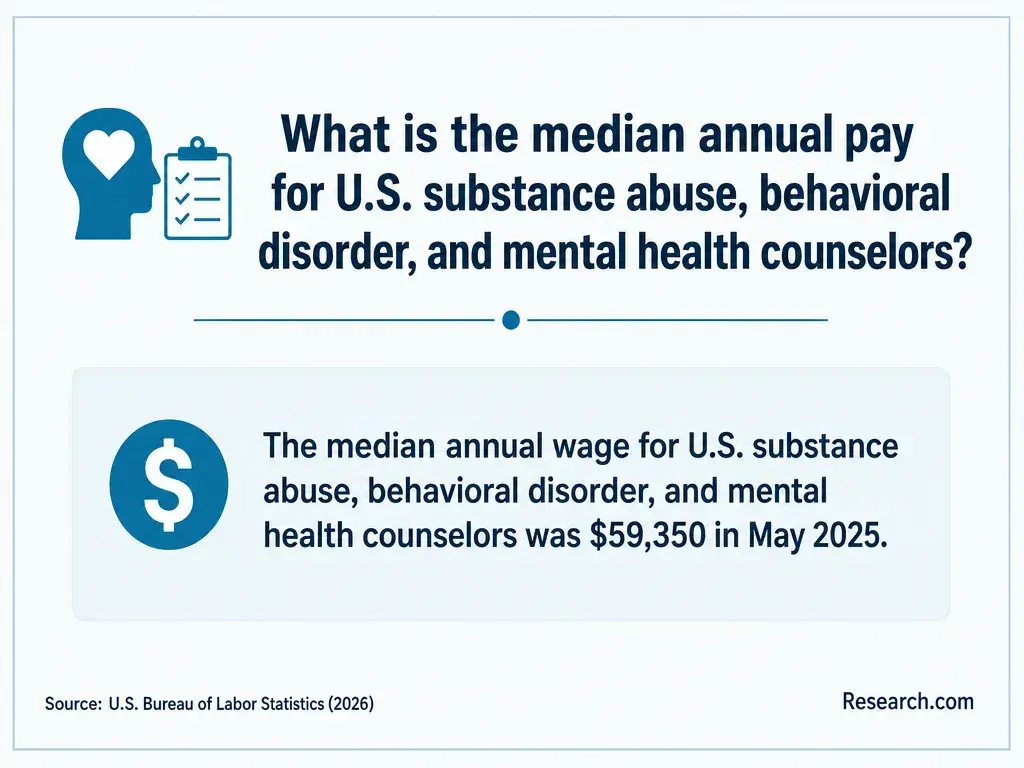
Occupational figures describe jobs, not earnings promised to graduates of this BA. The US Bureau of Labor Statistics reports a May 2024 median annual wage of $59,190 for substance abuse, behavioral disorder, and mental health counselors and projects 17% employment growth for that combined occupation from 2024 to 2034. Those figures indicate demand in a broad counseling category, but its typical entry education and state licensing requirements mean the median is not a realistic estimate for a newly qualified psychology BA holder.
For a trainer considering the switch, compare local postings for the precise education or support role you want with your current compensation and benefits. Record the required credential, experience, and pay range for each posting before estimating whether a degree pays off. Adjacent specialties also have different qualification structures; online forensic psychology degree costs versus career outcomes should not be used as a proxy for addiction-service wages.
Other Things You Should Know About Psychology
Yes. Seek a bounded volunteer, prevention-education, or training partnership with an addiction-service organization. Agree on your duties and supervision first; observe whether you enjoy the service setting as well as the teaching.
Possibly, if the instructor approves its scope and your employer permits the work. Do not use employee disclosures, identifiable records, or internal data without the necessary permissions and privacy review.
That is your choice unless a specific role or credential has a lawful disclosure requirement. You can instead describe relevant skills and experience; personal recovery does not replace required training or supervision.
Often, yes, when the task is approved education rather than individualized assessment or treatment. Use evidence-based materials, protect employee privacy, and refer requests for personal help to qualified services under your employer's procedures.
- Behavioral Health Career Descriptions | samhsa.gov https://www.samhsa.gov/about/careers/behavioral-health-workforce/careers-by-state/descriptions
- Substance Use Disorder Professional (SUDP) | Washington State Department of Health https://doh.wa.gov/licenses-permits-and-certificates/professions-new-renew-or-update/substance-use-disorder-professional/certification-requirements
- Cost of Attendance (Budget) | 2025-2026 Federal Student Aid Handbook https://fsapartners.ed.gov/knowledge-center/fsa-handbook/2025-2026/vol3/ch2-cost-attendance-budget
- Military Training Evaluation Program (MTEP) | dantes.mil https://www.dantes.mil/credit4training/
- Counselor Certification - DHCS - CA.gov https://www.dhcs.ca.gov/providers-partners/counselor-certification/
- Workplace Supported Recovery | Substance Use https://www.cdc.gov/niosh/substance-use/workplace-supported-recovery/index.html
- Types of Financial Aid: Grants, Work-Study, and Loans | studentaid.gov https://studentaid.gov/understand-aid/types
- Psychology careers guide | apa.org https://www.apa.org/education-career/guide/careers
- Can Work Experience Count Toward a College Degree? | Whitworth Online https://online.whitworth.edu/news-articles/can-work-experience-count-toward-a-college-degree/
- B.S. Human Services/Substance Abuse and Addiction | Columbia Southern University https://www.columbiasouthern.edu/online-degree/view-all-programs/bachelors/bs-human-services-substance-abuse-and-addiction