2027 Online AGPCNP Programs for Nurses in New Hampshire: MSN Options and Primary Care Clinicals
Audited and Verified:
Our Editorial and Data Verification Process
Research.com uses government datasets, official education statistics and primary institutional information to support its career and degree guides. Our review process checks factual accuracy, occupational definitions, source dates and the requirements associated with the credentials discussed.
How This Article Was Fact-Checked
Our editorial team verifies salary estimates, employment projections, education requirements and program information against original data providers and official organizations. Salary figures are checked against the relevant occupational definitions and reporting periods. Information about licensure, accreditation and required in-person training is reviewed separately.
Fact-checked and verified on:

Co-Founder and Chief Data Scientist
An online adult-gerontology primary care nurse practitioner MSN can let a New Hampshire RN complete much of the academic work remotely, but the clinical training must happen with patients at approved sites. The harder decision is finding a program that enrolls New Hampshire residents, supports local placements, and prepares graduates for the right certification and state license.
This guide explains how to evaluate those requirements, compare MSN options and costs, and identify what to confirm before applying.
Key Things You Should Know
- An AGPCNP MSN is a postlicensure advanced practice track for primary care across adulthood and older age; online coursework does not replace supervised, in-person clinical care.
- Confirm three separate matters before enrolling: authorization to study from New Hampshire, an approved clinical-placement plan, and eligibility for an adult-gerontology primary care certification exam.
- ANCC and AANPCB offer distinct national AGPCNP certification pathways; the degree alone does not confer certification or a New Hampshire APRN license.
What are online AGPCNP programs in New Hampshire?
An online AGPCNP program prepares an already-licensed RN to assess, diagnose, treat, and coordinate ongoing care for adult and older-adult patients within an NP's authorized scope. The MSN specialty combines graduate nursing courses with supervised primary care practice. "Online" generally describes the coursework, not the clinical component; programs may also require live classes, skills assessments, or campus visits.
The distinction from other NP tracks matters. Family nurse practitioner preparation spans the family across the lifespan, while adult-gerontology acute care preparation centers on patients with acute, complex, or critical illness. An AGPCNP track is the closer match for an RN seeking a primary care role focused on adults and older adults.
This is not an initial nursing-license program. An ADN-prepared RN who needs a bachelor's degree before applying can first investigate BSN completion options for experienced RNs, while checking whether a prospective AGPCNP school accepts another route.
Which New Hampshire schools offer online AGPCNP MSN programs?
Do not assume that a New Hampshire school offering an online MSN or another NP specialty offers an online AGPCNP MSN. A current, institution-verified list of New Hampshire-based programs with this exact degree, population focus, and delivery format is not established here. Naming a school as a confirmed option without its current track catalog and New Hampshire enrollment terms would be misleading.
A New Hampshire resident can also consider an out-of-state online program, provided the school accepts students in New Hampshire and can approve clinical education there. When contacting a school, request the catalog page naming the adult-gerontology primary care nurse practitioner MSN track, the entry-term requirements, a list of any required visits, and written confirmation of New Hampshire enrollment and placement eligibility. A school's general online-program availability is not enough.
Compare only programs leading to the intended credential. A broader list of affordable graduate study after a nursing bachelor's may help identify schools to investigate, but each listed MSN still needs a separately confirmed AGPCNP track.
What are the admission requirements for online AGPCNP programs?
Applicants generally need an active RN license, an eligible nursing degree, transcripts, and evidence that they can undertake graduate study. Schools may also request a résumé, references, a statement of purpose, an interview, or relevant RN experience. Minimum GPA, work-experience rules, and prerequisites differ; admission to a university is not necessarily admission to its AGPCNP track.
For a New Hampshire RN, the first eligibility check is the school's required entry credential. A BSN-to-MSN track may not accept an ADN alone, and an RN with a non-nursing bachelor's degree needs an individual transcript review. Bridge programs from an ADN to an MSN can provide another route, but the bridge must actually lead to AGPCNP preparation rather than a general or non-APRN MSN.
Before paying an application fee, ask whether your RN license, degrees, prior courses, and practice experience meet the specific track's rules. If you already hold an MSN or another APRN credential, request a formal review of prior coursework and clinical documentation; experience in another population focus does not automatically replace AGPCNP training.
Students complete supervised, direct patient care at sites the program approves, such as adult primary care practices or other settings that meet its population-focus objectives. Faculty remain responsible for educational oversight and evaluation even when a local clinician serves as the preceptor. The required hours, acceptable settings, preceptor qualifications, and mix of patient encounters depend on the program and applicable certification standards.
Placement responsibility is the decisive online-program question. Some schools identify and arrange sites; others help evaluate leads proposed by students. Neither "placement assistance" nor an RN's existing job guarantees an approved AGPCNP rotation. A site must agree to participate, the preceptor must meet program rules, and required agreements and approvals must be completed before hours begin.
Ask the clinical coordinator how far in advance New Hampshire sites must be secured, whether the school has existing local agreements, who contacts prospective preceptors, and what happens if a site falls through. For a comparison of what stronger placement support can look like in a different population focus, see preceptor-provided FNP program comparisons; verify an AGPCNP school's own policy rather than transferring an FNP claim to it.
Check institutional accreditation and nursing-program accreditation separately. ACEN and CCNE are nursing accreditors, but an accreditation statement must be checked for the actual institution and nursing degree; it does not, by itself, verify that an AGPCNP track is offered or that a New Hampshire student may enroll.
Also ask the program to identify the certification exams its graduates are prepared to pursue and to confirm its current authority to enroll New Hampshire residents and arrange their clinical education. The school, certifying organization, and New Hampshire Board of Nursing answer different eligibility questions. A favorable answer from one does not substitute for the others.
Apply the same checks to lower-cost online NP degree options: an attractive tuition figure is useful only if the named track, accreditation, state eligibility, and clinical arrangements fit your goal.
Expect graduate work in advanced health assessment, pathophysiology, and pharmacology, followed by courses and supervised practice addressing adult-gerontology primary care. Specialty study commonly covers health promotion, chronic-condition management, diagnostic reasoning, prescribing principles, and care coordination. Programs also include graduate nursing content such as evidence appraisal and quality improvement, but course names and sequencing vary.
Read the curriculum alongside its clinical objectives. An adult-gerontology primary care track should offer a clear progression from classroom knowledge to faculty-evaluated care with adult and older-adult patients; a transcript full of general MSN courses does not establish specialty preparation. Simulation can support learning, but it should not be assumed to replace required direct patient care.
If your goal is psychiatric-mental health practice rather than longitudinal adult primary care, that calls for a different population-focus track. Comparing shorter psychiatric-mental health nursing master's pathways is more useful than choosing AGPCNP coursework because it appears broadly applicable.
Completion time depends on admitted credits, full- or part-time enrollment, course sequencing, and when approved clinical sites are available. Published timelines often assume uninterrupted progression; they may not account for a delayed preceptor agreement, an unavailable course, or a student reducing work hours to complete weekday clinical sessions.
Request a term-by-term plan showing when clinical courses start and whether placements can be completed near home. If you are already an appropriately prepared graduate nurse, ask whether a post-graduate AGPCNP certificate is available and obtain a formal gap analysis before assuming it will be shorter. An accelerated postgraduate family NP certificate illustrates a different specialty route, not a substitute for an AGPCNP certificate.
There is no reliable single price for "online AGPCNP in New Hampshire." First confirm an actual program and its New Hampshire enrollment terms, then multiply the tuition rate by the credits you must take and add mandatory charges. An out-of-state school may use a flat online rate or a residency-based rate; neither should be assumed.
Build a comparison from each school's written estimate. The costs most likely to change the apparent price advantage are:
- Required credits, tuition rate, university and course fees, and charges for any additional terms.
- Books, technology, screening, immunizations, clinical documentation, and required travel or campus visits.
- Certification and licensing expenses, plus any wages lost while completing supervised clinical hours.
Ask how employer tuition assistance applies to part-time graduate study and whether reducing work shifts would outweigh a lower tuition rate. A shorter degree is not automatically cheaper if it requires costly travel or an impractical clinical schedule. When comparing an MSN with later doctoral study, shorter routes to a DNP degree may inform a separate long-term cost plan; a DNP is not necessary solely because the immediate goal is AGPCNP preparation.
Graduation, national certification, and state authorization are distinct steps. AGPCNP graduates can investigate the adult-gerontology primary care certification offered by the American Nurses Credentialing Center (ANCC) and the adult-gerontology primary care certification offered by the American Academy of Nurse Practitioners Certification Board (AANPCB). Each organization determines eligibility for its own examination; confirm that your specific program meets the chosen pathway's current requirements.
To practice as an APRN in New Hampshire, follow the New Hampshire Board of Nursing's current application and licensing requirements, including its rules for RN license status, graduate preparation, national certification, and any other required documentation. Do not begin APRN practice merely because an MSN has been awarded or an exam has been passed. Confirm the rules again near graduation, especially if you intend to practice or provide telehealth in another state.
Certification must also match the role. Comparing faster PMHNP certificate pathways is relevant to a nurse seeking psychiatric-mental health NP preparation, but such a certificate does not replace AGPCNP education or certification for adult-gerontology primary care.
What careers, salaries, and job outlook do AGPCNP graduates have?
Licensed, appropriately certified AGPCNPs may work in adult primary care, geriatrics, and other outpatient or community-based services consistent with their preparation and state scope. The role emphasizes assessment, diagnosis, treatment planning, prevention, and follow-up for adults and older adults. Employers may additionally assess prescribing readiness, documentation skills, patient mix, and the support available to a newly practicing NP.
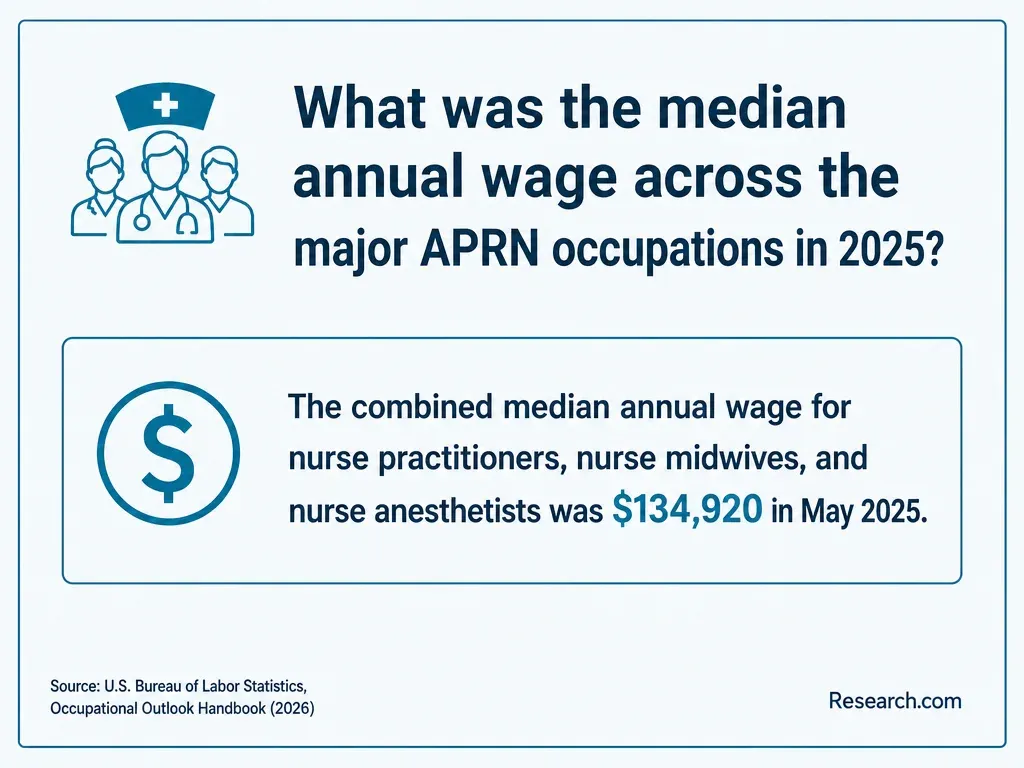
The U.S. Bureau of Labor Statistics reports wages and employment projections for the broader nurse practitioner occupation, not a separate AGPCNP graduate salary or New Hampshire MSN return on investment. Use the latest published NP figures as labor-market context, then compare actual local offers by setting, experience requirements, schedule, benefits, and expected patient load. An occupation-wide median is not a starting salary or a guarantee of employment.
For an experienced AGPCNP, later doctoral study may serve a distinct practice, leadership, or educational goal; it is not a prerequisite to every primary care job. If that becomes relevant, doctoral nursing application requirements compared can help frame the next decision. For now, the strongest choice is a program whose clinical preparation, cost, and credential pathway fit the role you actually want.
Other Things You Should Know About Nursing
AGPCNP preparation focuses on the adult-gerontology population, not comprehensive pediatric care. Check the certifier's population definition and your state's scope rules rather than assuming an AGPCNP credential covers every age group.
Possibly, if it offers appropriate primary care experiences and the school approves the site, preceptor, supervision, and arrangements. RN employment hours do not automatically become graduate clinical hours.
An FNP's education and authorization may already support some adult primary care roles. If you specifically need AGPCNP certification, ask an AGPCNP program and the certifier to review your prior preparation; do not assume a new credential is necessary or automatic.
No. Online education does not grant interstate practice authority. Check the licensing and practice rules applicable to both the clinician and the patient's location before providing care across state lines.
- The Availability of Supervision in Routine Mental Health Care | nih.gov https://pmc.ncbi.nlm.nih.gov/articles/PMC6426317/
- Board of Nursing Forms and Other Documents | NH Office of Professional Licensure and Certification https://www.oplc.nh.gov/board-nursing-forms-and-other-documents
- MSN in AGPCNP | Online Master's Degree | Capella University https://www.capella.edu/online-nursing-degrees/msn-nursing-program/masters-msn-agpcnp/
- Adult Gerontology Primary Care Nurse Practitioner | Nell Hodgson Woodruff School of Nursing https://www.nursing.emory.edu/degrees-programs/nursing/adult-gerontology-primary-care-nurse-practitioner
- Nursing: Direct Entry, M.S. - CHHS, UNH https://www.unh.edu/program/master-science/nursing-direct-entry
- The Complete Guide to Nurse Practitioner Clinicals | Wilkes University Online https://onlinenursingdegrees.wilkes.edu/blog/nurse-practitioner-clinicals-guide
- Inside Penn Nursing's adult-gerontology programs | upenn.edu https://penntoday.upenn.edu/news/inside-penn-nursings-adult-gerontology-programs
- Adult-Gerontology Overview - Rutgers School of Nursing https://nursing.rutgers.edu/adult-gerontology/
- Adult Gerontological Primary Care Nurse Practitioner (AGNP) | Florida Atlantic University https://www.fau.edu/nursing/areas-of-study/agnp/
- Nursing Field Experience: Find a Preceptor and Site | Academics at Walden University https://academicguides.waldenu.edu/nursing-field/find-preceptor