2027 Online AGACNP Programs for Nurses in Iowa: MSN Options and Acute Care Clinicals
Audited and Verified:
Our Editorial and Data Verification Process
Research.com uses government datasets, official education statistics and primary institutional information to support its career and degree guides. Our review process checks factual accuracy, occupational definitions, source dates and the requirements associated with the credentials discussed.
How This Article Was Fact-Checked
Our editorial team verifies salary estimates, employment projections, education requirements and program information against original data providers and official organizations. Salary figures are checked against the relevant occupational definitions and reporting periods. Information about licensure, accreditation and required in-person training is reviewed separately.
Fact-checked and verified on:

Co-Founder and Chief Data Scientist
An Iowa RN can complete much of an adult-gerontology acute care nurse practitioner MSN online, but the degree still requires supervised patient care in approved clinical settings. That distinction matters when comparing programs: a convenient course schedule does not guarantee a workable Iowa placement or eligibility for the NP role you want.
This guide explains who qualifies, how acute care clinicals work, what to verify before enrolling, and how education connects to certification and Iowa licensure. Use it to identify a program you can complete without mistaking "online" for entirely remote.
Key Things You Should Know
- Online AGACNP MSN study combines remote coursework with required, supervised in-person clinical education; confirm that a school can approve your Iowa sites and preceptors before enrolling.
- The usual entry point is an active RN license and qualifying prior nursing education. Adult-gerontology acute care preparation is distinct from family or psychiatric NP preparation.
- Graduation is only one step: graduates must meet a national AGACNP certifier's requirements and obtain Iowa APRN authorization before practicing in that role.
What are online AGACNP programs for nurses in Iowa?
An online adult-gerontology acute care nurse practitioner (AGACNP) program prepares licensed nurses to assess, diagnose, and manage adults and older adults with complex acute, critical, or unstable health conditions. An MSN AGACNP track is graduate-level, advanced practice education - not initial RN preparation. "Online" usually describes lectures, assignments, and some faculty interaction, not the supervised clinical care required for the specialty.
Iowa residents may consider an Iowa-based school or an out-of-state program that accepts Iowa students and supports clinical education in Iowa. Verify the exact MSN track and population focus; a general MSN, nursing leadership degree, or adult-gerontology primary care NP track does not provide the same preparation. If the goal is completing a bachelor's degree rather than becoming an acute care NP, RN-to-BSN pathways without standard hospital rotations address a different educational need.
Which Iowa nurses qualify for online AGACNP MSN programs?
The most direct applicant is an RN with a BSN who meets the school's academic and clinical-experience requirements. Acute care RN experience can strengthen preparation and may be required by a particular school, but it does not replace graduate-level AGACNP coursework or approved NP clinical hours.
Prior education changes which application route is realistic. The table distinguishes possible routes without implying that every school offers them.
| Current background | Potential route | Critical check |
| RN with a BSN | BSN-to-MSN AGACNP track | Required RN experience and Iowa clinical eligibility |
| RN with an ADN or diploma | RN-to-MSN bridge with an AGACNP track, if offered | Whether the bridge actually leads to AGACNP preparation |
| RN with a non-APRN MSN | AGACNP post-graduate certificate or another qualifying track | Faculty review of prior courses and required specialty clinical work |
| NP certified in another population focus | AGACNP post-graduate certificate | Formal gap analysis and new adult-gerontology acute care competencies |
An ADN-prepared RN should compare a verified AGACNP bridge with other routes to master's nursing study after an ADN. An existing FNP or PMHNP credential is not a substitute for AGACNP education; the receiving school determines what prior graduate work, if any, applies.
How do Iowa online AGACNP programs meet clinical requirements?
Students complete faculty-supervised, direct patient care in settings and encounters that meet the school's adult-gerontology acute care objectives. Depending on program approval and patient exposure, sites may include hospital services, specialty inpatient teams, critical care, emergency care, or other acute care settings. The school and its faculty - not the student's employer alone - determine whether a proposed site, preceptor, schedule, and documented hours qualify.
Placement policies can make two otherwise similar online programs very different for an Iowa nurse. Before paying a deposit, get written answers to these questions:
- Does the school secure Iowa placements, help students find them, or require students to arrange their own?
- Which Iowa sites and preceptor credentials are acceptable, and when must agreements and approvals be completed?
- How many clinical hours, in-person intensives, and scheduled live sessions apply to your entry cohort?
- Can rotations occur at your employer, and what safeguards separate student clinical work from paid RN duties?
- What happens if an approved Iowa placement is unavailable when the clinical sequence begins?
An RN shift is not automatically an NP clinical rotation, and simulation is not automatically interchangeable with direct patient care. Nurses comparing placement support across NP specialties may find it useful to examine planning family NP study around clinical placement policies, while confirming that any prospective AGACNP school supports the acute care sites they need.
Check institutional accreditation and the nursing program's accreditation separately. Common nursing program accreditors include the Commission on Collegiate Nursing Education (CCNE) and the Accreditation Commission for Education in Nursing (ACEN). Confirm that the published accreditation covers the relevant degree program, rather than assuming that an accredited university has every nursing track covered.
Accreditation is not the same as permission to enroll an Iowa student, approve Iowa clinical placements, or qualify a graduate for a particular certification exam. Ask the school to confirm those points for its specific AGACNP MSN track and your intended entry term, then check the applicable certifier's and Iowa Board of Nursing's requirements.
Many DNP program options beyond new clinical licensure may be appropriate for a leadership goal, but its accreditation does not turn it into acute care NP preparation.
Curricula typically build on advanced physiology and pathophysiology, pharmacology, and health assessment, then apply those foundations to complex adult and older-adult care. Acute care coursework may address diagnostic reasoning, management of rapidly changing conditions, evidence-based treatment, transitions of care, and interprofessional communication. Skills labs or simulation may supplement supervised clinical rotations; course titles and sequence vary by school.
Read the course and clinical descriptions for population-focus alignment, not just a list of familiar graduate nursing subjects. A nurse primarily interested in mental health treatment, for example, should compare psychiatric NP preparation - including PMHNP programs compared by tuition - rather than choose AGACNP because both programs contain advanced assessment and pharmacology.
Schools commonly review an active RN license, qualifying nursing degree and transcripts, academic performance, professional recommendations, a statement of goals, and relevant RN practice. Some specify acute care or critical care experience; others assess experience more broadly. Schools may also require an interview, résumé, background screening, immunization documentation, or proof that the applicant can meet clinical-site requirements.
Admission to the university does not necessarily mean admission to the AGACNP track or clearance to begin clinicals. If you hold graduate nursing credits, request a written review of course syllabi and documented clinical experiences before assuming they shorten the MSN. The same caution applies when comparing DNP programs with accessible admission requirements: a less restrictive application process says nothing by itself about AGACNP specialty eligibility or clinical capacity.
Time to completion depends on entry credential, transfer decisions, course sequencing, enrollment pace, and the availability of approved clinical placements. Ask for a term-by-term plan for your intended pace; the shortest advertised timeline may assume full-time enrollment and clinical availability that do not fit an Iowa RN's work schedule.
Compare written, cohort-specific estimates rather than a tuition-per-credit figure alone. Total expense can include tuition and mandatory fees, books and technology, background checks and health requirements, travel to clinical sites or campus intensives, certification and licensing fees, and earnings lost when clinical hours conflict with paid shifts.
For a BSN-prepared applicant, budget planning for BSN-to-MSN study offers a broader cost-comparison framework; use the AGACNP school's own fee schedule and clinical calendar for the final calculation.
Employer tuition assistance may reduce out-of-pocket spending, but check reimbursement caps, grade requirements, and any commitment to remain employed. A program with a lower tuition quote can cost more overall if distant placements require travel or a delayed rotation adds another term.
Completing an AGACNP MSN does not itself authorize NP practice. Graduates generally must meet a national certifier's eligibility rules, pass the applicable adult-gerontology acute care NP certification examination, and obtain Iowa APRN licensure or recognition under Iowa Board of Nursing requirements before practicing as an AGACNP in the state.
The American Nurses Credentialing Center offers the AGACNP-BC credential; AACN Certification Corporation offers ACNPC-AG. Check each organization's current eligibility criteria and confirm that the program prepares graduates for the exam they plan to take.
Keep degree and specialty-track documentation, clinical records, certification results, and RN license information available for the application process. The board makes the licensing decision, while employers separately verify privileges and role-specific competence. The shortest online nursing practice doctorates are not a shortcut around AGACNP population-focus education, certification, or Iowa authorization.
AGACNPs may pursue roles with hospital-based services, critical care teams, specialty practices, and other employers caring for adults with complex acute conditions. Actual duties depend on Iowa law, employer policies, privileges, and demonstrated competence. Completing the degree does not guarantee a position in an ICU or authorize every procedure used there; employers may expect substantial specialty experience and provide additional onboarding.
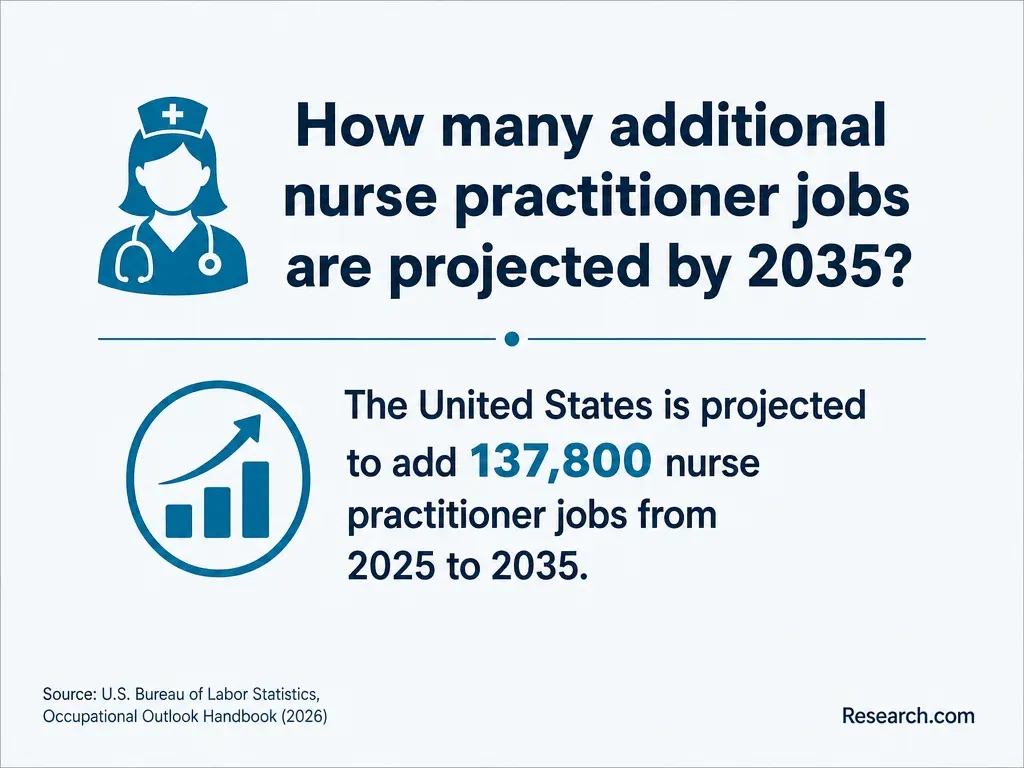
The U.S. Bureau of Labor Statistics reports wages and employment projections for the broader nurse practitioner occupation, not separate Iowa AGACNP graduate salaries. Use those occupation-wide figures for market context, not as a predicted offer.
To evaluate an Iowa position, compare the employer's stated base pay and differentials alongside call requirements, patient acuity, orientation, benefits, and expected schedule. Nurses drawn primarily to psychiatric care should compare that role's preparation and hiring market instead; comparing accelerated psychiatric nursing master's programs addresses a different NP career target.
How can nurses choose a reputable online AGACNP program?
Start with the intended job: adult-gerontology acute care NP practice in Iowa. Then ask each school for the same cohort-specific information so that a flexible-looking program is not compared with another program on tuition or marketing claims alone.
- Confirm the exact MSN AGACNP award, nursing accreditation scope, Iowa enrollment eligibility, and the certification exams for which graduates are prepared.
- Obtain the clinical handbook or written policies covering placement responsibility, Iowa site approval, preceptors, required patient experiences, campus visits, and delays.
- Request a term-by-term schedule and complete cost estimate, including fees and any required travel.
- Ask for recent AGACNP-specific completion and certification results, including reporting years and cohort sizes; do not treat university-wide outcomes as specialty-track results.
- Speak with program staff about your RN background and intended Iowa practice setting, and retain written answers to questions that affect enrollment.
Speed can be useful only when the clinical sequence and your schedule are workable. Even 12-month FNP program options serve a different population focus; an attractive timeline in another specialty is not a reason to compromise the AGACNP preparation your target role requires.
Other Things You Should Know About Nursing
Adult-gerontology preparation is not pediatric NP preparation. Check the applicable population-focus boundaries, Iowa rules, and employer privileges rather than assuming an acute care setting permits care for every age group.
No. An RN multistate privilege does not itself grant APRN authority. Before practicing across state lines, check the other state's APRN requirements and the location-based rules that apply to the care provided.
Do not assume a doctorate is required solely because some schools offer DNP tracks. Verify Iowa's current APRN requirements and the certification eligibility of the specific MSN program before choosing a degree level.
Yes. National certification and Iowa APRN authorization have ongoing maintenance requirements that are separate from initial graduation. Check your certifier's renewal rules and the Iowa Board of Nursing's current renewal instructions.
- Apply for an ARNP license | iowa.gov https://dial.iowa.gov/licenses/health-professions/nursing-professional-midwifery/nursing-licensure/how-do-i-apply-arnp-license
- ARC 5286C - Iowa Administrative Rules https://rules.iowa.gov/Notice/Details/5286C
- Adult-Gerontology Acute Care Nurse Practitioner | Morningside University https://www.morningside.edu/academics/graduate/adult-gerontology-acute-care-nurse-practitioner
- Tuition and Estimated Costs | Admissions | The University of Iowa https://admissions.uiowa.edu/finances/estimated-costs-attendance
- Doctor of Nursing Practice (DNP) - Adult/Gerontology Nurse Practitioner (Acute Care) | The University of Iowa https://nursing.uiowa.edu/academics/dnp-programs/adult-gero-nurse-practitioner-acute-care
- Online MSN AGACNP at The University of Texas Arlington https://academicpartnerships.uta.edu/healthcare-nursing-online-programs/msn-adult-gerontology/acnp/
- Adult-Gerontology Acute Care Nurse Practitioner - AGACNP | Ohio University https://www.ohio.edu/chsp/nursing/graduate/masters/adult-gerontology-acute-care-nurse-practitioner
- Adult-Gerontology Acute Care Nurse Practitioner Certificate (AGAC-NP) | Purdue Global https://www.purdueglobal.edu/degree-programs/nursing/acute-care-nurse-practitioner-certificate/
- MSN Adult-Gerontology Acute Care Nurse Practitioner Online Program | Chamberlain University https://www.chamberlain.edu/nursing-programs/master-of-science-in-nursing/adult-gerontology-acute-care-nurse-practitioner-online-program
- University of Iowa Tuition & Fees | uiowa.edu https://tuition.ais.its.uiowa.edu/