
2027 Most Affordable Associate Degrees for Students Paying Out of Pocket

Co-Founder and Chief Data Scientist
When you are paying for college yourself, the cheapest tuition rate is not necessarily the cheapest path to a degree. The College Board reported average published tuition and fees of $4,050 for in-district students at public two-year colleges in 2024-25, but books, transportation, program fees, and extra semesters can change the final bill. This guide compares associate degree fields by likely cost pressures and career purpose, then shows you how to calculate your own total cost before enrolling.
Key Things You Should Know
- Start with an in-district public community college, then compare the cost of completing each major - not just its per-credit tuition.
- Business, information technology, criminal justice, and transfer-focused psychology often have fewer required clinical expenses; healthcare and nursing may cost more because of labs, placements, and equipment.
- An AA or AS may be economical for a planned transfer, while an AAS may better suit direct employment; neither choice is a bargain if its credits or credentials do not meet your goal.
Top 10 Most Affordable Associate Degrees for Students Paying Out of Pocket
Business Programs
Business administration and accounting associate degrees can be relatively inexpensive because they usually avoid clinical placements and specialized equipment. An AA or AS may suit students planning to transfer; an AAS may emphasize bookkeeping, office operations, or entry-level business work.
Compare required software, course availability, and transfer agreements before choosing the lowest-priced option. A general business degree alone is unlikely to qualify you for a management position, which typically requires experience and sometimes further education.
Healthcare Programs
Healthcare administration and medical information programs may have lower required expenses than hands-on allied-health degrees. Radiography, dental hygiene, and similar clinical programs can add lab fees, screenings, supplies, and travel to placements; selective admission may also extend the time you pay to attend.
A cheaper nonclinical degree is not a substitute for training in a licensed clinical occupation. Confirm both the program's full cost and its eligibility for your intended credential.
Information Technology Programs
Information technology, networking, and cybersecurity associate degrees may avoid clinical costs, but required hardware, software, certification exams, and lab access can affect the budget. An AAS often targets technical employment, while an AS may offer a clearer transfer route; verify the actual curriculum and agreements.
Compare the degree with a shorter certificate if you need a specific skill quickly. Entry-level hiring depends on demonstrated skills and employer requirements, not the degree title alone.
Nursing / Pre-Nursing Programs
Pre-nursing is typically preparation for applying to a nursing program, not a nursing credential. An associate degree in nursing can offer a direct route toward registered-nurse licensure, but admission is often selective and clinical placements, supplies, and testing add costs.
Ask whether prerequisite courses are included in the advertised price and how long students typically wait to enter nursing coursework. Graduation alone does not grant a license; state eligibility requirements and the NCLEX-RN still apply.
Criminal Justice Programs
Criminal justice associate degrees often have modest equipment costs, making local public-college options worth comparing. An AA or AS may support transfer; an AAS may focus more on workforce preparation.
Neither degree automatically qualifies a graduate to become a police officer: agencies set their own hiring, fitness, background, and academy requirements. Before paying for the program, check whether target employers value the degree and whether its credits apply to any bachelor's degree you may later want.
Psychology / Counseling Programs
A transfer-focused psychology AA or AS can be an affordable start toward a bachelor's degree, especially under a documented articulation agreement. Compare it with social-services programs if your immediate goal is support work.
An associate degree does not qualify someone to practice independently as a psychologist or licensed counselor; those paths require substantially more education and state-specific requirements. Budget for the full educational pathway, rather than treating the associate degree's price as the total cost of entry.
What Are the Most Affordable Associate Degrees for Out-of-Pocket Students?
The most affordable associate degree is the one with the lowest realistic cost to complete for your specific goal. For many out-of-pocket students, that means an in-district public community college program with available required courses, manageable extra fees, and a clear employment or transfer outcome.
Business, criminal justice, psychology, and some IT programs may have fewer mandatory hands-on expenses than clinical fields, but no field is universally cheapest.
The comparison below identifies where costs commonly arise. It is a guide to what to price - not a ranking of every college or a claim that all programs in one field cost the same.
| Associate degree field | Common additional costs | Best fit when |
| Business | Books or software | You want a flexible transfer foundation or entry-level office skills |
| Information technology | Computer, software, or certification exams | You want technical coursework and can verify the skills employers seek |
| Criminal justice | Books and possible travel for experiential work | You have checked employer requirements or a transfer agreement |
| Psychology | Costs of later education if pursuing a licensed profession | You intend to transfer and have priced the longer pathway |
| Clinical healthcare or nursing | Labs, equipment, screenings, exams, and placement travel | The program leads toward your intended credential and its full cost is manageable |
If you will transfer, compare how credits apply to the intended bachelor's major. If you want to work soon after graduation, compare career-focused AAS programs with certificates and apprenticeships, which may cost less or reach a specific entry-level goal sooner.
How Much Do Affordable Associate Degree Programs Cost?
Published tuition is only the starting price. The College Board's 2024-25 average of $4,050 in published tuition and fees for in-district public two-year students provides a national benchmark, not a quote for your degree. Residency, enrollment pace, and required courses can make your actual bill substantially different.
Use the same cost categories for every program you compare. Request a written estimate covering the courses you still need, mandatory college and program fees, books and equipment, transportation, and any required in-person placement. A
sk how tuition changes if you study part time, attend in summer, or do not qualify for in-district rates. For online study, include technology fees and any travel requirements.
Distinguish sticker price (published charges), net price (cost after grants and scholarships), and total completion cost (what you expect to pay through graduation). Federal aid eligibility depends on the institution, program, and your circumstances; submit the FAFSA and check state grants and employer assistance even if you expect to pay out of pocket.
If application charges matter to your budget, best online colleges with no application fee can provide another comparison point - but a waived application fee does not establish that the degree itself is inexpensive.
Which Associate Degrees Offer the Best Career and Salary Potential?
The strongest career value comes from matching the credential to a job you can realistically pursue. Clinical degrees may justify higher program costs when they lead to eligibility for a specific occupation, while lower-cost transfer degrees can make sense if you need a bachelor's degree for your eventual goal.
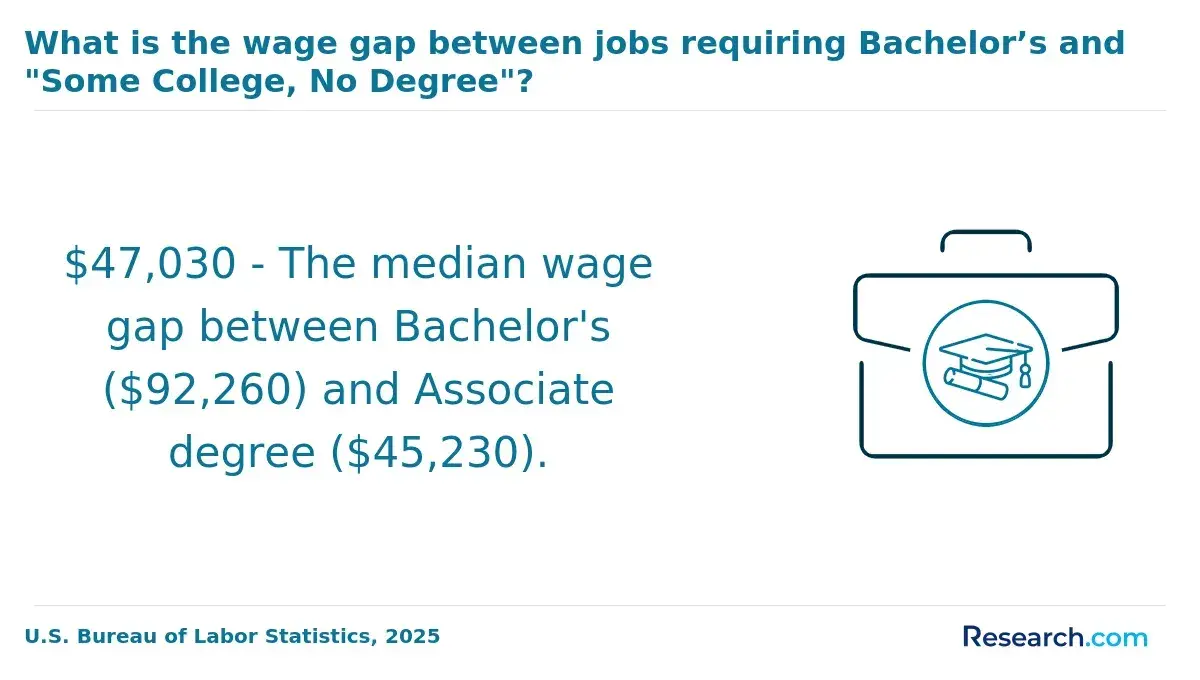
For context, the U.S. Bureau of Labor Statistics reported a May 2024 median annual wage of $93,600 for registered nurses. That is an occupational wage across working nurses - not the expected earnings of a new associate degree graduate - and becoming an RN requires meeting state licensing requirements.
Nursing applicants should weigh that potential pathway against selective admission, clinical scheduling, and the full cost of qualifying.
Business, IT, and criminal justice graduates may enter a range of roles with widely varying pay and hiring requirements, so a single salary figure would be misleading. Check local job postings for required skills and credentials.
If your target role calls for further study, compare the eventual cost and opportunities associated with bachelor's degrees job outlook rather than judging the associate degree in isolation.
How Long Does It Take to Earn an Affordable Associate Degree?
Many associate degrees require roughly 60 semester credits and can take about two years of full-time study, but your schedule may differ. Part-time attendance, unavailable required courses, developmental coursework, and prerequisites can extend completion. Nursing and other clinical programs may also have separate application cycles or fixed placement schedules.
Ask an advisor for a term-by-term plan based on your completed credits and intended enrollment pace. A program with a lower tuition rate can cost more overall if its course sequence adds another term of fees, transportation, or lost work time.
Conversely, accepted transfer credit may reduce your remaining courses, provided it satisfies degree requirements rather than counting only as electives. Students considering shorter training can also compare online programs that pay well, while verifying the credential and experience each occupation actually requires.
Are Online Associate Degrees More Affordable Than Campus Programs?
Online is not automatically cheaper. It may reduce commuting or relocation costs, but technology fees, equipment needs, and tuition rules can offset those savings. A nearby campus program may cost less overall for an in-district student, particularly if required labs would otherwise involve travel.
Compare delivery requirements as carefully as prices. Online courses may have scheduled live sessions or fixed deadlines; nursing and clinical healthcare programs generally require in-person practical work.
Confirm where examinations, labs, internships, or clinical placements occur before relying on a program's "online" label. When evaluating accredited online colleges, check the specific associate program's delivery details and total charges, not just the institution's general description.
What Accreditation Should an Affordable Associate Degree Program Have?
Choose an institution accredited by an accreditor recognized by the U.S. Department of Education. Institutional accreditation matters when considering federal aid and credit transfer, but it does not guarantee that another college will apply every course to your chosen major.
For a regulated clinical field, also verify any programmatic accreditation or state approval required for your intended license or certification. Requirements differ by occupation and state.
Ask the program to identify the relevant approval, whether it covers your campus or delivery format, and whether graduates are eligible to seek the credential where you plan to work. An unusually low price is not a saving if the program cannot serve your career goal.
What Are the Admission Requirements for Affordable Associate Degrees?
Public community colleges commonly admit students with a high school diploma or equivalent, then use placement information or prerequisite records to guide course enrollment.
Admission to the college does not necessarily mean admission to a specific major. Nursing and some allied-health programs may have separate applications, prerequisite grades, screenings, and limited seats.
Before applying, request requirements for the exact program - not just the institution. Ask whether previous coursework satisfies prerequisites, whether placement or testing is needed, and when the next major-entry term begins. An extra semester spent meeting requirements belongs in your affordability calculation.
Which Associate Degrees Require Licensure or Professional Certification?
An associate degree and permission to practice are separate things. Nursing generally requires state licensure and passage of the NCLEX-RN. Fields such as radiography and dental hygiene have their own state requirements, which may include approved education, examinations, or both.
Some IT roles value optional industry certifications, while criminal justice employers may require academy training. A psychology or counseling associate degree does not qualify someone for independent professional licensure.
Verify requirements with the appropriate state board or target employer before enrolling. In particular, do not assume an online program based in another state meets the rules where you intend to work.
How Can Students Choose a Reputable Affordable Associate Degree Program?
Compare programs using a written plan rather than a headline tuition rate or a ranking. The steps below help reveal expenses and requirements that can turn an apparently cheap option into a costly detour.
- Define your goal: immediate employment, a specific license or certification, or transfer to a named bachelor's program.
- Request a degree audit and term-by-term course plan showing prerequisites, accepted transfer credits, and any required in-person components.
- Get an itemized estimate through completion, including residency-based tuition, mandatory fees, supplies, travel, and likely financial aid.
- Verify institutional accreditation, any required program approval, and how credits apply at your intended transfer institution.
- Check course availability and ask about outcomes relevant to your goal, such as credential-exam eligibility or documented transfer pathways.
Watch for vague claims that a degree "leads to" a licensed career without explaining the licensing steps, or that credits "transfer" without showing how they count toward your intended major.
If a school cannot provide a clear cost estimate or explain required placements, keep comparing. The right affordable program is one you can finish, pay for, and use.
Other Things You Should Know About
An in-district public community college is often a strong starting point, but compare its full completion cost with other eligible options. Program fees, course availability, aid, and accepted transfer credits can change which choice costs you less.
None is inherently cheaper. An AA or AS may save money on a planned bachelor's pathway if credits apply to the major; an AAS may offer better value for direct workforce preparation. Compare the actual courses and total costs.
Possibly. Submit the FAFSA to check eligibility for federal and sometimes state aid, and ask your college about scholarships, payment plans, and employer tuition assistance. Eligibility varies.
Only if it meets the approval and training requirements for your intended credential. Include prerequisites, clinical travel, supplies, and licensing-related expenses when comparing prices.
References
- Estimate your college cost | USAGov https://www.usa.gov/estimate-college-cost
- Associate's degree - Career Outlook - Bureau of Labor Statistics https://www.bls.gov/careeroutlook/subject/associates_degree.htm
- Qualified Ed expenses | Internal Revenue Service https://www.irs.gov/credits-deductions/individuals/qualified-ed-expenses
- Cost of Attendance (Budget) | 2025-2026 Federal Student Aid Handbook https://fsapartners.ed.gov/knowledge-center/fsa-handbook/2025-2026/vol3/ch2-cost-attendance-budget
- North Star Promise | MN Office of Higher Education https://ohe.mn.gov/northstarpromise
- What are the different ways to pay for college or graduate school? | consumerfinance.gov https://www.consumerfinance.gov/ask-cfpb/what-are-the-different-ways-to-pay-for-college-or-graduate-school-en-545/
- Creating a Debt Free College Program | California Legislative Analyst's Office https://www.lao.ca.gov/publications/report/3540
- Persistent Cost Efficiency at Public Community Colleges in the US: A Stochastic Frontier Analysis - PMC https://pmc.ncbi.nlm.nih.gov/articles/PMC8032850/
- What Financial Aid Offers Don't Tell You About the Cost of College | U.S. GAO https://www.gao.gov/blog/what-financial-aid-offers-dont-tell-you-about-cost-college
- Cost of Attendance - Financial Aid and Scholarships | The University of Utah https://financialaid.utah.edu/tuition-and-fees/cost-of-attendance.php


