
2027 MLIS Programs for Public Records Compliance Careers

Co-Founder and Chief Data Scientist
Public records work calls for more than finding documents: agencies must preserve records, respond to requests, and protect information that cannot lawfully be released. If you are considering an MLIS for this work, the key decision is whether a program teaches those responsibilities in enough depth to justify its cost.
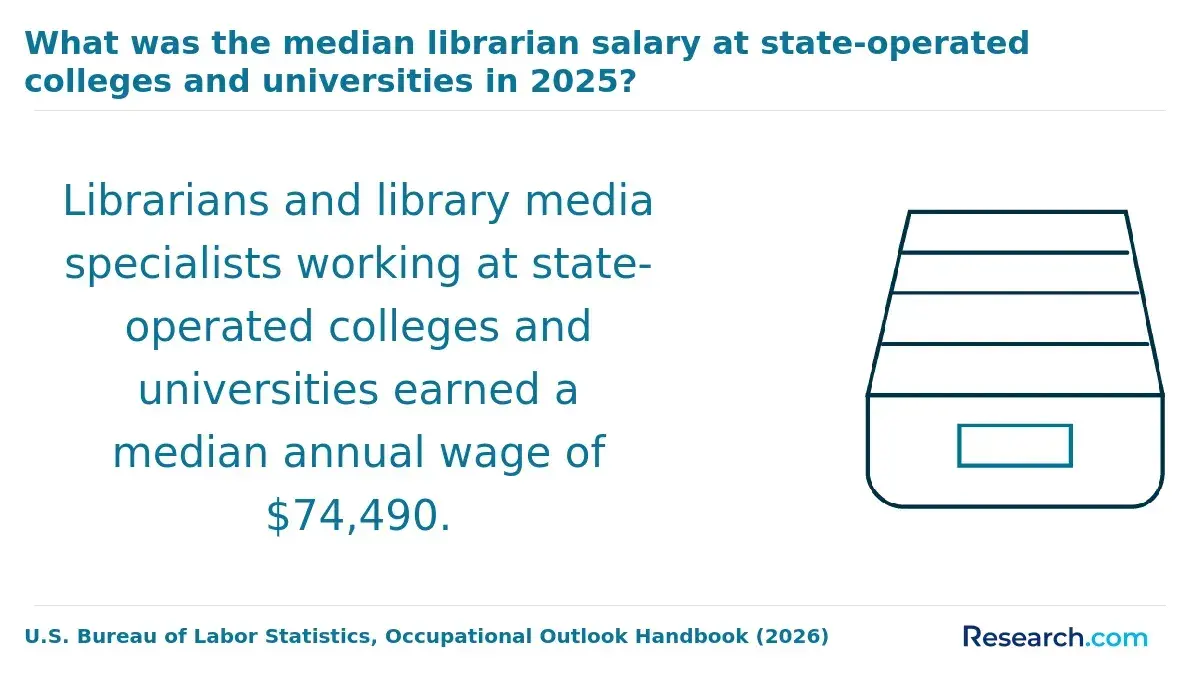
The U.S. Bureau of Labor Statistics reports a May 2025 median annual salary of $68,270 for librarians and media collections specialists, though that category is not a measure of public records jobs specifically. This guide explains which courses, experience, credentials, and program features to compare before enrolling.
Key Things You Should Know
- Look for records management, information law, privacy, and applied agency work - not a concentration name alone. Confirm when relevant electives actually run.
- An MLIS can support public records careers, but many compliance and records roles accept other degrees or substantial experience; check the jobs you want before committing.
- BLS projects 2.6% growth for librarians and media collections specialists from 2025 to 2035, but this broad occupation does not forecast demand for public records specialists.
What are MLIS programs for public records compliance careers?
These are library and information science master's programs whose courses and practical opportunities can prepare students to manage government records and support lawful access to them. Public records compliance work may include identifying responsive records, applying retention schedules, coordinating reviews for legally protected information, documenting decisions, and helping an agency meet request deadlines. The applicable rules depend on whether the employer is federal, state, or local.
An MLIS is one possible route, not a standard degree title for this specialty. Related programs may award an MLS, a Master of Science in Library Science, or another institution-specific information degree. The MLIS degree overview can help you compare those degree paths; for this career, the curriculum and employer requirements matter more than the abbreviation.
Records management is not identical to archives work. Records managers address how records are classified, retained, retrieved, and disposed of during an organization's operations. Archivists generally focus on records selected for enduring value. Public records roles may draw on both, but they also require close attention to access laws, exemptions, privacy, and defensible workflows.
What education is required for public records compliance jobs?
There is no single degree requirement across public records jobs. An agency might seek a bachelor's degree and relevant administrative experience for a records or request-coordination position, while a librarian or archivist opening may prefer or require a related master's degree. Information governance and legal-operations roles may also value backgrounds in law, public administration, information technology, or business.
Read actual postings from the type of agency where you want to work. Separate required qualifications from preferred ones, and note whether the work centers on request processing, retention policy, electronic systems, or archival stewardship. If your target jobs accept experience in place of a master's, a graduate certificate or supervised agency experience may be a lower-cost first step. An MLIS makes a stronger case when it also qualifies you for librarian positions you would genuinely consider.
Which MLIS programs offer public records and records management training?
A named school list would be misleading without confirming each program's current catalog and course schedule. Instead, build a shortlist from programs that document relevant instruction, then ask whether you can complete a coherent records-focused pathway within your enrollment period. A catalog listing establishes that a course exists; it does not establish that it will run when you need it.
Compare library science programs worth applying to against the same evidence for each option. The distinctions below help prevent a general LIS offering from being mistaken for a documented specialty.
| Evidence to check | What it establishes | What to verify next |
| ALA-accredited master's program | The specific program holds professional accreditation | Its current status in the ALA directory; accreditation does not verify a specialty |
| Officially named concentration or track | The school documents a formal pathway | Requirements and whether they cover public records law and records management |
| Relevant electives | Students may be able to study particular skills | Recent and expected offerings, prerequisites, and available seats |
| Practicum or applied project | The program documents an experiential option | Whether an appropriate agency placement is permitted and who arranges it |
Institutional accreditation and ALA program accreditation are different. Neither accreditation, by itself, confirms that a particular course, concentration, or placement is available. Ask an adviser to map your proposed electives across actual terms before treating a program as a fit.
How do online and campus-based MLIS programs compare?
Either format can prepare a student for this work if the relevant courses and applied opportunities are accessible. Online delivery can make continued employment easier, but it does not necessarily mean self-paced classes or a remote practicum. Campus study may offer convenient access to nearby agency placements, but location alone does not guarantee one.
The library degree time commitment depends on more than the format shown on a program page. Before choosing, ask whether required classes meet live, whether records-focused electives are offered online, how frequently they run, and whether an internship can be completed where you live. For a working applicant, a predictable elective schedule may be more valuable than the fastest advertised completion time.
What courses prepare students for public records compliance work?
The most useful curriculum connects legal obligations to the full record lifecycle. Seek courses in records management and retention, information policy or law, privacy, archival appraisal, digital preservation, and metadata. Metadata is structured information that helps identify and retrieve a record; in compliance work, reliable description and documentation can make searches and retention decisions easier to explain.
Applied assignments matter as much as course titles. A useful project might involve drafting a retention schedule for a simulated agency, documenting a search workflow, or assessing how an electronic records system captures context and access restrictions. Request an anonymized syllabus or assignment description when a title is broad: "information organization" may teach valuable foundations without covering public records requests.
Electronic records also raise practical questions about email, shared drives, and records held in newer communication systems. Programs need not teach one vendor's software to be useful, but students should learn how to evaluate whether a system supports retrieval, retention, access controls, and an auditable record of decisions.
What are the admission requirements for MLIS programs?
Applicants generally need a bachelor's degree and must follow each program's published graduate admission process. Schools may request transcripts, a statement of purpose, references, a résumé, or other materials; academic thresholds and test policies vary. A prior library degree is not necessarily required.
Use your statement to connect your experience to a specific compliance problem, such as organizing electronic files or explaining access rules to the public. Before applying, confirm any prerequisite, application deadline, and transfer-credit policy with the school. Professional experience can strengthen an application, but do not assume it replaces a published degree requirement or earns graduate credit.
How long do MLIS programs take and what do they cost?
Completion time depends on required credits, enrollment pace, and course sequencing. Rather than relying on an advertised minimum, ask for a term-by-term plan that includes the electives and any placement you want. A course offered infrequently can extend the timeline even when the core curriculum is readily available.
To compare costs, multiply each program's required credits by the tuition rate that applies to you, then add mandatory fees and likely expenses for books, technology, travel, and practica. Check the applicable tuition schedule and academic year; online enrollment does not automatically confer an in-state rate. A comparison of competency based graduate degree cost may be useful if you are considering a different billing model, but compare the total cost of a realistic completion plan rather than a single term's price.
Keep the gross program cost separate from your expected out-of-pocket cost and any amount you would borrow. Confirm current aid eligibility, enrollment rules, employer benefits, and repayment terms with the relevant offices before making a financing decision. If a certificate or workplace training meets the qualifications in your target postings, weigh that option against the additional career flexibility an MLIS might provide.
What careers can an MLIS lead to in public records compliance?
Job titles vary by employer, so search by duties as well as title. The following roles illustrate where MLIS skills may be useful; they do not all require the degree.
| Potential role | Typical focus | Degree consideration |
| Public records or FOIA specialist | Coordinates requests, searches, review, and response documentation | Check agency-specific requirements; an MLIS is one possible background |
| Records manager | Develops classification, retention, and disposition practices | Employers may value records experience or other related degrees |
| Government archivist | Appraises and preserves records of continuing value | Graduate archival preparation may be important for some positions |
| Government librarian | Provides research, information access, and collection services | An accredited LIS master's may be required or preferred by the employer |
For an entry point, look for work that involves records inventories, request tracking, document review, or system administration under supervision. A portfolio can show a sample retention analysis or documented search process using invented or authorized data. Never publish restricted agency records to demonstrate your skills.
How much do public records and records management professionals earn?
There is no single BLS salary category for public records compliance professionals. As one nearby benchmark, the May 2025 median annual salary for archivists was $64,550. That figure describes a broader occupation, not an expected offer for a records manager, FOIA specialist, or new MLIS graduate.
For a meaningful library degree salary comparison, match job postings by employer, location, seniority, and duties. Compare their stated pay ranges with the degree and experience they require. This is more useful for an enrollment decision than treating an occupational median as a program outcome or a projected return on tuition.
Do public records professionals need certification or licensing?
There is no universal professional license for public records compliance work in the United States. Employers may prefer records-management or information-governance certification, but an optional credential should not be confused with a legal requirement. Some agencies also provide job-specific training on their governing public records rules.
Check the qualifications in the positions you intend to pursue before paying for a credential. If certification is preferred, ask whether it requires prior experience and whether an employer will support preparation or fees. An MLIS, a professional certification, and agency training demonstrate different things; none substitutes automatically for knowing the law and procedures applicable to a particular jurisdiction.
Other Things You Should Know About Library Science
No. The federal Freedom of Information Act governs access to federal agency records. State and local requests are governed by the applicable state law and agency procedures.
They can be, depending on their content and the governing law - not simply the device or account used. Follow the agency's preservation and review rules rather than deciding independently that a message is disposable.
Only with appropriate authorization. A safer choice is a simulated project or material approved for public release, with any required confidentiality and privacy protections observed.
Not necessarily. A backup supports system recovery, while a records retention process identifies which records must remain available for the required period. Ask how an agency distinguishes the two in its policies and systems.
References
- Records Management Training Online Lessons | National Archives https://www.archives.gov/records-mgmt/training/online-lessons
- Retention Schedules - Library of Virginia https://www.lva.virginia.gov/services/rm/schedules
- MLIS Internships - College of Information Science https://infosci.arizona.edu/ma-library-information-science/internships
- Program: Library and Information Science, MLIS - Pitt Catalog https://catalog.upp.pitt.edu/preview_program.php
- Library and Information Science - MLIS - Kent State Online https://onlinedegrees.kent.edu/degrees/master-of-library-and-information-science
- Records Management Specialization | St. John's University Programs https://online.stjohns.edu/online-programs/mslis/records-management-specialization
- Master of Library and Information Science | pitt.edu https://www.sci.pitt.edu/academics/masters-degrees/library-and-information-science-mlis
- MLIS - Archival Studies Online - The University of Alabama https://online.ua.edu/degrees/mlis-master-of-library-and-information-studies-concentration-in-archival-studies/
- Practicum - School of Information Science & Learning Technologies https://cehd.missouri.edu/information-science-learning-technologies/practicum/
- Library and Information Science: Archives Concentration, Online - School of Information Studies | Academic Affairs https://uwm.edu/informationstudies/academics/library-and-information-science-archives-concentration-online/


