
2027 Master's in Data Science vs. Master's in Health Informatics: Choosing Your Graduate Path

Co-Founder and Chief Data Scientist
A master's in data science and a master's in health informatics can both lead to work with healthcare data, but they prepare students to solve different problems. Data science emphasizes statistical modeling and computational methods that transfer across industries.
Health informatics focuses on how health information is recorded, exchanged, governed, and used in care settings. If you are choosing between them, the most useful question is not which title sounds stronger: it is whether you want to build analytical methods, improve healthcare information systems, or combine both.
Key Things You Should Know
- Choose data science for deeper modeling skills and greater flexibility across industries; choose health informatics when healthcare workflows, information systems, and implementation are central to your goal.
- The U.S. Bureau of Labor Statistics projects 35% employment growth for data scientists from 2025 to 2035, but that occupation-wide forecast does not predict demand for either degree's graduates.
- Compare actual courses, projects, total costs, and target jobs - not degree titles alone. A health informatics program may teach analytics, while a data science program may offer healthcare-focused work.
What Is the Difference Between Data Science and Health Informatics?
Data science is primarily a set of analytical and computational methods. Health informatics is primarily concerned with using information and technology effectively within healthcare. The fields overlap when, for example, a hospital uses data to predict demand or evaluate care, but the work does not end at building a model: it may also involve data quality, clinical workflows, privacy, and adoption by staff.
The comparison below describes typical emphases, not requirements shared by every program. Individual curricula can depart substantially from these patterns.
| Decision factor | Master's in data science | Master's in health informatics |
| Core emphasis | Analyzing data and developing models | Managing and improving the use of health information |
| Typical technical focus | Programming, statistics, machine learning, and data pipelines | Health information systems, interoperability, data governance, and applied analytics |
| Domain preparation | Varies with electives and projects | Usually built around healthcare organizations and workflows |
| Portability | Methods may apply across industries | Specialized preparation for healthcare settings |
A data science degree is not automatically the better choice for healthcare analytics. If you want to help implement an electronic health record system or improve the flow of information between care teams, informatics may be more directly relevant. If you want to develop predictive models and preserve options outside healthcare, data science is likely the stronger starting point.
Which Master's Degree Has Better Career Opportunities?
Neither degree has a universal career advantage. Data science offers a wider range of potential industries; health informatics offers more targeted preparation for healthcare organizations. Your prior experience matters, too: clinical or health-operations knowledge can be valuable in informatics, while strong programming and quantitative skills can support data science roles.
The Bureau of Labor Statistics projects 35% growth in data scientist employment from 2025 to 2035. That signals substantial demand for the occupation, not a guaranteed job for new graduates or a direct comparison with health informatics. Informatics graduates pursue several occupations rather than one consistently defined job category, so a single national growth rate would be misleading.
For either degree, examine job postings from employers you would realistically pursue. Separate roles that build models from roles that configure systems, manage health data, or coordinate implementation; then compare those duties with required courses and projects. For a closer look at how programs connect coursework to hiring needs, see online data science degrees and labor market alignment.
How Do Data Science and Health Informatics Salaries Compare?
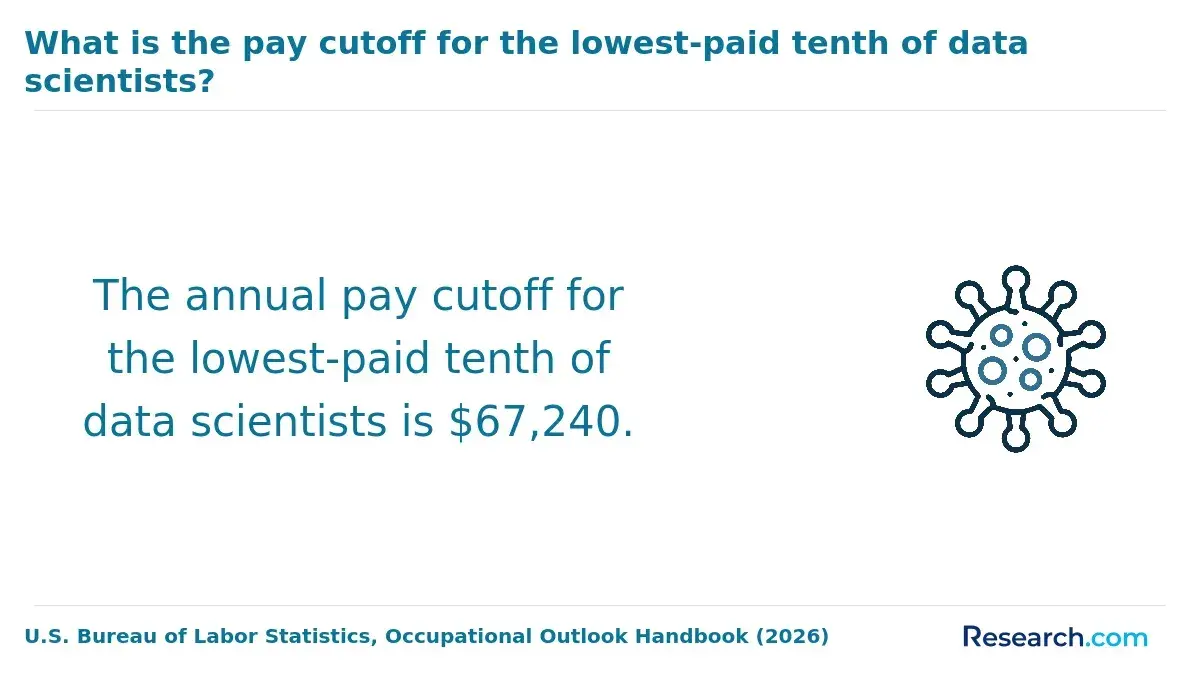
The Bureau of Labor Statistics reports a $120,230 median annual wage for data scientists in May 2025. That is an occupation-wide figure for employed workers at different career stages, not an expected starting salary or the payoff from a data science master's. It should not be compared directly with a salary labeled "health informatics graduate," which could combine very different jobs.
For a meaningful comparison, match specific roles, locations, experience levels, and employers. A health informatics graduate working in systems implementation and one working in analytics may face different pay markets. The same applies to data scientists across industries; data science career earnings by industry provides additional context. Treat any school-reported graduate salary cautiously unless the school explains its sample, response rate, prior experience, and whether it measures salary level or salary increase.
What Do You Learn in Each Master's Degree Program?
A data science curriculum generally develops statistical reasoning, programming, data management, and machine learning. A health informatics curriculum generally connects information systems and data practices to healthcare operations, including how people enter, share, interpret, and protect information. Both can include analytics, but the depth and purpose of that training may differ.
Read course descriptions and project requirements rather than relying on titles. If you want to build and evaluate predictive models, look for sustained work in statistics, coding, and model evaluation - not just an introductory analytics course. If you want to improve clinical information systems, look for substantive coverage of healthcare workflows, interoperability, governance, and implementation, ideally with a relevant applied project.
Artificial intelligence coursework can appear in either degree, but its presence alone does not establish technical depth. If building AI systems is your overriding goal, compare both curricula with affordable graduate-level artificial intelligence study before committing to a broader degree.
What Jobs Can You Get With Each Master's Degree?
A data science graduate might pursue data scientist, machine learning, analytics, or data-focused research roles, depending on their skills and experience. Health informatics graduates might pursue health information systems, clinical informatics, interoperability, implementation, or healthcare analytics roles. These are possible paths, not jobs conferred by the credential; employers set their own requirements.
There is meaningful overlap in healthcare analytics. A data science graduate may need to learn clinical terminology, data standards, and organizational constraints. A health informatics graduate seeking a model-development role may need more advanced statistics and programming than their program requires. For your preferred job, compare recent postings with the degree's required courses and capstone, then identify any skills you would still need to demonstrate through work or projects.
How Long Do These Master's Degree Programs Take?
Neither degree name determines a reliable completion time. Required credits, full- or part-time enrollment, course availability, prerequisites, and capstone scheduling determine how long an individual student takes. An advertised accelerated route may assume continuous enrollment or a course load that is difficult to combine with full-time work.
Ask each program for a course-by-course plan based on your intended pace. Check when required classes are offered and whether a project, internship, or prerequisite could delay graduation. The better option is the one whose actual schedule you can complete - not necessarily the one with the shortest advertised timeline.
How Much Do These Graduate Programs Cost?
There is no dependable universal price for either degree. Tuition and fees depend on the institution, credit requirements, residency rules, delivery format, and enrollment pace. Comparing a data science program's tuition alone with a health informatics program's total published budget would produce a false bargain.
To make a like-for-like comparison, calculate the following for each program using its current official tuition schedule and your expected enrollment plan:
- Required credits multiplied by the applicable tuition rate, plus mandatory program and university fees.
- Materials, technology, travel, and any internship-related expenses that apply to your format.
- Net cost after confirmed employer benefits, scholarships, or other aid, alongside any borrowing costs.
- Income you would give up if the schedule requires reducing work hours.
An affordable online master's in data science can be a useful starting point for finding options, but verify current charges with each university. Judge value against the roles and skills you need; a lower price does not make a poorly matched curriculum a better investment.
Are Online or Campus-Based Programs Better for Graduate Students?
Format is a question of access and learning fit, not degree quality by itself. Online study may let working professionals keep their jobs and consider programs outside commuting distance. Campus study may make in-person collaboration and local employer connections easier. Either format can be effective if its teaching, support, and applied work suit your goals.
The distinction matters particularly for health informatics students seeking exposure to healthcare organizations, and for data science students who need substantial feedback on coding and projects. Ask whether classes meet live, whether group work or site visits are required, how students obtain project data, and whether career support reaches remote learners. Confirm that the institution can enroll students in your state before treating an online offer as available to you.
What Are the Admission Requirements for Each Master's Degree?
Requirements vary by program. Data science applicants may be asked to show preparation in programming, mathematics, or statistics. Health informatics programs may seek evidence that applicants can work with technology and healthcare problems, but they do not all require clinical employment. A program's published prerequisites - not assumptions based on its degree title - determine eligibility.
If your background does not match the curriculum, distinguish an admission requirement from a skill you can develop before starting. Ask admissions staff whether a particular course or experience satisfies a stated prerequisite, and ask faculty what preparation students need for the first technical courses. Applicants considering an AI-intensive data science path can also investigate artificial intelligence master's foundation courses; a bridge course helps only if the program accepts it for the purpose you need.
How Can You Choose an Accredited Data Science or Health Informatics Program?
Start by verifying the institution's current accreditation through the accreditor or an authoritative higher-education directory. Then determine whether your intended field or employer values a particular program-level accreditation; institutional and programmatic accreditation are different claims. Do not assume that accreditation alone proves strong career outcomes or that a degree qualifies you for a regulated clinical profession.
Once legitimacy is established, make the decision against your target job rather than a ranking. Use the same questions for every finalist:
- Do required courses - not merely optional electives - teach the skills the target role uses?
- Can the capstone or applied project produce relevant evidence of your abilities?
- What is your verified total cost and feasible completion schedule?
- Can the program document the support, healthcare access, or technical feedback you need?
Choose data science when rigorous analytical training and cross-industry flexibility are priorities. Choose health informatics when your main objective is improving healthcare information systems and how they function in practice. If you want healthcare modeling specifically, the best fit may be a data science program with substantial healthcare projects or an informatics program with demonstrably strong quantitative coursework.
Other Things You Should Know About Data Science
No. Health informatics generally centers on information used in healthcare delivery and organizations. Bioinformatics generally applies computational methods to biological data. Some programs cross these boundaries, so check their required courses.
Not necessarily. Certification requirements and preferences depend on the role and employer. Check postings for your target jobs before paying for a certification or choosing a degree around one.
Possibly, but access requires appropriate organizational permission and safeguards; admission to a program does not grant it. Ask how students obtain approved datasets and what alternatives exist.
Do not assume so from the degree title. Ask the university for the specific program's classification and consult its international student office about how current rules apply to your situation.
References
- Healthcare data scientist qualifications, skills, and job focus | nih.gov https://pmc.ncbi.nlm.nih.gov/articles/PMC7787353/
- Program Eligibility, Written Arrangements, and Distance Education | 2024-2025 Federal Student Aid Handbook https://fsapartners.ed.gov/knowledge-center/fsa-handbook/2024-2025/vol2/ch2-program-eligibility-written-arrangements-and-distance-education
- Summary of the HIPAA Security Rule | hhs.gov https://www.hhs.gov/hipaa/for-professionals/security/laws-regulations/index.html
- Master of Science in Health Data Science and Informatics | The University of Kansas Academic Catalog https://catalog.ku.edu/medicine/biostatistics/ms-health-data-science/
- 12 Data Science Skills (+10 Hard-Won Career Lessons) | Syracuse University https://ischool.syracuse.edu/data-science-skills/
- Curriculum and Degree Requirements | kumc.edu https://www.kumc.edu/school-of-health-professions/academics/departments/health-information-management/academics/health-informatics/master-of-science-in-health-informatics/curriculum-and-degree-requirements.html
- M.S. in Health Informatics | Rutgers https://shp.rutgers.edu/ms-health-informatics/
- Master's in Health Informatics | Yale School of Public Health https://ysph.yale.edu/school-of-public-health/graduate-programs/master-of-science-in-public-health-msph/health-informatics/


