2027 LPN-to-RN Bridge Programs in Ohio: Admission, Schedules, and Campus Requirements
Audited and Verified:
Our Editorial and Data Verification Process
Research.com uses government datasets, official education statistics and primary institutional information to support its career and degree guides. Our review process checks factual accuracy, occupational definitions, source dates and the requirements associated with the credentials discussed.
How This Article Was Fact-Checked
Our editorial team verifies salary estimates, employment projections, education requirements and program information against original data providers and official organizations. Salary figures are checked against the relevant occupational definitions and reporting periods. Information about licensure, accreditation and required in-person training is reviewed separately.
Fact-checked and verified on:

Co-Founder and Chief Data Scientist
An Ohio LPN-to-RN bridge can build on your practical nursing education, but the advertised program length rarely tells you when you can actually graduate. Prerequisite courses, nursing-seat availability, labs, and assigned clinical shifts can all change the schedule—especially if you work while enrolled.
This guide explains how Ohio bridge pathways differ, what to verify before applying, and how to compare the full commitment rather than the classroom format alone. You can use it to narrow your options and ask each school for a realistic, written plan to RN eligibility.
Key Things You Should Know
- An Ohio LPN-to-RN bridge generally leads to an associate or bachelor's degree in nursing; neither graduation nor an existing LPN license automatically grants an RN license.
- Compare three separate decisions before enrolling: admission to the nursing track, the school's application of your prior coursework, and its available clinical schedule.
- Even when lectures are online, expect required in-person skills assessment and supervised clinical education; ask for actual days, locations, and travel expectations.
What Are LPN-to-RN Bridge Programs in Ohio?
An LPN-to-RN bridge is a prelicensure RN pathway designed for licensed practical nurses. It recognizes some prior nursing preparation while requiring students to complete the receiving program's RN-level coursework and clinical competencies. Ohio schools may offer an associate degree in nursing, often called an ADN or ASN, or a bachelor of science in nursing (BSN). The exact credit award and remaining courses depend on the school's evaluation.
Choose the award that fits your immediate goal and feasible schedule. An associate-degree bridge may offer a more direct route to RN exam eligibility; a BSN bridge includes additional bachelor's-degree requirements and may fit an employer or longer-term academic goal. Neither route should be confused with an RN-to-BSN program, which generally assumes the student already holds an RN license. A nurse who later completes an ADN and becomes licensed can separately investigate nursing master's bridges for ADN graduates; those are not substitutes for initial RN preparation.
What Are the Admission Requirements for Ohio LPN-to-RN Programs?
Requirements vary by institution and entry term. Schools commonly review an applicant's LPN license, practical-nursing education, transcripts, prerequisite grades, and readiness for clinical placement. Some use an entrance assessment or a transition course. Admission to the college does not necessarily mean admission to its limited-seat nursing bridge.
Before applying, request the current nursing-track requirements and a transcript review. Ask whether anatomy and physiology or microbiology need labs, whether sciences have an age limit, what grades qualify, when prerequisites must be complete, and how LPN coursework becomes credit toward this degree. Also ask when background checks, health documentation, and clinical-site clearances are due. The program determines academic admission and credit application; clinical partners may impose additional placement conditions.
If you have credits from another college, obtain a written degree audit showing which requirements they satisfy—not just a statement that the credits transfer. Doctoral admissions comparisons, such as admission-focused nursing practice doctorate comparisons, address a much later educational decision and cannot establish eligibility for an Ohio prelicensure bridge.
How Long Do Ohio LPN-to-RN Bridge Programs Take?
There is no dependable statewide completion time. A school's advertised nursing sequence may exclude prerequisite semesters, a wait for an available cohort, repeated courses, or a summer when a required course is not offered. Part-time enrollment can also extend the sequence if nursing courses must be taken in order.
The comparison below separates the time periods that matter when you ask a school for an individualized graduation estimate:
| Time period | What can affect it? | What to verify |
| Before nursing entry | Prerequisites, transcript review, application cycle, and seat availability | Earliest term for which you are eligible to start nursing courses |
| Bridge sequence | Credit awarded for LPN learning, course order, and full- or part-time options | A term-by-term plan for your evaluated transcript |
| After graduation | Application processing, examination scheduling, and licensing decisions | When the school reports completion and how to apply for RN licensure |
For a working LPN, the fastest published sequence may not be the fastest workable one. Ask whether missing one clinical course delays progression by a term or until the next annual cohort. Later, if you pursue doctoral education, short-format DNP degree programs have different entry requirements and should not be counted as part of this RN timeline.
Ohio bridge programs may deliver theory on campus or partly online, but an online lecture does not make the entire prelicensure program remote. Skills labs, simulation, assessments, and supervised patient care experiences can require attendance at specific times and places. An asynchronous lecture can still be paired with a fixed early-morning clinical shift.
Request the schedule for the actual cohort you would join: required campus days, lab and exam locations, clinical shift lengths, weekend or evening availability, and the distance to assigned sites. Confirm whether students arrange any placements themselves and whether a proposed site needs school approval. If you work rotating shifts or provide care at home, ask how much notice the school gives before clinical assignments and whether schedule changes are possible.
Do not use online BSN completion clinical policies to judge a bridge. RN-to-BSN study is postlicensure; an LPN seeking an initial RN license must complete the prelicensure program's required clinical preparation.
Check three different statuses: the institution's recognized accreditation, the nursing program's accreditation where applicable, and the Ohio Board of Nursing's current approval status for the specific prelicensure RN program. They serve different purposes. Institutional accreditation concerns the college; nursing accreditation, such as ACEN or CCNE accreditation, applies to an identified program; board approval addresses the program's regulatory status in Ohio.
Confirm the exact campus, degree, and entry track with the school and the relevant official accreditor or board listing. Ask whether the bridge students join the same approved RN program, whether any status is conditional, and which policies apply to your entry cohort. A college's general accreditation or an impressive pass-rate claim does not, by itself, answer those questions.
Accreditation must also be checked anew for later graduate study. For example, online PMHNP certificate clinical requirements concern a different post-master's pathway—not the approval or clinical requirements of an Ohio LPN-to-RN program.
Curricula differ, but bridge students typically move from practical-nursing preparation into RN-level assessment, pharmacology or medication-related study, medical-surgical nursing, mental health, maternal-child care, and care coordination. Schools may require anatomy and physiology, microbiology, general education, and a transition course before or during the nursing sequence. Coursework is paired with supervised practice and evaluation of clinical judgment, documentation, prioritization, and safe delegation.
Compare the remaining curriculum after your transcript review. A school might accept a science course as college credit yet decide it does not meet a nursing prerequisite because of its lab, content, grade, or completion date. Likewise, years of LPN employment can inform your readiness without automatically replacing a required RN clinical course.
RN-level foundational courses also differ from later specialty education. Online psychiatric NP master's schedule options, for instance, apply to graduate preparation after RN entry, not to the mental health content in a prelicensure bridge.
The receiving school sets its curriculum and approves clinical learning arrangements consistent with applicable board requirements. Expect to demonstrate skills in person and attend assigned, supervised experiences; the exact hours, sites, shifts, simulation use, and assessment methods are program-specific. Working as an LPN does not automatically turn a paid shift into approved RN-student clinical time.
Before paying an enrollment deposit, ask for the campus address and possible clinical service area, whether travel between sites is required, and how placements are assigned. Clarify required onboarding, immunizations or other health documentation, background checks, equipment, and what happens if a site cannot clear you. If caregiving or employment limits your availability, ask specifically about missed-clinical makeup rules, leave, and reentry—not simply whether the program is "flexible."
Clinical requirements remain important at later stages of nursing education, too; exploring accelerated family NP certificates after a master's involves separate graduate-level preparation and does not reduce an LPN bridge's required RN clinical experiences.
There is no single Ohio bridge price. Tuition may depend on residency, institution, credit load, and whether accepted LPN learning actually reduces courses needed for graduation. A low per-credit rate is not necessarily the lowest total cost if you must complete more prerequisites or travel farther for clinicals.
Build a term-by-term estimate from your written degree audit and the school's current charges. Include the costs that are easy to miss:
- Tuition and mandatory college or nursing program fees for every remaining term
- Books, software, testing products, uniforms, equipment, and lab supplies
- Health and background-check requirements, transportation, parking, and possible childcare
- RN examination and licensure application expenses, plus income lost if clinical shifts reduce paid work
Ask financial aid staff how part-time status, prerequisite-only enrollment, repeated courses, and employer reimbursement affect your own funding. Compare written total estimates, not advertised tuition alone. Affordable online advanced practice nursing routes are a separate, later financial decision for nurses who pursue advanced practice after RN licensure.
Completing an Ohio prelicensure RN program is an educational step, not an automatic license upgrade. Graduates must meet the Ohio Board of Nursing's applicable RN licensure requirements, apply through its process, and satisfy examination and other eligibility conditions. The RN licensure examination is the NCLEX-RN, not the NCLEX-PN previously taken for LPN licensure.
Before enrolling, confirm the program's current Ohio approval and ask how it documents graduates' eligibility to apply for RN licensure. As graduation approaches, use the board's current application instructions for required checks, fees, and examination registration. Passing the exam and receiving an active RN license are distinct steps; verify the license before accepting work that requires RN authority.
An RN license does not itself authorize advanced practice. Later options such as affordable graduate psychiatric nursing options involve additional education and separate credentialing and regulatory decisions.
What Careers, Salaries, and Job Outlook Follow Ohio RN Licensure?
RN licensure can open applications for hospital, ambulatory, long-term care, home health, and other RN positions, but employers set their own degree preferences and onboarding requirements. Your LPN experience can be valuable in interviews; it does not replace orientation to an RN role, a new patient population, or an employer's competency checks. Compare offers by shift, staffing support, orientation, commute, benefits, and advancement opportunities as well as pay.
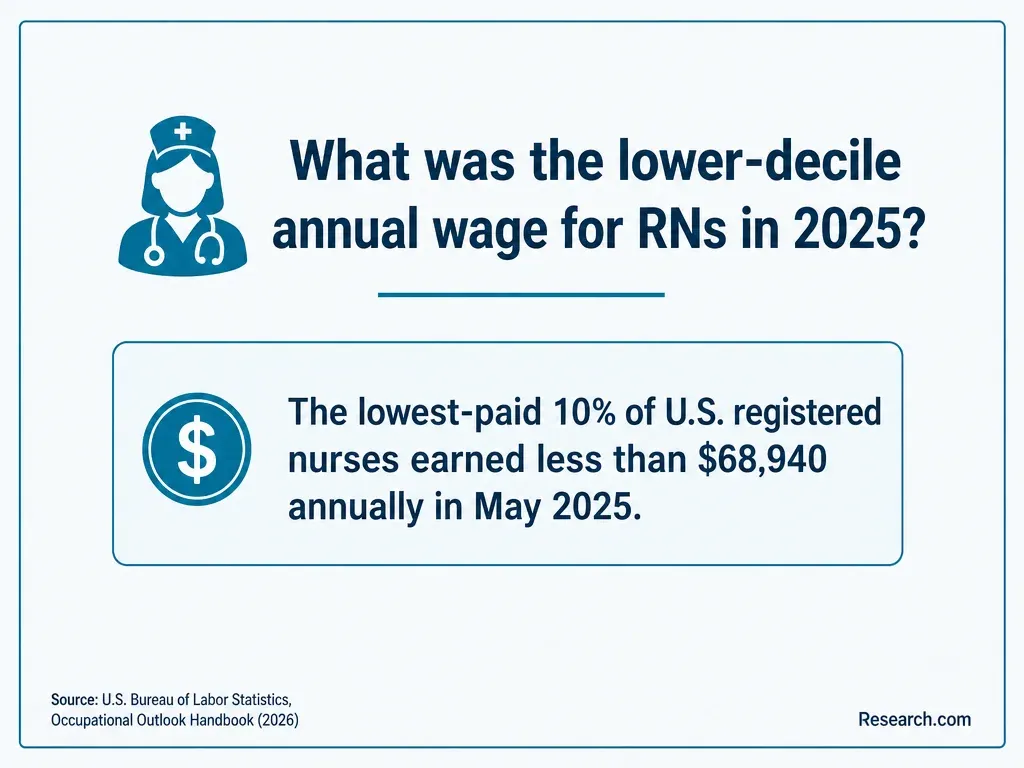
The U.S. Bureau of Labor Statistics reports registered-nurse wages and employment projections for the occupation, not guaranteed earnings for Ohio bridge graduates. National figures also conceal differences among Ohio regions, employers, shifts, and experience levels. For a personal return-on-investment estimate, compare local RN job postings and likely offers with your current LPN compensation, then subtract education costs and any earnings you would forgo while studying.
If a future role requires a BSN or graduate education, first identify the employer's actual requirement. Planning the cost of a BSN-to-MSN transition is useful only after you have established the RN pathway and confirmed that further study serves a specific career goal.
Other Things You Should Know About Nursing
Possibly. Ask the school which LPN licenses it accepts at application and enrollment, and whether Ohio licensure is required for clinical placement. Do not assume that admission rules and authorization to work as an LPN in Ohio are the same.
Many students do, but feasibility depends on assigned clinical shifts and course demands. Request a sample cohort schedule and ask your employer about predictable scheduling before committing to a work-hour plan.
Ask for the nursing program's written leave and reentry policy. Returning may depend on course sequencing, seat availability, time limits, and updated clinical clearances; readmission should not be assumed.
Yes, an RN who completes an associate-degree pathway can explore RN-to-BSN programs. Confirm how the receiving school applies prior credits and whether its schedule and cost improve on choosing a BSN bridge from the outset.
- RN Education Programs - Ohio Board of Nursing https://nursing.ohio.gov/page/iEM5Mmp8nkQ_6t6ecBxJ0
- Health Profession Student Clinical Training Standards | oregon.gov https://www.oregon.gov/oha/hpa/hp/pages/sct.aspx
- Nursing Licensure Guide | Department of State https://www.pa.gov/agencies/dos/resources/professional-licensing-resources/licensure-processing-guides-and-timelines/nursing-guide
- LPN to RN | Ohio University https://www.ohio.edu/chsp/nursing/associate-degree/lpn-rn
- Nurse Education - Advanced Placement LPN | Quinsigamond https://www.qcc.edu/healthcare/nurse-education-advanced-placement-lpn
- Associate Degree Nursing | Registered Nurse | COTC https://www.cotc.edu/degrees-certificates/nursing-technology
- LPN-RN Associate Degree in Nursing Pathway | Shawnee State University https://www.shawnee.edu/academics/college-health-human-services/nursing/associate-degree-nursing/lpn-rn.html
- Pre- and Co-requisite Courses - Medgar Evers College Catalog https://mec.catalog.cuny.edu/academic-requirements-regulations-policies/pre-and-co-requisite-courses
- LPN to RN bridge program | Nursing | Stark State College https://www.starkstate.edu/academics/explore-all-programs/lpn-to-rn/