2027 Is an Online Ed.D. in Leadership and Learning in Organizations a Good Fit for K-12 Instructional Coaches?
Audited and Verified:
Our Editorial and Data Verification Process
Research.com uses government datasets, official education statistics and primary institutional information to support its career and degree guides. Our review process checks factual accuracy, occupational definitions, source dates and the requirements associated with the credentials discussed.
How This Article Was Fact-Checked
Our editorial team verifies salary estimates, employment projections, education requirements and program information against original data providers and official organizations. Salary figures are checked against the relevant occupational definitions and reporting periods. Information about licensure, accreditation and required in-person training is reviewed separately.
Fact-checked and verified on:

Co-Founder and Chief Data Scientist
Instructional coaches already help teachers improve practice. An online Ed.D. in Leadership and Learning in Organizations may help a coach lead professional learning across schools, evaluate initiatives, and manage organizational change - but it may be more education than a coaching role requires.
For K-12 coaches considering advancement or a move beyond school systems, this guide explains what the degree can add, where its limits matter, and how to compare programs against a specific career goal before committing time and money.
Key Things You Should Know
- An organizational leadership Ed.D. is most useful when a coach wants responsibility for systemwide adult learning, improvement, or change - not simply to become a stronger one-on-one coach.
- It does not automatically qualify graduates for principal or superintendent licensure. Verify state requirements and whether the particular program is approved for the credential sought.
- The U.S. Bureau of Labor Statistics reports a $77,440 median annual salary for instructional coordinators in 2025; that occupational figure is not a predicted salary after an Ed.D.
Is an online Ed.D. in Leadership and Learning in Organizations right for K-12 instructional coaches?
It can be a good fit when your next goal is to lead learning across an organization, rather than only coach individual teachers. An instructional coach brings experience in observation, feedback, curriculum implementation, and teacher development. A practice-oriented Ed.D. can build on that foundation with organizational change, leadership, and applied inquiry: skills useful when a district needs to understand why an initiative is - or is not - taking hold across schools.
The choice depends on the work you want to do next. These pathways solve different problems, even when their course titles sound similar.
| Pathway | Best fit for a coach seeking | Important limitation |
| Leadership and learning Ed.D. | Broader responsibility for adult learning, change, and evaluation within or beyond K-12 | May not meet school-administrator licensure requirements |
| State-approved educational leadership pathway | A principal or other regulated school-leadership position | May focus less on cross-sector organizational learning |
| Targeted training or supervised leadership experience | Stronger coaching, facilitation, or initiative-management skills without needing a doctorate | May offer less sustained research preparation |
An Ed.D. is less compelling if the immediate goal is a better coaching technique, a salary-lane change that the district has not confirmed, or a credential required for administration that the program does not provide. A coach who has not yet led work beyond a small caseload may benefit first from managing a districtwide professional-learning initiative, with mentorship and documented results.
What careers can an Ed.D. in Leadership and Learning prepare instructional coaches for?
Within K-12, a coach might pursue instructional coordination, professional-learning leadership, curriculum implementation, or district improvement work. These roles can require decisions about budgets, staff development, evaluation, and stakeholder priorities - not just excellent coaching. The doctorate may strengthen preparation, but hiring and promotion still depend on experience, district rules, and any required credential.
A coach interested in organizational learning outside schools could explore training and development or consulting. That transition calls for evidence that K-12 skills transfer: for example, a documented needs assessment, a learning design for adults, or an evaluation that explains its limitations. Corporate talent-management experience cannot be assumed from school-based coaching alone. Coaches considering college administration can compare organizational leadership doctoral options for college administrators, while recognizing that higher-education hiring typically also values direct institutional experience.
What accreditation should instructional coaches verify before choosing an online Ed.D.?
Verify that the institution holds recognized institutional accreditation and that the accreditation covers the university awarding the Ed.D. Then confirm the exact degree name and program, rather than assuming a leadership-related course represents a formal specialization.
Accreditation establishes institutional standing; it does not establish eligibility for a principal, superintendent, or other state credential. If licensure is the goal, ask the program which states and specific credentials its preparation addresses, check the applicable state licensing authority, and obtain the answer for your intended entry term. Also ask your district whether the degree and institution satisfy its promotion, reimbursement, or salary-schedule policies.
Online study removes a regular commute but does not necessarily make doctoral work self-paced. A program may require live evening classes, cohort meetings, group projects, or campus convenings. For a coach whose school-day schedule follows a fixed calendar, these commitments can be harder to accommodate than recorded lectures.
A campus-based program may offer more routine face-to-face contact with faculty and local research partners, but travel can conflict with school obligations. Compare the actual meeting schedule, attendance rules, travel requirements, faculty access, and project supervision - not the delivery label alone. Ask what happens if your district assignment changes while an applied project is underway.
Relevant study may include adult learning, organizational culture, change implementation, leadership, program evaluation, and qualitative or quantitative inquiry. For a coach, the crucial shift is from asking whether a workshop was well received to examining whether teachers can apply new practices, what conditions support implementation, and what evidence can responsibly inform the next decision.
Review required courses and the final project, not just elective titles. Programs differ in whether they require a dissertation, dissertation in practice, or another approved deliverable; online education doctorates with alternative final projects offer a useful comparison, but the school must confirm its own requirements. If you hope to study district professional learning, ask about faculty approval, district permission, access to teacher or student information, FERPA obligations, and any required research-ethics review. Employment in a district does not itself authorize data use.
Requirements vary by institution. Programs may request a completed graduate degree, transcripts, professional-experience evidence, recommendations, a statement of purpose, and an interview; entrance-test and GPA policies differ. A coach can make an application more informative by describing a real learning or implementation problem, their own decision-making responsibility, and what they need to learn - without claiming unmeasured student or teacher outcomes.
If you have unfinished doctoral study, ask separately whether prior work supports admission and whether any credits would apply to the new degree. Neither follows automatically from the other. Reviewing unfinished education doctorate study and completion choices can help frame that conversation, but request a written evaluation from the prospective institution before counting on a shorter path.
Time and total cost depend on required credits, enrollment pace, course availability, final-project progress, and any travel. A published tuition rate alone omits fees, materials, campus visits, and possible extra terms if a project takes longer than planned. Request a term-by-term estimate from each school rather than assuming that an online format is cheaper or faster.
For a district employee, the financial comparison should also include the district's written reimbursement ceiling, approved-degree rules, grade requirements, and any obligation to remain employed. Higher education leadership doctorate tuition assistance provides a starting point for funding questions, but your employer and university must confirm what applies to you. Compare that verified net expense with the cost of a narrower credential or employer-sponsored development - not an assumed promotion or pay increase.
A school-leadership license is not a universal admission requirement for an organizational leadership Ed.D. A program may, however, set its own professional-background requirements. Separately, your current coaching position may be subject to state or district educator-credential rules.
Keep admission and career eligibility distinct. Completing a general leadership and learning doctorate does not automatically award a teaching credential, administrator license, or coaching certification. If a regulated role is your goal, check the relevant state requirements and obtain written confirmation of the program's licensure status before enrolling.
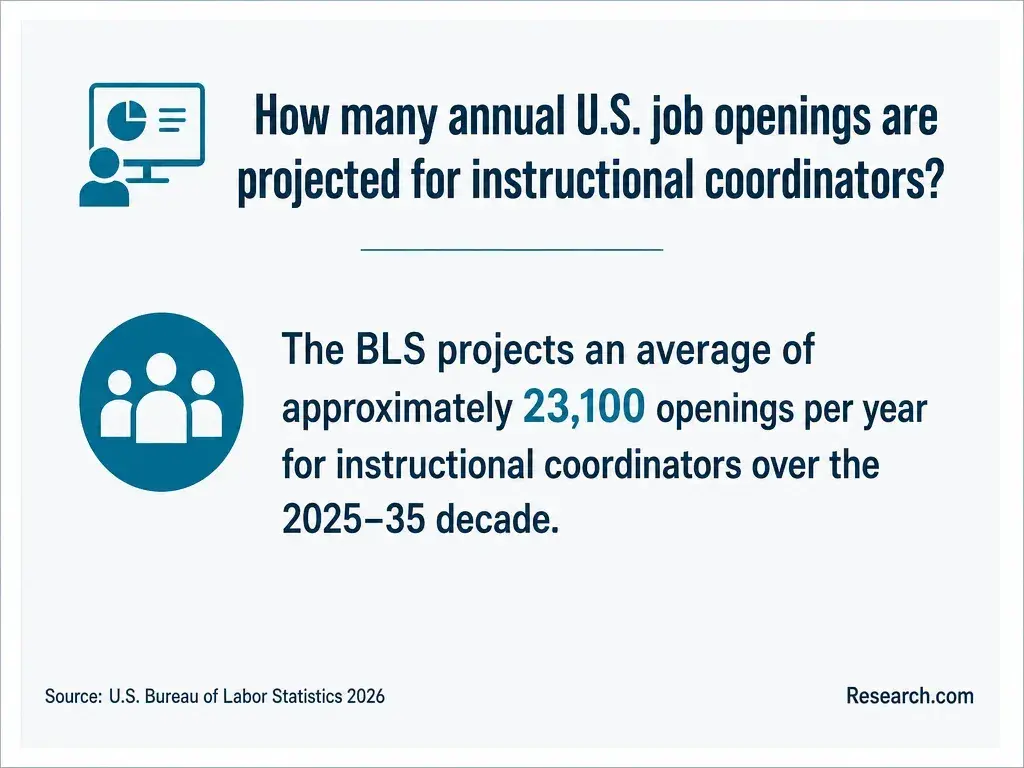
The closest federal occupational category for many instructional-coaching and curriculum roles is instructional coordinators. The U.S. Bureau of Labor Statistics reports a 2025 median annual salary of $77,440 for that occupation and projects 1.6% employment growth from 2025 to 2035. Those figures describe an occupation - not Ed.D. graduates, your district's pay scale, or the return on tuition.
Moving into district leadership, administration, or organizational consulting changes the relevant occupation and qualifications. Before treating a doctorate as a financial investment, examine actual job postings, required credentials, your district's salary schedule, and whether you can gain the necessary leadership responsibility in your current position.
How can instructional coaches choose a reputable online Ed.D. program?
Start with one target responsibility - such as leading district professional learning - and compare programs against it. A reputable fit should make its curriculum, faculty support, delivery requirements, total charges, final-project expectations, and licensure disclosures clear enough to evaluate before enrollment.
Use these questions to turn program descriptions into a decision:
- Which required courses teach adult learning, implementation, and evaluation at the depth my goal requires?
- What live meetings, group work, campus visits, and project milestones would conflict with my school calendar?
- Who approves an applied project, and what happens if district access or my job assignment changes?
- What is the estimated total cost, and what written evidence supports any claimed licensure or advancement benefit?
If speed matters, compare shorter online Ed.D. degree pathways against those same criteria. A shorter advertised schedule is useful only if its workload, support, and final-project requirements are realistic for a working coach.
Other Things You Should Know About EdD Leadership
Possibly. Colleges set their own qualifications by subject and position, and teaching or research experience may matter alongside the degree. Check postings for the specific courses you want to teach.
Only if your district's contract or salary schedule recognizes the degree under its rules. Ask human resources to confirm how the proposed program would be classified before enrolling.
It may be possible if the program permits external sites and the school grants appropriate access. Academic approval, site permission, and any required data or ethics review are separate steps.
Not automatically. State and district rules determine which doctoral coursework, if any, counts toward renewal. Confirm the applicable rules before relying on courses for that purpose.
- Administrative Supervisory | Department of Education https://www.pa.gov/agencies/education/programs-and-services/educators/certification/current-pa-educators/administrative-supervisory
- Frequently Asked Questions - BOSA https://bosa.mn.gov/BOSA/FAQ/index.html
- EdD vs. PhD in Education: What's the Difference? | Northeastern University Charlotte https://charlotte.northeastern.edu/news/edd-vs-phd-in-education-whats-the-difference/
- What Topics Do EdD Students Research in the EdD Program? | Fairfield University https://www.fairfield.edu/news/insights/education-human-development/what-topics-do-edd-students-research.html
- Educational Leadership Program FAQs | Binghamton University https://www.binghamton.edu/tlel/academics/educational-leadership/faq.html
- Coaching and Teaching Studies, EdD | West Virginia University https://www.wvu.edu/academics/programs/coaching-and-teaching-studies-edd/
- 2026 UNC Online EdD in Organizational Learning & Leadership https://online.unc.edu/online-doctoral-programs/online-edd-organizational-learning-and-leadership/
- EdD vs. PhD in Education: Choosing the Right Program | Goodwin College of Professional Studies https://drexel.edu/soe/resources/career-path/edd-vs-phd/
- Instructional Leadership, Doctor of Education | St. John's University https://www.stjohns.edu/academics/programs/instructional-leadership-doctor-education
- D. Ed. Degree in Educational Leadership | psu.edu https://ed.psu.edu/academics/departments/department-education-policy-studies/educational-leadership-program/ded-degree-educational-leadership