2027 Graph Machine Learning in an Online Data Science Master's: Courses, Projects, and Program Selection

Co-Founder and Chief Data Scientist
Graph machine learning is a specialized reason to choose a data science master's, not a feature to assume every program offers. For prospective online students interested in fraud networks, recommendations, biological interactions, or other connected data, the decision hinges on course depth and access to a meaningful project.
This guide explains what to look for in a curriculum, how to test whether a program supports your goals, and which practical constraints to check before enrolling.
Key Things You Should Know
- Look beyond course titles: graph machine learning may be a brief unit, a dedicated elective, or a substantial supervised project.
- A strong project compares graph methods with simpler baselines and evaluates whether network connections improve the result without leaking information.
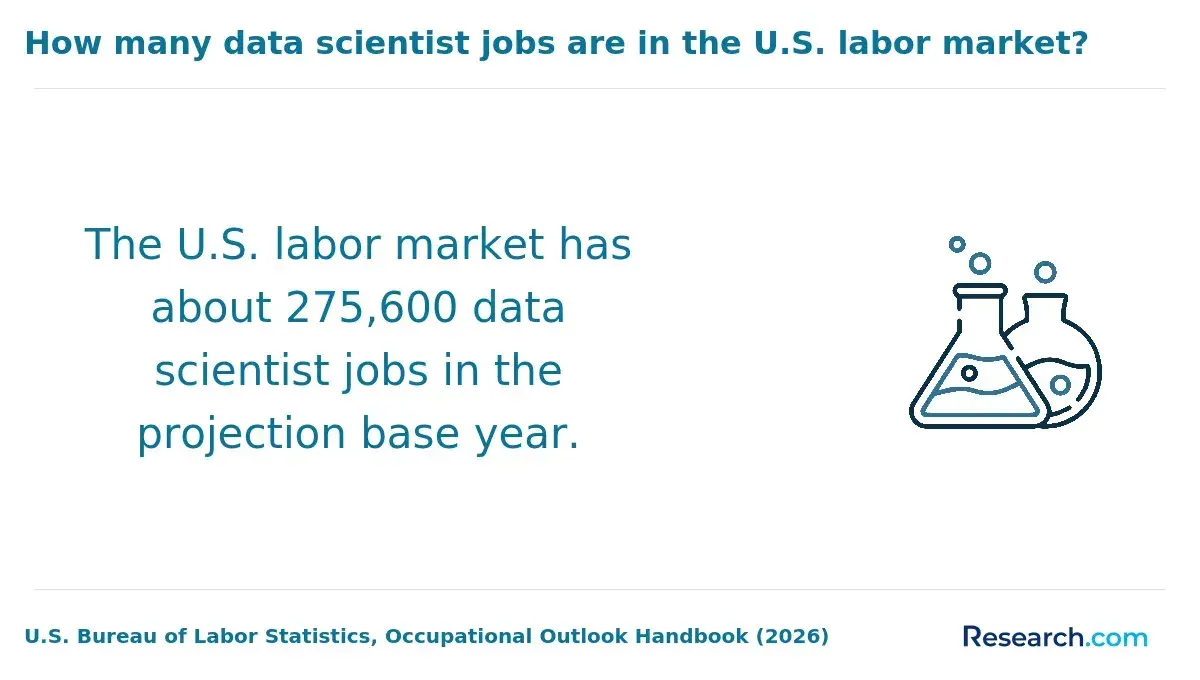
- For career context, the U.S. Bureau of Labor Statistics reports a $120,230 median annual wage for data scientists in May 2025. That occupation-wide figure is not a salary prediction for graph specialists or graduates.
What is graph machine learning in an online data science master's program?
Graph machine learning uses information about relationships as well as individual records. A graph represents entities as nodes and connections as edges: accounts and transactions, for example, or users and products. Graduate work may cover graph construction, network statistics, link prediction, node classification, embeddings, and graph neural networks (GNNs).
The important question is whether those connections improve the analysis. Students should learn to compare a graph-based approach with a conventional model using the same decision objective, not assume that a GNN is automatically better.
If a program emphasizes tabular prediction rather than connected data, a broader data analytics graduate degree guide may help you assess whether that emphasis better fits your goals.
Useful preparation includes Python, linear algebra, probability, machine learning evaluation, and data handling. Advanced graph work adds challenges that ordinary model training can miss: highly connected nodes can dominate results, relationships change over time, and careless train-test splits can reveal information the model would not have in practice.
What courses do online master's programs offer in graph machine learning?
Graph topics may appear under network science, data mining, recommender systems, computational biology, advanced machine learning, or deep learning rather than a course named "graph machine learning." A catalog title establishes availability, but a current syllabus and assignment list are better evidence of depth.
The distinctions below help you compare programs without treating every mention of graphs as equivalent.
| Curriculum exposure | What the evidence might show | Likely learning opportunity |
| Passing mention | Graphs appear in a course description or reading. | Conceptual awareness, with little practice. |
| Single unit | A lecture sequence or assignment covers networks. | Some implementation or evaluation practice. |
| Dedicated course | The syllabus covers multiple graph methods and assessed work. | More sustained technical study. |
| Advanced elective or project | Students can investigate a graph problem with faculty feedback. | Greater opportunity to build and defend an applied result. |
For deeper study, look for work on graph representation, sampling, temporal or heterogeneous networks, and evaluation, not just library demonstrations. Also check whether courses in databases and pipelines support graph construction at usable scale.
A program focused primarily on AI infrastructure may be worth comparing through master's-level AI programs that teach data engineering, particularly if preparing connected data interests you as much as modeling it.
What projects build practical graph machine learning skills?
A useful graph project starts with a decision that relationships could plausibly improve, such as identifying suspicious account connections or predicting which products a customer may consider. Merely converting a dataset into nodes and edges does not demonstrate that the graph is useful.
For a portfolio or capstone, assess whether the program gives you room to complete the following sequence:
- Define the prediction or analysis task, the stakeholder, and what information would be available at decision time.
- Document how nodes and edges are created, including missing links, timestamps, and data permissions.
- Build a non-graph baseline, then compare it with an appropriate graph method using task-relevant measures.
- Split and evaluate the data to limit leakage through shared connections or future events.
- Report limitations, reproducible code or methods, and what the result would mean in practice.
Choose a program with project supervision and accessible computing resources if you want substantial GNN experience. If the program permits only a fixed capstone topic, ask whether a graph-focused independent study or course project is possible; do not assume an elective guarantees a graph capstone.
What are the admission requirements for an online data science master's?
Requirements vary by institution. Applicants may need evidence of programming, mathematics, statistics, or prior quantitative work, but admission to a data science program does not necessarily require previous graph experience. Check the official admissions page for formal prerequisites and deadlines, then compare them with the preparation needed for the graph courses you want.
If you have a gap, ask admissions staff whether a proposed course fulfills a formal requirement; self-study and professional projects may improve readiness without satisfying one.
Applicants considering an AI-focused alternative can compare foundation pathways into artificial intelligence graduate programs, while confirming each program's own policies. Before applying, also check whether advanced graph electives require earlier courses that could delay your intended sequence.
How long does an online data science master's take and cost?
There is no reliable single duration or price for an online data science master's. Credit requirements, part-time options, course availability, and project scheduling vary. For graph-focused applicants, an elective offered infrequently can matter more than the program's advertised minimum completion time.
Compare schools using a written estimate of total required credits, tuition at the rate applicable to you, mandatory fees, materials or computing charges, and any required travel. Ask whether tuition can change during enrollment and whether employer assistance applies.
An inexpensive online graduate program in AI may be a sensible alternative, but compare its full estimated cost and relevant graph coursework, not tuition alone. Do not treat a possible future salary as a guaranteed return on the degree.
How does online learning compare with campus-based data science programs?
Online study can reduce the need to relocate and may fit around employment; campus study may make in-person collaboration and access to particular research groups easier. Neither format establishes graph-course quality by itself. For this subject, access to faculty feedback, suitable computing, and collaborators matters more than the delivery label.
Before choosing online study, check whether the graph elective is actually available to online students, whether meetings or exams are synchronous, and how project teams work across time zones.
Choose a campus option if your intended research depends on facilities or mentorship unavailable remotely; choose online study if its specific courses and project support meet your goals within your schedule.
How can students verify data science program accreditation?
Verify the institution's accreditation through its official disclosures and the accreditor's own directory. Do not assume that an individual graph elective, or every data science degree, has separate programmatic accreditation. If a school makes a program-specific claim, check exactly what entity and program the claim covers.
Accreditation is one screening criterion, not proof that graph machine learning is taught well. Separately confirm that the institution can enroll online students in your state and ask whether any residency or travel requirement applies. A program's official catalog and current online-course schedule are the more direct evidence for curriculum fit.
What careers can graph machine learning graduates pursue?
Graph skills can support data scientist or machine learning roles involving recommendations, fraud detection, network analysis, knowledge graphs, or biological data. Some work centers on building models.
Other roles emphasize constructing reliable connected datasets or interpreting network patterns. Job titles alone may not reveal which kind of work an employer needs.
Match your portfolio to the target role. For model-focused positions, show defensible evaluation against baselines. For data-oriented positions, show how you designed relationships, handled changing data, and made the pipeline reproducible.
A master's may help you develop those capabilities, but relevant experience and demonstrable work can also matter; the degree is not a universal entry requirement.
What salaries and job outlook apply to data science graduates?
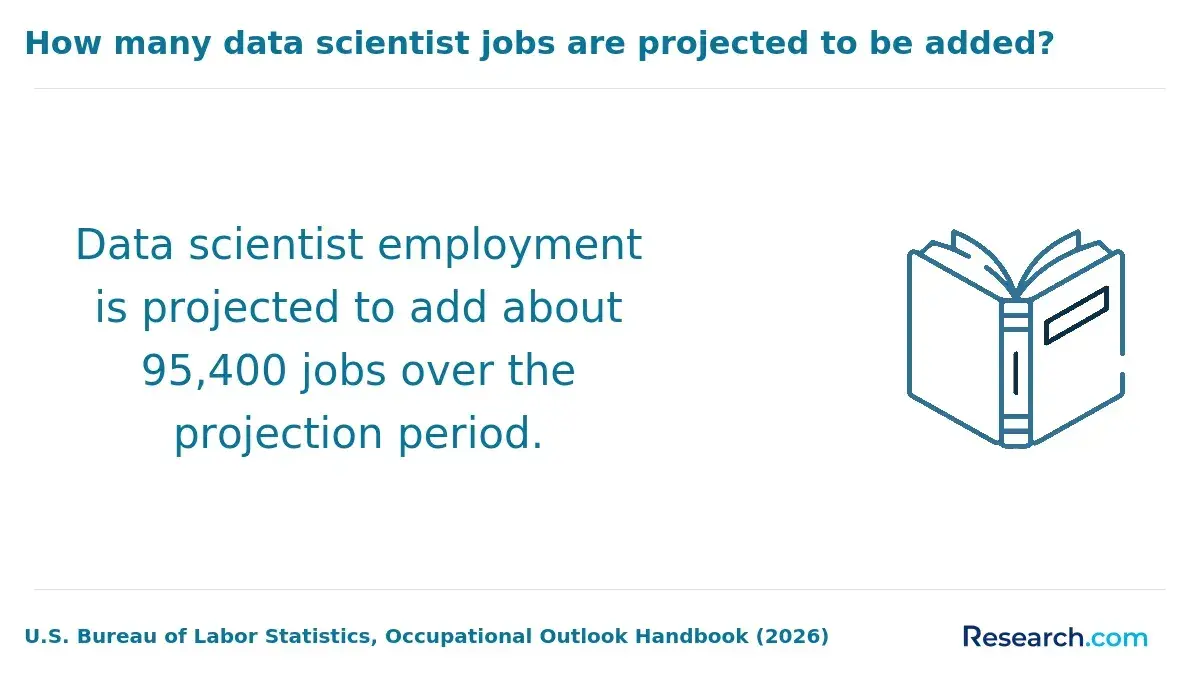
The U.S. Bureau of Labor Statistics reports a $120,230 median annual wage for data scientists in May 2025 and projects 35% employment growth from 2025 to 2035. These figures describe the broad U.S. occupation, not graph machine learning positions or outcomes for any particular master's program. Prior experience, role, location, and employer can substantially affect an individual offer.
Use labor-market figures to assess the broader field, then inspect postings for your intended niche to see which graph skills employers request. For context on how opportunities differ by employer type, consult data science salary opportunities across sectors. Do not compare a program's tuition with the occupation-wide median as though the degree caused that wage.
Which certifications and standards matter in graph machine learning?
No single graph machine learning certification is a standard requirement across data science jobs. A tool-specific credential can show familiarity with a platform, but it is not a substitute for explaining graph design, leakage controls, baselines, and model evaluation. Choose one only when target job postings identify the tool or your project needs it.
More broadly, look for programs that teach reproducible experimentation, responsible data use, and documentation of model limitations. These practices make a graph project easier for an employer to assess and are particularly important when connections involve sensitive people or organizations.
Other Things You Should Know About Data Science Programs
No. You can learn graph construction and modeling from appropriately structured data without using a dedicated graph database. Database experience becomes more relevant when storing, querying, or updating a large connected dataset is part of the task.
Not necessarily. Small graphs and introductory methods may run on ordinary hardware. Ask the program about computing access if its advanced assignments use large datasets or computationally demanding neural models.
Yes, but a changing network requires a method and evaluation design that respect time. For a time-sensitive project, check whether the courses address temporal graphs rather than only static network snapshots.
No. Public availability does not settle questions about licensing, identifiable relationships, or acceptable reuse. Check the dataset's terms and remove or protect sensitive information before publishing project materials.
References
- Graph Neural Networks and Their Current Applications in Bioinformatics - PMC https://pmc.ncbi.nlm.nih.gov/articles/PMC8360394/
- Master's in Data Science | utexas.edu https://cdso.utexas.edu/msds
- Inside the Harvard Extension School Data Science Capstone https://extension.harvard.edu/blog/harvard-extension-school-data-science-capstone-experience/
- Independent Study and Capstone Course Approval | charlotte.edu https://cci.charlotte.edu/independent-study-approval/
- Hands-on activities results in better learning | Open Learning https://openlearning.mit.edu/mit-faculty/research-based-learning-findings/active-learning
- CS224W | Home | stanford.edu https://cs224w.stanford.edu/
- Online Program - UChicago Data Science Institute https://datascience.uchicago.edu/education/masters-programs/online-program/
- Directed study & special topics | umn.edu https://cse.umn.edu/cs/directed-study-special-topic
- Master of Data Science | pitt.edu https://www.sci.pitt.edu/academics/masters-degrees/data-science
- Graph neural networks: A review of methods and applications | sciencedirect.com https://www.sciencedirect.com/science/article/pii/S2666651021000012