2027 Evaluating Nurse Educator MSN Outcomes: Completion Rates, Certification Results, and Data Gaps
Audited and Verified:
Our Editorial and Data Verification Process
Research.com uses government datasets, official education statistics and primary institutional information to support its career and degree guides. Our review process checks factual accuracy, occupational definitions, source dates and the requirements associated with the credentials discussed.
How This Article Was Fact-Checked
Our editorial team verifies salary estimates, employment projections, education requirements and program information against original data providers and official organizations. Salary figures are checked against the relevant occupational definitions and reporting periods. Information about licensure, accreditation and required in-person training is reviewed separately.
Fact-checked and verified on:

Co-Founder and Chief Data Scientist
A nurse educator MSN program may advertise graduation and certification success without showing which students were counted or when results were measured. That makes it difficult for working RNs to judge whether a program will fit their schedules and prepare them to teach. This guide explains how to compare completion rates, interpret certification results, and identify missing evidence. It also covers accreditation, curriculum, cost, and career outcomes - but keeps the central decision in view: whether a program can substantiate the results that matter to you.
Key Things You Should Know
- A reported 80% completion rate could mean 8 of 10 students graduated; ask for the starting cohort, time limit, and exclusions before comparing it with another program.
- An MSN awards 0 certifications automatically. Graduation, eligibility for an educator credential, taking its exam, and passing it are separate outcomes.
- Compare at least 3 distinct measures: cohort completion, certification exam results among eligible graduates, and preparation for the teaching role you want.
What Are Nurse Educator MSN Outcomes and Why Do They Matter?
Nurse educator MSN outcomes are measurable results for students in a graduate nursing education track - not results for every MSN student at the institution. They can include persistence, graduation within a stated period, teaching-practicum completion, certification exam performance, and employment in education roles. Each measure answers a different question: Can students finish? Are graduates prepared for a credential? Does the training fit the intended job?
For an experienced RN, the most useful outcome depends on the target role. An academic faculty position may call for evidence of curriculum design and supervised teaching; a hospital staff-development role may place more weight on clinical expertise and workplace education. Neither is an advanced practice nursing role. If your actual goal is to provide care as an NP, compare the education and eligibility implications of comparing post-master's FNP study options instead of treating an educator MSN as NP preparation.
A program's published result describes a past group, not your probability of graduating or getting hired. Use it alongside the course schedule, practicum arrangements, faculty support, and requirements that will apply to your entry cohort.
How Do MSN Nurse Educator Completion Rates Compare Across Programs?
There is no sound national ranking of nurse educator MSN programs by completion rate when schools use different cohorts and reporting windows. Before comparing percentages, put each school's figures into the same framework. The table shows how apparently similar claims can measure different results.
| Reported measure | Students counted | What it can - and cannot - show |
| On-time completion | Students who entered a defined cohort and graduated within its published program length | Shows schedule predictability; may disadvantage planned part-time routes. |
| Completion within an extended window | The same entry cohort, measured over a longer stated period | Captures delayed graduates; may hide frequent interruptions. |
| Graduation among remaining students | Students still enrolled after an earlier checkpoint | Describes later-stage success but can omit those who left early. |
| Schoolwide MSN completion | Students across multiple MSN tracks | May provide context but does not establish the educator track's result. |
For example, 8 graduates among 10 entrants is 80%; 8 graduates among 8 students who remained after two withdrew is 100%. Both calculations can be accurate, but they answer different questions. Request the entrant count, graduation count, reporting years, time window, and treatment of transfers, leaves, and students still enrolled. Small cohorts can produce large percentage swings, so examine several cohorts when available.
Bridge pathways need particular care: a reported MSN rate may start counting only after students complete undergraduate bridge work. If you would enter with an associate degree, use an ADN-to-MSN bridge program guide to identify the earlier stages you would also need to evaluate, then ask the school for outcomes from your actual entry point.
What Certification Results Should Applicants Expect From Nurse Educator MSN Programs?
Expect a program to explain which credential its curriculum supports, not to promise certification. The National League for Nursing offers educator credentials, including the Certified Nurse Educator (CNE) and the Certified Academic Clinical Nurse Educator (CNEcl). Their eligibility rules address different teaching roles and may include education and experience conditions. Applicants should check the current credential handbook against their own qualifications; an MSN diploma alone is not a passing exam result or a guarantee of eligibility.
A useful pass-rate disclosure identifies the specific exam, exam year, number eligible, number who took it, first-attempt passes, and whether repeat attempts were included. "100% passed" means much less if one graduate tested while others did not. Some graduates may enter teaching before meeting a credential's experience requirement, making an immediate postgraduation pass rate an incomplete measure of preparation.
Do not compare educator exam results with NP board results. Those examinations assess different preparation and lead to different credentials; browsing online psychiatric NP master's schedule options is relevant only if your intended role is psychiatric advanced practice rather than nursing education.
The Accreditation Commission for Education in Nursing (ACEN) and the Commission on Collegiate Nursing Education (CCNE) accredit nursing education at applicable program levels and scopes. Accreditation involves review of educational quality and outcomes processes; it does not establish that two educator tracks have equal completion rates or guarantee an individual's certification or employment.
Verify the exact institution, degree level, accreditation status, and effective dates directly with the accreditor. Then ask the school whether its published outcomes cover the nurse educator track and your entry location or format. Institutional accreditation is a separate matter. State authorization to enroll a student in a particular jurisdiction is separate as well; do not infer either from a nursing accreditation listing.
Scope matters especially when comparing credentials. An MSN educator track and online DNP programs emphasizing organizational practice can both sit within accredited nursing education while preparing students for different work. Evaluate the outcomes of the actual degree and track you would enter, not the strongest result advertised anywhere in the nursing school.
Common elements include graduate nursing theory and evidence appraisal; teaching and learning methods; curriculum design; student assessment; and instruction in clinical, classroom, online, or simulation settings. Programs may also require graduate coursework in advanced health assessment, pathophysiology, or pharmacology. Course titles and credit requirements vary, so compare syllabi and assessments rather than assuming similarly named tracks teach identical skills.
The educator practicum is particularly informative. Ask what teaching activities students perform, who supervises and evaluates them, whether the site must be approved, and whether you must find an eligible preceptor. A practicum at your employer may be possible, but employment hours do not automatically count as supervised academic teaching. Evidence of lesson planning, feedback, and learner evaluation is more relevant to educator readiness than a course list alone.
A shorter graduate-entry nursing program addresses a different starting point: preparation for someone who is not yet an RN. It should not be used as a curriculum or completion-rate comparison for a postlicensure nurse educator track.
Most postlicensure nurse educator MSN tracks expect an RN license and qualifying prior nursing education. Schools may also review GPA, transcripts, recommendations, a professional statement, and nursing experience; some specify a BSN, while others offer an RN-to-MSN route. Admission to the university does not necessarily mean admission to the educator track. Check whether your license, prior degree, and experience satisfy the precise pathway advertised.
If you hold an RN license and a bachelor's degree outside nursing, ask whether the school accepts that combination and what bridge coursework remains. If you are not an RN, this postlicensure track is generally not your entry route; accelerated nursing programs with broader entry criteria may be worth investigating for initial nursing preparation. A prior non-nursing degree does not itself grant RN licensure or waive a school's prerequisites.
Request a written account of required prerequisite courses, credit evaluation, license conditions, and practicum-site eligibility before using a school's completion rate to predict your own path.
Online coursework can reduce commuting, but it does not make every requirement asynchronous. Live discussions, group work, teaching demonstrations, simulation sessions, campus visits, and supervised practica may have fixed times. Campus programs may offer easier access to faculty and teaching sites, though commuting can reduce the time available for work and study. Neither format has an inherent completion-rate advantage without comparable cohort evidence.
Ask for a sample term schedule and the location of every required in-person activity. Clarify whether faculty arrange practicum sites, help identify them, or require students to secure approved placements independently. The same question matters in other graduate tracks, as illustrated by planning family NP study around clinical placement policies, although an educator teaching practicum is not an NP direct-care clinical placement.
For a working RN, a feasible schedule is an outcome-relevant feature: a program with strong published graduation numbers may still be a poor fit if its fixed teaching hours conflict with employment or caregiving.
Length depends on entry credentials, accepted credits, course sequence, enrollment pace, and practicum availability. A school's advertised shortest path may assume uninterrupted full-time study and immediate placement. Compare the term-by-term plan for your entry route, including what happens if a required course is offered only once a year or you need a leave of absence.
For a meaningful cost comparison, obtain the school's current per-credit tuition, required credit total, mandatory fees, and charges that continue during delayed enrollment. Add books, technology, travel or campus visits, practicum-related expenses, and income you may forgo if teaching hours conflict with paid shifts. Ask whether employer reimbursement depends on grades, continued employment, or a service commitment.
Lists of online BSN-to-MSN programs organized by tuition can help establish a starting shortlist, but the lowest advertised tuition is not necessarily the lowest total cost - or the least costly route to graduation.
Graduates may seek academic instructor, clinical faculty, simulation educator, or healthcare staff-development roles, subject to employer requirements. These jobs differ: academic instructors teach and evaluate students; staff-development educators design and assess learning for employed clinicians. Prior clinical experience, the teaching setting, and the ability to demonstrate instructional skills can matter as much as the degree title.
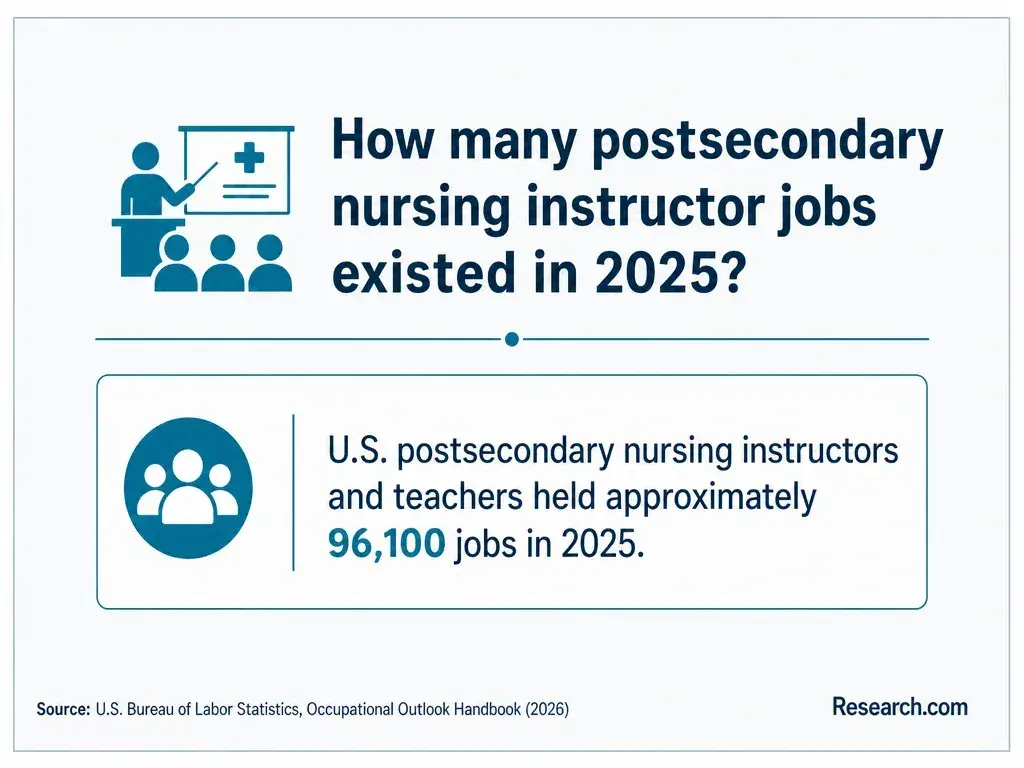
The U.S. Bureau of Labor Statistics reports wages and employment projections for nursing instructors and teachers, postsecondary, but that occupation does not represent every hospital educator job or predict an individual MSN graduate's pay. Before estimating a return on tuition, compare current local openings for the exact role you want, their salary ranges and experience requirements, and the earnings you would give up while studying. A staff educator seeking a specific promotion may also find that employer-supported training or a narrower credential meets the requirement without another degree.
If the desired career is psychiatric NP practice rather than teaching, lower-tuition psychiatric nursing graduate programs are a more relevant cost comparison. A non-APRN educator MSN does not establish NP certification or licensure eligibility.
Why Are Nurse Educator MSN Outcome Data Often Incomplete or Difficult to Compare?
Educator cohorts may be small, and schools may publish outcomes for the entire MSN rather than a specialty track. Reporting periods differ; part-time and bridge students may enter the denominator at different points; and certification reports may count only graduates who choose to test. Employment figures can likewise reflect survey respondents rather than all graduates. Missing track-level data is a limitation, not proof of either poor or strong performance.
Ask each school for the same evidence: its most recent educator-track entrant and graduate counts by cohort; on-time and extended-window completion definitions; withdrawals and leaves; credential-specific exam eligibility, participation, and passes; and the method used to collect job-placement information. If the school cannot share a figure, ask why and what evidence it can provide instead, such as practicum evaluation methods and graduate teaching support.
Do not replace missing MSN data with results from another degree. Even shortest online nursing practice doctorates may report duration and outcomes using different entry requirements, cohorts, and milestones. The defensible choice is the program whose requirements fit your circumstances and whose relevant results you can interpret - not simply the one displaying the highest percentage.
Other Things You Should Know About Nursing
Possibly. Qualifications vary by institution, teaching assignment, and applicable requirements. An experienced RN may be able to precept or assist with clinical learning without holding a graduate degree; a faculty appointment may have different requirements.
It depends on the role and employer. Clinical teaching commonly requires an active RN license appropriate to the work and jurisdiction. Confirm license expectations before changing roles or allowing a license to lapse.
Only if your employer permits it and you remove protected patient information and confidential organizational content. An original, de-identified teaching sample is often a safer way to demonstrate your methods.
Request the definition and counts behind its broader MSN figures, then compare those limits with other schools' disclosures. If the missing information is central to your decision, treat the uncertainty as a real disadvantage rather than assuming the schoolwide result applies to you.
- Educating Nurses for the Future - NCBI - NIH https://www.ncbi.nlm.nih.gov/books/NBK573912/
- 2026-27 Survey Materials FAQ - IPEDS Data Collection System https://surveys.nces.ed.gov/ipeds/public/survey-materials/faq
- Nurse Educator FAQs | UAMS College of Nursing https://nursing.uams.edu/programs/mnsc/faqs-2/
- FAQ: MSN in Nursing Education Online | Lamar https://degree.lamar.edu/online-programs/healthcare/msn/nursing-education/msn-nursing-education-faq/
- Nursing Certifications | Berkley School of Nursing https://nursing.georgetown.edu/blog/nursing-certifications/
- MSN in Nursing Education Program (BSN to MSN) | Herzing University https://www.herzing.edu/nursing/msn-nursing-educator-program
- Master's Education | aacnnursing.org https://www.aacnnursing.org/students/nursing-education-pathways/masters-education