2027 DNP Pediatric Primary Care NP Programs for Nurses in Florida: BSN and MSN Entry Routes and Clinical Training
Audited and Verified:
Our Editorial and Data Verification Process
Research.com uses government datasets, official education statistics and primary institutional information to support its career and degree guides. Our review process checks factual accuracy, occupational definitions, source dates and the requirements associated with the credentials discussed.
How This Article Was Fact-Checked
Our editorial team verifies salary estimates, employment projections, education requirements and program information against original data providers and official organizations. Salary figures are checked against the relevant occupational definitions and reporting periods. Information about licensure, accreditation and required in-person training is reviewed separately.
Fact-checked and verified on:

Co-Founder and Chief Data Scientist
A Florida nurse choosing a pediatric primary care DNP needs more than a school name. The right route depends on whether you hold a BSN or MSN, whether your prior graduate work prepared you as an NP, and whether you can complete supervised pediatric care at approved sites.
This guide compares entry routes, identifies Florida programs to investigate, and explains the clinical, financial, and credentialing questions to settle before applying. It is designed to help you avoid paying for a doctorate that does not match your intended pediatric practice.
Key Things You Should Know
- A BSN-to-DNP pediatric primary care track provides initial NP preparation; an MSN-to-DNP route may focus on doctoral work and may not prepare an MSN graduate for a new pediatric NP population focus.
- Ask each school to separate supervised pediatric direct-care hours from total doctoral practice hours; programs commonly plan around at least 1,000 post-baccalaureate practice hours for the DNP.
- Verify three distinct outcomes before enrolling: the active pediatric primary care track, eligibility for pediatric primary care NP certification, and eligibility to apply for Florida APRN licensure.
What Are DNP Pediatric Primary Care NP Programs in Florida?
A Doctor of Nursing Practice (DNP) pediatric primary care nurse practitioner program combines graduate preparation for the pediatric primary care NP (PNP-PC) role with practice-focused doctoral study. PNP-PCs care for children and adolescents through health promotion, routine and preventive visits, evaluation of common concerns, and coordination of ongoing care. Pediatric acute care is a different population-focus track with different preparation and certification.
The degree label alone is not enough. A DNP in leadership or education does not prepare a nurse for NP certification, and a general DNP completion program may not teach a new pediatric specialty. Nurses whose goal is practice improvement rather than a new patient-care role may find nonclinical DNP specialization options more relevant.
How Do BSN and MSN Entry Routes Differ for Florida Pediatric DNP Programs?
The decisive distinction is initial PNP-PC preparation versus completion of a doctorate after graduate study. An MSN does not automatically shorten the route to pediatric NP practice: the school must evaluate its courses, documented supervised hours, certification status, and population focus.
This comparison shows what each route generally needs to accomplish. An individual degree audit can change the timeline.
| Starting point | Likely educational need | Question for the program |
| RN with a BSN | Advanced-practice courses, supervised pediatric primary care, and DNP coursework and project | Is the BSN-to-DNP PNP-PC track accepting students for my entry term? |
| MSN-prepared, certified PNP-PC | Primarily doctoral coursework and a DNP project, subject to review of prior practice hours | Which prior hours count toward the school's DNP total? |
| MSN-prepared in another NP population focus or a non-APRN field | A formal pediatric primary care competency gap analysis and potentially substantial new coursework and clinical care | Does this route actually provide initial PNP-PC certification preparation? |
If you have an associate degree and an RN license, do not assume you can enter a BSN-to-DNP track directly. An ADN-to-MSN bridge program guide can help you understand intermediate degree options, but you must still confirm how you would reach an eligible PNP-PC track.
What Are the Admission Requirements for Florida Pediatric Primary Care DNP Programs?
Expect schools to review an active RN license, an eligible nursing degree, transcripts and GPA, a résumé, recommendations, a statement of goals, and sometimes an interview or relevant RN experience. MSN entrants may also need graduate course syllabi, clinical-hour records, and proof of existing NP certification. Clinical sites can impose separate background-check, immunization, and onboarding requirements after academic admission.
Ask whether the application is for the pediatric primary care track, not merely admission to a DNP. A BSN applicant planning to become an RN first is making a different admissions decision: TEAS and HESI requirement comparisons concern mainly prelicensure nursing admissions, not a universal requirement for postlicensure DNP entry.
The University of Florida is a Florida-based school to investigate for a DNP pediatric primary care NP pathway. The University of Miami is another school whose pediatric NP offerings merit review. Do not treat a school's general DNP listing as confirmation that its PNP-PC track is admitting students in your term. Track availability, entry points, and clinical-site policies can change.
For either school, obtain written confirmation of the exact degree and PNP-PC track, its current admissions status, and its intended certification outcome. Check nursing program accreditation at the DNP degree level through the accreditor's directory, then confirm institutional accreditation and the school's authority to enroll you where you live and place you where you plan to train. Accreditation of a DNP does not, by itself, establish that every advertised specialty is currently offered.
If comparing additional schools, use the same checks rather than interpreting an admissions-friendly description as evidence of an active specialty track. Resources on understanding barriers to DNP admission can help frame questions, but the school must confirm eligibility for its particular pediatric pathway.
Initial PNP-PC preparation typically integrates advanced assessment, pathophysiology, pharmacology, pediatric development, prevention, management of common childhood conditions, family education, and care coordination. Students apply that knowledge in supervised encounters, where faculty and preceptors evaluate clinical judgment rather than assuming that course completion proves independent competence.
DNP study adds evidence appraisal, quality improvement, leadership, population health, and a practice-focused project. A project might evaluate a pediatric care workflow, but access to records, organizational permission, privacy protections, and any required oversight must be settled before work begins.
Population focus should drive the curriculum choice. A nurse seeking mental health diagnosis and treatment preparation needs a different track; comparing shorter MSN-PMHNP routes is not a substitute for pediatric primary care training.
Online coursework can reduce commuting without making a clinical doctorate fully remote. Compare scheduled live classes, campus intensives, simulation, examinations, and where approved pediatric encounters must occur. A campus-based option may make faculty access or local networking easier, but neither format guarantees a convenient clinical placement.
Ask the program whether it secures sites, assists with introductions, or expects you to propose preceptors; also ask how far you may need to travel and whether your employment site is eligible. These questions matter more than an "online" label. Likewise, shorter online PMHNP certificate programs illustrate a delivery format, not an alternative route to PNP-PC preparation.
A BSN entrant generally has more graduate coursework and new supervised NP practice to complete than an already-certified PNP-PC entering a post-master's DNP. An MSN in another specialty may fall between those cases - or require a separate specialty certificate before doctoral completion. Actual duration depends on course sequencing, enrollment pace, approved prior hours, site availability, and project progress.
Published tuition alone is a poor comparison because schools may charge by credit, term, residency, or enrollment status. Request a program-specific estimate that includes mandatory fees, clinical compliance costs, books, certification and licensing expenses, travel, and any reduced work hours.
Do not assume a shorter advertised route costs less if it requires additional specialty coursework. A guide to shorter DNP programs can inform a timeline comparison, but confirm that any program considered actually includes the PNP-PC preparation you need.
Initial PNP-PC students need program-approved, supervised care involving the appropriate pediatric population and primary care competencies. Sites may include pediatric practices or other eligible ambulatory settings, depending on school policy. The school determines preceptor qualifications, faculty oversight, encounter documentation, and how performance is assessed; a student's current RN job or self-arranged preceptor does not automatically qualify.
Ask for two separate hour figures: direct pediatric patient-care hours required for the NP track and total practice hours required for the DNP. Prior MSN hours may count toward the latter only after documented review; they do not automatically replace new pediatric encounters.
Simulation and project activities also should not be presumed interchangeable with direct care. Even shorter online post-master's FNP certificates would require their own approved population-focus experiences rather than satisfying pediatric clinical requirements by title alone.
Graduation, national certification, and Florida practice authorization are separate steps. An initial PNP-PC graduate should confirm eligibility for the Certified Pediatric Nurse Practitioner-Primary Care (CPNP-PC) examination with the Pediatric Nursing Certification Board, apply for the appropriate Florida APRN license through the Florida Board of Nursing, and meet any additional employer credentialing requirements.
Requirements can change; check the current certifier handbook and board instructions before relying on a school's summary.
A nurse who does not yet hold an RN license must complete an eligible prelicensure route and obtain RN licensure before entering this postlicensure pathway. Admission-focused accelerated nursing comparisons may be useful at that earlier stage, but an accelerated BSN does not itself confer RN or APRN authority.
What Careers, Salaries, and Job Outlook Can Florida Pediatric DNP Graduates Expect?
After certification, Florida APRN licensure, and employer onboarding, PNP-PC graduates may pursue pediatric primary care positions in physician practices, health systems, and other ambulatory services. Their work can combine preventive visits, assessment and management within authorized scope, family education, referrals, and follow-up.
A DNP may also support practice-improvement or leadership responsibilities, but it does not guarantee a leadership appointment or a pay premium over an MSN-prepared PNP-PC.
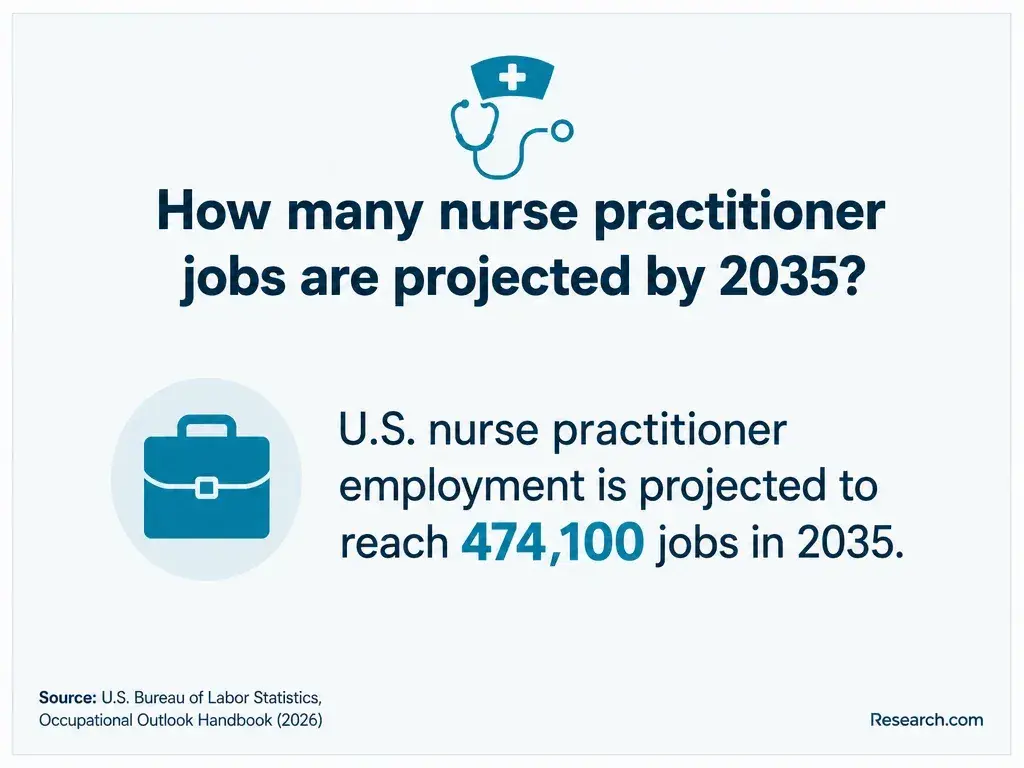
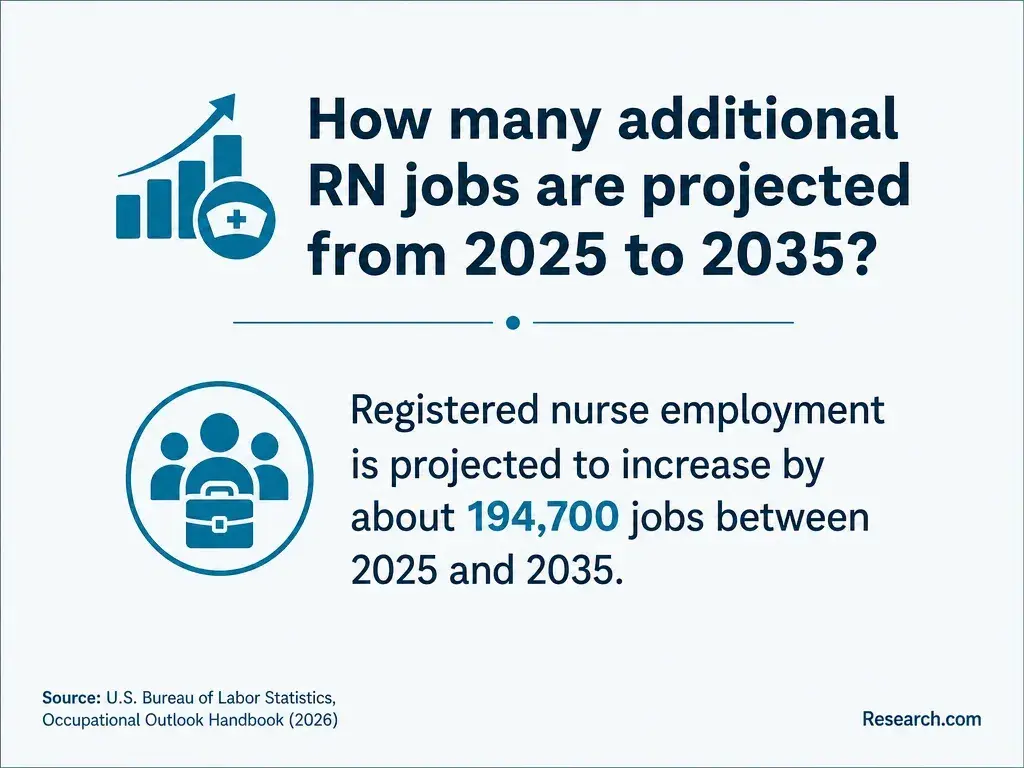
The U.S. Bureau of Labor Statistics reports wages and employment projections for nurse practitioners as an occupation, not separate Florida pediatric DNP graduate outcomes. Use those figures for broad market context, then compare current local PNP-PC postings for salary, schedule, patient mix, orientation, and experience requirements.
If your intended work is psychiatric rather than pediatric, compare that distinct role and its costs directly; lower-cost mental health advanced practice study cannot be judged as a substitute on tuition alone.
Other Things You Should Know About Nursing
FNP preparation includes care across the lifespan, but employer expectations and the complexity of a pediatric role may favor dedicated PNP-PC preparation. Compare the actual job duties and required credentials before pursuing another specialty.
It can strengthen an application and provide relevant context. It does not automatically replace graduate courses or supervised NP clinical hours.
Not by itself. Pediatric acute care NP roles generally call for acute care population-focus preparation and the corresponding credential, in addition to employer requirements.
Possibly, if the school accepts the location and site, can provide required oversight, and is authorized to enroll and place you there. Obtain approval before making employment or relocation plans.
- Licensing - Florida Board of Nursing https://floridasnursing.gov/licensing/
- Post-MSN to DNP Pathway | School of Nursing | The University of Alabama at Birmingham https://www.uab.edu/nursing/home/academics/doctoral/dnp/msn-to-dnp
- BSN to DNP vs. MSN to DNP: Which Pathway Works for You? | Herzing University https://www.herzing.edu/blog/bsn-dnp-vs-msn-dnp-which-pathway-works-you
- Doctor of Nursing Practice Program Overview | Florida Atlantic University https://www.fau.edu/nursing/academics/doctor-of-nursing-practice-program/
- BSN to DNP vs. MSN to DNP: Choosing the Right Doctoral Pathway in Nursing | wayne.edu https://nursing.wayne.edu/news/bsn-to-dnp-vs-msn-to-dnp-choosing-the-right-doctoral-pathway-in-nursing-70065
- Doctor of Nursing Practice (DNP) | ufl.edu https://nursing.ufl.edu/programs/doctor-of-nursing-practice-dnp/
- BSN to DNP - Nursing at The W | Mississippi University for Women https://www.muw.edu/nursing/graduate/dnp/bsn-to-dnp/
- Family Nurse Practitioner Track - UCF College of Nursing https://nursing.ucf.edu/academics/doctoral-degrees/fnp-dnp/
- Doctor of Nursing Practice | Coppin State University https://www.coppin.edu/academics/doctor-nursing-practice
- MSN to DNP: How the post-master's path works and how long it takes | Chamberlain University https://www.chamberlain.edu/blog/msn-to-dnp-how-the-post-masters-path-works-how-long-it-takes-and-what-to-check